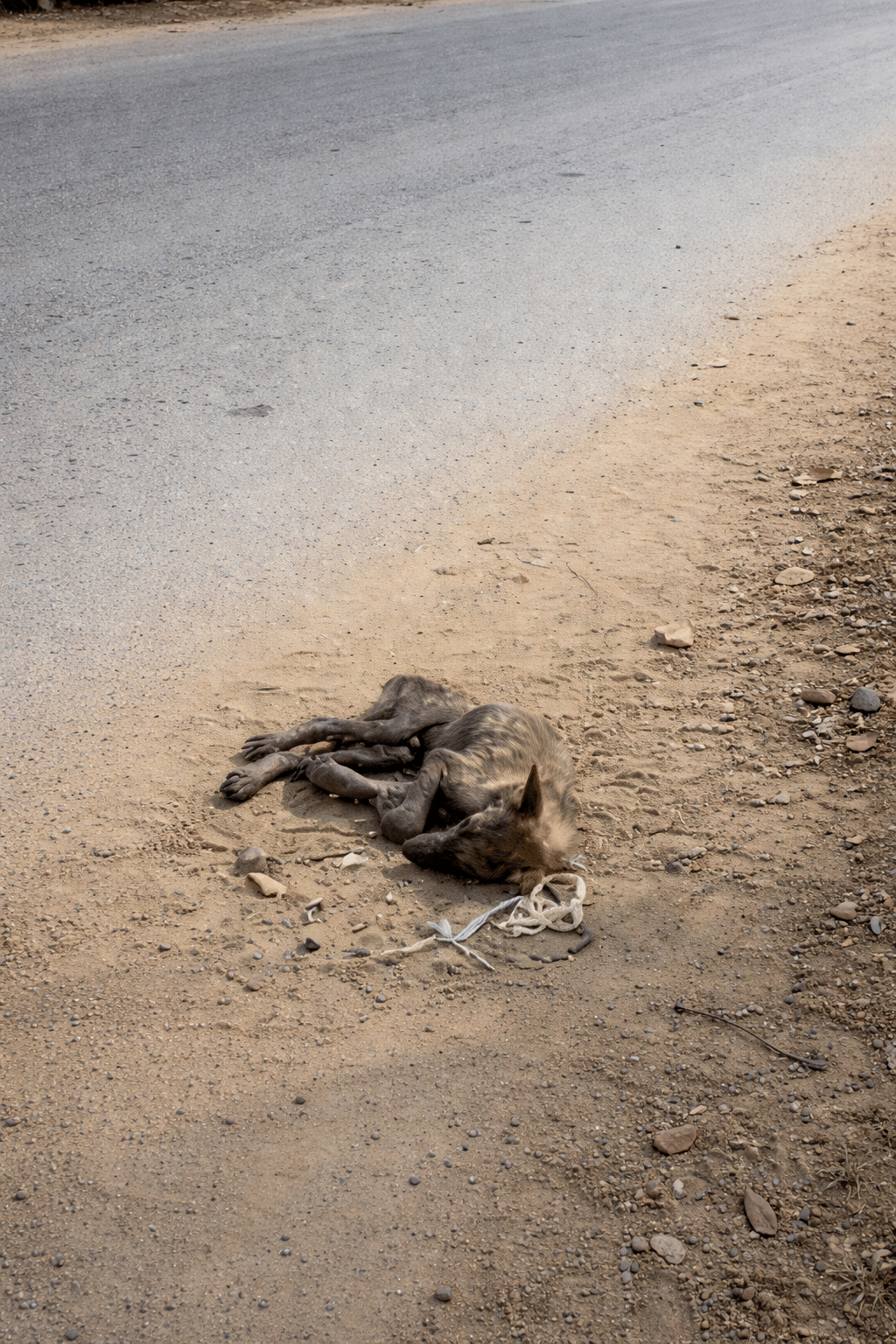
At first, he looked almost like part of the dusty roadside.
A tiny brindle puppy lay completely still, his body so thin that every line of his frame was visible beneath damaged skin.
Much of his fur was missing.
His front legs appeared injured.
And when someone finally came close, he did not have enough strength to get up and move away.
For a puppy so young, the world had already become a place of exhaustion.
Then a passerby stopped.
That single decision did not fix everything.
But it gave the little dog something he had not had moments earlier.
A chance.
He Was Too Weak to Leave the Road on His Own
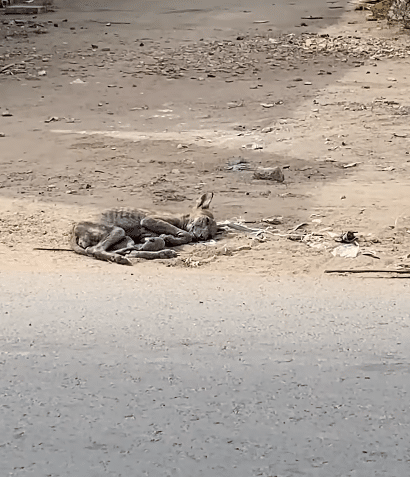
The puppy was found lying beside a quiet road with almost no energy left.
His physical condition immediately showed how badly he needed help.
His body was severely underweight.
Large areas of fur had disappeared, consistent with serious skin problems or prolonged neglect.
His weakened front legs could not properly support him.
He did not bark.
He did not try to run.
He simply remained where he was.
The person who found him approached carefully and lifted him from the ground.
There was no elaborate rescue equipment available.
Just a cardboard box.
But for the little dog, that simple box became something important.
It carried him away from the roadside.
Away from exposure.
And toward people who could finally begin helping him recover.
Video: From Despair to Joy — Watch This Brindle Dog’s Heartwarming Transformation
At the Rescue Center, Every Small Need Became Urgent
Once the puppy reached care, his condition became easier to assess.
He was far too weak to manage normal meals.
So caregivers started slowly.
Small amounts of food were offered by hand, giving his body time to accept nutrition without overwhelming him.
The process required patience.
A puppy in such fragile condition could not simply be given a full bowl and expected to recover overnight.
His body needed to rebuild gradually.
Caregivers also cleaned him carefully.
A gentle bath helped remove accumulated dirt and parasites from his skin.
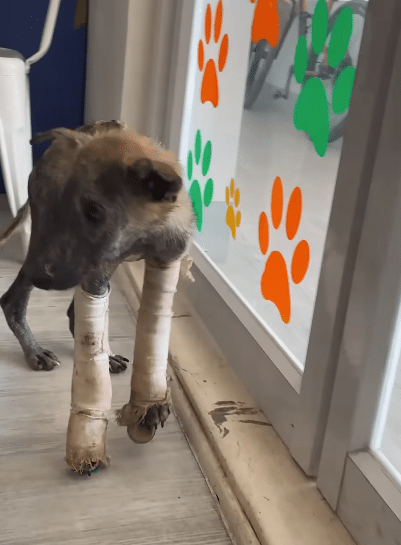
His front legs were wrapped with soft bandages to provide support while the team continued monitoring his condition.
Everything had to be done slowly.
Even ordinary handling could be stressful for a puppy who had arrived exhausted and vulnerable.
So the rescuers focused on creating a routine he could begin to understand.
Food.
Warmth.
Rest.
Gentle contact.
Then the same things again the next day.
The First Goal Was Not Running — It Was Simply Getting Stronger
Recovery began with very modest expectations.
No one needed him to play.
No one expected him to immediately trust every hand reaching toward him.
He simply needed to eat.
Rest.
And regain enough strength to hold himself differently.
At first, progress could be measured in tiny changes.
He became more responsive when caregivers approached.
He accepted food more consistently.
His body looked a little less depleted.
Then he began trying to reposition himself.
Those small efforts mattered because of how little movement he had been capable of when he was found.
His caregivers kept supporting his front legs and monitoring his skin while continuing to feed him carefully.
Day by day, the puppy’s body began responding.
He was not suddenly healed.
But he was no longer completely motionless.
Something had started to return.
Strength.
Then He Tried to Stand
Eventually, the puppy attempted something that had once seemed far away.
He tried to stand.
At first, the effort was unsteady.
His legs were still weak, and the bandages around his front limbs were a reminder that his body had not finished healing.
But he pushed himself upward.
Even maintaining the position for a short time was progress.
Then came another attempt.
And another.
With repeated care and better nutrition, his muscles slowly became stronger.
Standing began to look less impossible.
Soon, he was taking tentative steps.
They were not smooth.
They were not confident.
But they were his.
For the people who had first seen him lying helplessly beside the road, those few steps represented an enormous change.
The puppy had begun moving through the world again.
His Appetite Returned Before His Confidence Fully Did
Another visible sign of recovery appeared around mealtime.
The puppy who once needed to be hand-fed began showing greater interest in food.
Eventually, he could eat from a bowl.
Then he began eating eagerly.
That change revealed more than hunger.
It showed that his body finally had enough strength to participate in one of the most basic parts of daily life without constant assistance.
Regular meals helped him continue gaining weight.
His energy increased.
And with more energy came curiosity.
He began noticing what was happening around him.
Sounds that once seemed overwhelming became familiar.
People who had once been strangers became part of his routine.
The frightened, depleted puppy was gradually becoming more engaged with his surroundings.
Recovery was beginning to show not only in his body, but also in the way he interacted with the world.
Beneath the Damaged Skin, His Brindle Coat Began Returning
As treatment continued, the condition of his skin improved.
Areas that had once been nearly bare began showing new fur.
Slowly, his brindle pattern emerged.
The change was striking.
When he had been found, the puppy’s appearance was dominated by illness and exhaustion.
Now his natural coat was becoming visible again.
That new fur did not create the transformation.
It revealed it.
Underneath the damaged skin had always been the same puppy.
He simply had never been given the conditions needed to grow, heal, and show what he could become.
The more his coat returned, the easier it became to see how far his body had come.
He looked stronger.
Healthier.
More alert.
And increasingly like a young dog rather than an animal simply trying to survive another day.
The Puppy Who Could Not Stand Began Wanting to Play
Physical recovery eventually made room for something else.
Play.
The little dog began showing interest in other dogs.
He explored.
He became curious about people and the environment around him.
Instead of conserving every bit of energy simply to stay alive, he could finally use some of it for the ordinary things puppies naturally want to do.
Move.
Investigate.
Interact.
Enjoy attention.
The change happened gradually, but it became impossible to miss.
His body language softened.
He became more willing to approach.
Affection no longer seemed unfamiliar.
And the puppy who once lay unmoving beside the road began behaving like a dog who expected something good might happen next.
That may have been one of the biggest signs of recovery.
Not simply that his legs worked better.
But that he had enough comfort and strength to become playful.
His Rescue Was Built From Ordinary Acts Repeated Every Day
There was no single treatment that explains the puppy’s transformation.
His recovery came from many small forms of care working together.
Someone stopped beside the road.
Someone lifted him gently.
Someone found a safe place for him.
Caregivers fed him by hand when he could not eat independently.
They cleaned his skin.
They supported his injured legs.
They watched his progress.
And they continued long enough for his body to respond.
Each action by itself might seem simple.
Together, they changed the direction of his life.
That is often what rescue looks like after the dramatic first moment has passed.
Not one miracle.
A routine.
Meals arriving at the same time.
Bandages being checked.
Skin slowly healing.
A frightened puppy learning that hands can bring comfort instead of harm.
Those ordinary repetitions gave him something the roadside never could.
Consistency.
He Was Finally Able to Become More Than a Survivor
By the time his recovery had advanced, the difference was remarkable.
The fragile puppy found nearly motionless had gained strength.
His appetite had returned.
His coat had grown back.
He could stand and move independently.
And his personality had begun filling the space around him.
He became playful.
Curious.
Comfortable around other dogs.
More accepting of human affection.
His life no longer revolved entirely around weakness and discomfort.
He had finally been given enough safety to discover what being a puppy could feel like.
There were toys to investigate.
Other dogs to meet.
People willing to touch him gently.
Meals that arrived before hunger became desperate.
Simple things.
But for him, they represented a completely different life.
One Person Stopped — And Everything After That Became Possible
The most important moment in this puppy’s story may have lasted only seconds.
Someone saw him beside the road.
And instead of continuing past, they stopped.
Everything that followed depended on that choice.
The cardboard box.
The rescue center.
The hand-feeding.
The bandages.
The first attempt to stand.
The returning brindle coat.
The playful dog who eventually emerged.
None of it could erase what his body had already endured.
But it prevented that suffering from becoming the only life he would ever know.
When he was found, he could barely move.
Later, he could stand.
Then walk.
Then eat eagerly.
Then play.
His recovery was not defined by one dramatic leap from suffering to happiness.
It happened through small changes that accumulated until the dog at the end of the journey barely resembled the one lying beside the road.
Not because he had become someone different.
Because he had finally been given the chance to become himself.
Once, he had no strength to lift his body from the dirt.
Now, he has something far more valuable than survival alone.
A life he can actually enjoy.


