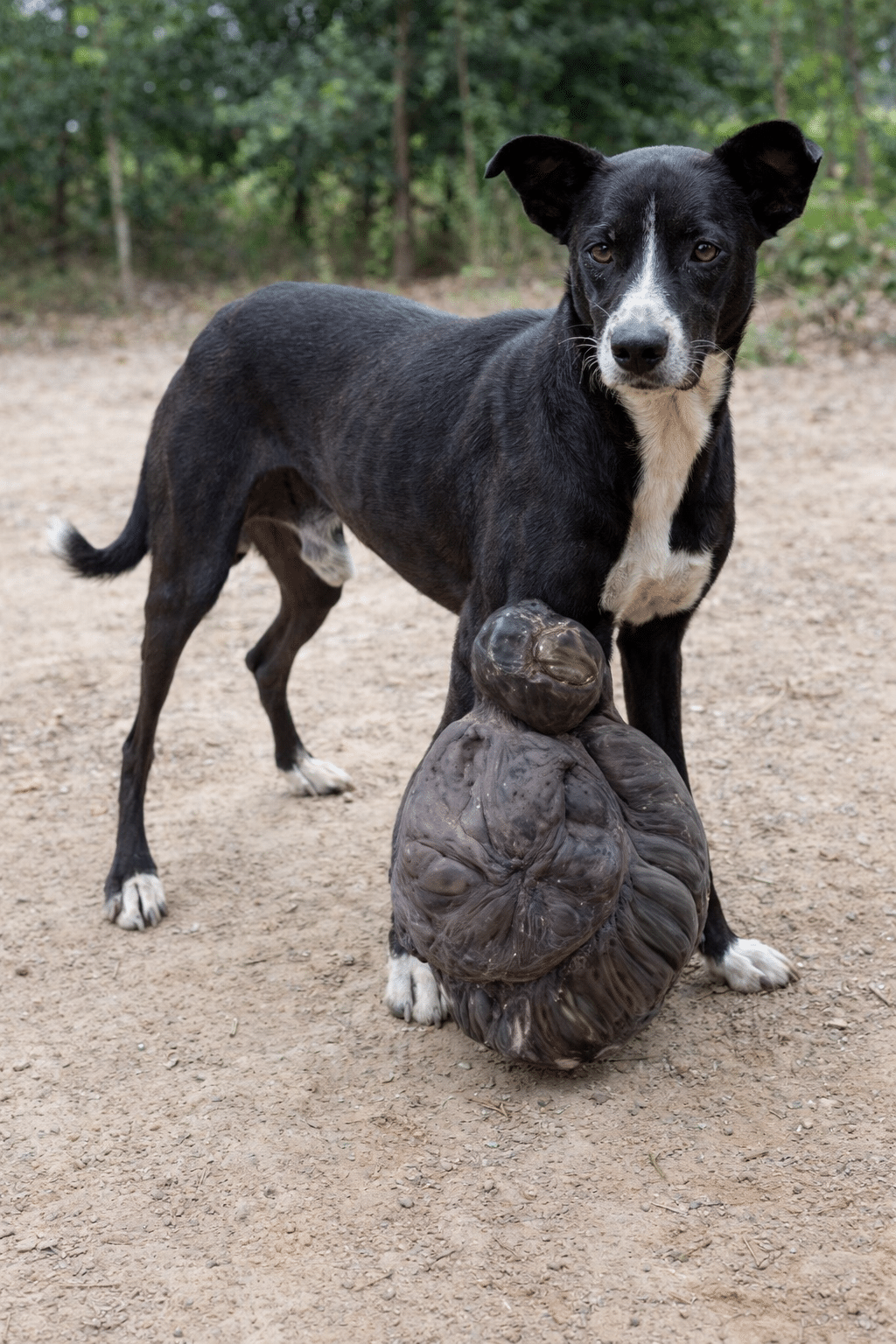
At first, rescuers noticed how thin the black dog was.
Then they saw his front leg.
Hanging from it was a mass so large that it seemed almost impossible for his body to carry.
Every time the dog moved, the growth moved with him.
It pulled downward from his right front leg, forcing him to compensate with every step.
His ribs were visible.
Parasites had left him weakened.
And yet the dog was still walking.
Slowly.
Carefully.
Dragging an enormous burden wherever he went.
The rescuers would later call him Shadow.
When one of them crouched nearby, Shadow did something unexpected.
His tail moved.
Then he leaned forward and licked the person’s hand.
Whatever had happened before that moment, Shadow was willing to let someone come close.
The team did not waste time.
A dog carrying a mass that large needed veterinary care immediately.
And once doctors examined him, they discovered that the tumor was only one of the serious problems Shadow had been living with.
The Tumor Was Nearly as Shocking Up Close as It Had Been From the Street
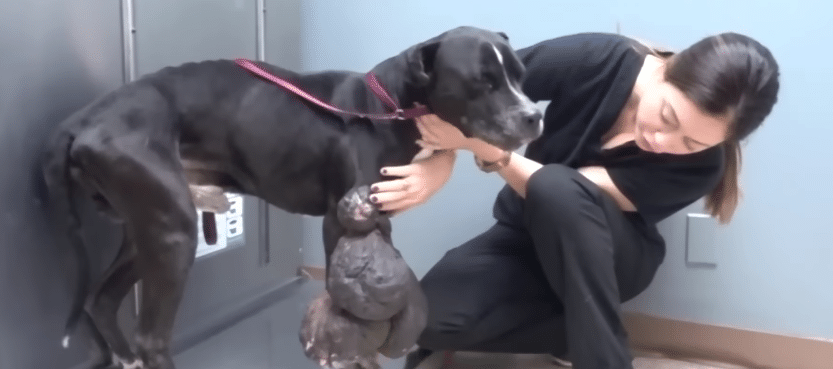
At the veterinary hospital, Shadow could finally be examined properly.
The mass on his right front leg was enormous.
According to the rescue account, it weighed more than 11 pounds—roughly 5 kilograms—and would later be measured at close to 12 pounds after removal.
For a dog already severely underweight, that was an extraordinary amount of additional weight to carry on a single limb.
The tumor affected more than appearance.
Its size changed the way Shadow moved.
Each step required him to accommodate a heavy mass hanging from the leg.
The rest of his body had to compensate.
And because Shadow was already physically depleted, there was little reserve strength available.
Veterinarians also found another significant problem.
Shadow had advanced heartworm disease.
That diagnosis added a new layer of risk.
Heartworm can place serious strain on a dog’s cardiovascular system, and Shadow was already facing the possibility of major surgery.
The medical team now had two urgent goals.
Address the enormous tumor.
And do it without pushing Shadow’s weakened body beyond what it could tolerate.
VIDEO: Shadow Carried a Nearly 12-Pound Tumor on His Front Leg—Then Surgeons Tried to Save the Limb
At First, the Team Feared His Entire Leg Might Have to Be Removed
The tumor was not sitting loosely on the surface.
It was deeply associated with the tissues of Shadow’s front leg.
That created a difficult surgical question.
Could the mass be removed while preserving enough healthy tissue for the leg to remain functional?
At first, the answer looked uncertain.
The surgeons considered the possibility that amputation might be necessary.
Removing the entire limb could potentially provide a safer way to eliminate the mass if it could not be separated from critical structures.
But losing a front leg would be a major adjustment for any dog—especially one already weakened by malnutrition and heartworm disease.
The team needed more information.
Once Shadow was placed under anesthesia and the surgical area could be examined more carefully, the doctors saw something encouraging.
There appeared to be a possibility of separating the tumor from the leg.
It would not be easy.
The mass had become closely involved with surrounding muscle and blood vessels.
But there was enough of a chance that the surgeons decided to try.
The goal changed.
Not simply remove the tumor.
Remove it and save Shadow’s leg if they safely could.
The Operation Required Hours of Careful Work Around Muscle and Blood Vessels
The surgery began slowly.
With a mass this large, there was no room for careless movement.
Blood vessels had to be identified and protected.
Healthy tissue needed to be preserved wherever possible.
The surgeons worked gradually around the tumor.
Section by section.
Layer by layer.
The challenge was not only its size.
The mass had existed long enough to become closely associated with the structures around it.
Separating it required patience.
A rushed cut could damage tissue Shadow would need for recovery.
The team continued working.
Minutes became hours.
Shadow remained under anesthesia while the surgeons carefully freed more of the growth.
Then, finally, the last section came away.
The tumor was out.
When it was weighed, the number was extraordinary.
Nearly 12 pounds.
For the first time since rescuers had found him, Shadow’s body was no longer carrying that weight.
And there was even better news.
His front leg was still there.
The surgeons had managed to preserve it.
Waking Up With His Leg Was Only the Beginning
The surgery solved the largest visible problem.
It did not immediately make Shadow healthy.
His leg required protection.
The surgical area was bandaged and monitored closely.
He needed pain control.
He needed good nutrition.
And because his body had been weakened before the procedure, recovery had to be watched carefully.
Shadow rested.
His caregivers offered food.
They checked the incision.
They watched how he responded when he began using the leg again.
Every small movement mattered.
A front limb carries significant weight during walking.
Shadow’s muscles had also adapted for a long time to the enormous mass that once hung from that leg.
Now his body had to learn a new balance.
The weight was gone.
But strength and normal movement would take time to return.
Then the veterinary team received another important piece of information.
The removed tumor had been sent for laboratory testing.
Everyone wanted to know what kind of mass Shadow had been carrying.
The result brought enormous relief.
The Nearly 12-Pound Mass Was Benign
Laboratory testing showed that Shadow’s tumor was benign.
According to the rescue account, it was not cancerous.
That result changed the outlook considerably.
The team no longer had to focus on the possibility that an aggressive cancer might have spread elsewhere.
Instead, attention could turn toward the problems they already knew needed treatment.
Healing the surgical site.
Rebuilding strength.
Improving nutrition.
And addressing the heartworm disease.
Shadow began heartworm treatment as his condition allowed.
At the same time, caregivers introduced gentle movement to help his front leg become stronger again.
Nothing needed to happen quickly.
His body had already undergone a major transformation.
The safest recovery would come through gradual progress.
A little more weight on the leg.
A few more steps.
Then rest.
Another attempt later.
And while Shadow’s physical condition changed, one behavior noticed on the street continued.
His tail still moved when familiar people approached.
Without the Tumor, Shadow Had to Learn a Different Way of Walking
For a long time, Shadow had adapted his entire stride around the enormous growth.
His body had learned to shift weight.
To protect the affected leg.
To move while something weighing several kilograms swung beside him.
Once the mass disappeared, his movement had to adjust again.
At first, caregivers watched him carefully.
They encouraged gentle use of the leg without forcing too much activity.
As the surgical area healed, Shadow began placing more weight on it.
His steps became steadier.
His muscles started doing work they had struggled to perform before surgery.
Nutrition played an important role as well.
Shadow had arrived extremely thin.
Now he received regular meals designed to help restore healthy body condition.
His ribs became less prominent.
Muscle began returning.
His black coat improved as his overall health changed.
The difference was not visible only in photographs.
Shadow had more energy.
And with more energy came something rescuers had hoped to see.
Play.
About a Month Later, Shadow Was Running Instead of Dragging Weight
Approximately one month after rescue, Shadow looked remarkably different.
The enormous mass was gone.
His surgical wound had healed substantially.
He had gained healthy weight.
His coat appeared fuller and brighter.
Most importantly, he was moving.
Shadow could run.
He could play.
He could cross the ground without the tumor swinging from his front leg with every step.
For the people who had first seen him on the street, the contrast was difficult to ignore.
Then, every step had looked complicated.
Now movement could be spontaneous.
He could change direction.
Follow another dog.
Approach a caregiver.
Move simply because something had caught his attention.
The leg the surgeons once feared they might have to remove was still helping carry him.
His recovery was not magic.
It came from the decision to examine the surgical possibilities carefully rather than assuming amputation was the only option.
It came from hours in the operating room.
Then days of bandages, monitoring, food, medication, and gradual exercise.
The nearly 12-pound tumor had been removed in a single operation.
Rebuilding Shadow took much longer.
Heartworm Treatment Became the Next Part of the Journey
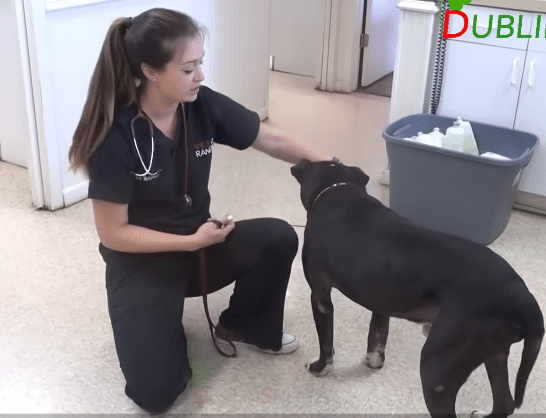
Although the tumor attracted the most attention, rescuers did not forget the heartworm diagnosis.
That condition needed its own treatment plan.
Shadow’s overall strength had to be considered carefully because heartworm therapy can require controlled activity and veterinary monitoring.
The rescue account describes him beginning treatment while continuing to recover from surgery.
That meant his caregivers had to balance two things.
Shadow was finally energetic enough to want to move more.
But his medical condition still required caution.
So recovery continued under supervision.
Food supported his improving body condition.
Rest gave his cardiovascular system time to recover.
Veterinary treatment addressed the parasite infection.
The dramatic tumor removal might have been the most visible part of his rescue.
But this quieter medical care was just as important to his future.
Shadow did not simply need to look better.
He needed to become healthier from the inside as well.
And gradually, that was happening.
The Dog Rescuers First Met Was Still There—Only Stronger
One detail from Shadow’s first day stayed with his caregivers.
The tail wag.
They had approached a dog carrying an extraordinary tumor while severely underweight and ill.
Still, he had responded to gentle contact by moving his tail and licking a hand.
Weeks later, that behavior had not disappeared.
What changed was everything around it.
Shadow now had more energy behind the wag.
He could walk toward people more comfortably.
He could play.
He could run.
His body no longer had to devote every step to compensating for an enormous growth.
The people around him also knew him differently now.
He was no longer simply “the dog with the tumor.”
He had habits.
Preferences.
A personality.
He enjoyed attention.
He interacted with the people caring for him.
And as recovery continued, the worst image from his story became increasingly disconnected from the dog standing in front of them.
Shadow’s Story Was Not About a Miracle Surgery Alone
It is easy to focus on one number.
12 pounds.
A tumor of that size hanging from a dog’s front leg is difficult to forget.
It is also easy to focus on the moment surgeons removed it without amputating the limb.
But Shadow’s transformation required far more than one successful operation.
Someone had to notice him on the street.
Someone had to approach.
Someone had to transport him.
Veterinarians had to evaluate the heartworm disease and surgical risk.
Surgeons had to decide whether preserving the leg was realistically possible.
Then they had to spend hours carefully separating the tumor from muscle and blood vessels.
Afterward came bandages.
Laboratory testing.
Nutrition.
Heartworm treatment.
Physical recovery.
And time.
Each part mattered.
Shadow’s life changed because many small decisions continued after the dramatic part of the story was already over.
Today, the dog who once carried nearly 12 extra pounds on one front leg can move without that burden.
His leg remains.
His body is stronger.
His coat has recovered.
And when people come close, his tail still moves.
The difference is that now, Shadow can do something he could barely manage before.
He can wag his tail—
and then run toward them.


