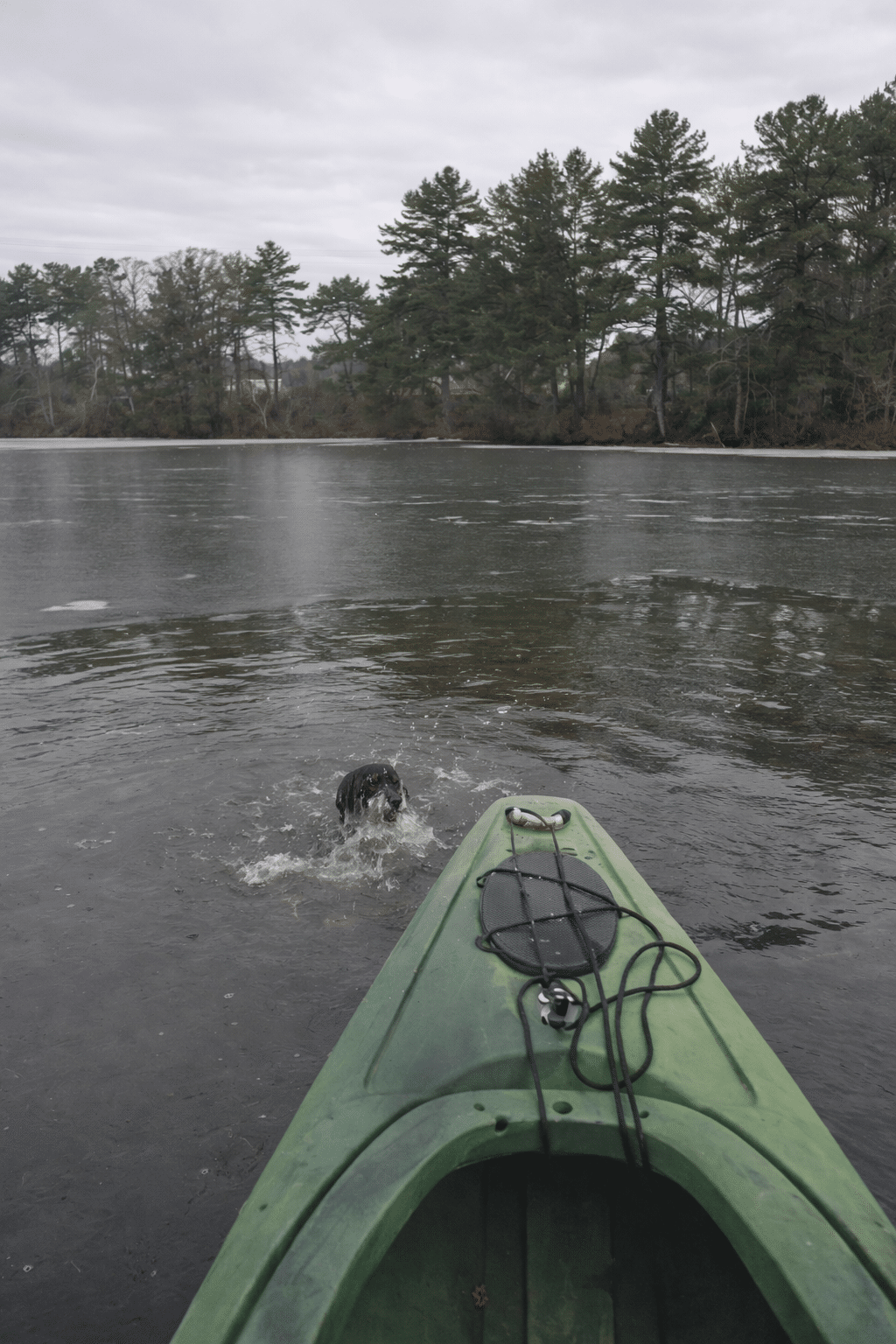
At first, the winter river looked almost peaceful.
Thin sheets of ice stretched across the surface, broken here and there by dark channels of moving water. From the shore, everything seemed still.
Then something moved between the ice.
A large gray-and-black dog was in the river.
He was trying desperately to climb out.
His front paws scraped against the frozen edges, but every attempt ended the same way. The ice was too slick to grip, and the water pulled his body back down.
Again he tried.
Again he slipped.
His thick coat was already soaked.
His movements were beginning to slow.
And then, not far away, a man in a bright green kayak noticed him.
The kayaker could have continued toward shore.
Instead, he turned.
And began paddling straight toward the dog.
Every Attempt to Climb Out Sent Him Back Into the Water
The river had not frozen completely.
That was what made the situation so dangerous.
Floating plates of ice covered parts of the surface, while cold water continued moving underneath them.
The dog had somehow ended up in one of those open sections.
There was nowhere secure for him to stand.
Each time he reached for the ice, his paws slid across the smooth surface.
His weight broke his balance.
Then the water swallowed his chest again.
He tried another section.
Same result.
The bank was too far away to reach easily, and the scattered ice made swimming difficult.
With every failed attempt, the dog was using more energy.
The cold water was doing the opposite.
It was taking strength away.
That was the scene the kayaker was approaching.
A dog still fighting.
But not with unlimited time.
Video: A Kayaker Turns Toward the Dog Struggling Between Sheets of Ice
The Man in the Green Kayak Changed Course
From the kayak, the movement could initially have been mistaken for shifting ice.
Then the man realized there was an animal in the water.
He turned his kayak toward the dog.
As he moved closer, the situation became clearer.
The dog was large.
His coat was saturated.
And he could not get himself onto the frozen surface.
The kayaker kept paddling.
There was little room for delay.
Getting close enough would be difficult on its own. A kayak is narrow, and leaning too far over one side can make it unstable.
The dog was frightened and exhausted.
The water was freezing.
The ice around them offered no reliable place to step.
Still, the man brought the kayak alongside him.
Now the distance between safety and the dog was only a few feet.
But those final few feet were the most important.
Everything Came Down to One Grip
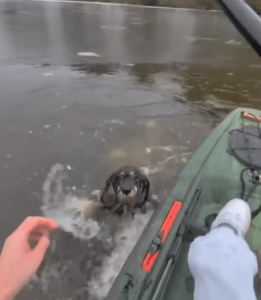
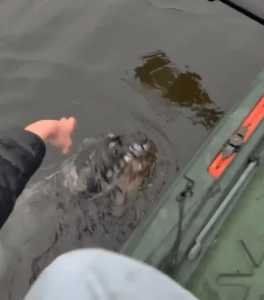
Once close enough, the kayaker leaned over the side.
He reached toward the dog.
There was no platform to lift him from and no easy way for the dog to climb aboard by himself.
The man needed to get hold of him before the animal slipped farther away.
He grabbed firmly at the fur around the back of the dog’s neck and upper body.
Then he pulled.
The dog was heavy with water.
The kayak shifted under the movement.
Cold river water splashed around them.
For a moment, the rescue depended almost entirely on whether the man could get enough of the dog’s weight over the side.
He pulled again.
The dog’s front end cleared the edge.
Then more of his body followed.
Finally, the dog landed inside the small kayak.
He was out of the river.
But he was still trembling.
“I’ve Got You, Buddy”
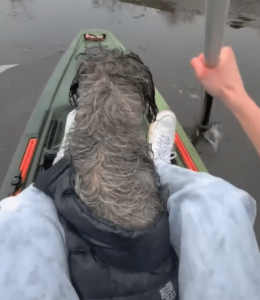
Inside the kayak, the dog collapsed low against the boat.
His soaked coat clung to him.
His body shook from the cold and the stress of what had just happened.
The man did not celebrate loudly.
He spoke to him.
“You’re okay.”
“I’ve got you, buddy.”
“It’s alright. You’re safe.”
The words were simple.
But the tone mattered.
The dog had gone from fighting alone in freezing water to lying only inches from the person who had pulled him out.
The kayaker kept his voice steady.
At one point, he admitted that he was cold and scared too.
There was no guarantee the dog understood the words.
But the calm voice continued while the man prepared to bring them both back toward land.
Then he called toward the shore.
There was someone standing there.
And the kayaker asked a question that suddenly changed how the entire scene felt.
“What’s your dog’s name?”
The answer came back.
“Barney!”
Suddenly, the Dog in the River Had a Name
Barney.
Until then, the kayaker had simply been rescuing a dog he saw struggling in the water.
Now he knew someone on shore was waiting for him.
He turned the kayak toward land.
Barney remained low inside the boat, still wet and shaking.
The man paddled carefully.
Moving too abruptly could make the narrow kayak unstable, especially with a large dog now sharing the limited space.
So the return was controlled.
Stroke by stroke, they moved toward shallower water.
The woman on shore watched them come closer.
Only minutes earlier, Barney had been trapped beyond her reach.
Now he was coming back.
Not swimming.
Not fighting against the ice.
Riding inside the green kayak beside a stranger who had decided to help.
The Best Moment Was When His Paws Touched Ground Again
As the kayak reached the shallow edge, Barney began to move.
Solid ground was close.
The man guided the boat carefully toward shore.
For a brief moment, Barney hesitated.
Then he jumped.
Out of the kayak.
Onto land.
After the freezing water and unstable ice, his paws were finally on something solid again.
There was no need for a dramatic ending.
The rescue had already said enough.
Barney was no longer surrounded by moving water.
He was no longer clawing at ice he could not climb.
The person waiting for him could reach him again.
The kayaker had done exactly what was needed.
He had seen a problem.
Moved toward it.
Pulled Barney aboard.
And brought him back.
The Rescue Lasted Minutes — But One Decision Made It Possible
Barney’s story could have looked very different if the kayak had continued past him.
The river was cold.
The ice was unstable.
And the dog’s strength was already being tested every time he tried unsuccessfully to climb out.
The kayaker did not know Barney.
He did not know who was waiting on the bank.
He did not know how the dog had ended up in the water.
None of that had to be answered first.
He only needed to recognize what was happening.
A dog could not get himself out.
So the kayak changed direction.
That turn may have been the smallest physical movement in the entire rescue.
Yet everything that followed depended on it.
Without that choice, there would have been no approach.
No grip.
No dog lifted into the boat.
No question shouted toward shore.
No Barney jumping back onto solid ground.
Sometimes rescue begins long before anyone touches the animal.
It begins in the moment someone decides the emergency belongs to them too.
Courage Did Not Look Dramatic From the Shore
There was nothing theatrical about the way the rescue happened.
The man did not have specialized rescue equipment.
He had a kayak.
He had his hands.
And he had the ability to reach the dog when others on shore could not.
The conditions were still risky.
Cold water can be dangerous for people as well as animals, and leaning over the edge of a small boat requires care.
The kayaker appeared to understand that.
He did not leap blindly into the river.
He used what he already had.
He maneuvered the kayak close enough.
He reached from the boat.
Then he brought Barney with him toward shore.
That distinction matters.
Courage is not always ignoring danger.
Sometimes it is recognizing danger clearly and still finding a workable way to help.
For Barney, that help happened to arrive in a bright green kayak.
Sometimes Hope Is Just Someone Turning Around
The first image of Barney is difficult to forget.
A dog surrounded by ice.
His paws slipping.
His wet body sinking back into the river every time he tried to escape.
Then there is the final image.
The same dog reaching shore.
Solid ground beneath him.
A familiar person waiting nearby.
Between those two moments was one stranger.
He did not know Barney’s name when he started paddling toward him.
He learned it only after the dog was already inside the kayak.
That may be the simplest part of the story.
Barney did not have to belong to the rescuer for his life to matter.
He did not have to be familiar.
He only had to be in trouble.
Someone noticed.
Someone changed course.
And when Barney could no longer pull himself onto the ice, another pair of hands did what his exhausted paws could not.
They lifted him out.
A few minutes later, the dog who had been fighting the freezing river was back on land.
Sometimes kindness is quiet.
Sometimes it sounds like a few reassuring words from a small boat.
Sometimes it looks like one hand reaching over the side.
And sometimes the difference between continuing past and changing someone’s ending is nothing more than this:
Turning the kayak around.


