In 1989, a man browsing a flea market in Adamstown, Pennsylvania, spotted a landscape painting he had no real interest in keeping. What caught his eye was the frame. He figured it might be useful for something else, and the price — four dollars — made the decision easy.
He brought the painting home, removed the canvas, and began pulling the frame apart. Tucked behind the picture, folded and pressed flat against the backing, was a single sheet of paper. It was old, clearly old, but there was nothing about its plain appearance to suggest it was anything more than some forgotten document from another era.
He almost set it aside. Instead, he took a closer look.
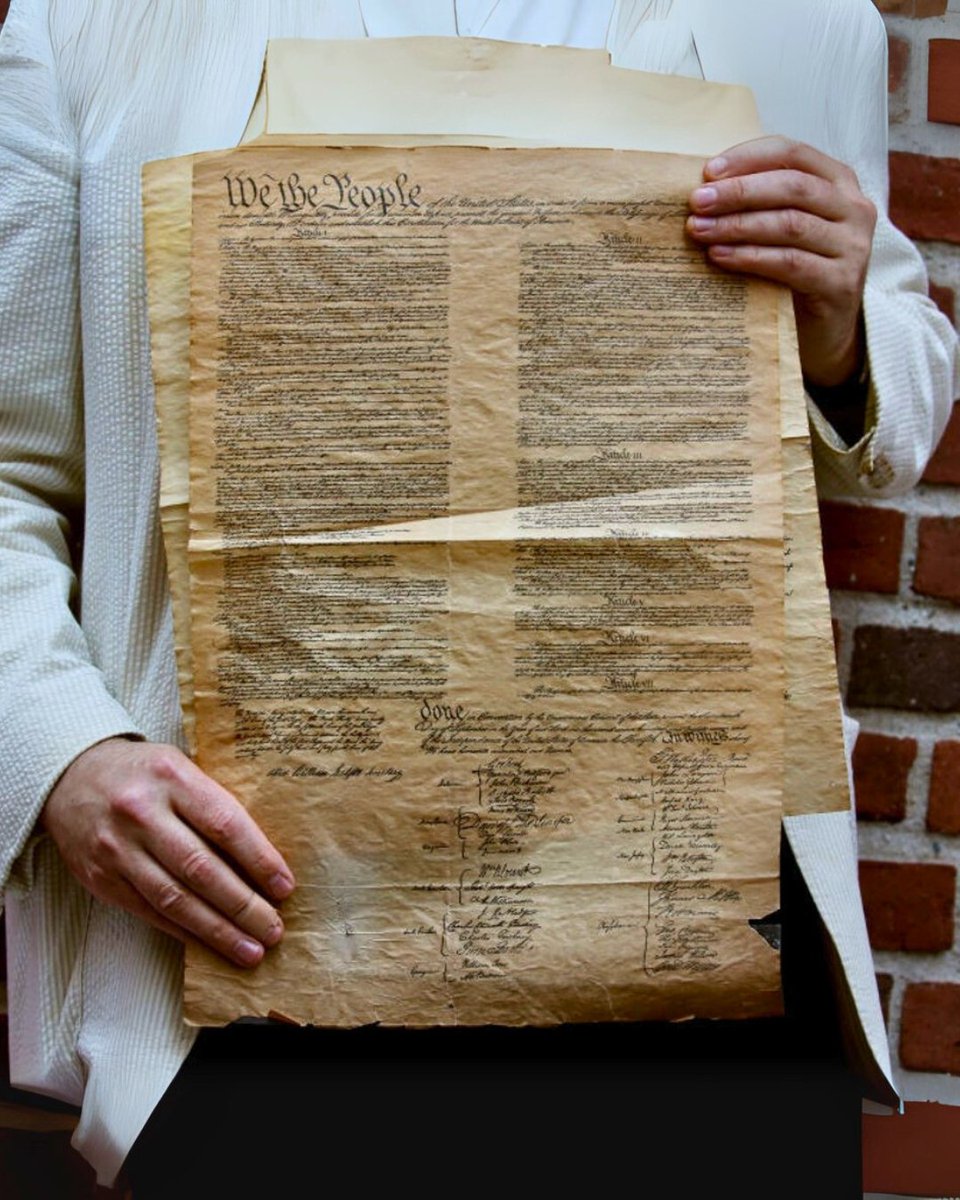
That folded sheet turned out to be a Dunlap broadside — one of the original first printings of the Declaration of Independence, ordered by the Continental Congress on the night of July 4, 1776. It later sold at auction for $2.42 million.
Why the Painting Seemed Worth Only Four Dollars
The painting itself was unremarkable. By most accounts, it was a generic landscape in a plain frame — the kind of piece that fills the back tables at flea markets without drawing much attention. The anonymous buyer was not hunting for anything historically significant. He was not a collector of documents or Americana. He simply liked the frame.
At four dollars, there was almost nothing to lose. Flea markets in southeastern Pennsylvania have long attracted bargain hunters looking for furniture parts, frames and forgotten goods from estate sales and attic cleanouts. Objects with extraordinary histories routinely pass through those kinds of markets without anyone recognizing them. This was one of those cases — until the frame came apart.
The Folded Sheet Hidden Behind the Canvas
When the buyer removed the backing, the folded document fell free. It was printed on a large sheet of paper in period typeface, and even to an untrained eye, certain phrases would have been immediately recognizable. The text began with language that echoed the Declaration of Independence — because it was the Declaration of Independence.
The document had been folded and stored behind the painting at some point in its history, likely as a way of preserving or concealing it, though the exact reason it ended up there has never been established. The man who found it brought it to a professional for evaluation, uncertain what he actually had. The answer, once experts examined it, was unambiguous.
This was not a later reproduction. It was not a commemorative reprint. It was one of the original broadsides printed in Philadelphia on the night the Continental Congress voted to formally adopt the Declaration.
How Experts Recognized a Dunlap Broadside
The name “Dunlap broadside” refers to the first printed version of the Declaration of Independence, produced by Philadelphia printer John Dunlap in the early hours of July 5, 1776. The Continental Congress had finalized the text of the Declaration on July 4th and immediately commissioned Dunlap to print copies for distribution to colonial assemblies, military commanders and the general public. These printed sheets were the primary means by which Americans first learned that independence had been declared.
Historians estimate that Dunlap printed approximately 200 copies that night. As of the late twentieth century, only around 25 copies were known to survive — held primarily by institutions such as the Library of Congress, the National Archives and major universities. A small number had passed through private hands and appeared at auction over the decades.
Authenticating the broadside found at the flea market required close examination of the paper, the typeface, the ink aging and the physical dimensions — all cross-referenced against known surviving examples. Scholars and experts in historical documents, including those connected to major auction houses, confirmed that the sheet was genuine. The typography matched Dunlap’s known work. The paper was consistent with eighteenth-century production. There were no signs of modern reproduction.
The discovery added a newly surfaced copy to the small group of known surviving Dunlap broadsides — a significant event in the world of American historical documents.
YOUTUBE EMBED — PRIMARY SEARCH QUERY: “$4 painting Declaration of Independence discovery documentary”
The Auction That Turned Four Dollars Into Millions
The broadside was consigned to Sotheby’s, the major auction house with deep experience handling rare historical documents and Americana. On June 13, 2000, it sold for $2.42 million — a figure that reflected both the document’s age and its extraordinary scarcity.
The buyer at auction was television producer and collector David Redden, bidding on behalf of a group later identified as including Norman Lear, the television writer and producer, and a partnership of investors who intended to make the document publicly accessible. The broadside subsequently traveled across all fifty states as part of a public education initiative, allowing Americans in every part of the country to view one of the original first printings of the Declaration in person.
The original buyer — the man who had paid four dollars for the painting — received the auction proceeds. He had purchased the document entirely by accident and had held it for roughly a decade before its sale. The gap between what he paid and what it sold for remains one of the most dramatic in the recorded history of American flea-market finds.
YOUTUBE EMBED — SECONDARY SEARCH QUERY: “Dunlap broadside Declaration of Independence museum”
Why These First Printings Matter
The Dunlap broadsides occupy a specific and irreplaceable place in American history. The handwritten parchment copy of the Declaration — the one most people picture when they think of the document — was not produced until August 2, 1776, nearly a month after independence was declared. It was the printed Dunlap sheets, distributed rapidly across the colonies in early July 1776, that actually carried the news of independence to the American public.
George Washington had the Declaration read aloud to his troops from a Dunlap broadside. Colonial assemblies received their official notification through these printed sheets. For the people who lived through the founding period, the Dunlap broadside was the Declaration of Independence as they first encountered it — not a ceremonial document behind glass, but a piece of printed paper passed hand to hand.
The scarcity of surviving copies reflects the fragility of the medium. Broadsides were working documents, printed for immediate distribution and use. Most were discarded, lost, damaged or simply wore out over two and a half centuries. The ones that survived often did so by accident — tucked into books, folded into trunks or, in at least one documented case, slipped behind a painting in a frame that would eventually end up at a Pennsylvania flea market for four dollars.
Each surviving copy is now treated as a primary artifact of the American founding. Institutions that hold them restrict access, control display conditions and consider them among their most significant holdings.
A Four-Dollar Frame and a Foundational Document
The broadside found in Adamstown sold for $2.42 million in June 2000. It had spent an unknown number of years folded behind a painting that no one particularly valued. The man who found it had not been looking for it. He had been looking for a frame.
What made the story remarkable was not just the dollar figures — it was the reminder that objects of profound historical significance do not always announce themselves. The Dunlap broadside that helped carry the news of American independence across the colonies in 1776 survived two hundred years of American history and nearly ended up discarded along with the painting it had been hiding behind. The four-dollar price tag came within a moment of being the last transaction that document ever saw.

