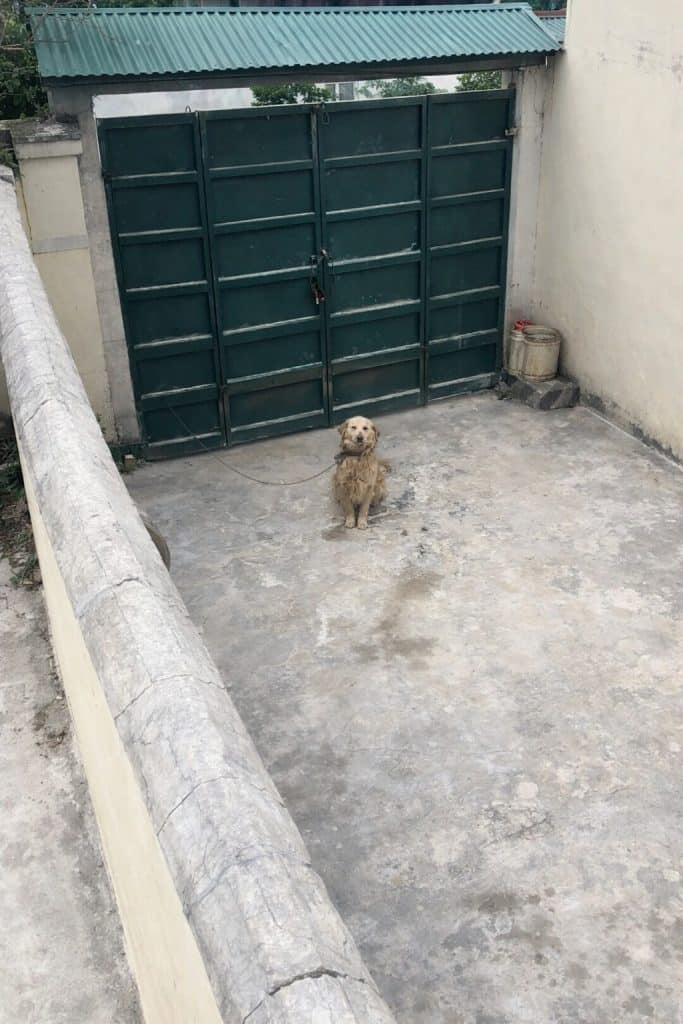
Every time the woman looked toward the property next door, the same dog was there.
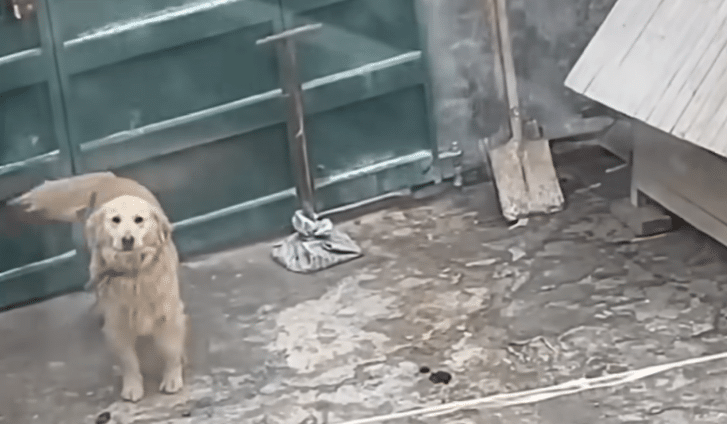
A Golden Retriever sat alone inside an overgrown yard, attached to a chain that limited him to a small patch of ground.
He rarely barked.
He did not throw himself against the fence or demand attention.
He simply watched her quietly.
At first, she assumed someone would eventually come to care for him. But as the days passed and the house remained empty, she began to realize that the dog might be waiting for help that was never going to arrive.
The Dog Remained Even After the House Became Empty
The woman had only recently moved into the neighborhood when she began noticing the Golden Retriever next door.
The property appeared neglected.
The yard was untidy, and there were few signs that anyone was spending time there. Yet the dog remained outside, attached to a chain near the abandoned-looking home.
Whenever the woman stepped outdoors or looked through a window, she often found him watching.
His behavior was calm and cautious.
He did not appear aggressive when she came near the fence. Instead, he accepted small pieces of food she tossed into the yard and remained close enough to observe her.
At first, those brief interactions seemed like a simple way to make his day more comfortable.
Then she started paying closer attention.
No one appeared to walk him.
No one played with him.
She rarely saw anyone entering the property or spending meaningful time with the dog.
Eventually, she learned that the people associated with the home had moved elsewhere.
The Golden Retriever had remained behind.
According to the story shared about him, he was being kept on the property partly to discourage strangers from entering.
The woman could not know exactly how often someone visited or what arrangements had been made for his care.
What she could see was that he spent most of his time alone.
Video: Chained Golden Retriever Leaves an Empty Property and Learns to Live Inside a Home
Food Over the Fence Was No Longer Enough
The woman continued offering the dog food whenever she could.
He accepted it gently.
His calm response made it easier for her to approach the fence, but the physical boundary between them remained.
She could not simply enter another person’s property and remove the dog.
The ownership situation had to be handled carefully.
Still, she worried that he might not have reliable access to fresh food and water.
Together with a friend, she created a temporary way to help from outside the property.
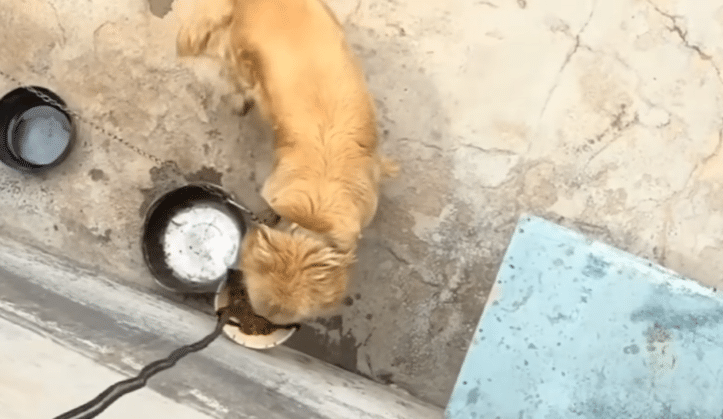
They positioned a ladder near the fence and used a rope to lower containers into the yard. The method allowed them to provide food and water without entering illegally or frightening the dog by climbing directly over.
Each evening, the Golden Retriever began waiting for them.
He recognized the sounds of their arrival.
He approached the containers.
And for a few minutes, the empty yard no longer felt completely forgotten.
But the routine also made the limits of their help impossible to ignore.
They could feed him.
They could speak to him.
They could remain nearby for a short time.
Then they had to leave.
The dog stayed behind, still attached to the same chain.
The woman began understanding that temporary assistance would not change the larger problem.
He needed more than meals lowered over a fence.
He needed a safe home.
One Carefully Prepared Meal Changed Her Decision
One day, the woman decided to prepare something more substantial for him.
She cooked a meal containing meat, eggs, and vegetables, then carefully lowered it into the yard.
The dog ate eagerly.
Watching him made the situation feel more urgent to her.
She could not know when he had last received a freshly prepared meal or how regularly he was being fed. But his interest in the food reinforced her belief that his daily needs required more attention.
Until then, she had been helping him remain in the yard.
Now she wanted to help him leave it.
The woman contacted the people who owned the dog and asked whether they would allow her to adopt him.
Her first request was refused.
They reportedly explained that they still wanted the Golden Retriever to remain at the property as a guard dog.
The woman continued the conversation.
She described what she had observed and explained that the dog needed companionship, regular care, and a home where he would not spend his days alone on a chain.
The discussion lasted for some time.
She remained calm but persistent.
Eventually, the owners agreed to let her take him.
The arrangement reportedly included a request that the dog occasionally be brought back to see them.
It was not a simple or perfect resolution.
But it meant the Golden Retriever could finally leave the neglected yard.
The Chain Came Off, but Adjustment Took Time
The following day, the woman began moving the dog into his new life.
Her first priority was his health.
After spending so much time outdoors with uncertain care, he needed to be examined by a veterinarian. The appointment would help identify any immediate medical concerns and establish what continued treatment or preventive care he might require.
After the examination, she cleaned him and brought him home.
Then she gave him a name.
Kele.
The name was chosen to represent happiness—a quality she hoped would gradually become part of his life.
For Kele, however, the transition was enormous.
His world had previously consisted largely of a yard, a chain, and an empty building.
Now he was entering enclosed rooms filled with unfamiliar surfaces, household objects, and sounds.
Soft bedding may have felt strange.
A person moving freely around him required attention.
Even a full bowl left within reach could be difficult to trust when an animal has not always known when the next meal will arrive.
The woman did not expect Kele to understand everything immediately.
She offered him space.
She maintained regular routines.
Food and water appeared in the same places.
Her voice remained gentle.
If Kele wanted to remain close, she allowed him.
If he needed time to observe from a distance, she did not force him forward.
Little by little, his body began to relax inside the home.
The First Peaceful Sleep Meant More Than Excitement
One of the most meaningful changes appeared during an ordinary moment.
Kele settled beside his new caregiver and fell asleep.
There was no dramatic celebration.
No sudden burst of energy.
He simply rested near someone he was beginning to trust.
For a dog accustomed to sleeping outdoors, remaining alert may have become part of his routine. Passing sounds, weather, unfamiliar people, and movement around the property could interrupt rest at any time.
Inside the home, the environment was different.
The door remained closed.
The same person stayed nearby.
A soft surface supported his body.
Nothing pulled him back when he changed position.
Kele’s sleep appeared deeper and more relaxed than the cautious resting his caregiver had previously observed.
That moment helped her understand that rescue was not only about removing a chain.
It was about creating conditions in which the dog no longer felt responsible for watching everything around him.
Safety was becoming something Kele could experience rather than something he had to search for.
His caregiver continued building that feeling through daily routines.
Meals came predictably.
Gentle contact remained available.
And every night ended with Kele inside a home rather than alone beside an empty house.
A Visit to the Former Property Was Emotionally Difficult
Several weeks later, the woman honored the agreement to bring Kele back for a visit.
As they approached the familiar property, he appeared to recognize the place and the people associated with it.
His movements became animated.
His tail wagged.
He moved toward them with visible excitement.
Dogs can retain strong associations with familiar people and environments, even when their previous living conditions were far from ideal.
Kele’s response did not erase the neglect his new caregiver believed she had witnessed.
It simply showed that the relationships from his earlier life still mattered to him.
The visit did not unfold as warmly as she had hoped.
According to her account, Kele received only brief attention before the people returned inside and closed the door.
He remained outside for a moment, looking toward the entrance.
The woman found the scene difficult to watch.
It is impossible to know exactly what Kele expected or understood. His reaction may have reflected confusion, excitement that had not yet settled, or a desire to continue following familiar people.
Rather than assign human thoughts to him, his caregiver focused on what she could do next.
She brought him back to the home where he now had regular care.
That evening, Kele stayed close to her and rested his head in her lap.
The gesture was quiet.
But it showed that he was becoming comfortable turning toward her for reassurance.
His Personality Began to Grow Beyond the Yard
As the weeks passed, Kele’s behavior continued changing.
The dog who had once spent most of his day sitting within the limits of a chain became more interested in play and companionship.
He followed his caregiver through the house.
He accepted affection more readily.
He began enjoying comfortable naps without appearing constantly alert.
Ordinary routines gave him opportunities he had not had in the abandoned yard.
He could move from one room to another.
He could choose where to rest.
He could approach people rather than waiting for them to come to the fence.
His caregiver also learned more about his individual personality.
Kele was gentle.
He enjoyed being near people.
He responded well to calm attention and appeared increasingly comfortable with the predictable rhythm of home life.
The change did not mean every earlier experience had disappeared.
Some dogs rescued from long-term outdoor confinement may remain sensitive to certain noises, movements, or separations.
They may need additional leash training, house training, veterinary care, or support when adjusting to new environments.
Kele’s caregiver understood that affection alone would not resolve every challenge.
But it gave him a foundation from which to learn.
A Chain Can Provide Restraint but Not a Life
Kele’s story highlights the difference between keeping an animal alive and meeting that animal’s broader needs.
A dog may have access to occasional food and still experience isolation.
He may have a yard and still lack safe shelter from heat, cold, or rain.
He may remain physically present on a property while receiving almost no companionship or mental stimulation.
Long-term tethering can also create practical dangers.
Chains may become tangled around objects.
Water bowls can be overturned outside the animal’s reach.
A dog may be unable to escape extreme weather or avoid threats entering the yard.
Restricted movement can contribute to frustration, boredom, and physical discomfort.
Laws governing tethering and animal care vary by location, but basic needs remain the same.
Dogs require appropriate food and clean water.
They need shelter and veterinary care.
They also benefit from exercise, social interaction, and a living environment where they are treated as companions rather than equipment.
Kele had reportedly been left to discourage strangers from entering an empty property.
But a dog is not a replacement for a security system.
He is a living animal whose safety and comfort require daily attention.
The neighbor understood that each time she looked across the fence.
The Woman Helped Before She Knew the Ending
When the woman first tossed food over the fence, she did not know that Kele would eventually become her dog.
She only knew that he appeared alone.
Her first action did not solve the situation.
Neither did the second.
Real change developed through a series of decisions.
She noticed the dog.
She watched the property.
She provided food and water.
She learned more about his circumstances.
Then she contacted the owners and continued speaking until an agreement was reached.
Each step carried Kele farther from isolation.
The story did not require the woman to enter the yard secretly or take the dog without permission.
She helped within the limits of what she could legally and safely do while working toward a permanent solution.
That patience mattered.
Animal welfare situations can be complicated, especially when ownership is disputed or when the full circumstances are not immediately known.
When there is concern about an animal’s safety, local animal control, law enforcement, or established rescue organizations may be able to document conditions and advise on legal next steps.
The woman’s food deliveries provided temporary relief.
Her persistence created a future.
The Empty House Was No Longer His Responsibility
Once, Kele spent his days watching the neighborhood from a neglected yard.
The property remained empty.
The chain limited every movement.
And the brief moments when his neighbor appeared may have been the only regular companionship he received.
Today, his surroundings are different.
There is a home with people inside it.
Food arrives without being lowered over a fence.
Water remains within reach.
Soft places are available whenever he wants to rest.
Most importantly, he no longer has to remain outside protecting a building that offers him nothing in return.
Kele’s new life did not begin with one dramatic rescue scene.
It began with attention.
A woman looked toward the next property and noticed that the same dog was always there.
Then she continued noticing.
She recognized when no one arrived.
She saw that food alone was not enough.
And she refused to accept that a gentle Golden Retriever should spend his life chained beside an empty house.
Kele once watched her quietly from behind the fence.
Now he rests beside her inside the home they share.
The property he guarded is part of his past.
The door that matters today is the one that opened and allowed him to become a family member instead of a forgotten watchdog.


