On the afternoon of November 24, 1971, a man in a business suit boarded Northwest Orient Flight 305 in Portland, Oregon. He was calm, polite, and unremarkable — the kind of passenger no one looks at twice. He ordered a bourbon and soda, paid for it, and waited until the plane was airborne before passing a handwritten note to a flight attendant.
The note said he had a bomb.
What followed was the only unsolved case of air piracy in American commercial aviation history. The hijacker collected $200,000 in ransom, strapped on a parachute, and stepped out of a Boeing 727 into a dark, rainy sky somewhere over the Pacific Northwest. He has never been found.
The case remains open in the public imagination — and, for decades, in the FBI’s active files. The hijacking itself is thoroughly documented. What happened to the man after he jumped is not. No confirmed identity has ever been established. No body was ever recovered. The question the case leaves behind is still the same one investigators faced in 1971: Did D.B. Cooper survive, and who was he?
What Happened Aboard Flight 305
The hijacker gave his name as Dan Cooper when he purchased his ticket. A reporting error by a wire service in the early hours of coverage turned “Dan Cooper” into “D.B. Cooper,” and that name stuck permanently in public memory. He was never known by any other.
YOUTUBE EMBED — PRIMARY SEARCH QUERY: “FBI D.B. Cooper case documentary evidence”
Flight 305 was a short domestic route from Portland to Seattle, Washington — a commuter run that took less than half an hour. There were 36 passengers and six crew members aboard. Once airborne, Cooper passed his note to flight attendant Florence Schaffner. When she moved to pocket it without reading it, he told her she should look at it. The note described a bomb in his briefcase and demanded $200,000 in negotiable currency and four parachutes.
The crew relayed Cooper’s demands to the airline and to law enforcement on the ground. Northwest Orient and the FBI agreed to comply. The plane circled Seattle-Tacoma Airport for approximately two hours while authorities assembled the ransom. The $200,000 was delivered in used, non-sequential $20 bills — a detail the FBI would later use to trace the money. Law enforcement also photographed every bill before handing it over, recording all 10,000 serial numbers.
Cooper allowed the other passengers to deplane in Seattle once the money and parachutes arrived. He kept three crew members aboard. He then directed the pilots to fly toward Mexico City at a low altitude — no higher than 10,000 feet — with the landing gear down and the flaps partially extended. Those instructions were unusual and specific, suggesting some familiarity with aircraft performance.
The Ransom Exchange and Nighttime Jump
The flight departed Seattle at approximately 7:40 p.m. with a skeleton crew and the four parachutes — two military-issue and two civilian sport chutes. Investigators later noted that one of the civilian parachutes Cooper received was a dummy training chute, its lines sewn shut and non-functional. He apparently did not notice or did not care. He chose one of the military chutes for his jump.
Somewhere over southwestern Washington, at an altitude estimated between 7,000 and 10,000 feet, Cooper lowered the rear airstair of the Boeing 727 — a feature unique to that aircraft model that allows the stairs to be deployed in flight. He had learned about this capability somehow. He was not asked. He simply knew.
At approximately 8:13 p.m., a pressure change was detected in the aircraft. The crew, isolated in the cockpit per Cooper’s instructions, felt the tail move. Cooper had jumped. He was carrying the $200,000 in a canvas bag, wearing a business suit, a thin raincoat, and loafers — clothing entirely unsuited to a nighttime parachute landing in November terrain.
The plane landed safely in Reno, Nevada. Cooper was not aboard. The FBI launched an immediate ground search of the jump zone, which covered rugged, heavily forested terrain near the Lewis River in Cowlitz County, Washington. They found nothing.
The Evidence Cooper Left Behind
Cooper was not entirely invisible. He left physical evidence on the aircraft that investigators have analyzed for decades.
Most significantly, he left his clip-on tie on the seat. The FBI recovered it and eventually submitted it for DNA analysis. In 2011, a private researcher working with the FBI confirmed the tie contained rare earth elements — specifically, particles of pure titanium and other industrial metals — that were not commonly found in consumer goods in 1971. Investigators suggested this profile might indicate someone who worked in a manufacturing or aerospace-related industry, though no definitive professional match was ever confirmed.
The tie has remained one of the case’s most analyzed physical artifacts. In recent years, independent researchers using more advanced techniques have continued to examine it, with results that are intriguing but not conclusive.
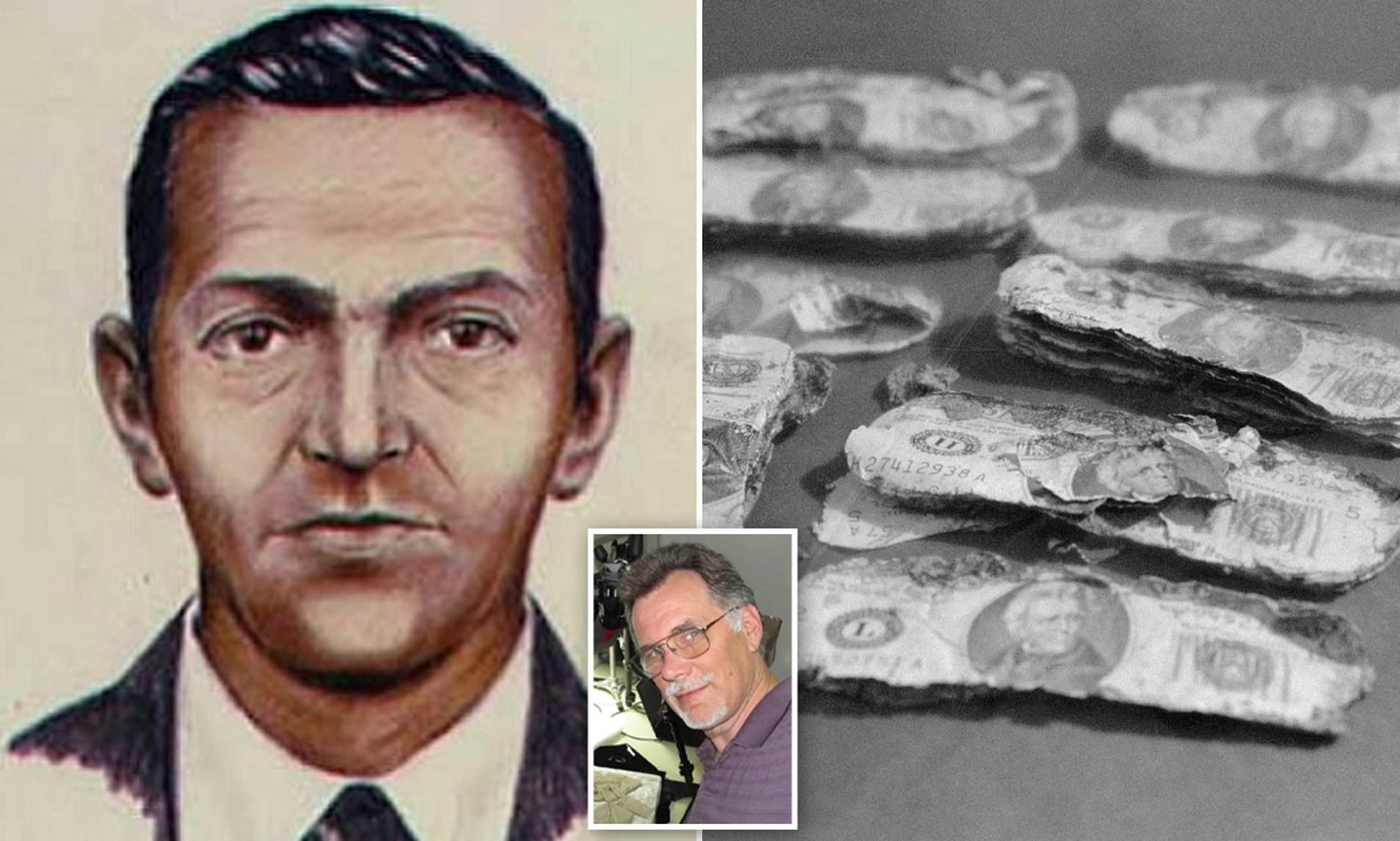
Cigarette butts recovered from the aircraft were also catalogued as evidence. Cooper smoked during the flight, ordering multiple drinks and appearing relaxed throughout. Witnesses described him as a middle-aged white man, approximately 5 feet 10 inches to 6 feet tall, with dark hair and dark sunglasses. He was described as courteous and calm throughout the entire incident, never threatening crew members beyond the initial note.
The FBI composite sketches, developed from crew descriptions, were circulated widely. They generated thousands of tips over the following decades — none of which produced a confirmed match.
Why the FBI Believed the Jump Was So Dangerous
Aviation and parachute experts consulted by the FBI expressed serious doubt that Cooper survived the jump. The conditions on the night of November 24, 1971 were severe. The temperature at jump altitude was estimated at around minus 7 degrees Fahrenheit with wind chill factored in. Rain and darkness obscured any visual reference point. Cooper was wearing street clothes, not cold-weather gear.
The jump zone itself presented additional hazards. The terrain below is a mix of dense forest, steep ravines, and river systems — unforgiving ground for a parachute landing even under ideal daytime conditions. Military-trained parachutists expressed skepticism that someone without recent jump experience could have executed a safe landing in those conditions, at night, over unfamiliar terrain.
The FBI concluded early that survival was possible but unlikely. That assessment has not changed in the decades since. No remains, no parachute, and no portion of the canvas money bag were ever definitively recovered from the jump zone.
The Money Found on a Riverbank
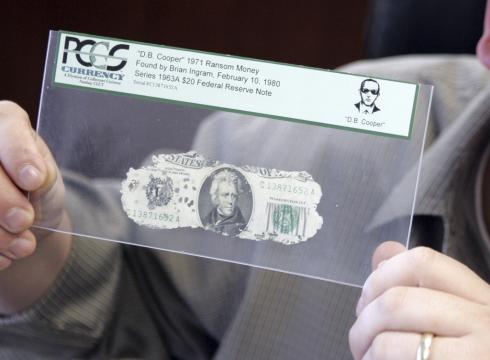
For nearly nine years, the case produced no physical trace of the ransom. Then, in February 1980, an eight-year-old boy named Brian Ingram was digging along the north bank of the Columbia River near Tena Bar, Washington, during a family outing. He unearthed three bundles of decaying bills partially buried in the sand.
The FBI confirmed the bills were from Cooper’s ransom. The serial numbers matched. A total of $5,800 was recovered — about 58 bills — all severely deteriorated by water and time. The remaining roughly $194,200 has never been found.
The location of the Tena Bar bills complicated the geography of the investigation. Tena Bar sits downstream on the Columbia, some distance from the primary jump zone that the FBI had identified based on the flight path. Some investigators argued the bills could have been deposited by river movement over years. Others suggested the jump zone calculations might need revision. The discrepancy has never been fully resolved.
The bills’ condition made clear they had been in water for an extended period, but forensic analysis could not determine exactly how long or from which upstream point they had traveled.
YOUTUBE EMBED — SECONDARY SEARCH QUERY: “D.B. Cooper ransom money Tena Bar evidence”
What Remains Unknown
The FBI conducted one of the longest active investigations in the history of American law enforcement around this case. Over the years, investigators pursued more than a thousand named suspects. None were ever charged. Some prominent suspects — including a man named L.D. Cooper, named by a relative, and a man identified by a researcher as Robert Rackstraw, who disputed the claim — generated significant media coverage. None produced a prosecutable identification.
In July 2016, the FBI announced it was redirecting resources away from the active investigation, ending the routine pursuit of new suspect leads. The bureau stated it would continue to accept credible physical evidence if submitted. The case file, maintained in the FBI Vault, remains accessible to the public. The investigation is technically still open but is no longer being actively worked in the traditional sense.
Several fundamental questions remain entirely unanswered. Investigators do not know Cooper’s real name. They do not know his background, his motive beyond the money, or his level of parachute training. They do not know whether he landed safely, whether he was injured, or whether he survived the winter night. The nearly $194,000 that was not found at Tena Bar has not surfaced anywhere in the decades since — not in circulation, not at another dig site, not in an estate.
The case sits at an unusual intersection: the crime itself is richly documented, with an intact crew, passenger accounts, radio communications, recovered evidence and a photographic record of every ransom bill. But the man at the center of it walked off an airplane staircase and disappeared as completely as if he had never existed.
Where the Case Stands
The D.B. Cooper hijacking is the only unsolved case of air piracy in U.S. commercial aviation history. That status has not changed since November 24, 1971. The FBI’s decades-long investigation ended without a confirmed identity, a confirmed fate, or a recovered body. The $5,800 found at Tena Bar in 1980 remains the only portion of the ransom ever located.
What is certain is this: a man boarded Flight 305 using a false name, executed a deliberate and logistically specific hijacking, collected $200,000, and jumped from a moving aircraft into a dark and hostile sky. Every theory about who he was or what happened next remains exactly that — a theory, unsupported by the physical evidence needed to close the case. The FBI has said it will examine credible new evidence if it emerges. So far, none has.

