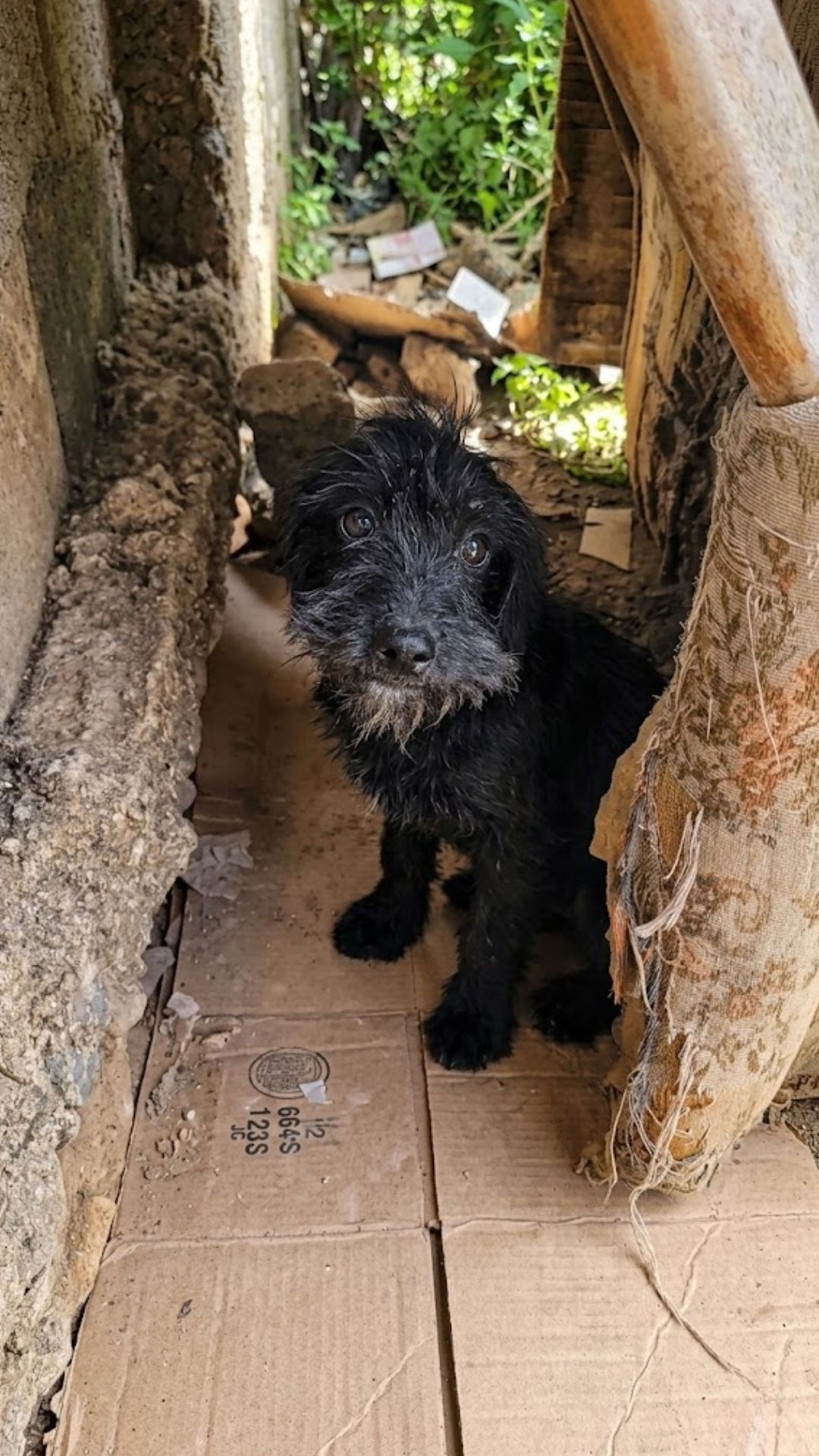
The neighbor had gone into the overgrown backyard looking for a missing cat.
They expected to search beneath bushes, behind old boards, and along the forgotten corners where a frightened animal might hide.
Instead, they found a dog.
He was standing beside an old couch that looked as though it had been discarded years earlier.
The sofa sat directly on the dirt.
A piece of damp cardboard covered part of it.
Around the dog’s neck was a heavy chain.
The other end was fixed near the broken furniture.
His name was Max.
According to the rescue account, he had been kept in that small corner since he was a puppy.
Rain had turned the ground around him into mud.
His skin was badly irritated.
Large areas of fur were missing.
And although the neighbor had entered the yard looking for one animal, it quickly became clear that another one desperately needed attention.
The missing cat search was no longer the most urgent problem.
Because Max had finally been seen.
His Entire World Ended Where the Chain Became Tight
When rescuers later arrived, the small space around Max told much of the story.
There was no proper kennel.
No raised sleeping area protected from wet ground.
The worn couch and cardboard appeared to be the main place available for him to rest.
When rain accumulated in the yard, Max could not simply walk somewhere dry.
The chain decided how far he could go.
A few steps in one direction.
A few steps in another.
Then the metal stopped him.
According to those involved in the rescue, Max had lived this way for years.
Food was reportedly provided intermittently, but his overall physical condition suggested that regular veterinary and environmental care had been inadequate.
His skin was one of the most obvious concerns.
Large patches were inflamed.
Fur had disappeared from extensive areas.
Scratching and irritation had damaged the skin further.
Max did not rush toward the rescuers when they entered.
He remained cautious.
His body stayed low.
Instead of excitedly approaching unfamiliar people, he watched them from the limited area his chain allowed.
The team could not know exactly what Max understood about their arrival.
They could only see a dog who appeared uncomfortable, physically unwell, and uncertain about human contact.
And before they could take him anywhere, they still had to deal with the person responsible for the property.
VIDEO: A Missing Cat Search Revealed Max Chained Beside a Broken Couch—And Rescuers Knew He Needed Help
Getting Max Off the Chain Was Not as Simple as Unclipping It
According to the rescue account, the person keeping Max initially resisted surrendering him.
The conversation became tense.
The rescuers questioned the dog’s living conditions and asked about previous treatment for his skin.
They were reportedly told that treatment had already been attempted and that euthanasia was being considered.
The rescue account also states that money was requested before Max would be released, with previous veterinary expenses given as a reason.
Without independent documentation, the rescuers could not verify every claim about Max’s earlier medical care.
But they did not need paperwork to understand his current condition.
They could see the damaged skin.
They could see the parasites.
They could see the chain.
And they could see the environment in which he had been living.
Their immediate goal was simple:
get Max somewhere he could be properly examined.
Eventually, an agreement was reached.
The chain was removed.
For most dogs, freedom from restraint might lead immediately to excited running.
Max did not react that way.
He had spent a long time moving only within a very small radius.
Now strangers were guiding him away from the only environment he knew.
The rescuers moved carefully.
Max left the yard.
The broken couch remained behind.
And for the first time in years, according to the rescue account, the distance Max could travel was no longer determined by a piece of metal around his neck.
At the Clinic, His Skin Was Only the Beginning
Once Max reached veterinary care, the team could finally examine him properly.
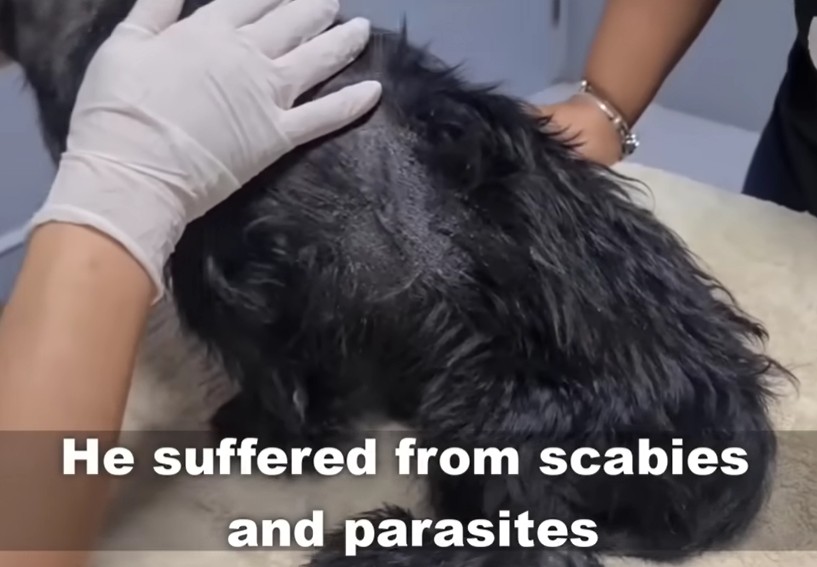
The skin disease was extensive.
Large ticks were found around his ears.
Parasites had contributed to irritation and inflammation.
Mange had affected broad areas of his body.
His coat was thin and patchy, with exposed skin visible across multiple sections.
Some areas were raw from scratching and chronic irritation.
Treatment began immediately.
But veterinary tests revealed that Max’s problems were not limited to the outside of his body.
Bloodwork indicated abnormalities involving his liver and pancreas.
The precise cause could not be determined from appearance alone.
Long-term poor nutrition, parasites, chronic stress, untreated illness, or combinations of those factors could all potentially affect an animal’s overall health.
What the veterinary team knew was that Max needed sustained treatment rather than a single medication or bath.
His body had multiple problems that would need to be addressed together.
Nutrition.
Parasite control.
Skin treatment.
Monitoring of his internal health.
Rest.
And time.
Max also showed very little enthusiasm during those first days.
He ate poorly.
He remained withdrawn.
He did not seek much interaction.
Rather than labeling that behavior as hopelessness, the caregivers treated it as another part of his condition.
A dog who is uncomfortable, weak, itchy, unfamiliar with his surroundings, and suddenly surrounded by strangers may need time before his personality becomes visible.
So they gave him that time.

Every Two Days, Max Was Given Another Medicated Bath
Skin recovery rarely looks dramatic at the beginning.
For Max, treatment became repetitive.
Medication.
Cleaning.
Food.
Rest.
Then another day.
Approximately every two days, he received medicated baths intended to help soothe the damaged skin and address the underlying dermatological problems.
The baths were not instant cures.
His fur continued shedding in damaged areas.
His skin still looked irritated.
Some days, the visible improvement was difficult to notice.
But caregivers kept following the treatment plan.
By around day 20, changes were beginning to appear.
One of the most important was his appetite.
Max started eating more consistently.
Proper nutrition gave his body the raw materials required to repair damaged skin and rebuild strength.
His overall condition slowly improved.
His posture became less depleted.
He became more attentive when people entered.
Still, Max remained shy.
He did not suddenly transform into an outgoing dog simply because the chain was gone.
Caregivers approached him patiently.
They allowed him to decide how much contact he wanted.
There was no reason to rush.
For years, according to the rescue story, his world had changed very little.
Now nearly everything was unfamiliar.
New people.
New rooms.
New smells.
Medical procedures.
Different food.
Even the absence of the chain was something new.
Then, about a month after his rescue, the team decided to introduce Max to something else he had not had much opportunity to experience.
Open space.
One Month Later, Max Reached the Steps—and Stopped
The door opened.
Beyond it was an outdoor area.
Sunlight.
Fresh air.
Ground he could move across without a chain deciding when he had gone far enough.
The rescuers expected Max to need time.
They were right.
He approached the steps and stopped.
Instead of immediately racing into the open area, he stood there.
His body remained cautious.
The wide space in front of him seemed to require a decision he had rarely been allowed to make.
Where should he go?
How far?
Was he expected to stay close?
Max remained near the caregiver beside him.
So no one pushed him forward.
They let him look.
They let him smell the air.
They gave him the opportunity to move when he felt ready.
Eventually, Max took a step.
Then another.
He explored only a small area at first.
That was enough.
Freedom did not need to be measured by distance on the first day.
The important difference was that when Max reached the end of those few steps, nothing pulled him backward.
No chain tightened.
He could stop because he chose to stop.
Then he could move again.
The Outside World Had to Be Introduced One Small Step at a Time
Over the following days, Max received more opportunities to explore.
His confidence developed gradually.
At first, he preferred remaining near familiar caregivers.
Open areas still seemed to make him uncertain.
Grass.
Movement around him.
Other animals.
Sounds coming from farther away.
For a dog accustomed to one small corner, the amount of information outside that space could be overwhelming.
So his caregivers kept the experiences manageable.
A little time outside.
Then rest.
Another short walk.
Another opportunity to investigate.
Max began going farther.
He sniffed unfamiliar places.
He watched the other rescue dogs.
His body language started becoming more relaxed.
These changes coincided with his physical recovery.
The healthier Max felt, the more energy he had available for curiosity.
His skin continued healing.
New fur started appearing.
His appetite remained stronger.
Follow-up testing showed improvement in the medical issues that had concerned the veterinary team.
The rescue account describes his liver and pancreas values as recovering as treatment continued.
The dog who once spent much of his time standing or lying beside a deteriorating couch was now being given reasons to move.
And gradually, he began using them.
By Day 40, Max Barely Resembled the Dog Found in the Yard
Around the fortieth day, photographs showed an extraordinary physical difference.
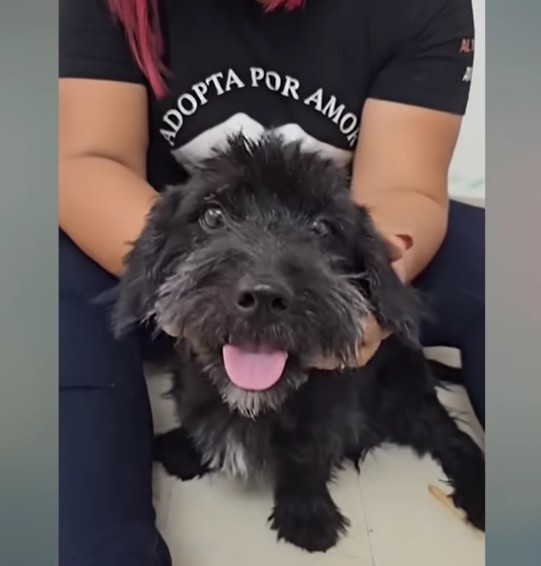
The exposed, inflamed skin was disappearing beneath new fur.
His coat had become noticeably fuller.
The areas once damaged by mange and parasites looked healthier.
He had gained strength.
His body no longer carried the same frail appearance seen on the day of rescue.
Medical care had addressed more than the surface problems.
According to the rescue update, the concerns involving his liver and pancreas had also improved substantially.
But Max’s caregivers noticed another transformation.
He was interacting.
He began moving more confidently around other rescue dogs.
Instead of remaining at the edge of activity, he joined in.
He explored open spaces.
He played.
His tail appeared more frequently in motion.
He approached familiar people more readily.
None of these behaviors erased his past.
They simply revealed that the withdrawn dog seen during his first days in care was not necessarily Max’s permanent personality.
Pain had been affecting him.
Skin disease had been affecting him.
Weakness had been affecting him.
Isolation had been affecting what opportunities he had to interact.
Once those pressures began changing, Max changed too.
Other Dogs Helped Make His New World Feel Less Unfamiliar
Life at the rescue introduced Max to something his old environment had provided very little room for:
choice.
He could decide where to rest.
He could follow another dog across the yard.
He could walk away from activity if he wanted quiet.
He could approach people.
He could explore.
Other rescue dogs became part of that process.
At first, interactions were supervised.
Max’s history of isolation meant caregivers could not simply assume he would know how to behave comfortably around every dog.
But he responded well.
He began spending time near them.
Then playing with them.
The dog who had once been tethered beside an old couch now had companions moving freely around him.
If one dog ran across the yard, Max could follow.
If another stopped to investigate something, Max could join.
These moments might appear ordinary in a shelter.
For Max, they represented skills and experiences he had been given little opportunity to develop before rescue.
His world was no longer measured in feet of chain.
It was measured by wherever his curiosity took him.
Max Is Healthy Now—but His Final Chapter Is Still Waiting
Max’s rescue did not immediately end with adoption.
After approximately 40 days of treatment, his medical condition had improved dramatically.
His skin had healed.
His coat had grown back.
His internal health markers had improved.
He was eating normally.
He was playing.
He was learning how to move confidently through a world far larger than the muddy corner where he had been found.
But there was still one step left.
A permanent family.
For the moment, Max remained safely with his rescuers.
There were no chains around his neck.
No broken couch serving as his primary shelter.
No flooded patch of dirt he could not escape when it rained.
Instead, there were regular meals.
Medical supervision.
Other dogs.
People who knew his name.
And space.
The rescue team could not give Max back the years already spent in confinement.
What they could do was make sure those years did not determine everything that followed.
The Missing Cat Led Someone to a Dog Who Might Otherwise Have Stayed Hidden
There is something unusual about the way Max’s rescue began.
No one arrived specifically looking for him.
There was no scheduled welfare check.
No rescue team had received his name beforehand.
Someone was searching for a cat.
That simple search took them into a forgotten corner of a property.
And there, they noticed a dog who had apparently spent years largely out of view.
Had the cat not gone missing, Max might have remained unseen longer.
Had the neighbor noticed him but decided not to become involved, the chain might have remained in place.
Instead, one discovery led to another.
A person looked.
They asked questions.
Rescuers came.
Max was removed.
Veterinarians treated his skin and internal health problems.
Caregivers introduced him to open spaces without forcing him to understand everything at once.
Other dogs became companions.
And by day 40, the animal beside the broken couch had become difficult to recognize.
Max is still waiting for the final piece of that transformation.
A family.
A home where furniture is something he can sleep beside because he chooses to—not something his chain forces him to remain next to.
A yard he can enter and leave without metal determining the distance.
People who notice when something is wrong before years pass.
For most of his life, according to the rescue account, Max’s world was only a few feet across.
Today, the chain is gone.
His body has healed.
And for the first time, the question is no longer how far Max is allowed to go.
It’s how far his new life can take him.


