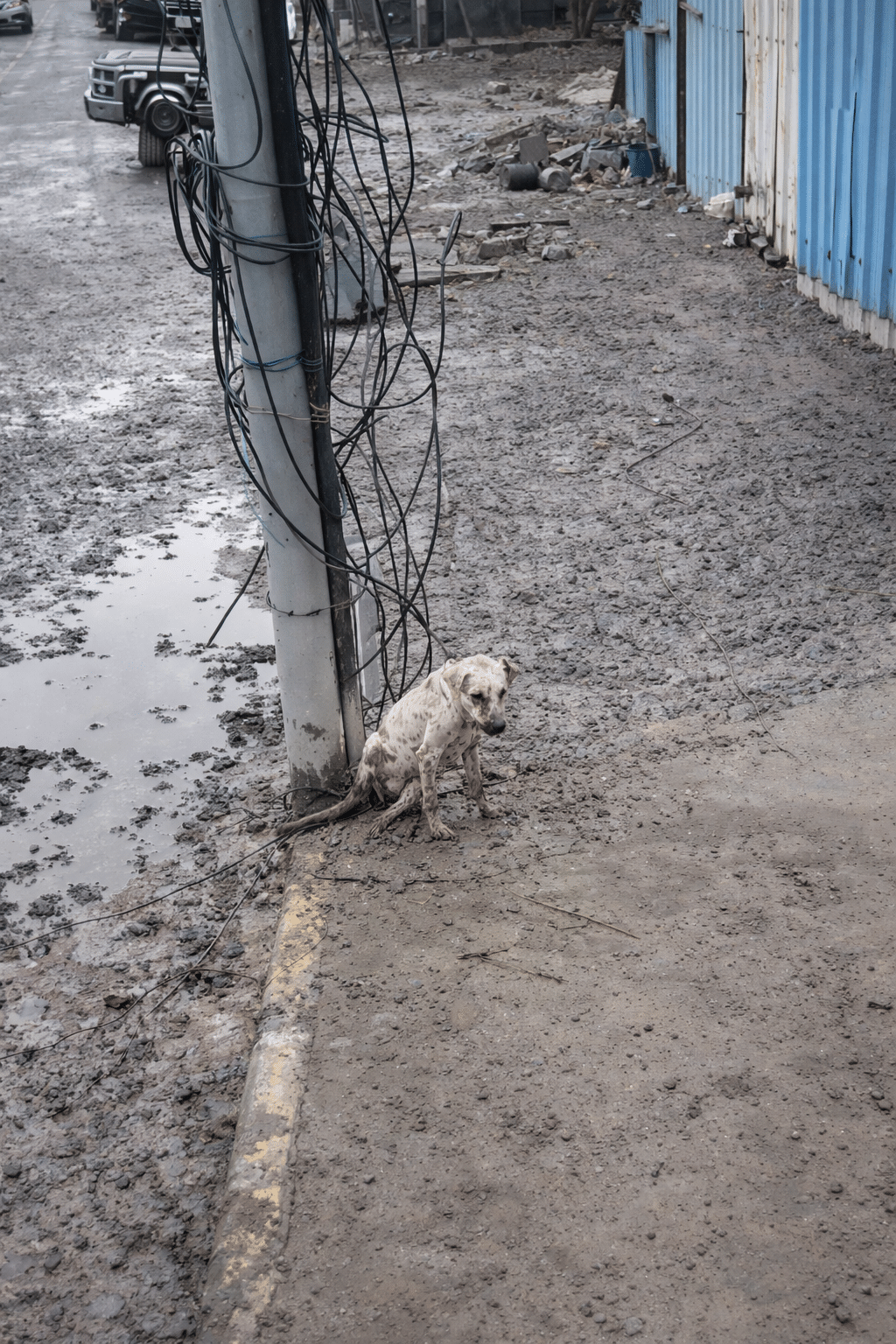
The photo was difficult to understand at first.
A tiny puppy.
A strip of tape wrapped tightly around his muzzle.
A body so thin that the shape of his ribs could be seen beneath the skin.
The image began circulating through an online community group, where people shared it again and again, hoping someone nearby would recognize the location.
Then rescuers received enough information to begin searching.
The trail led them to a garbage dump.
There, among discarded bags, broken objects, and piles of waste, they found the puppy from the photo.
He was alive.
Barely.
A thin plastic cord restrained part of his body.
His mouth was still sealed.
He looked too weak to move far on his own.
The rescuers carefully lifted him from the trash.
They removed what they could safely remove.
And they gave him a name.
Satya.
The Puppy From the Viral Photo Was in Worse Condition Than Anyone Expected
Seeing Satya in person revealed details the photograph could not show.
His body was severely underweight.
His energy was almost gone.
The tape around his muzzle had prevented normal eating and drinking for an unknown period of time.
The skin beneath it was damaged.
Areas around his mouth were raw and injured from prolonged pressure.
The plastic cord found with him added another troubling detail to the scene.
Satya had not simply wandered into the dump and become trapped in loose trash.
According to the rescue account, he appeared to have been deliberately restrained and left there.
The rescuers did not spend time trying to invent an explanation for why.
The puppy in front of them needed care immediately.
His mouth had to be freed.
His wounds needed evaluation.
His dehydration and malnutrition needed treatment.
And the rest of his body had to be checked for injuries hidden beneath dirt and damaged fur.
Satya was taken straight to veterinary care.
VIDEO: From Abandoned and Injured to Running Again — Satya’s Journey
The Tape Around His Mouth Had Already Damaged the Skin Beneath It
At the clinic, the team began examining Satya carefully.
Removing tape from an injured muzzle was not as simple as pulling it away quickly.
The material had been wrapped tightly enough to damage the skin and underlying tissue.
Every section needed to be loosened with care.
The goal was to free Satya’s mouth without tearing already compromised skin or causing unnecessary pain.
Once the area was exposed, the extent of the injury became easier to assess.
The wounds needed cleaning.
They needed protection from infection.
Satya also needed hydration and nutritional support after going without enough food and water.
Then the veterinarians found another serious problem.
Large wounds covered portions of his back.
The tissue there was damaged and painful.
According to the original rescue account, the veterinary team suspected that a hot liquid—possibly oil—may have been involved.
There was no direct evidence explaining exactly what had happened.
What mattered now was treating the injury that was visible.
Satya’s body had already endured enough uncertainty.
The clinic could at least begin replacing it with care.
His Weak Legs Showed How Much Strength He Had Lost
Satya’s lower body was also extremely weak.
His legs trembled when he tried to support himself.
Standing for more than a short time appeared exhausting.
Some of that weakness likely reflected his overall condition.
He was thin.
Dehydrated.
In pain.
And recovering from injuries affecting several parts of his body at once.
During the early examination, Satya remained quiet.
He did not have much energy to resist handling.
Veterinarians cleaned his wounds.
Medication was introduced to control pain and reduce the risk of infection.
His hydration was addressed.
Food had to be reintroduced carefully.
The immediate goal was not to make Satya playful.
It was to stabilize him.
A puppy this depleted does not recover because someone gives him one large meal and a warm bed.
His body needed time to process nutrition again.
Time to heal.
Time to rest.
And time to show whether it still had enough reserve to respond.
The First Days Were Mostly About Resting and Watching
Satya spent much of the early recovery period sitting or lying quietly.
He was exhausted.
At times, his head remained lowered for long stretches.
Eating was difficult at first.
The injuries around his mouth had made one of the most basic parts of life uncomfortable.
So the caregivers did not rush him.
Food was offered in forms he could manage.
His wounds were cleaned regularly.
Medication continued.
And volunteers stayed nearby.
There was no reason to overwhelm him with constant touch.
Instead, they allowed Satya to become familiar with quiet voices and gentle hands.
Someone would sit near him.
Speak softly.
Offer food.
Touch him only when he seemed comfortable.
Then return later.
Those interactions were small.
But Satya had entered care after a period in which human involvement had clearly not been safe or dependable.
Now the pattern was different.
People came close.
And nothing bad followed.
The same caregivers returned.
The same meals appeared.
The same safe resting area remained.
Little by little, Satya began reacting differently to the world around him.
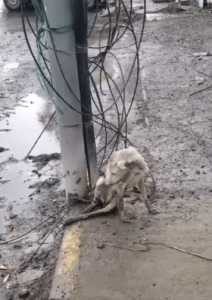
About a Week Later, His Tail Started to Move
The physical changes came gradually.
The wounds across Satya’s back began showing signs of healing.
Inflammation decreased.
His body appeared stronger.
Then came a behavioral change caregivers noticed immediately.
Satya wagged his tail.
At first, the movement was small.
A brief response when someone familiar came near.
Then it happened again.
For the people who had seen him lying quietly after rescue, that simple motion carried more meaning than a dramatic transformation could.
Satya was becoming more engaged.
He began eating with greater consistency.
He watched people more closely.
He responded when caregivers approached.
His body was still healing.
The wounds were not gone.
His strength had not fully returned.
But he was no longer spending every moment simply enduring treatment.
He was beginning to participate in his own routine.
Meal time became something he anticipated.
Familiar voices drew his attention.
And his tail, once almost motionless, began appearing more often in those interactions.
Strength Returned Before Anyone Expected Him to Look “Normal”
As the weeks passed, Satya’s appearance changed.
But the rescue team did not measure recovery only through photographs.
A dog can look cleaner long before the body beneath the coat is fully strong.
So progress was watched in more practical ways.
Could Satya stand longer?
Was he eating enough?
Were the wounds continuing to close?
Could he move without the same trembling?
Did he show interest in what other dogs were doing?
Slowly, the answers improved.
His legs became steadier.
His body gained strength.
He began exploring the rescue center rather than remaining in one place.
The puppy who had once been lifted from a garbage dump because he could barely manage on his own now wanted to know what was happening beyond his resting area.
He sniffed new spaces.
Watched other dogs.
Followed movement around the yard.
Eventually, simply walking was no longer enough.
Satya wanted to run.
The Other Dogs Showed Him What an Ordinary Day Could Look Like
As Satya recovered, he spent more time around the other dogs in care.
They ran.
Played.
Rested in the shade.
Approached people without fear.
Satya gradually began joining them.
At first, the interactions were cautious.
A short approach.
A sniff.
Following another dog for a few steps.
Then his confidence grew.
Soon, the puppy who had once been found restrained among trash was moving across the rescue yard with other dogs.
His legs carried him faster.
His body no longer shook with every attempt to stand.
He showed the energy expected from a young dog.
Curiosity replaced much of the stillness that had defined his first days.
Satya chased movement.
Explored.
Played.
Those behaviors were not extraordinary for a puppy.
That was precisely why they mattered.
The rescue had given Satya the chance to become ordinary.
To have days that were about food, play, naps, and companionship rather than injury and survival.
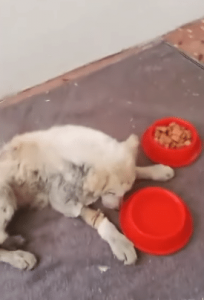
The Garbage Dump Stopped Being the Most Important Part of His Story
The first image of Satya was difficult to forget.
A puppy with his mouth taped shut.
Thin.
Restrained.
Left in a place surrounded by things people had discarded.
For a while, that image defined how everyone knew him.
But recovery gradually replaced it with other images.
Satya eating.
Satya standing.
Satya wagging his tail.
Satya walking across the yard.
Satya running with other dogs.
The injuries remained part of what happened to him.
They did not need to remain the only thing people saw.
His caregivers learned his personality as his health improved.
He became more alert.
More playful.
More interested in companionship.
The puppy from the disturbing social media post became a young dog whose daily life no longer revolved around what had been done to him.
That is one of the quieter changes rescue can create.
It does not erase the beginning.
It gives the animal enough new experiences that the beginning stops taking up the entire story.
One Shared Post Eventually Reached the People Who Could Help
Satya’s rescue began online.
Someone saw the photograph.
Someone shared it.
Another person reported it.
Information moved from one person to the next until it reached rescuers close enough to act.
Then the story moved offline.
People searched.
They reached the garbage dump.
They removed the tape.
They carried Satya to a clinic.
Veterinarians treated his wounds.
Volunteers remained with him through the difficult first days.
None of those steps would have mattered alone.
The photograph by itself could not save Satya.
Sharing by itself could not heal his wounds.
Veterinary care could not begin until someone physically reached him.
His recovery happened because each person carried the situation one step farther.
That chain of attention changed the direction of one small life.
Satya No Longer Has to Fight Just to Be Seen
Today, the puppy moving through the rescue center looks very different from the dog first discovered among garbage.
He can eat.
He can move.
He can play.
He can approach caregivers without the same uncertainty that surrounded his early days.
The wounds that once demanded constant treatment have healed significantly.
The weakness in his legs has improved.
And the yard gives him space to do something that once seemed far away.
Run.
Satya’s story is not powerful because suffering somehow made him stronger.
He should never have needed to endure what he did.
What matters is what happened when people finally intervened.
Pain was treated.
Hunger was answered with food.
Fear was met with patience.
Isolation was replaced with companionship.
And a puppy whose mouth had once been physically prevented from opening was given a life where he no longer had to struggle for anyone to understand that he needed help.
Once, Satya was found in a place filled with things people had decided no longer mattered.
He was never one of them.
Someone saw the difference.
And because they did, the final image of Satya’s story is no longer a puppy lying among garbage.
It is a young dog running toward the rest of his life.


