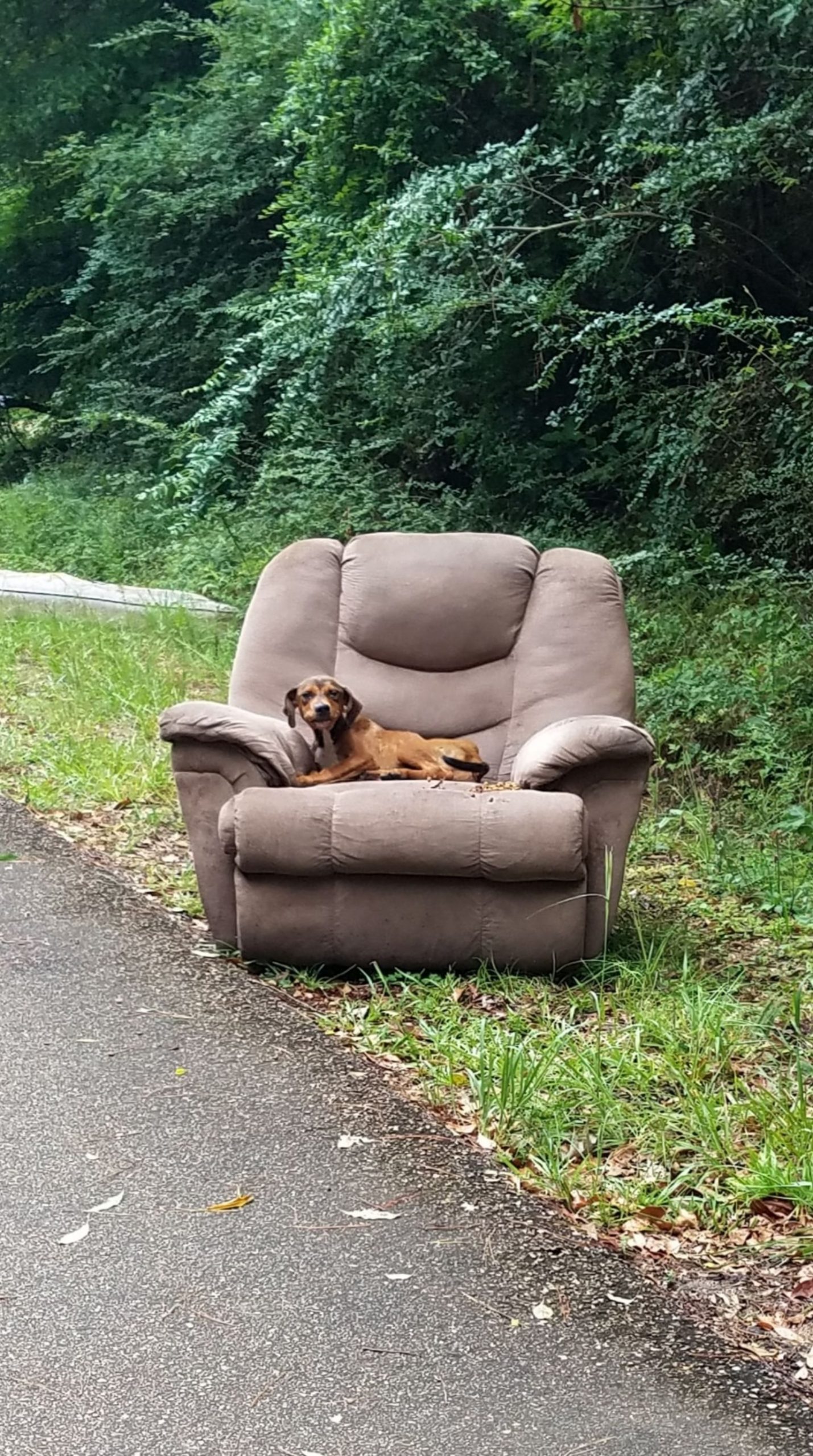
The broken recliner sat beside a rural road near Brookhaven, Mississippi, surrounded by discarded household items.
Curled inside its torn cushions was a small puppy.
His body was painfully thin, and his cautious eyes followed every movement around him. Although there was open ground nearby, he remained pressed against the chair as though it were the only familiar place left.
Then an animal control officer arrived.
She did not pull him from the cushions.
She knelt down, opened her hand, and waited.
He Was Almost Hidden Among the Roadside Debris
The puppy might easily have been mistaken for another dark shape among the abandoned furniture.
A damaged television and other unwanted objects had reportedly been left beside the road along with the old recliner. The young dog was curled into one corner of the chair, his small frame partly concealed by the worn fabric.
According to reports, a witness had seen a truck stop at the location.
The occupants unloaded the household items and the puppy before driving away.
The witness contacted Brookhaven Animal Control, and Officer Sharon Norton was sent to investigate.
When she arrived, she immediately saw that the puppy needed more than transportation away from the road.
He appeared severely underweight.
His body looked weak.
And when she approached, he pressed himself farther into the recliner rather than coming forward.
The chair offered little real protection from heat, traffic, insects, or passing animals. Yet the puppy remained there because the unfamiliar world beyond it may have felt even more frightening.
He did not know who Sharon was.
He could not understand why she had stopped.
All he could do was watch and decide whether moving toward her was safe.
Video: Puppy Found Waiting on an Abandoned Recliner Beside a Mississippi Road
Sharon Let Hunger Open the First Door
Sharon understood that rushing toward the puppy could cause him to flee into the road or retreat deeper among the debris.
Instead, she lowered herself beside the chair.
She spoke calmly.
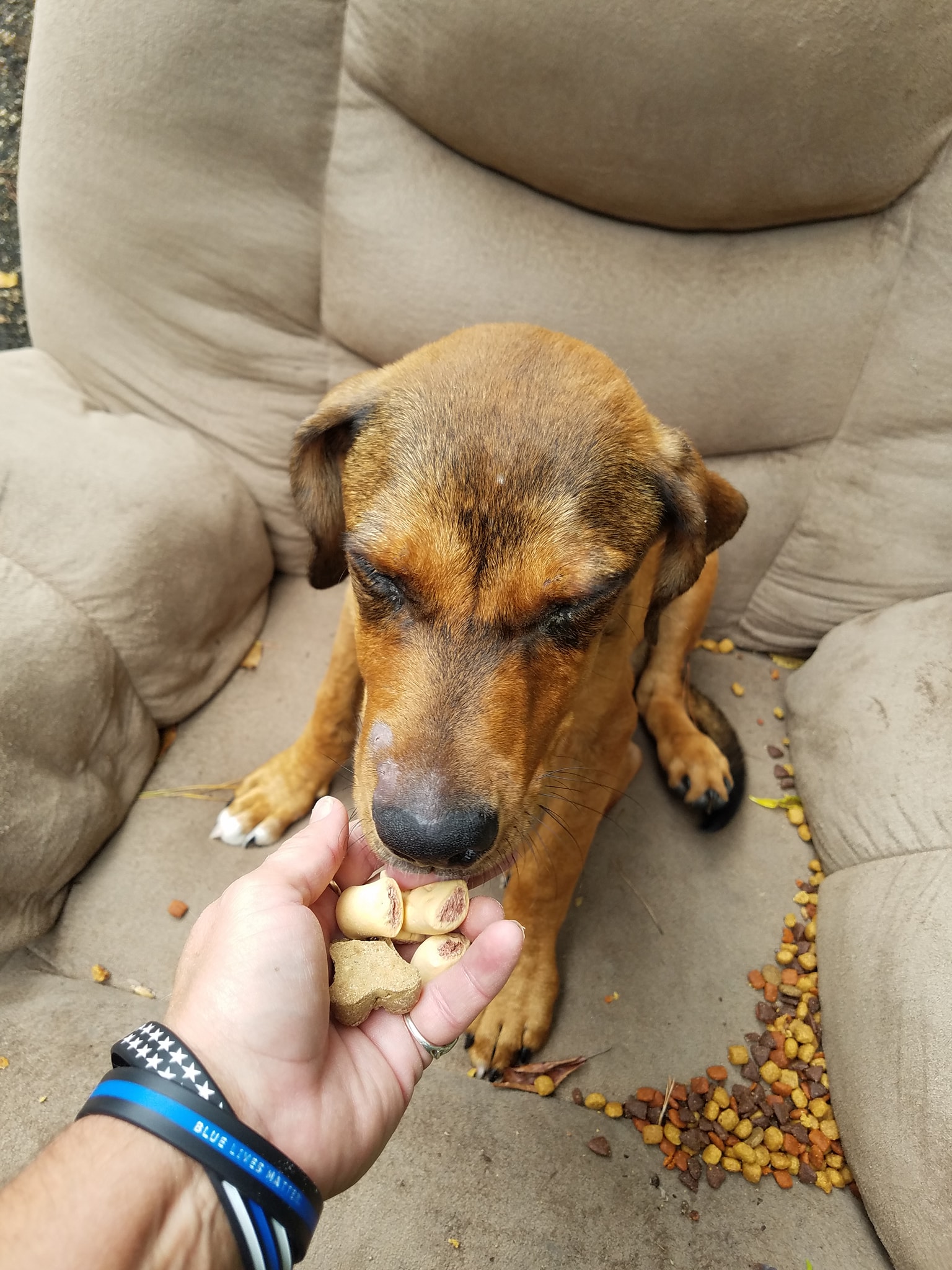
Then she offered him treats.
At first, the puppy stayed in place.
His body remained tense as he watched her hand. He appeared interested in the food, but fear kept him from immediately moving closer.
Sharon did not force the interaction.
She waited.
Little by little, the puppy leaned forward.
He stretched his neck toward the treat, paused, and then finally took it from her hand.
It was a small moment, but it gave Sharon the opening she needed.
The puppy was still frightened, yet he was willing to accept something from the stranger beside him. Food had begun building a connection where there had previously been only uncertainty.
Sharon continued offering treats and gentle reassurance until she could safely secure him.
The puppy did not instantly become relaxed.
Being lifted away from the only place he had chosen to hide was another unfamiliar experience.
But he was no longer alone beside the road.
The broken chair had stopped being his shelter.
Help had arrived.
The Shelter Team Saw How Much Care He Needed
The puppy was taken to the Brookhaven Animal Rescue League, commonly known as BARL.
There, staff members could examine him more closely.
His thin body suggested he had not been receiving enough food. He needed hydration, careful nutrition, and monitoring as he began recovering from the condition in which he had been found.
The team named him Gatson.
Before long, his unusual rescue earned him another name among those following his story: the “Armchair Bandit.”
The nickname was playful, but his medical needs were serious.
A severely underweight puppy cannot simply be given unlimited food and expected to recover immediately. His body needed nourishment introduced in a controlled way while caregivers watched for signs of illness or additional complications.
Regular meals were provided.
Fresh water remained available.
A clean, quiet place replaced the roadside debris.
For the first time since he had been discovered, Gatson could sleep without remaining exposed to passing vehicles and the summer heat.
The staff also began learning about the puppy behind the fear.
He was cautious around unfamiliar situations, but he responded to gentle handling.
He watched people carefully.
And as the days passed, he began recognizing the caregivers who consistently brought food and comfort.
The chair had been removed from his life.
Now trust had to be built in its place.
One Photograph Carried His Story Far Beyond Mississippi
Images of Gatson sitting inside the abandoned recliner began circulating online.
The scene was difficult to forget.
A small puppy.
A broken chair.
A roadside filled with objects someone no longer wanted.
The photograph did not require an elaborate explanation. It captured the vulnerability of an animal left in a place where he had no reliable food, shelter, or protection.
People across the country began sharing Gatson’s story.
Messages of concern and encouragement reached the shelter. Many viewers wanted to know whether he was safe and how they could support the people caring for him.
Eventually, the story reached representatives of La-Z-Boy, the furniture company widely associated with recliners.
The connection between the company and Gatson’s unusual hiding place led to a meaningful response.
La-Z-Boy reportedly donated 50 pet beds to BARL and provided financial assistance for the organization’s rescue and medical work.
The donation did more than give Gatson a comfortable place to sleep.
It helped other animals at the shelter as well.
Dogs and cats arriving from difficult circumstances could rest on beds of their own while waiting for treatment, foster care, or adoption.
The broken recliner beside the road had represented neglect.
The new beds represented something very different.
Warmth.
Comfort.
And a community responding to an animal who had almost been overlooked.
The Frightened Puppy Began Acting Like a Puppy Again
Recovery did not happen in a single dramatic moment.
Gatson’s body needed time to regain strength.
His behavior also needed time to change.
During his early days at the shelter, staff members maintained a predictable routine around him. Meals arrived at regular times. People approached gently. Affection was offered without overwhelming him.
Gradually, Gatson began responding.
His posture became less guarded.
His eyes appeared more alert.
His tail began moving when familiar caregivers approached.
As his nutrition improved, so did his energy.
The puppy who had remained curled inside the roadside chair started exploring the shelter’s play areas. He walked more confidently and became increasingly interested in the activity around him.
Then he began to run.
For the staff members who had seen his fragile condition on arrival, watching him move freely carried special meaning.
He was no longer conserving every bit of energy.
He was no longer hiding because he had nowhere else to go.
He could play.
He could approach people.
He could rest and wake knowing that food would still be available.
These may seem like ordinary parts of a dog’s life.
For Gatson, each one marked another step away from the chair beside the road.
Trust Returned Through Repetition, Not Pressure
It is tempting to describe rescue as the instant an animal is picked up and removed from danger.
For Gatson, that moment was only the beginning.
Being physically safe did not mean every uncertainty disappeared.
He still had to learn what to expect from the people around him.
Shelter workers helped him through consistency.
They did not require Gatson to behave confidently before he received affection.
They did not punish him for hesitating.
Instead, they repeated the same reassuring experiences.
A hand offering food.
A voice speaking calmly.
A clean bed waiting at night.
A person returning the next morning.
Dogs often build trust through patterns. When care remains predictable, unfamiliar environments can gradually begin to feel safe.
Gatson’s transformation reflected that process.
He became more comfortable receiving attention.
He sought interaction instead of retreating.
His personality began emerging beyond the thin body and cautious expression shown in the original photographs.
The frightened roadside puppy had not disappeared.
He had simply been given enough good experiences to respond differently to the world.
A Permanent Family Became the Final Step
As Gatson became healthier and more confident, he was prepared for adoption.
The shelter had carried him through the most vulnerable part of his recovery.
Now he needed a home where the routines of safety could continue permanently.
Eventually, a family chose him.
The adoption gave Gatson something the broken recliner never could.
A real place to belong.
In his new home, he could rest without exposure to the weather.
He could eat without uncertainty.
He could explore his surroundings knowing that someone was watching over him.
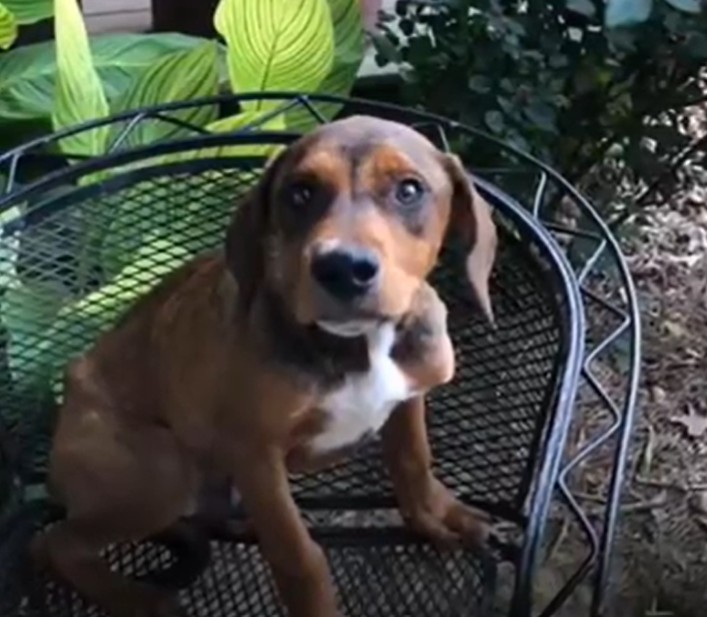
Photographs from his life after adoption showed a dog who looked very different from the puppy first discovered beside the road.
His body was healthier.
His movements were more confident.
And the cautious distance he once kept from people had been replaced by the comfort of living among those he knew.
The roadside was part of his story.
It no longer defined his daily life.
Gatson had gone from waiting inside discarded furniture to becoming a cherished companion in a family home.
Abandonment Is Never a Safe Solution
Gatson’s rescue also carries an important message about surrendering unwanted animals.
Leaving a dog beside a road places that animal at immediate risk.
The dog may be struck by a vehicle.
Extreme heat or cold can quickly become dangerous.
Young animals may not know how to find food or clean water.
Fear may cause them to hide in places where rescuers cannot easily see them.
There are safer alternatives.
Local shelters, animal control departments, veterinary clinics, and rescue organizations may be able to provide guidance when someone can no longer care for a pet.
Resources vary by location, and shelters sometimes face serious capacity limits. But contacting them still gives the animal a better chance than leaving the pet exposed and hoping someone eventually notices.
Gatson was fortunate that a witness saw what happened.
The person made a call.
Sharon responded.
BARL had people willing to accept him.
Many abandoned animals are never discovered so quickly.
Some remain hidden.
Others travel far from the place where they were left.
Gatson’s ending was hopeful because several people acted before the roadside became more dangerous.
The Chair Was Never His Home
When people first saw Gatson inside the recliner, it was easy to imagine that he was waiting for someone to return.
No one can know exactly what the puppy expected as he remained among the discarded furniture.
Perhaps the chair felt familiar.
Perhaps he was simply frightened to move.
Perhaps its torn cushions offered the only shade and shelter he could find.
What matters is what happened next.
A witness noticed.
An officer arrived.
She chose patience instead of force.
A shelter began rebuilding his health.
People across the country shared his story.
A company provided support that benefited many more animals.
And eventually, a family welcomed Gatson home.
His rescue was not created by one enormous gesture.
It was created by a chain of smaller decisions.
Someone made a phone call.
Someone knelt beside a frightened puppy.
Someone prepared his meals.
Someone provided a bed.
Someone chose adoption.
Each act moved Gatson farther from the roadside.
The broken recliner was never truly his home.
It was only the place where his old life ended—and where someone finally stopped long enough to begin a better one.


