The security guard saw the truck stop only briefly.
A man stepped out.
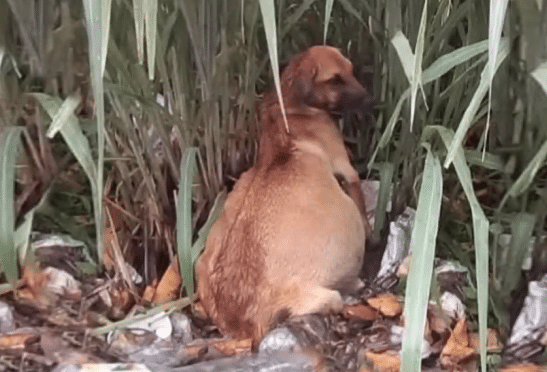
Something was removed from the vehicle and tossed beside a pile of trash.
Then the truck drove away.
At first, from a distance, it could have been almost anything.
A discarded bag.
An old blanket.
More rubbish added to what was already there.
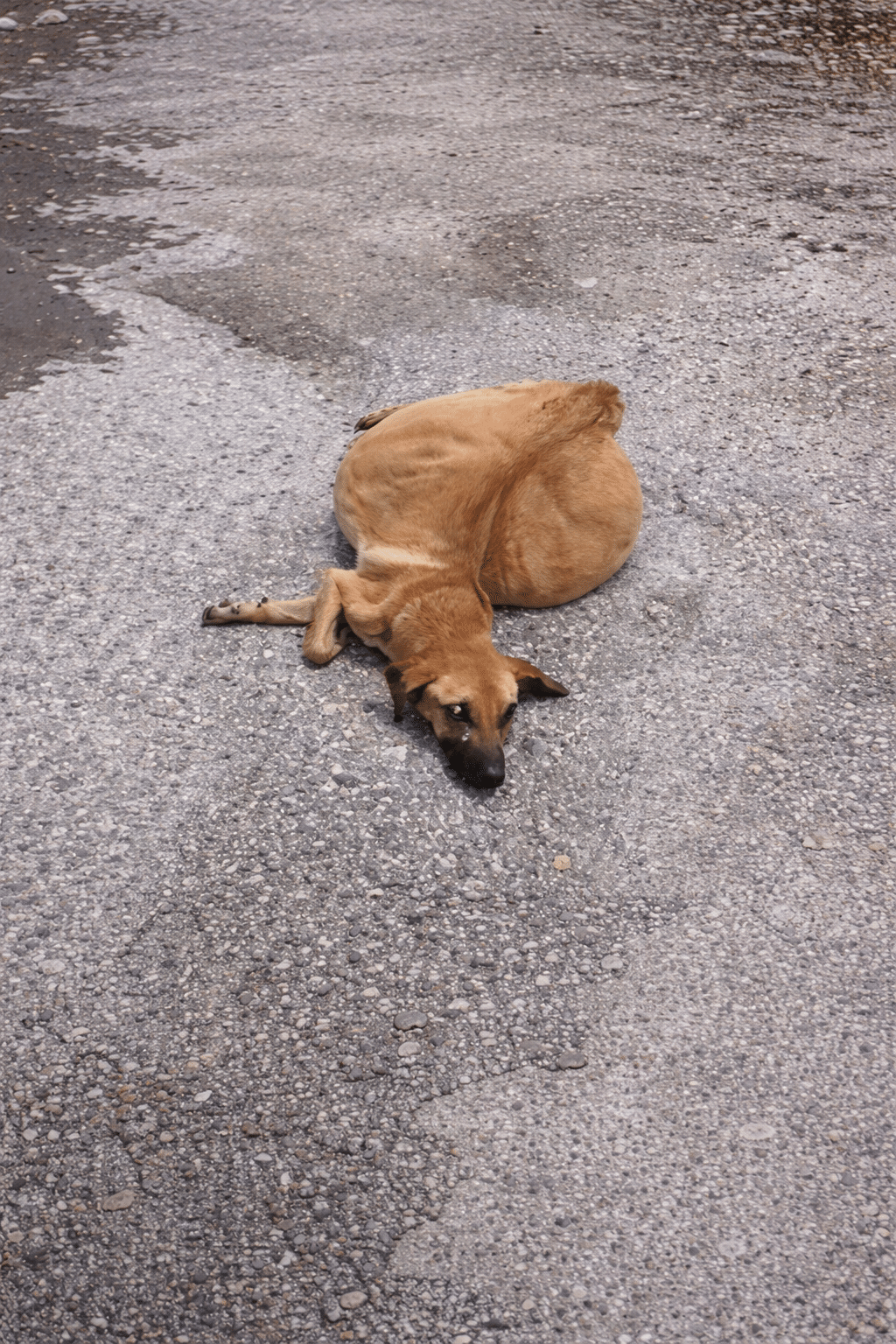
Then the shape moved.
Slowly, painfully, it began pulling itself away from the trash and toward the road.
It was a dog.
Her abdomen was so massively swollen that she could barely lift the rest of her body around it.
Every movement appeared exhausting.
Yet somehow, she had managed to crawl away from where she had been left.
Rescuers would later name her Azalea.
And once they saw her condition up close, they realized the enormous belly was not simply unusual.
It was a medical emergency.
Her Belly Was So Swollen That Walking Had Become Almost Impossible
When rescuers reached Azalea, they approached carefully.
Her body was in poor condition.
The abdomen dominated her entire frame, stretched outward by an enormous buildup of fluid.
Her legs appeared weak beneath her.
She could move only with great difficulty.
There were also wounds on her legs that showed signs of infection and required treatment.
Azalea needed a veterinary clinic immediately.
There was no time to determine every detail of what had happened before the security guard saw her.
The rescue team already had enough information to act.
She was severely compromised.
She could barely move.
And the pressure inside her abdomen appeared to be affecting her ability to breathe comfortably.
Azalea was lifted and transported for emergency care.
The first question veterinarians needed to answer was obvious:
What was filling her abdomen?
The second question was even more important.
Why?
VIDEO: Azalea Was Found Beside a Trash Pile With a Dangerously Swollen Belly—Then Doctors Began Draining the Fluid
The Swelling Was Ascites—and It Was Putting Pressure on Her Entire Body
Veterinary examination confirmed that Azalea’s abdomen was filled with fluid.
The condition is known as ascites.
Ascites is not a diagnosis by itself.
It describes abnormal fluid accumulation inside the abdomen and can occur for several medical reasons.
In Azalea’s case, the amount was extreme.
The pressure helped explain why moving had become so difficult.
Her body was also severely malnourished.
Once the swelling was considered alongside her thin frame, it became clear that the large abdomen was hiding how little healthy body mass she actually had.
Blood tests and ultrasound imaging were performed.
The team needed to evaluate the liver and other internal organs.
The results identified a serious problem.
According to the rescue account, Azalea was suffering from liver failure.
That diagnosis made her prognosis uncertain.
But the ultrasound also brought one encouraging finding.
No liver tumor was identified.
No cancer was found.
That did not mean Azalea was out of danger.
It meant the medical team could focus on supporting the liver and managing the enormous fluid buildup without also confronting a confirmed cancer diagnosis.
Nearly 20 Liters of Fluid Had to Be Removed Over Time
Treatment began carefully.
Azalea received IV support to stabilize her weakened body.
Veterinarians also used Furosemide, a diuretic medication that can help the body eliminate excess fluid.
But medication alone was not enough.
The amount of abdominal fluid was simply too great.
Doctors needed to drain it manually.
Not all at once.
Azalea was too fragile for abrupt changes.
Instead, fluid was removed repeatedly as the veterinary team monitored her response.
The amount eventually totaled close to 20 liters.
With each drainage session, the enormous tension in her abdomen decreased.
Her breathing became easier.
Movement required less effort.
And something else gradually became visible.
The real size of Azalea’s body.
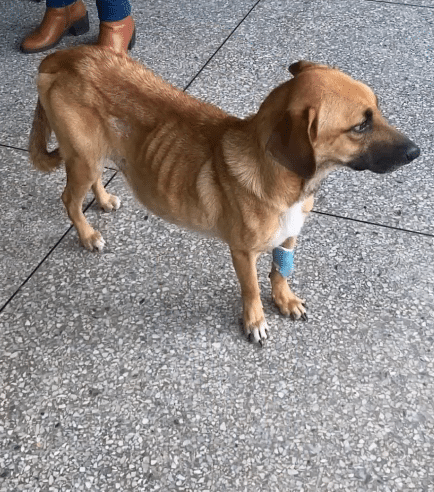
Without the fluid stretching her abdomen, rescuers could see just how severely underweight she was.
Her ribs and bones stood out beneath her skin.
The huge belly had not represented nourishment.
It had been hiding starvation.
Now that the fluid was disappearing, Azalea faced a second major challenge.
She needed to rebuild the body underneath it.
Once the Swelling Went Down, Her Severe Malnutrition Became Impossible to Miss
Azalea required more than liver medication.
She needed nutrition.
Carefully managed meals became part of her treatment plan.
Her body had gone through prolonged illness and significant fluid imbalance, so feeding had to support recovery without overwhelming a system already under stress.
At first, caregivers watched everything closely.
Would she eat?
Would she keep the food down?
Would her abdomen begin filling with fluid again?
Would the medications help stabilize her condition?
Azalea began showing interest in food.
Then she began eating more consistently.
That changed the pace of her recovery.
Every meal supplied energy her body had been lacking.
Protein and calories could finally be used to rebuild muscle.
Her wounds received treatment.
Her hydration improved.
The veterinary team continued monitoring her liver condition.
None of these improvements happened immediately.
But the direction was changing.
Azalea was no longer becoming weaker by the day.
She was beginning to regain what illness had taken from her.
On Day 10, Azalea Barked for the First Time
Ten days into intensive care, caregivers heard something they had not heard from Azalea before.
A bark.
It was a small moment compared with draining liters of fluid or managing liver failure.
But everyone noticed.
The dog who had arrived barely able to move now had enough energy to vocalize.
Soon, she began showing short bursts of activity around the clinic.
She moved more.
She paid greater attention to her surroundings.
Her appetite continued improving.
The difference could be seen in practical ways.
Breathing was easier.
Standing was easier.
Walking required less effort.
Her body still had a great deal of weight to regain, and liver disease could not be treated casually.
But the dog in front of them was behaving very differently from the one carried away from the trash pile.
The rescue team continued with medication, nutritional supplements, and a controlled diet.
Azalea was doing her part in the simplest possible way.
She kept eating.
She kept moving.
And each day gave her body another opportunity to recover.
Recovery Meant Managing the Liver, Not Just Making Her Look Better
As Azalea’s abdomen returned toward a more normal size, the visual transformation became striking.
But the veterinary team could not judge success only by appearance.
Her liver condition still required attention.
Medication continued.
Diet remained important.
Her energy level and hydration were monitored.
The goal was not simply to produce a healthier-looking dog for photographs.
It was to create a stable life that could continue after she left the clinic.
Gradually, Azalea became strong enough that hospitalization was no longer the center of her days.
She could walk more comfortably.
She could interact with caregivers.
She began behaving less like a critical patient and more like a dog interested in what was happening around her.
That opened the door to the next question.
Where would she go when she was ready to leave?
For Azalea, the answer was already closer than anyone needed to search.
The Person Who Helped Save Her Decided She Was Already Home
One of the rescuers involved in Azalea’s recovery made a permanent decision.
Azalea would not need to wait for an unknown adopter.
She was adopted by the person who had helped care for her through the crisis.
The home was not empty, either.
Ten other dogs already lived there.
For Azalea, this meant moving from the isolation of her discovery into a household filled with other animals and familiar human care.
The transition gave her a completely different daily routine.
Meals arrived consistently.
Medication and health needs could be monitored.
There were safe places to sleep.
There were other dogs moving around the home.
And there was no need to crawl toward a road hoping someone might notice.
The rescue had moved beyond simply keeping Azalea alive.
She now had somewhere to belong.
The Dog Beside the Trash Pile Became One of Eleven
Later scenes from Azalea’s life look almost disconnected from the beginning.
She moves alongside other dogs.
She plays.
Her body no longer carries the enormous fluid-filled abdomen.
Her frame looks stronger.
Her tail moves when she interacts with the people and animals around her.
The trash pile is gone from the picture.
So is the veterinary table.
Azalea is simply part of a household.
One dog among eleven.
That ordinary description carries enormous weight when compared with where her story began.
Once, her body was so swollen that moving toward the road required tremendous effort.
Now she can run with companions.
Once, almost 20 liters of fluid stood between people and the true condition of her body.
Now proper food has helped restore healthy strength beneath her coat.
Once, her medical future was uncertain.
Now she has a caregiver who knows exactly what she has been through and can continue watching her health.
Azalea’s Story Changed Because Someone Paid Attention to What Moved in the Trash
The most dramatic part of Azalea’s rescue began before a veterinarian ever saw her.
A security guard noticed a truck stop.
They saw something placed near the trash.
Then they realized the object was alive.
That observation mattered.
Azalea’s story could easily have remained hidden behind the appearance of another piece of discarded rubbish.
Instead, someone recognized a dog in distress.
Rescuers came.
Veterinarians identified severe ascites.
Blood tests and ultrasound revealed liver failure.
Medication began.
Fluid was drained repeatedly.
Nearly 20 liters eventually came out of her abdomen.
The severely underweight dog underneath began eating again.
On day 10, she barked.
Later, she walked more easily.
Eventually, she left the clinic.
Then the person helping her recovery made sure she would not need another temporary place.
Azalea went home.
Her story does not require us to claim that she understood every person who helped her or that she made a conscious decision to “fight.”
The physical changes say enough.
A dog who could barely crawl became a dog who could run with others.
A dangerously swollen abdomen returned toward normal.
A body hidden beneath fluid regained healthy strength.
And an animal once found beside discarded trash became a member of a family.
Azalea’s second chance did not begin with a miracle.
It began when someone looked at something moving beside a pile of garbage—
and realized it was a life worth stopping for.


