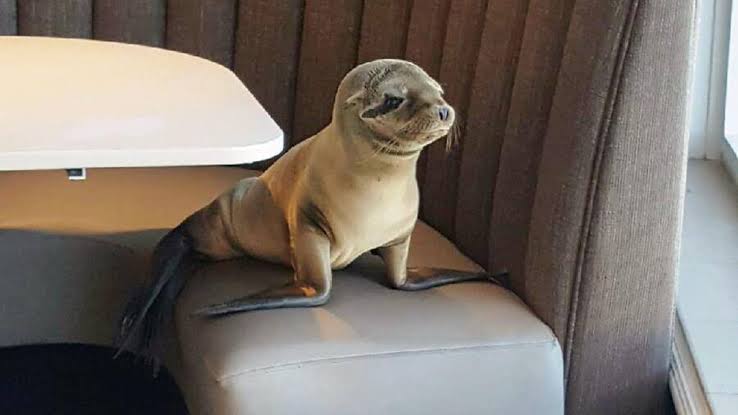
The morning shift at a San Diego waterfront restaurant started like any other. Staff unlocked the doors, began their prep routines, and switched on the lights — only to find that someone had already made themselves at home. Tucked inside one of the dining booths was an uninvited guest that had no intention of leaving quietly.
It was not a stray dog or a wandering toddler. Settled into the cushioned seat was a young California sea lion pup, alone and visibly exhausted, having apparently made its way from the ocean and through the restaurant entrance before anyone arrived for the day.
The unexpected customer was a young, underweight sea lion that had entered the restaurant before opening hours and chosen a booth as its resting spot. Restaurant staff immediately contacted SeaWorld San Diego’s rescue team, who responded, assessed the animal, and transported it for professional rehabilitation.
What Employees Found Before Opening
The incident took place at The Marine Room, a well-known La Jolla restaurant situated directly on the beach at La Jolla Shores. Few dining rooms in Southern California sit closer to the Pacific, which made the pup’s unlikely journey a short one by sea lion standards.
When employees arrived that morning, the animal was already settled in — curled up in one of the restaurant’s booths as though it had reserved the spot. The pup was not aggressive. It appeared lethargic and showed no signs of bolting. Staff recognized immediately that this was not a situation to handle alone and placed a call for professional wildlife assistance.
Photos taken at the scene spread quickly across social media and news outlets, showing the small sea lion resting against the booth’s upholstered back. The images were striking enough that they caught national attention within hours.
How the Sea Lion Reached the Dining Room
The Marine Room’s position on La Jolla Shores beach leaves almost no barrier between the restaurant and the waterline. During high surf or unusually high tide events, the ocean can push directly against the building’s large ocean-facing windows — a feature that makes the dining experience dramatic and, apparently, the entrance accessible to at least one adventurous marine mammal.
The pup most likely came ashore near the restaurant, moved across the beach, and found an open or unlocked door before the morning staff arrived. Sea lion pups that are malnourished and disoriented frequently wander onto shore and into unfamiliar environments. The behavior is a recognized distress signal — healthy, well-fed pups typically stay with their mothers or haul out on established rookery sites, not restaurant booths.
Rescuers noted that this kind of inland wandering is one of the clearest indicators that a pup is in trouble. When a young sea lion is too weak to forage or nurse adequately, it burns through its fat reserves and eventually loses the instinct to avoid human activity zones.
The Condition Rescuers Saw
SeaWorld San Diego’s rescue team, which operates one of the most active marine mammal rescue programs on the West Coast, responded to the restaurant’s call. When they arrived, the pup’s condition confirmed what the wandering behavior had already suggested: the animal was significantly underweight and in need of immediate veterinary attention.
Marine mammal rescuers assess pups using a combination of visible body condition scoring and behavioral observation. A healthy California sea lion pup carries enough blubber to appear rounded through the neck and torso. This pup did not. Prominent vertebrae and a sunken appearance around the midsection are standard indicators of starvation-level malnourishment, and rescuers documented the animal’s condition accordingly before transport.
The pup did not attempt to escape or bite during the initial assessment — another sign that it had little energy to spare. Rescuers were able to approach and secure the animal for transport without putting either the team or the pup at unnecessary risk.
YOUTUBE EMBED — PRIMARY SEARCH QUERY: “San Diego sea lion pup restaurant booth rescue footage”
How the Pup Was Safely Transported
SeaWorld’s rescue team transported the sea lion pup from The Marine Room to SeaWorld San Diego’s rescue facility, where its care was handed off to the park’s animal care and veterinary staff. The process of moving a distressed marine mammal involves keeping the animal calm and minimizing additional physical stress — rapid heart rate and unnecessary movement can worsen the condition of an already depleted animal.
Once at the facility, the pup entered a medically supervised intake process. This typically includes a full physical examination, bloodwork to assess organ function and hydration, and a controlled refeeding program. Marine mammal rescuers are careful not to overfeed a starving animal immediately — refeeding syndrome is a recognized risk, and caloric reintroduction is managed gradually.
SeaWorld San Diego’s rescue center has handled hundreds of California sea lion cases, particularly during periods when warmer-than-normal ocean temperatures reduce fish availability and push nursing mothers to forage farther from their pups. Those environmental conditions have contributed to repeated stranding surges along the Southern California coast in recent years.
What Happened After the Restaurant Visit
After entering SeaWorld’s care, the pup joined other stranded marine mammals in rehabilitation. The program’s goal for underweight sea lion pups is to bring the animal to a healthy body weight, confirm it can forage independently, and ultimately release it back to the wild at an appropriate coastal location.
California sea lion pups that arrive underweight but otherwise healthy — no severe infection, no significant injury — typically have strong rehabilitation outcomes when caught before their condition becomes critical. The Marine Room pup’s willingness to rest rather than flee, and the staff’s prompt call for help, meant the animal reached professional care before its situation became life-threatening.
SeaWorld San Diego does not always publish individual release updates for every animal that passes through its rescue program, particularly for cases that do not involve unusual circumstances or public naming campaigns. Based on available reporting at the time of this incident, the pup was receiving care and no complications had been publicly noted.
YOUTUBE EMBED — SECONDARY SEARCH QUERY: “SeaWorld San Diego rescued sea lion pup restaurant recovery”
The Marine Room returned to normal service after the pup was removed. The restaurant’s beachfront location means its staff are no strangers to the wildlife that moves along La Jolla Shores — but a sea lion occupying a dining booth before the breakfast shift is, by any measure, a first. The documented rescue confirmed that the animal’s best chance was exactly what it got: a staff that called the right people, and a rescue team that showed up ready to help.

