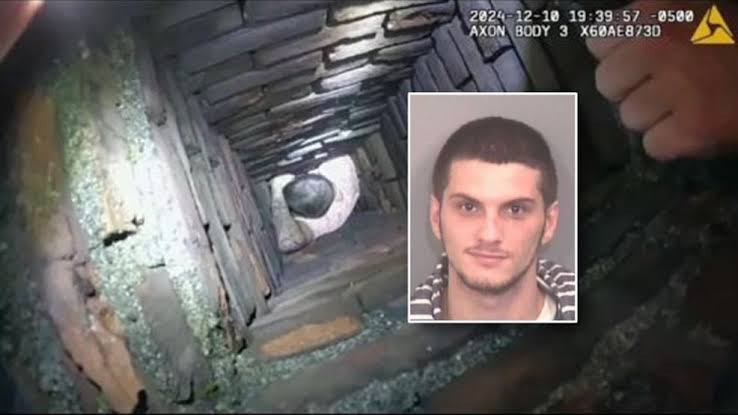
Fall River detectives were executing a search warrant when two suspects bolted from the building and scrambled onto the roof. Officers tracked the movement from below, watching both men pick their way across the rooftop. Then, without warning, one of them simply vanished.
There was no jump, no slide down a drainpipe, no leap to an adjacent building. One moment the man was visible. The next he was gone — swallowed by the rooftop itself.
It took only seconds for detectives to understand what had happened. The man had spotted a chimney opening and dropped himself inside, betting that the narrow brick shaft would serve as a hiding place. It did not. He became tightly wedged and could not move in either direction — not down and not back up.
The escape route had turned into a trap, and the only people who could free him were the detectives and firefighters he had been trying to avoid.
The Rooftop Escape
Fall River Police were serving a search warrant at a residential address when the two suspects decided to run. According to the department, both men made it onto the roof of the building and began moving across it. Officers on the ground maintained sight of the rooftop while others worked to secure the perimeter.
One suspect managed to flee and was not immediately apprehended at the scene. The second kept moving across the roof until he reached the chimney. Whether he believed it led somewhere passable or simply looked like a place to hide from officers watching from street level, he lowered himself into the opening.
The chimney was not built to accommodate a person. The brick shaft was narrow, and the suspect’s body became wedged partway down — held in place by the walls on all sides, unable to push himself free.
Why the Chimney Looked Like a Hiding Place
Chimneys are a recurring poor choice in evasion attempts precisely because they look more promising from above than they are. From the roof, an open flue can appear to offer concealment or even a path down into the building. In reality, residential chimney flues are designed for airflow, not passage. Widths vary, but many are too narrow for an adult body to move freely once weight is applied and friction sets in against the brick.
Once a person drops far enough that their arms are pinned or their torso is compressed by the walls, self-rescue becomes nearly impossible. Moving downward requires room that the shaft does not provide. Pushing back upward requires leverage that a person in that position cannot generate.
In this case, the suspect found himself immobilized inside the chimney shortly after entry. He was stuck, in the dark, inside a brick column — and the only people who knew where he was were the officers working the search warrant outside.
The Screams Detectives Heard Below
Detectives did not have to search long. According to Fall River Police, officers could hear the suspect’s cries for help coming from inside the chimney. The sounds confirmed both his location and the fact that he was alive and conscious but unable to free himself.
Body-camera footage from the scene captured detectives at the chimney, listening and speaking to the man inside. The exchange documented on camera removed any ambiguity about what had happened: the suspect was wedged in the shaft and needed to be pulled out. The same investigators he had run from were now the ones coordinating his rescue.
Fall River Police notified the fire department, and a rescue response was dispatched to the address.
YOUTUBE EMBED — PRIMARY SEARCH QUERY: “Fall River suspect stuck chimney bodycam”
How Firefighters Freed the Suspect
Getting the man out required more than a rope and a strong pull. Firefighters responding to the scene determined that the chimney bricks would need to be removed to create enough space to extract him safely. According to reporting on the incident, crews worked to dismantle a portion of the chimney structure to widen the shaft and allow rescuers to reach the suspect and bring him out.
The process was methodical. Removing bricks from a chimney under these conditions requires care — too much structural disruption can cause a collapse that makes the situation worse. Firefighters worked around the man’s position until they had enough access to pull him free.
The rescue took a significant amount of time. The suspect remained inside the chimney throughout the operation, waiting for the people he had fled to complete the work of getting him out.
YOUTUBE EMBED — SECONDARY SEARCH QUERY: “Fall River chimney rescue firefighters”
The Charges Waiting After the Rescue
Once the suspect was out of the chimney, he was evaluated. As a precaution following the physically demanding extraction — being compressed inside a narrow brick shaft carries real risks of injury, including chest compression and circulation problems — he was taken to a hospital to be checked over by medical staff.
After he was medically cleared, he was returned to police custody. The search warrant that had prompted the initial flight was still fully in effect. Whatever evidence or contraband officers had been seeking when they arrived at the address remained part of the investigation.
Fall River Police confirmed the suspect faced charges connected to the underlying warrant. The second individual who had fled across the roof and escaped the scene at the time of the incident remained the subject of continued investigation by the department.
An Escape Plan That Required a Rescue
The Fall River chimney incident is a clean example of how an evasion instinct, executed without an actual exit, can reverse every advantage a fleeing suspect might have. A rooftop gives height and distance from ground-level officers. A chimney opening on that rooftop suggests concealment. But concealment inside a brick shaft, with no way to descend and no way to climb back out, eliminates every option except calling for help.
The suspect went from fleeing a search warrant to being physically dependent on the officers serving it — all within minutes of stepping off the rooftop edge. Detectives located him by sound. Firefighters freed him brick by brick. He was taken to a hospital, cleared by medical staff, and returned directly to the custody he had tried to outrun.
The search warrant process continued exactly as it had been intended to. The only thing the chimney changed was how long the arrest took and how many first responders were needed to complete it.

