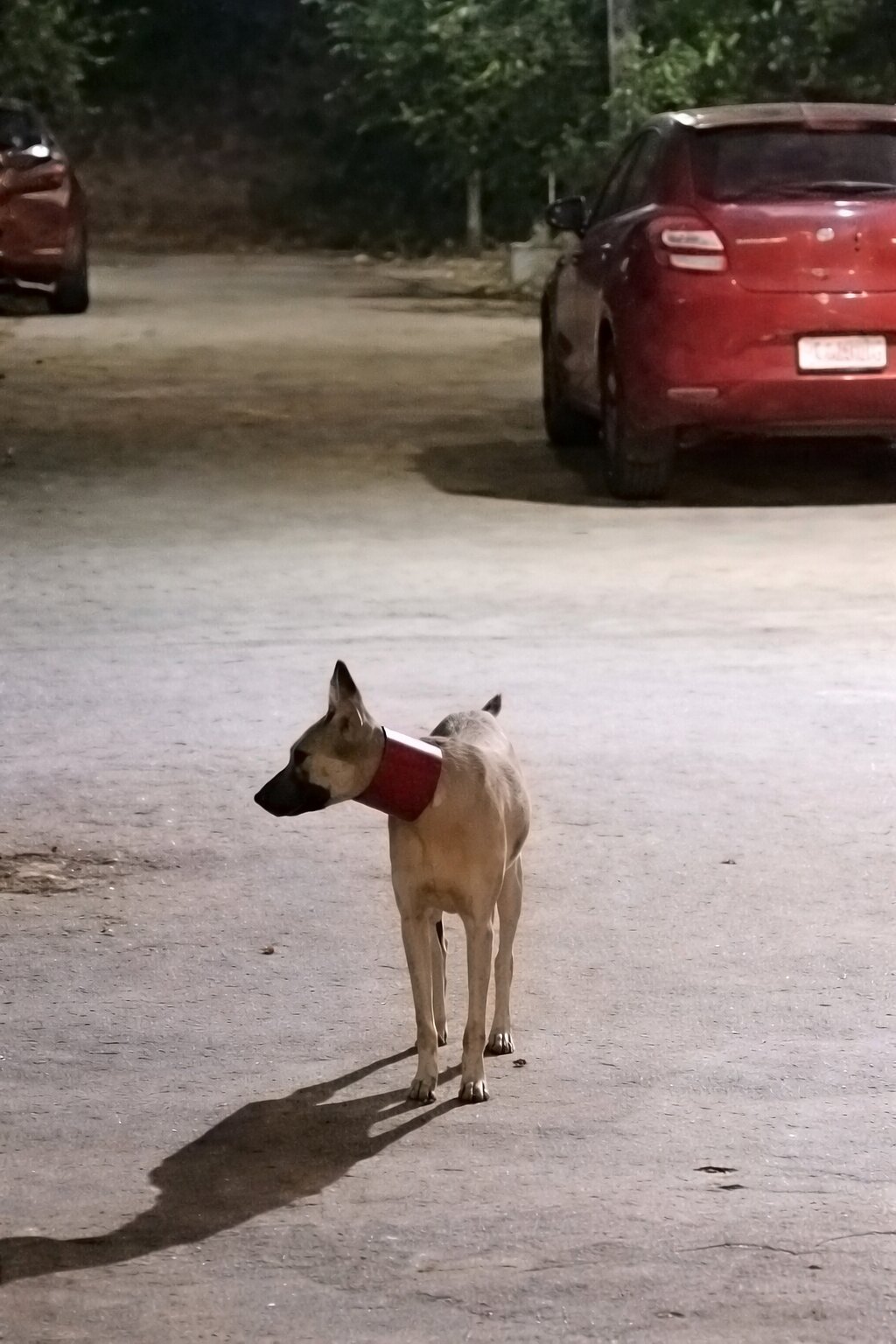
At first, the dog looked like another stray moving quietly through the night.
The streets were mostly empty.
Streetlights cast weak patches of light across the road.
Then rescuers noticed something around his neck.
A thick piece of black plastic pipe had become stuck around him.
It was rigid.
Too narrow to slip back over his head.
And every step forced the dog to carry something his body was never meant to wear.
He could still walk.
That made the emergency easy to underestimate.
But the longer the pipe remained in place, the greater the chance that rubbing, pressure, or another accident could injure him.
The dog could not understand how to remove it.
He could only keep moving.
So when rescuers saw him disappearing through the darkness, they knew they needed to stop him before he disappeared somewhere they could no longer reach.
Getting Close Was Harder Than Removing the Pipe
The dog was alert from the moment the rescuers began approaching.
That was understandable.
He was a stray.
He did not know the people following him.
And although the pipe around his neck needed to come off, he had no way of knowing that their intentions were good.
A sudden chase could send him running.
There was traffic nearby.
There were dark side streets where he might disappear.
And every frantic movement could make the rigid plastic rub harder against his neck.
So the team avoided rushing him.
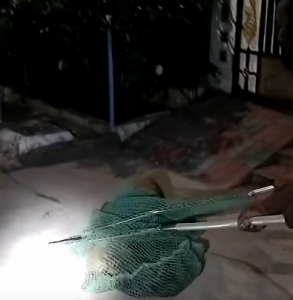
Instead, they brought out a large rescue net.
Several people positioned themselves carefully around the dog, leaving as little opportunity as possible for him to panic and sprint away.
Their movements were controlled.
No shouting.
No chaotic pursuit.
They slowly guided him toward a safer area.
Then, when the opportunity appeared, the net came down around him.
For the first time, the dog could no longer disappear into the night.
Now the rescuers could finally see exactly what they were dealing with.
Video: Rescuers Secure the Stray Before Cutting the Thick Plastic Ring From His Neck
Up Close, the Plastic Was Much Tougher Than It Looked
The object around the dog’s neck was not a thin disposable ring that could simply be snapped apart by hand.
It was thick plastic.
Rigid enough to keep its shape.
Strong enough that the dog had apparently been unable to break it despite carrying it around.
That made removal more complicated.
The rescuers needed cutting tools.
But cutting something wrapped directly around an animal’s neck required precision.
There was very little room for error.
The blade needed to go through the plastic without touching the skin underneath.
So the team first examined the position of the pipe carefully.
They looked for an area where they could create a small gap.
Then one rescuer began positioning the tool.
The dog remained tense inside the net.
His body was stiff.
But he did not thrash wildly.
That made the job safer for everyone.
One Cut Wasn’t Enough
The first cut weakened the plastic.
It did not release it.
The pipe was simply too thick.
The rescuers repositioned the tool.
Another careful cut.
Then another adjustment.
The process looked slow because it needed to be slow.
A rushed movement could cause the cutting tool to slip.
So each time the blades moved closer to the dog’s neck, the rescuer checked the position again.
Plastic between the blades.
Skin safely below.
Then pressure.
Another section gave way.
The ring began to loosen.
But it still would not open enough to slide over the dog’s head.
They continued.
Cut.
Pause.
Reposition.
Cut again.
Throughout the process, the dog remained restrained by the net so he could not suddenly turn or bolt at the exact moment the tool was being used.
The restraint might have been uncomfortable.
But for those few minutes, staying still was what allowed the team to work safely.
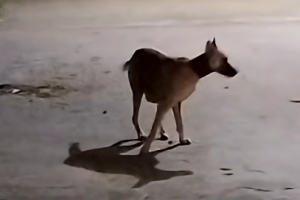
Then the Black Ring Finally Opened
After another controlled cut, the plastic changed shape.
The rigid circle separated enough for the rescuers to pull the two sides apart.
Suddenly, the object that had been locked around the dog’s neck was no longer closed.
They lifted it away.
The entire ring came off.
For the first time since anyone had seen him, there was nothing around his neck except his own fur.
The dog immediately raised his head.
His posture changed.
The bulky piece of plastic that had moved with him everywhere was gone.
No more rigid edge pressing against his neck.
No more object shifting every time he turned.
The rescuers checked him briefly while he remained secured.
Then they prepared to release him.
His First Steps Told Them What They Needed to Know
Once the net was lifted away, the dog did not immediately sprint.
He stepped forward cautiously.
A few paces.
Then a few more.
His head moved freely.
His body no longer had to compensate for the plastic ring around his neck.
As he realized nothing was holding him, his movement became more confident.
Soon, he was trotting away.
There was no dramatic reunion.
No clinic stay shown afterward.
No long rehabilitation sequence.
This rescue had a simpler goal.
Remove the dangerous object.
Make sure the dog could move normally.
Then give him his freedom back.
That was exactly what happened.
Not Every Rescue Needs an Operating Room
Some animal rescues involve complicated surgery.
Others require weeks of treatment.
This one did not.
But that does not make the intervention unimportant.
The pipe around the dog’s neck had become a continuing hazard.
As long as it stayed there, ordinary movements could create more rubbing and pressure.
The dog could become caught on another object.
He could injure himself while trying to escape.
And because he was living on the street, there was no owner nearby checking whether the situation was getting worse.
The problem was unlikely to solve itself.
Someone had to intervene.
For this dog, the necessary tools were relatively simple.
A rescue net.
A cutting tool.
Several people willing to coordinate calmly.
And enough patience to avoid turning a manageable rescue into a dangerous chase.
The Hardest Part Was Knowing When Not to Rush
Watching the final moments, it might seem as though the entire rescue came down to cutting through a piece of plastic.
But getting to that point required judgment.
The rescuers first had to prevent the dog from running into greater danger.
They needed to contain him without creating unnecessary panic.
Then they had to work with a sharp tool only inches from his skin.
Speed was not the goal.
Control was.
That is why the rescue team approached gradually.
Why they used the net.
Why every cut was made slowly.
And why the dog was released as soon as the problem had been safely removed.
There was no reason to keep him restrained longer than necessary.
The emergency was over.
A Piece of Plastic Had Changed the Way He Moved Through the World
Before the rescue, every turn of the dog’s head moved the pipe too.
Every narrow opening had the potential to catch it.
Every attempt to scratch or adjust his neck was limited by something rigid surrounding him.
He had apparently learned to move with it because he had no other choice.
Afterward, those restrictions disappeared instantly.
That contrast is what makes the final scene so satisfying.
Nothing about the dog had changed dramatically.
He was still the same stray.
The same street was around him.
The same night continued.
But one dangerous object was gone.
And suddenly he could move through that world without carrying it anymore.
Sometimes Helping Means Solving One Problem at the Right Time
The rescuers did not change every part of this dog’s life that night.
They did not know his entire history.
They did not need to.
They saw one clear problem they could fix.
A thick plastic pipe was trapped around his neck.
So they stopped.
They worked together.
They removed it.
That kind of rescue may not come with a dramatic medical recovery or a permanent home at the end.
It still matters.
Because for the dog walking away into the darkness, the difference was immediate.
Minutes earlier, every step carried the same rigid burden.
After the final cut, there was nothing left around his neck.
He lifted his head.
Walked forward.
Then disappeared down the road under his own control.
Sometimes compassion does not change an entire life in one night.
Sometimes it simply removes the thing making that life harder.
For this stray dog, that was enough.
One net.
A few careful cuts.
And the freedom to walk away without the plastic ring that had followed him everywhere.


