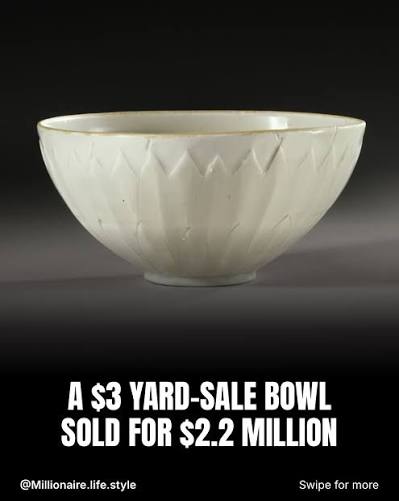
The bowl sat on a mantelpiece for years — small, matte, and quietly unremarkable. Its new owner had picked it up at a yard sale somewhere in the American Northeast, paid three dollars for it, and brought it home without any particular expectation. It fit comfortably in one hand. It looked like something a person might use to hold keys.
For a long time, that’s essentially what it was: a decoration. A trinket. Something that blended into the background of a home without demanding a second glance.
Then it went to Sotheby’s.
Experts identified the bowl as a Northern Song dynasty ceramic, produced in China nearly a thousand years ago — and at auction, it sold for approximately $2.2 million.
The Yard-Sale Purchase That Looked Ordinary
The bowl’s American story began the way most yard-sale finds do: casually, without ceremony. The buyer was not a trained collector. There was no moment of immediate recognition, no gut feeling that something extraordinary had just changed hands. The price — three dollars — reflected exactly what the bowl appeared to be at a glance: a modest piece of old pottery with a simple, unassuming glaze.
After the purchase, the bowl lived on a mantelpiece for an extended period before the owner sought a professional opinion. This kind of delay is not unusual. Many significant antique discoveries spend years — sometimes decades — in plain sight before anyone thinks to have them evaluated. The bowl’s relatively small size and its restrained, almost austere appearance did nothing to suggest its age or origin.
What eventually prompted the owner to pursue an expert assessment is not fully documented in public reporting. But once the bowl reached specialists, the story changed entirely.
The Clues Hidden in the Bowl’s Shape
To an untrained eye, the bowl’s most defining feature might seem like a flaw: its glaze is not glossy or brightly colored. It is a muted, grayish-blue tone — a color scholars associate with a category of Chinese ceramics known for restraint over ornamentation. The form is similarly spare. The walls taper with quiet precision. The rim is even, the foot ring carefully trimmed.
These details are not accidental. Song dynasty ceramics — particularly those produced during the Northern Song period, which ran from 960 to 1127 CE — are widely regarded among ceramic historians as among the most technically refined ever made. Where later Chinese dynasties favored elaborately painted surfaces, Song potters often pursued a different ideal: subtlety, balance, and a glaze that responded to light in complex and understated ways.
The bowl’s proportions and glaze characteristics placed it within this tradition. But placing it within the tradition was only the first step. Dating it with confidence, and establishing its rarity, required considerably more work.
How Experts Dated It to the Northern Song Dynasty
Authentication of a ceramic this old involves cross-referencing several categories of evidence. Specialists examine the composition of the clay body, the structure of the foot ring, the way the glaze pools and breaks near the base, and the overall forming technique. Each of these elements leaves traces that are difficult to replicate convincingly and that vary by period and kiln.
For this bowl, Sotheby’s specialists determined that its physical characteristics were consistent with Northern Song production — placing its likely origin somewhere in the late tenth to early twelfth century. That window spans roughly one hundred to one hundred and fifty years of Chinese history, a period that ended when the Jin dynasty forced the Song court to abandon its northern territories in 1127.
Crucially, experts also identified the bowl’s relationship to known comparable examples. Bowls of this type, glaze quality, and period are exceptionally rare in private hands. Museum collections hold some of the closest parallels, which is a significant indicator of value: when most surviving examples of a given ceramic type reside in institutions rather than on the open market, a privately held piece of comparable quality commands serious attention from collectors worldwide.
The estimate Sotheby’s placed on the bowl before the sale reflected this scarcity. But the final result exceeded it.
YOUTUBE EMBED — PRIMARY SEARCH QUERY: “$3 Northern Song bowl Sothebys auction”
The Auction That Surpassed Every Expectation
When the bowl appeared at Sotheby’s, it attracted competitive bidding that pushed the final price to approximately $2.2 million. The result drew significant media attention — not only because of the sum itself, but because of the distance between what the bowl had cost and what it ultimately proved to be worth.
A three-dollar yard-sale purchase becoming a seven-figure auction result is the kind of outcome that seems implausible until you understand the specific factors driving it. In this case, those factors were age, condition, dynasty, and above all, scarcity. Northern Song ceramics of confirmed quality and provenance do not appear at auction often. When they do, serious collectors and institutional buyers take notice.
The sale also illustrated something that auction specialists frequently emphasize: the market for authenticated Chinese ceramics of this period is genuinely global. Bidders competing for a piece like this bowl are not a local or regional audience. They represent collections and institutions from Asia, Europe, and the Americas — all of them aware that opportunities to acquire a millennium-old piece in this condition are rare and unlikely to repeat.
Why Rarity Matters More Than Size
One of the details that makes this story stick is the bowl’s physical modesty. It is not large. It is not decorated with figures or narrative scenes. It does not announce its importance in any obvious way. By the visual standards most people apply to expensive objects, it does not look like it should be worth millions of dollars.
But rarity operates independently of size and surface decoration. What makes a Northern Song ceramic valuable is not how much space it fills on a shelf. It is how few comparable pieces exist, how well this particular example has survived the intervening centuries, and how completely it represents the aesthetic and technical ideals of the period in which it was made.
Song dynasty potters were working within a philosophical framework that prized harmony and simplicity. A glaze that responded subtly to light, a form that felt balanced in the hand, a surface that rewarded close attention rather than immediate spectacle — these were considered achievements, not limitations. The bowl’s muted appearance is not the absence of quality. In the context of Song ceramics, it is the point.
Museum scholarship on the Northern Song period consistently identifies this ceramic tradition as one of the high points of Chinese art history. The bowl’s authentication placed it within that tradition. Its condition — remarkable for an object nearly a millennium old — made it a serious acquisition target.
YOUTUBE EMBED — SECONDARY SEARCH QUERY: “Northern Song dynasty bowl museum explanation”
From a Mantelpiece to a Major Sale
The bowl that sold for three dollars at a yard sale and sat on a mantelpiece for years eventually realized approximately $2.2 million at Sotheby’s — a result that placed it among the more striking hidden-fortune stories in recent auction history.
Its journey followed a pattern that antique specialists recognize but rarely see play out so dramatically: an object misidentified by its appearance, quietly preserved by an owner who had no idea what they held, and ultimately returned to the informed market where its age, rarity, and quality could be properly valued.
The bowl’s modest exterior never changed. What changed was the knowledge brought to bear on it. A thousand years of history were always present in the clay and the glaze — they simply needed the right eyes to read them.

