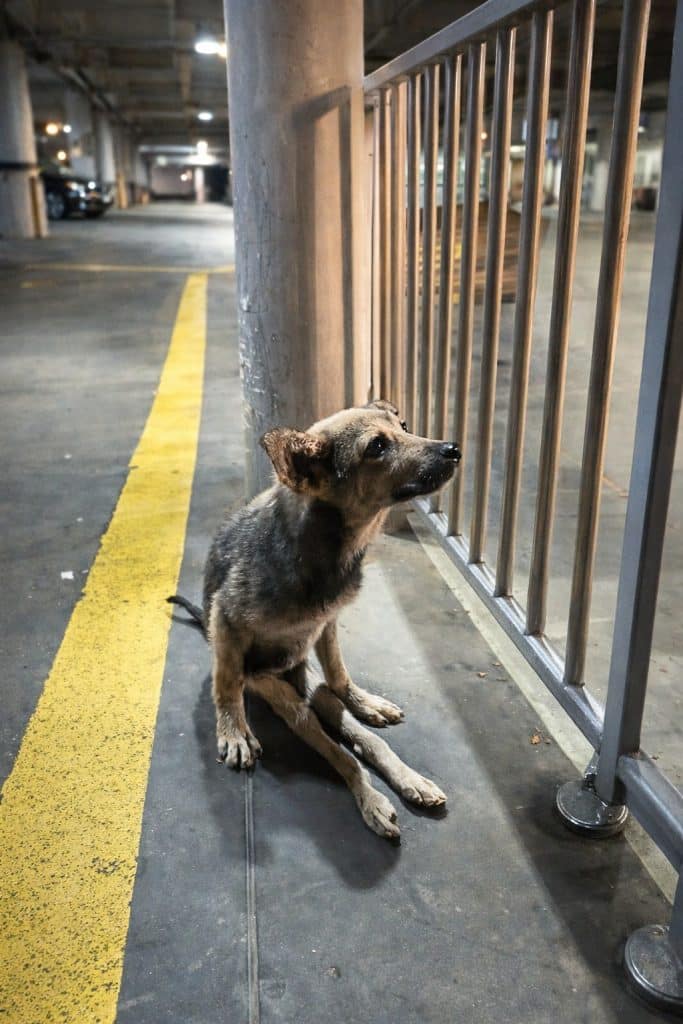
Dark clouds were gathering when the young man noticed something beside the road.
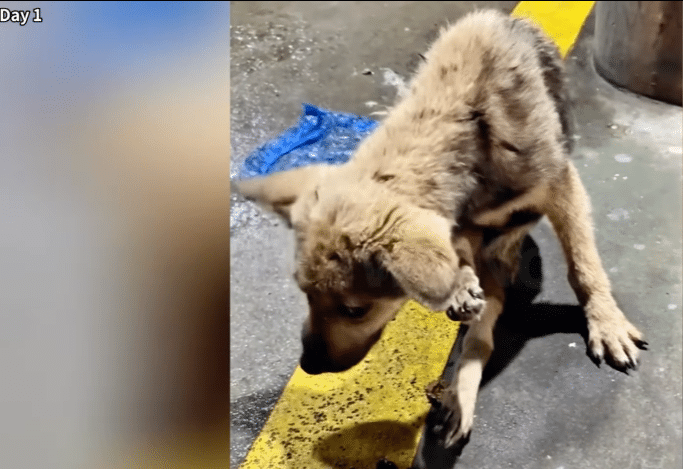
People hurried past, hoping to reach shelter before the rain became heavier. Near the edge of the wet pavement, however, a tiny dog remained almost completely still.
His fur was soaked.
His body was painfully thin.
And when he tried to move, his hind legs dragged behind him.
Then the dog saw the young man watching.
Instead of retreating, he placed both front paws against the ground and slowly pulled himself closer.
One difficult movement at a time.
He Pulled Himself Forward With Only His Front Legs
The little dog appeared too weak to travel far.
His narrow frame suggested that regular meals had been difficult to find. His coat was wet and dirty, while his back legs offered almost no visible support when he attempted to move.
Every few inches required effort.
He pushed down with his front paws.
Dragged the rest of his body forward.
Paused to recover.
Then tried again.
The young man remained nearby, watching the dog gradually close the distance between them.
It is impossible to know what experiences had brought the animal to that roadside or how long he had been unable to walk normally. The footage only revealed the situation in front of him.
A disabled stray was alone in worsening weather.
He was hungry.
He had nowhere obvious to shelter.
And despite his physical weakness, he was still trying to approach the first person who had stopped.
The young man bought him an egg and placed it within reach.
The dog began eating immediately.
His urgency suggested that food had not been reliable for some time. He focused completely on the meal, taking each bite without looking away.
The young man could have fed him and continued home.
Instead, he stayed.
The approaching storm made the decision more urgent. Leaving the dog on wet pavement would mean exposing him to colder rain while he had almost no ability to move himself to safety.
That evening, the stray left the roadside.
The young man carried him home.
Video: Fu Bao’s 90-Day Journey From Dragging Himself Through the Rain to Running Again
His New Home Began With One Cleared Corner
There was no rescue facility waiting for the dog.
The young man had not prepared equipment, medical supplies, or a specialized recovery room.
He simply made space with what he had.
A corner of the home was cleared so the dog could rest somewhere dry. Bedding was placed on the floor, creating a softer surface beneath his thin body.
Some of that space had previously belonged to the man’s cat.
Now it became the beginning of an improvised recovery area for a dog who had arrived without anything of his own.
The arrangement was modest.
But it provided immediate protection from the storm.
There were walls around him.
A roof overhead.
Food within reach.
And someone nearby who noticed when he needed help.
The dog was later named Fu Bao.
During his first days indoors, his condition became easier to assess.
He appeared extremely hungry even after being fed.
Fleas were found throughout his coat.
His skin required cleaning and treatment.
Most importantly, his hind legs still could not support him normally.
Fu Bao moved by using his front legs to pull his body across the floor. On smoother surfaces, his back legs followed behind. On rougher ground, even that movement required considerable effort.
His caregiver adjusted the space to reduce unnecessary strain.
Food and water were kept close.
The bedding was arranged so Fu Bao would not have to cross the entire room to rest.
Clean surfaces helped protect his skin while he received care for the fleas and irritation affecting his body.
Nothing about the setup was elaborate.
Its value came from consistency.
Fu Bao woke in the same safe place.
Meals arrived.
His bedding remained dry.
And the person who had carried him from the rain continued returning.
Before He Could Walk, His Body Needed Strength
Fu Bao’s mobility was the most visible concern, but it could not be addressed in isolation.
His body first needed enough strength to participate in recovery.
Regular meals were introduced carefully.
For an animal that has been severely undernourished, sudden overfeeding can place additional stress on the digestive system. Fu Bao needed nutrition that supported gradual weight gain rather than one enormous meal attempting to replace everything he had missed.
His caregiver monitored how much he ate.
Fresh water remained available.
As the days passed, Fu Bao’s intense urgency around food slowly became less noticeable.
He began learning that an empty bowl did not mean food had disappeared forever.
Another meal would come.
The flea problem also required attention.
His coat was cleaned, and treatment was provided to remove the parasites that had been feeding on an already weakened animal.
His skin was monitored as it began recovering.
These physical improvements created the foundation for everything that followed.
A dog cannot rebuild muscle without proper nutrition.
He cannot focus on movement while constantly exhausted, hungry, or irritated by parasites.
Fu Bao still dragged his hindquarters.
But his front legs became stronger.
He remained more alert throughout the day.
His eyes followed his caregiver around the room.
And whenever the young man moved nearby, Fu Bao attempted to follow.
Sometimes he managed only a short distance.
Sometimes his body tired quickly.
But the interest was there.
He no longer remained in one place because there was nowhere worth going.
Now there was someone he wanted to stay near.
Rehabilitation Began With Movements Small Enough to Miss
Fu Bao’s recovery did not begin with running.
It began with support.
His caregiver helped position his body more naturally and encouraged safe, controlled movement. Instead of allowing his back legs to drag constantly across hard surfaces, he supported Fu Bao when possible and created opportunities for the dog to place his paws beneath himself.
The earliest efforts were brief.
Fu Bao shifted his weight.
His hind legs moved slightly.
He attempted to hold his body upright.
Then he rested.
These exercises could not be rushed.
A dog who has experienced prolonged weakness may need time to rebuild muscle and coordination. Too much activity can lead to fatigue, skin irritation, or additional strain.
Progress was measured in small changes.
One day, Fu Bao held himself up for a moment longer.
Another day, one back paw pressed more firmly against the floor.
Later, he attempted a step rather than allowing both legs to trail completely behind him.
Not every attempt looked successful.
Sometimes his legs folded.
Sometimes his body tipped to the side.
Sometimes he returned to pulling himself forward with the method he already understood.
His caregiver did not treat those moments as failure.
Fu Bao’s body was learning.
Strength develops through repetition.
Balance improves through practice.
And an animal adjusting to unfamiliar movement may need many attempts before a small change becomes reliable.
The young man remained close.
He encouraged Fu Bao without forcing him beyond what he could manage.
Then gave him time to rest before trying again.
Fu Bao Began Following His Rescuer Around the Home
As Fu Bao became physically stronger, his personality also became easier to see.
He did not spend all day resting in the corner prepared for him.
He wanted to know where his caregiver was going.
When the young man crossed the room, Fu Bao moved after him.
At first, he still relied heavily on his front legs.
Then his hind legs began contributing more.
The steps were unsteady.
His body swayed.
But he was no longer simply dragging himself across the floor.
Fu Bao was attempting to walk.
The change did not happen overnight.
There were still days when he tired quickly.
There were moments when his back legs appeared weaker than they had the day before.
Recovery rarely moves in one perfect direction.
But the larger pattern was clear.
Fu Bao was gaining weight.
His skin looked healthier.
His coat improved.
And the distance he could travel continued increasing.
His caregiver adjusted daily life around those developments.
Short periods of movement were followed by rest.
Surfaces were chosen carefully.
Fu Bao was given room to explore without needing to cross dangerous obstacles.
The cat who had once occupied the space also became part of his new environment.
Fu Bao was no longer isolated from other living beings.
He had a household around him.
The ordinary sounds of daily life replaced the traffic and approaching storm from the day he was found.
Doors opening.
Food being prepared.
Footsteps moving from one room to another.
These sounds began carrying familiar meanings.
They told Fu Bao that his caregiver was near.
And each time Fu Bao followed, his recovering legs received another reason to keep working.
The First Real Steps Changed the Direction of His Story
At some point during the recovery, Fu Bao managed more than a brief supported movement.
He stood.
His legs trembled beneath him, but they remained in position.
Then he took a step.
It was not smooth.
It was not fast.
But it was his.
One step became another.
Fu Bao still lost his balance at times. He still needed pauses, encouragement, and opportunities to rebuild strength.
Yet the possibility of walking had become visible.
The young man continued documenting his progress.
The contrast between the early footage and the newer moments was striking.
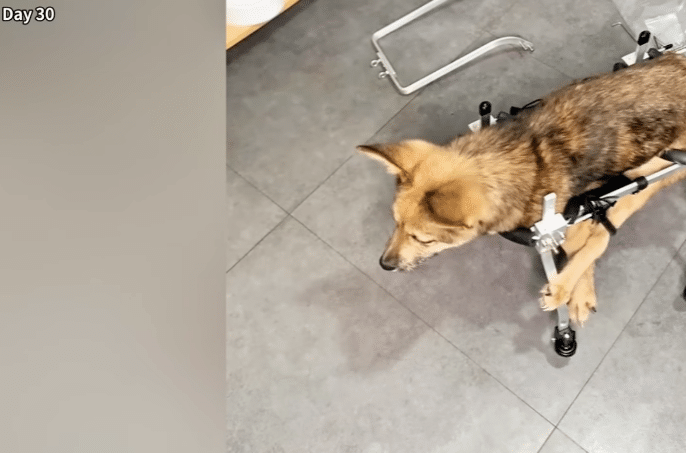
The dog first seen pulling himself through the rain could now lift his hindquarters from the floor.
He could place weight through his back paws.
He could move forward using all four legs, even when the motion remained uncertain.
Those changes were not the result of determination alone.
Fu Bao’s persistence mattered, but so did the practical support surrounding it.
Food strengthened his body.
Treatment relieved the problems affecting his skin and coat.
A safe floor gave him somewhere to practice.
Rest allowed his muscles to recover.
And a caregiver remained present through the repetitive work that happened between visible milestones.
Without those things, effort alone might not have been enough.
With them, Fu Bao’s world began expanding beyond the corner where he had first rested.
Ninety Days Later, He Was No Longer Crawling
Approximately three months after the rescue, Fu Bao stepped outside as a very different dog.
His body had filled out.
His coat looked cleaner and healthier.
His posture had changed.
Most remarkably, his hind legs were working.
Fu Bao did not merely stand in the yard.
He ran.
His movement may not have looked identical to that of a dog who had never experienced weakness, but the difference from his first day was extraordinary.
The legs that had once trailed behind him now pushed against the ground.
His body moved forward with speed.
He crossed the open space toward his caregiver, appearing eager to close the distance between them.
There was no storm surrounding him.
No wet pavement beneath his thin body.
No crowd passing without stopping.
The dog who had once used every bit of strength to move a few inches could now race across the yard.
For his caregiver, the moment represented months of work that most people would never see.
Cleaning bedding.
Preparing meals.
Treating parasites.
Supporting Fu Bao’s body.
Helping him practice.
Watching for setbacks.
Repeating the same small exercises day after day.
The transformation looked dramatic when the first and final footage were placed together.
The process itself had been quiet.
It was built through ordinary care delivered consistently.
His Recovery Was Never Only About Walking
Fu Bao’s ability to run became the most visible symbol of his recovery.
But walking was not the only part of his life that changed.
He no longer searched the roadside for food.
He no longer had to find protection from approaching weather.
He did not need to pull himself toward strangers hoping one of them might stop.
His days now contained predictable meals, shelter, companionship, and rest.
Fu Bao also appeared increasingly comfortable around his caregiver.
He followed him.
Stayed close.
Accepted touch.
And participated in the life of the home instead of merely recovering inside it.
These changes matter because rescuing a disabled or injured animal involves more than restoring movement.
Some dogs may never walk normally again.
Others may require carts, rehabilitation, or lifelong assistance.
Their quality of life cannot be judged only by whether they eventually run.
Comfort matters.
Interest in food matters.
The ability to engage with people and surroundings matters.
Freedom from untreated pain and exposure matters.
Fu Bao’s story happened to include a remarkable improvement in mobility.
But his second chance began long before his first successful steps.
It began the moment someone removed him from the rain.
One Person Stopped When Everyone Else Was Hurrying Home
The young man did not know how Fu Bao’s story would end when he first saw him.
He had no guarantee that the dog would walk.
He did not know how much treatment would be needed or how completely his daily routine would have to change.
He only saw an animal who could not protect himself from the approaching storm.
So he offered food.
Then shelter.
Then another day of care.
That first decision created every opportunity that followed.
Fu Bao could rebuild strength because someone kept feeding him.
He could practice moving because someone gave him a safe place to try.
He could rest after each effort because he no longer had to remain exposed outdoors.
Three months later, the little dog was not simply alive.
He was running toward the person who had once watched him drag himself across wet pavement.
The roadside had revealed Fu Bao at his weakest.
The following ninety days revealed something else.
Not a miracle that happened without effort.
Not a transformation created by hope alone.
But what can happen when persistence is met by practical, patient care.
Once, Fu Bao could barely move through the coming storm.
Then one stranger stopped.
And ninety days later, the dog who had pulled himself forward inch by inch was crossing the grass on four working legs—finally moving toward a life that no longer required him to struggle alone.


