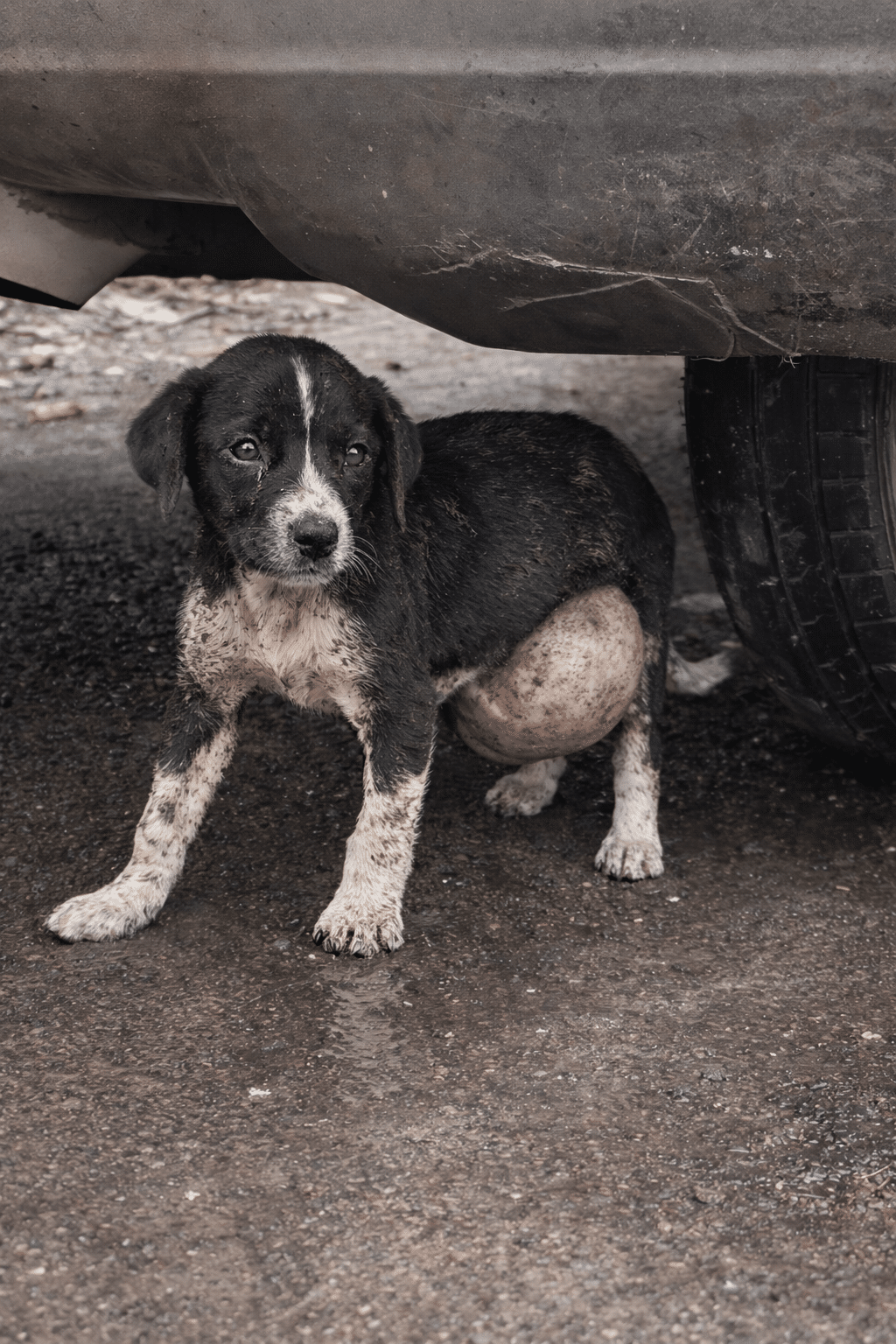
At first, he was easy to miss.
A tiny black-and-white puppy stood beneath a parked car on a quiet neighborhood street, using the shadow underneath as a place to stay out of sight.
From a distance, he looked like many young strays trying to find somewhere safe to rest.
Then rescuers saw his abdomen.
A large mass hung beneath his small body.
Compared with the puppy himself, it was enormous—nearly half his size.
The swelling pulled downward as he moved, making his already tiny frame look even more fragile.
He was young.
He was small.
And he was carrying something no puppy should have had to manage alone.
The Mass Was Impossible to Ignore Up Close
Once rescuers moved closer, the scale of the problem became clearer.
The puppy’s body was still developing.
His legs were thin.
His frame was slight.
But the growth beneath his abdomen was disproportionately large.
It stretched the skin and hung heavily from the lower part of his body.
Even simple movement appeared more difficult because of the extra weight.
The rescuers could not determine the exact nature of the mass just by looking at it.
What they did know was that the puppy needed a veterinary examination.
Waiting was not going to make the situation easier.
So the team from Saahas for Animals stepped in.
Video: Tiny Puppy Found With a Massive Abdominal Tumor — Then Surgery Gave Him a Chance to Heal
Saahas for Animals Took Him in for Evaluation
The puppy was carefully lifted and transported to the rescue center.
Up close, the contrast between his small body and the mass was even more striking.
Veterinary staff began examining him to understand how serious the condition was and what could safely be done.
The rescue account does not specify the exact type of tumor.
But after assessment, the team determined that surgical removal was necessary.
For such a small puppy, that decision required careful planning.
His age and body size made the procedure more delicate.
The medical team needed to remove the mass while minimizing additional stress on a body that was already under strain.
The surgery was scheduled.
The Operation Focused on Removing the Heavy Mass
During the procedure, the veterinary team worked carefully around the growth.
The goal was straightforward.
Remove the tumor.
Give the puppy relief from the weight hanging beneath him.
And allow his body a better chance to recover.
The operation took patience.
For a young dog with such a large mass, even routine handling had to be controlled.
Eventually, the tumor was fully removed.
The visual difference was immediate.
The large swelling that had dominated the puppy’s small body was gone.
For the first time since rescuers had found him, there was no heavy mass pulling beneath his abdomen.
But surgery was only the beginning.
Recovery Became the Next Important Step
After the operation, the puppy needed time to heal.
He received medication.
Nutritious meals were provided to support recovery.
And the rescue team made sure he had a quiet place to rest.
There was no reason to rush the process.
His body had just undergone major treatment.
The incision needed time.
His strength needed to return gradually.
So the days that followed were simple.
Food.
Rest.
Medication.
Observation.
Then the same routine again.
Little by little, he began looking stronger.
Moving Without the Extra Weight Changed Everything
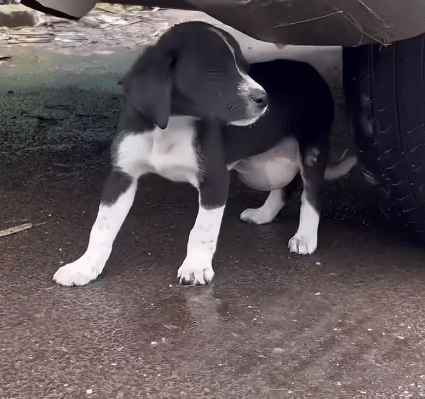
As the puppy recovered, one of the clearest differences was the way he moved.
Before surgery, the mass had hung beneath his abdomen with every step.
Now that weight was gone.
His posture looked more natural.
He could reposition himself more easily.
His movements became less awkward.
And as his energy returned, he began showing more interest in the world around him.
The puppy who had once stayed beneath a parked car was now able to explore without the same physical burden attached to his body.
That change did not happen because of one dramatic moment.
It came from surgery followed by consistent recovery care.
His Small Body Finally Had Room to Heal
The healing process continued as the days passed.
The surgical area improved.
His appetite supported gradual strength gain.
And the puppy became more active.
Without the mass stretching his abdomen, his body began looking far more proportionate.
The transformation was especially noticeable when comparing the early footage with later images.
At the beginning, nearly every glance was drawn toward the enormous swelling.
Later, what stood out instead was simply the puppy himself.
Small.
Alert.
Recovering.
Exactly how it should have been from the start.
The Final Images Looked Nothing Like the Beginning
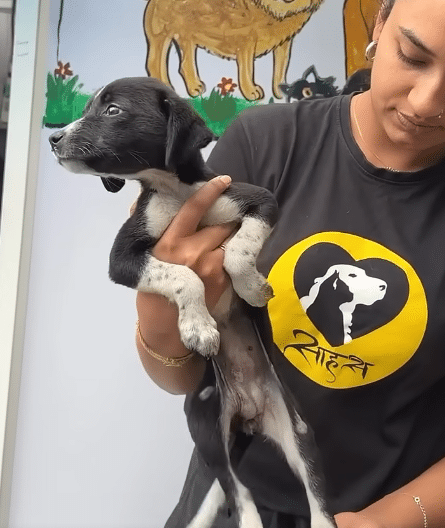
By the final part of the rescue video, the large abdominal mass was no longer visible.
The puppy’s belly looked dramatically different after surgery and healing.
He was being held by the rescuers who had cared for him through the process.
His body appeared stronger.
His movements were easier.
And the physical obstacle that had once defined every image of him was gone.
There is no need to exaggerate what happened next.
The source does not document a permanent adoption or identify a final family.
What it does show is meaningful enough.
A puppy was found carrying a growth nearly half his size.
He was brought into care.
Veterinarians removed it.
And he recovered well enough for his body to begin functioning more normally again.
The Puppy Under the Car Was Finally Carrying Only Himself
His story began beneath a parked vehicle.
A tiny stray body.
A huge mass.
And no obvious way for him to solve the problem alone.
Then someone noticed.
Saahas for Animals responded.
Veterinary staff examined him.
Surgery removed the growth.
And recovery gave him time to rebuild strength.
The tumor had once seemed almost as large as the puppy carrying it.
After treatment, it was simply gone.
What remained was a young dog with a much lighter body and a better chance to continue growing.
Sometimes rescue is dramatic.
Sometimes it is a long medical journey.
And sometimes it begins with someone looking beneath a parked car and realizing that a tiny animal is carrying far more than he should.
For this puppy, that closer look changed everything.


