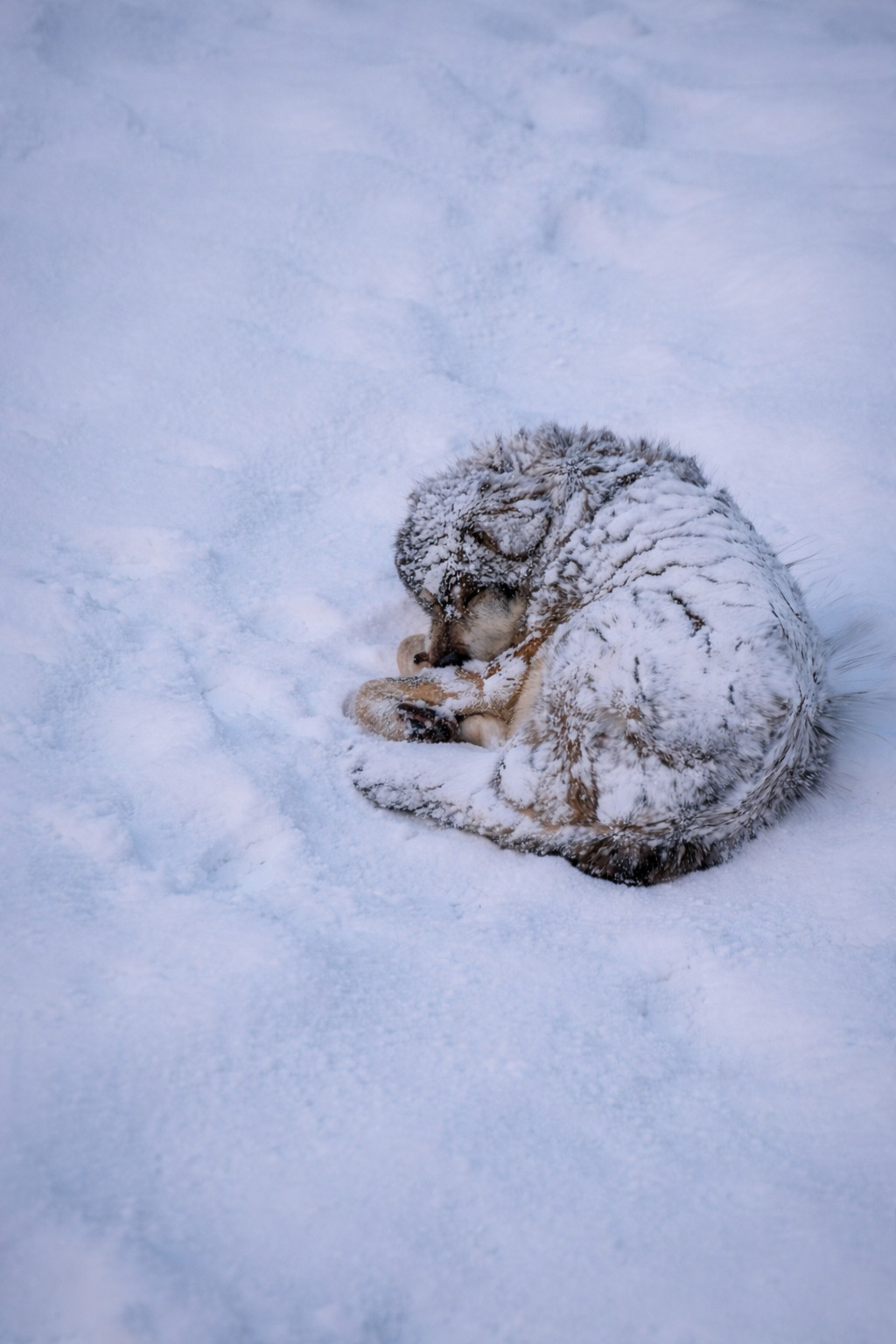
The road had nearly disappeared beneath the snow.
At −17°C, even standing outside for a few minutes was difficult. The landscape had become almost completely white, with little movement and even less reason for anyone to stop.
Then someone noticed a dark shape near the roadside.
It was so small that, from a distance, it could easily have been mistaken for debris.
But when they looked again, the shape moved.
Barely.
There was a puppy in the snow.
He appeared to be only a few weeks old, far too young and far too small to be outside alone in temperatures like these.
His body was trembling.
His breathing appeared weak.
Snow had gathered around him as he lay close to the frozen ground.
The people who found him did not know how long he had been there.
They only knew they could not leave him for another minute.
They lifted the puppy from the snow, wrapped him carefully, and carried him toward warmth.
That night, nobody knew whether the little dog they had just rescued would still be alive by morning.
The Smallest Shape on an Almost Empty Road
There was little about the scene that immediately drew attention.
No barking.
No dog running toward passing cars.
No movement large enough to be seen from far away.
Frozen was simply lying there.
That may have been the most dangerous part.
A tiny puppy can disappear surprisingly quickly against deep snow, especially when exhaustion has taken away the energy to move or cry out.
When his rescuers approached, his condition made the urgency clear.
He was intensely cold.
His small body continued trembling as they picked him up.
At only a few weeks old, he had very little protection against such extreme temperatures.
There was no time to wait for a dramatic rescue plan.
The first priority was obvious.
Get him somewhere warm.
The puppy was wrapped close and transported indoors, away from the frozen roadside.
Only then could his rescuers begin working out whether his weakened body could recover.
VIDEO: Found Almost Buried in Snow at −17°C, the Tiny Puppy Is Carried Into Warmth
That First Night Was About One Thing: Warmth
Once Frozen was inside, the rescuers resisted the urge to expect an immediate transformation.
A severely chilled puppy needed careful warming and close observation.
They surrounded him with blankets.
Warm bottles were placed nearby.
An electric blanket helped create a safer, more controlled source of heat.
Then they watched.
Minutes passed.
Then hours.
Frozen remained weak, and the people caring for him stayed close through the night.
There was little else they could do except continue warming him gradually and monitor how his body responded.
No one knew how long he had been exposed to the cold.
No one could promise that simply bringing him inside had happened soon enough.
So the night became a waiting game.
Was his breathing becoming stronger?
Was the trembling changing?
Was his body temperature improving?
Every small sign mattered.
Eventually, morning came.
Frozen was still there.
And then his eyes opened.
By Morning, He Was Ready to Eat
One of the first encouraging changes came with food.
Frozen began eating.
For a puppy who had spent the previous night barely moving, his interest in food was an important sign that he was becoming more responsive.
His caregivers fed him carefully.
His body was still small and recovering, so there was no need to rush.
A little food.
Rest.
Then more when appropriate.
The transformation was not dramatic yet.
Frozen did not leap from his blankets and begin racing around the house.
He remained a vulnerable young puppy who needed constant care.
But there was now something the rescuers had not been able to count on the night before.
Appetite.
And with every meal, his body had more energy available for recovery and growth.
The tiny figure they had found nearly hidden beneath snow was beginning to behave less like an emergency case and more like a very young dog.
That was progress enough.
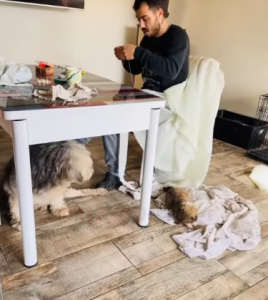
On the Third Day, His Body Began to Relax
During the first days indoors, Frozen stayed close to warmth.
Blankets became familiar.
Hands brought food.
Someone was almost always nearby.
By around the third day, his caregivers noticed that he appeared more relaxed.
He no longer seemed as tense when being held.
He settled more comfortably against people.
He began seeking out the warmth around him instead of simply remaining where he had been placed.
Those changes were small, but they suggested that Frozen was becoming accustomed to his new surroundings.
The rescuers could not know what he remembered from before he was found.
There was no need to invent a story about fear or abandonment that could not be confirmed.
What they could see was enough.
This puppy was beginning to respond differently.
He ate.
He rested.
He accepted gentle contact.
And day by day, he spent less time looking like the fragile little animal lifted from the snow.
Day Nine Brought an Ordinary Milestone
By the ninth day, Frozen had become stable enough for another small step in his care.
A gentle bath.
For most puppies, a bath would hardly qualify as an important moment.
For Frozen, it showed how far he had already come.
During his first night indoors, the only goal had been keeping him warm and alive.
Now his caregivers could pay attention to ordinary things.
Cleaning his coat.
Removing dirt.
Drying him carefully afterward.
Keeping him comfortable.
The bath did not erase his past.
Nor did it somehow make him understand that every difficulty was over.
It simply marked a change in priorities.
Frozen was no longer being cared for only as a puppy in immediate danger from the cold.
He was becoming a puppy whose everyday needs could finally matter.
Afterward, as he continued settling into the home, another side of him began appearing.
Curiosity.
Toys Slowly Became More Interesting Than Blankets
As his strength increased, Frozen began paying attention to things that had meant nothing during the first days.
Toys.
At first, his play was tentative.
A sniff.
A paw.
A small attempt to investigate something nearby.
Then the hesitation began fading.
The puppy who had once been almost motionless in the snow became increasingly interested in exploring his surroundings.
He also developed a habit familiar to many people who have cared for very young rescue dogs.
Frozen followed his caregiver.
From room to room, he liked staying nearby.
Whether that came from curiosity, comfort, or simply the attachment of a very young puppy, it became part of his daily routine.
He no longer spent his days curled beneath layers of blankets because he had no energy for anything else.
Now there were things to investigate.
People to follow.
Places to explore.
And other dogs to meet.
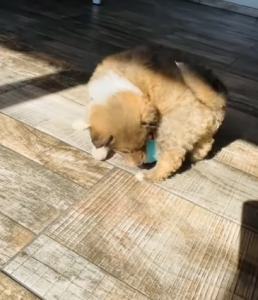
Lucky Became Part of His New World
Frozen was not the only dog in the home.
Among the other animals was a dog named Lucky.
As Frozen grew stronger, Lucky often remained nearby.
The older dog’s presence gave the puppy another form of companionship while he adjusted to life indoors.
They shared space.
Rested near one another.
And Frozen had the chance to learn ordinary canine routines from dogs already comfortable in the home.
There was no need to claim Lucky understood everything Frozen had experienced.
The simpler truth was meaningful enough.
The little puppy was no longer alone.
There were humans around him.
There were other dogs.
There was food.
Warmth.
And a predictable place to sleep at night.
The contrast with the snowy roadside became greater with every passing day.
Forty-Five Days Later, the Difference Was Impossible to Miss
By day 45, Frozen looked remarkably different.
The tiny puppy found trembling against the snow had grown.
His coat appeared fuller.
His eyes were brighter.
His movements carried the energy expected from a young dog.
He played.
He explored.
He interacted with the people and animals around him.
The transformation was easiest to understand when comparing the first images with the later ones.
In the beginning, Frozen was barely visible against a winter landscape.
Weeks later, he was difficult to keep still.
But those two images were connected by dozens of ordinary days.
Meals.
Sleep.
Warmth.
Bathing.
Play.
Companionship.
And caregivers who continued doing the same small things after the immediate emergency had passed.
There was no single moment when Frozen suddenly became safe.
Safety was built around him gradually.
Frozen’s Story Began Because Someone Looked Twice
It is easy to imagine what might have happened if the dark shape beside the road had gone unnoticed.
The snow could have covered more of him.
The temperature could have continued falling.
And a puppy already too weak to move much had very few ways to help himself.
But someone saw something.
Then looked again.
That second look changed everything.
Frozen was lifted from the snow.
He spent the night surrounded by warmth.
By morning, he opened his eyes and began eating.
Three days later, he was settling more comfortably around people.
By the ninth day, ordinary puppy care had begun replacing emergency care.
Soon came toys.
Then companionship with Lucky.
Then growth.
And by day 45, the nearly motionless shape beside a winter road had become a playful young dog.
Frozen’s recovery was not created by luck alone.
It began with attention.
Someone noticed what could easily have been missed.
Someone stopped when continuing down the road would have been easier.
And someone carried a tiny animal out of temperatures no puppy should have faced alone.
Weeks later, Frozen no longer needed electric blankets to make it through the night.
He had something far more dependable.
A warm place to sleep.
Food waiting for him.
Dogs nearby.
People he had learned to follow from room to room.
And a life that continued because, on one freezing day, somebody looked at a small dark shape in the snow—
and decided to stop.


