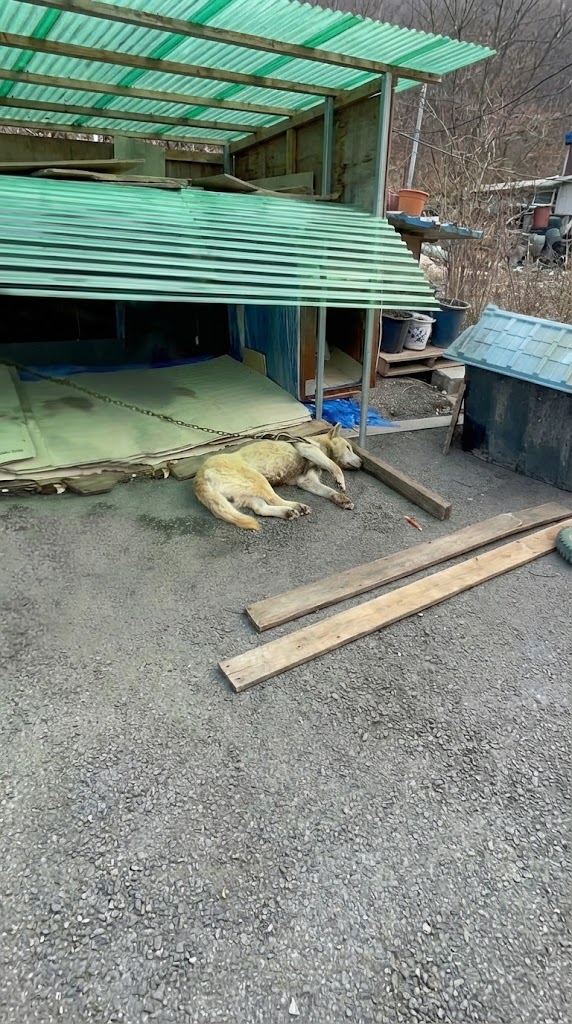
At first, the shape beside the old fence barely moved.
It was a bitterly cold morning, and a man passing nearby noticed what looked like a dog lying on the frozen ground.
He stepped closer.
The dog did not get up.
He did not bark.
He barely reacted at all.
His body was stiff from cold and weakness, and even the rise and fall of his breathing was difficult to see.
When the man spoke, there was almost no response.
Only a pair of clouded eyes.
This was not a dog taking a winter nap.
Something was terribly wrong.
The man called for help.
And for a dog who had already lived fourteen difficult years, that phone call became the beginning of a very different chapter.
He Was Too Weak to Stand
When rescuers arrived, they approached slowly.
The elderly dog remained almost completely still.
He was wrapped in warm blankets and lifted carefully from the frozen ground.
There was no struggle.
His body seemed to have very little strength left for anything.
The team gave him a name.
Lucky.
At the time, it may have sounded almost painfully optimistic.
His coat was dull.
His muscles were severely wasted.
His body showed signs of having spent long periods in the same position.
Pressure sores marked areas where fragile skin had repeatedly pressed against hard surfaces.
Nothing about his condition suggested a problem that had begun yesterday.
Lucky had been declining for a long time.
But the full story would not become clear until later.
VIDEO: After 14 Years Chained as a Guard Dog, Lucky Was Found Unable to Stand in the Freezing Cold
A Phone Call Explained Much of His Past
At the veterinary clinic, the team began assessing Lucky’s condition.
Then information about his earlier life emerged.
According to the rescue account, Lucky’s former owner said the dog had spent approximately 14 years chained at an abandoned factory as a guard dog.
For most of his life, that had been his routine.
A chain.
The factory grounds.
Very little freedom of movement.
As Lucky grew older, his health deteriorated.
Eventually, he stopped eating normally.
His ability to stand declined.
And when his body could no longer function the way it once had, he was reportedly taken outside and left in the cold.
The rescuers could not change those fourteen years.
They could only decide what the days ahead would look like.
So they stopped focusing on what Lucky had been denied.
They focused on what could still be given.
Warmth.
Medical care.
Food.
Comfort.
And time.
His Medical Problems Went Far Beyond Old Age
Lucky’s examination revealed several serious conditions.
His mobility was limited by a spinal problem.
His weakened muscles made even simple movement difficult.
Cataracts had clouded his vision.
And he was also diagnosed with stage 3 heartworm disease, requiring careful treatment and close monitoring.
For an elderly dog already in such a fragile state, no single problem could be treated in isolation.
Everything had to be balanced.
The team needed to help his wounds heal without placing unnecessary stress on his body.
They needed to rebuild nutrition without overwhelming him.
Pain had to be controlled.
His heartworm treatment had to be approached cautiously.
And his limited mobility meant caregivers had to protect his skin from developing further pressure injuries.
Lucky was not a case that would be transformed in a few days.
His recovery would require patience.
Care Began With Small Things Repeated Every Day
Lucky’s wounds were cleaned regularly.
Soft bedding reduced pressure on damaged areas.
Gentle massage was used to encourage circulation through muscles that had become weak from prolonged inactivity.
Instead of large meals, he received smaller nutritious portions throughout the day.
The goal was not to make him gain weight as quickly as possible.
It was to rebuild him safely.
Caregivers stayed nearby.
When someone spoke softly, Lucky sometimes responded with a small movement of his ears.
Occasionally, his tail moved slightly.
They were tiny reactions.
But at the beginning of recovery, tiny reactions were enough.
Lucky did not need to perform gratitude.
He did not need to wag enthusiastically or become playful overnight.
He only needed the chance to rest while his body adjusted to being cared for.
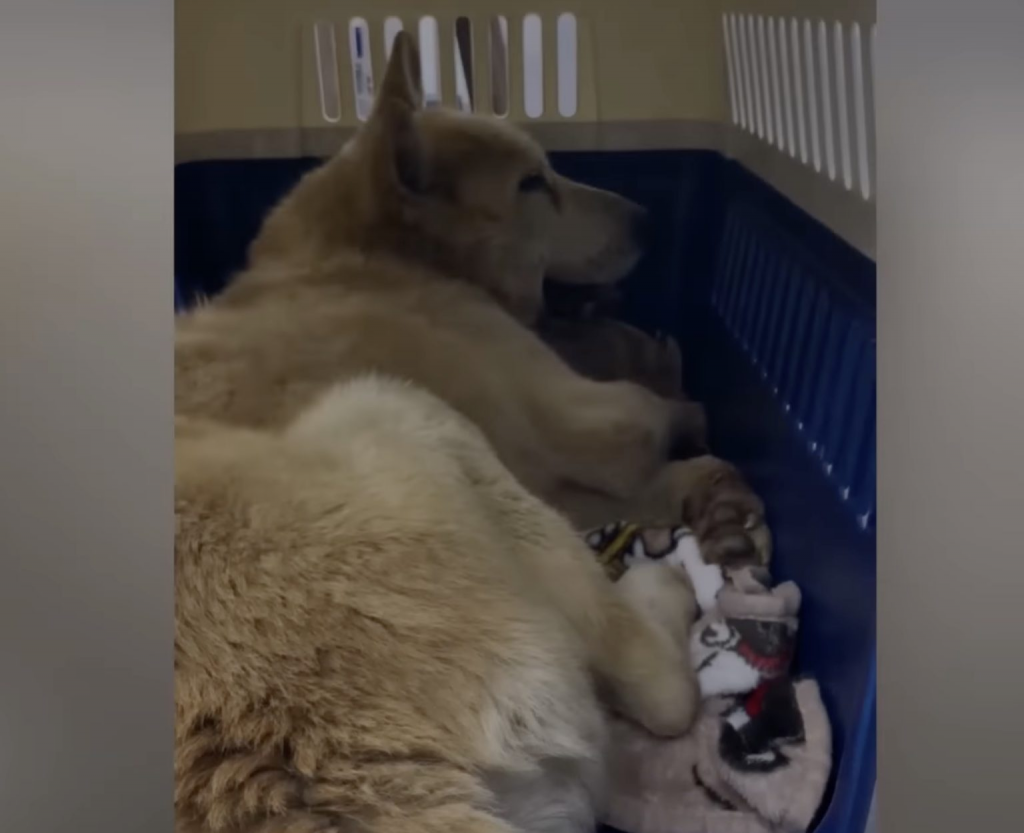
Acupuncture Became Part of His Rehabilitation
As the weeks passed, the team explored additional ways to support Lucky’s comfort and mobility.
Acupuncture was added to his rehabilitation program.
The goal was to help manage discomfort and encourage responses in areas affected by his neurological and mobility problems.
During the sessions, caregivers observed Lucky becoming more relaxed.
His muscles appeared less tense.
Treatment continued alongside the rest of his care rather than replacing it.
Nutrition still mattered.
Wound care still mattered.
Pain management still mattered.
So did physical support.
Then, over time, the team began noticing small changes.
There appeared to be more response in his legs.
His posture improved.
And one day, Lucky did something that would have seemed almost insignificant to anyone who had not seen him when he arrived.
He lifted his head by himself.
One Lift of the Head Became a Major Milestone
For a healthy dog, raising the head requires no thought.
For Lucky, it represented strength he had not possessed when rescuers first found him.
The movement lasted only a moment.
But it showed that his body was capable of more than it had been doing.
Caregivers continued the same routine.
Support.
Exercise.
Rest.
Treatment.
Then another attempt.
There was no reason to expect a dramatic leap from lying down to walking independently.
Lucky was elderly.
His body carried years of physical deterioration.
Instead, the team measured progress in smaller units.
Holding his head up.
Shifting position.
Responding to touch.
Putting a little more weight through his body.
Each one meant something.
A Mobility Device Helped Him Experience Standing Again
Encouraged by the gradual progress, the rescuers arranged a special mobility support device for Lucky.
The equipment allowed him to practice an upright position without forcing weakened muscles and joints to support all of his weight immediately.
His earliest attempts were uncertain.
He needed support.
His movements were slow.
Sometimes he paused after only a short effort.
But the equipment gave him something he had been missing.
A safer way to practice standing and moving.
With repeated sessions, Lucky began doing more.
His coat improved as his overall health stabilized.
His posture became stronger.
He spent short periods outside.
Sunlight replaced the frozen ground where he had been found.
Even if he never returned to normal independent walking, his world was becoming larger again.
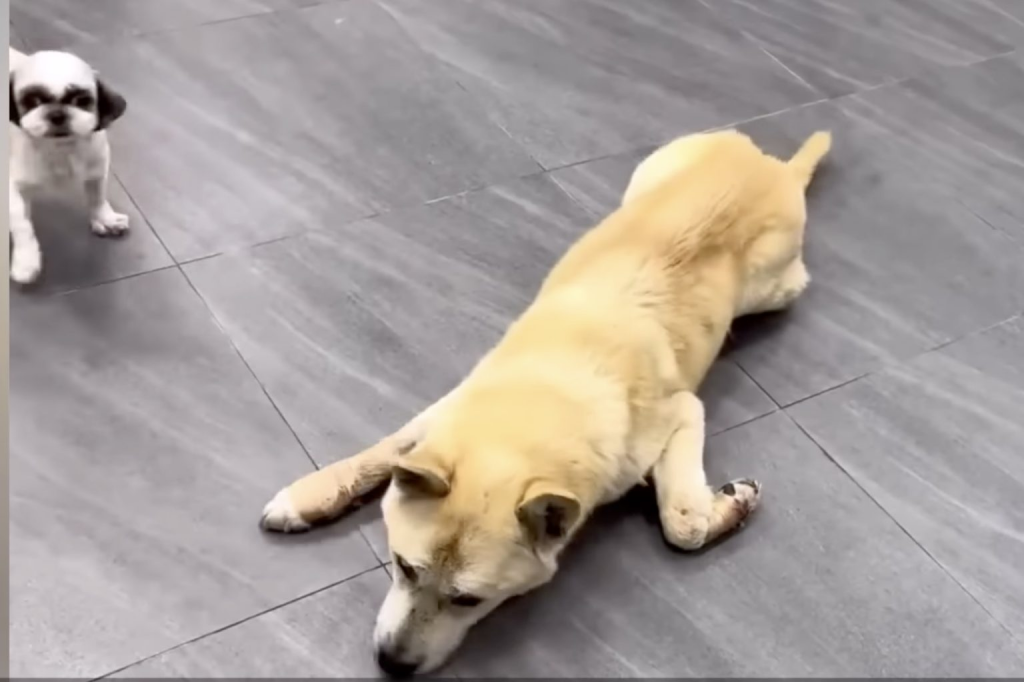
Then Lucky Barked
Months into his recovery, another moment caught everyone by surprise.
Lucky was using his mobility support and moving forward with greater confidence.
Then he barked.
It was a simple sound.
One bark from an elderly dog.
But caregivers had known Lucky first as an animal lying nearly motionless in the cold.
They had watched him through wounds, weakness, medical treatment, and rehabilitation.
Hearing his voice carried a different meaning because of everything that had come before it.
Lucky was more alert.
More engaged.
More responsive to the life around him.
The sound did not mean every illness had disappeared.
It did not mean his spine had suddenly healed.
But it showed just how different he had become from the dog first lifted off the frozen ground.
Recovery Did Not Mean Becoming Young Again
Lucky was fourteen years old.
No amount of kindness could make him a puppy again.
His cataracts remained part of his life.
His heartworm disease required medical management.
His mobility would likely always need support.
That did not make his rescue incomplete.
A good outcome for Lucky did not have to mean running across a field on four perfectly healthy legs.
It could mean something quieter.
Sleeping on a soft bed without pressure against his wounds.
Eating regular meals.
Feeling sunlight.
Being moved gently instead of dragged.
Receiving medical treatment when something hurt.
Having people notice when he needed help.
Growing old somewhere warm.
For an animal who had reportedly spent fourteen years attached to a factory chain, those ordinary comforts mattered enormously.
The Final Chapter Did Not Have to Resemble the First Fourteen Years
Lucky’s story is difficult because so much of it had already happened before rescuers ever met him.
Fourteen years cannot be undone.
The team could not return his youth.
They could not erase the physical consequences of long-term immobility.
They could not promise that every medical problem would disappear.
What they could do was make sure the rest of his life looked different.
And it did.
The frozen ground was replaced by soft bedding.
The chain was gone.
His wounds were treated.
Food arrived regularly.
Caregivers stayed close.
Acupuncture and rehabilitation gave him opportunities to use his body again.
A mobility device allowed him to experience standing and moving more safely.
And after months of recovery, the nearly silent dog found enough energy to bark.
That may be the most important way to understand Lucky’s rescue.
It was not about turning back time.
It was about refusing to let the past claim every day he had left.
Once, Lucky lay motionless beside a rusted fence, too weak even to stand.
Now he is surrounded by warmth, assistance, and people who respond when he needs them.
He may never walk perfectly.
He does not have to.
After fourteen years of being expected to guard a place for others, Lucky finally reached a stage of life where someone else was watching over him.
And this time, he did not have to earn that care.


