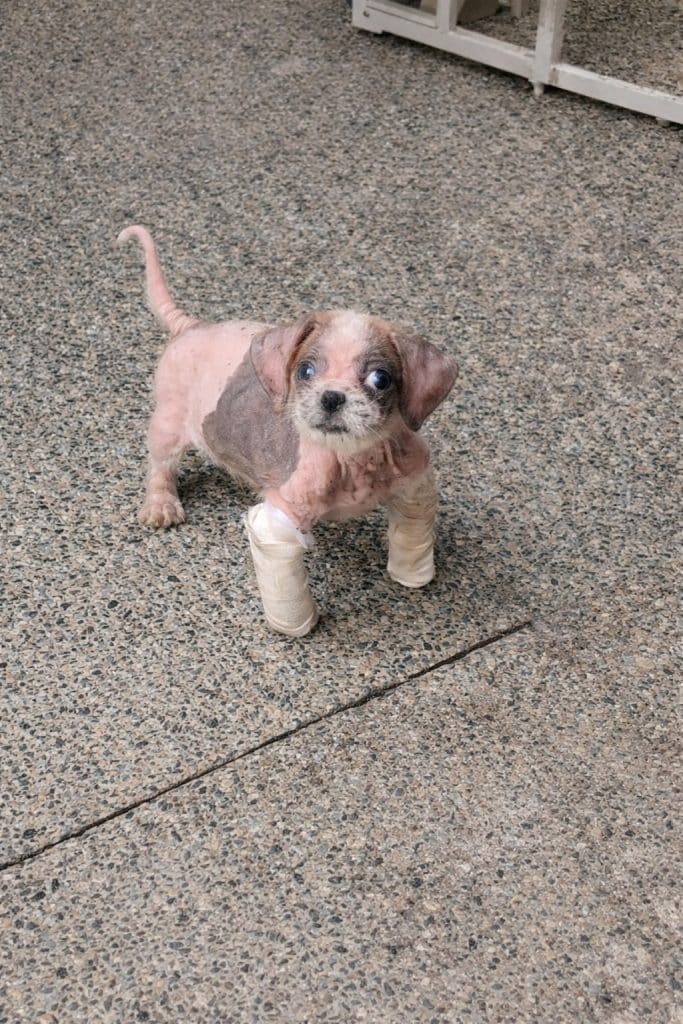
Allie was only about five months old when someone found her inside a trash bin.
She was tiny.
Weak.
And so physically depleted that, for a moment, it was difficult to imagine what she might have looked like as a healthy puppy.
Much of her fur was gone.
Her skin was inflamed and painfully red.
One eye had already lost its sight.
Yet underneath everything her body had endured, Allie was still breathing.
That was enough for rescuers to begin.
Her Skin Revealed How Much Her Young Body Had Already Endured
Once rescuers were able to examine Allie more closely, the extent of her condition became clear.
Large areas of her body were nearly hairless.
The exposed skin underneath was irritated and inflamed.
Her legs trembled when she tried to support herself.
Even at such a young age, she had already become dangerously thin.
At the veterinary clinic, Allie was diagnosed with demodectic mange, a condition caused by mites affecting the skin and hair follicles.
The diagnosis at least gave the team a direction.
Her condition was serious, but treatment was possible.
The harder question was how quickly her weakened body would respond.
Allie needed more than medication.
She needed nutrition.
Rest.
Protection for the eye that still had vision.
And enough time for her body to begin rebuilding itself.
VIDEO: Allie Was Found Hairless and Weak Inside a Trash Bin—Then Treatment Finally Began
The First Days Were About Making Her Comfortable Enough to Heal
There was no instant transformation.
Allie’s skin needed repeated treatment.
Medicated care helped soothe the irritation and address the mange.
Her meals were kept simple and nourishing, including foods such as rice and pumpkin described by her caregivers as part of her recovery diet.
Most importantly, food began arriving consistently.
For a puppy who had been found in such poor condition, that routine mattered.
Eat.
Rest.
Receive treatment.
Sleep somewhere clean.
Then repeat the same process the next day.
At first, Allie remained quiet and cautious.
She did not immediately become playful simply because she had been rescued.
Her body was tired.
Her surroundings were unfamiliar.
So her caregivers gave her space while continuing the treatment she needed.
Little by little, she began responding.
Two Weeks Later, Allie Was Strong Enough to Leave the Clinic
Within roughly two weeks, Allie’s condition had improved enough for her to leave intensive veterinary care.
She was still healing.
Her coat had not fully returned.
Her body was still recovering from malnutrition and skin disease.
But she was stronger.
More stable.
And able to continue the next phase of recovery outside the clinic.
That change opened up a different kind of healing.
Allie could begin experiencing ordinary life.
A room to explore.
People moving around her.
Regular meals without medical urgency surrounding every moment.
Soft places to rest.
For a young dog, those experiences helped reveal something the illness had hidden.
There was still a puppy underneath all of it.
By Day 50, Fur Was Returning—and So Was Her Curiosity
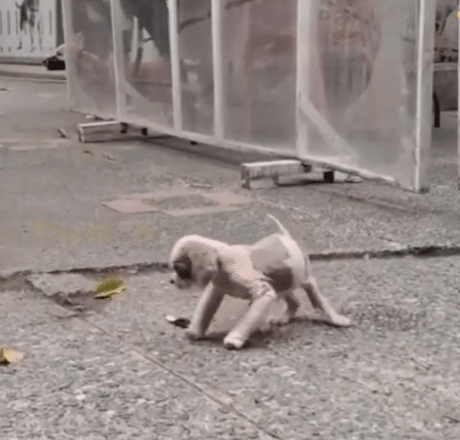
Around the fiftieth day of recovery, the difference was becoming obvious.
Allie’s skin looked healthier.
Soft fur began appearing over areas that had once been bare.
The inflamed red patches gradually gave way to a coat of white and brown.
But the change in her behavior was just as important.
Allie began following people.
She looked up when someone entered.
Her tail started moving more freely.
She became curious about rooms and objects around her rather than remaining withdrawn.
The puppy who had first been found weak and nearly motionless was becoming more engaged with the world.
Her lost vision in one eye remained part of her life.
That did not prevent her from exploring.
She adapted.
Used the vision she still had.
Followed sounds and familiar people.
And kept growing stronger.
The Transformation Was More Than a New Coat
Before-and-after photographs made Allie’s recovery easy to see.
At the beginning, there was a small puppy with exposed skin, a thin body, and very little energy.
Weeks later, there was a healthier young dog with a returning coat and brighter expression.
But photographs could not show everything that had changed.
They could not show the daily meals.
The treatments.
The quiet nights of rest.
The people who continued showing up even when improvement was slow.
Those repeated experiences gave Allie something she had not had when she was found.
Consistency.
And with consistency came confidence.
She began moving more freely through her surroundings.
She became more interested in play.
Affection no longer seemed quite as unfamiliar.
The dog who had once been discarded was beginning to act as though she expected to be included.
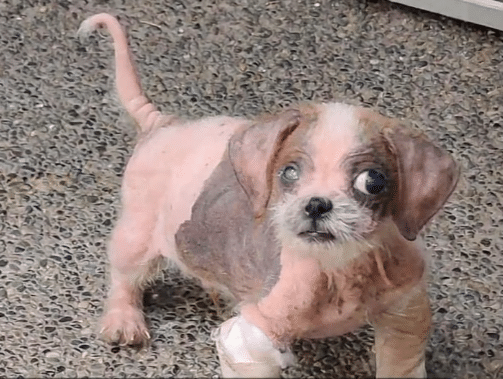
Ninety Days After the Trash Bin, Allie Found a Home
Around three months after her rescue, another major change arrived.
Allie was adopted by a man named Sir Gary.
She left rescue care and entered a permanent home.
There, the routines that had helped her heal could continue.
Meals.
Rest.
Play.
A safe place to sleep.
People who knew her history and accepted the dog she had become.
Allie quickly began using the freedom of her new environment.
She explored the house.
Moved through the yard.
Ran with far more strength than she had shown during her first days in care.
And eventually, she even learned something no one watching her original rescue would have expected.
She balanced on a skateboard.
For a dog once barely able to support herself, the image was striking.
Not because riding a skateboard was necessary.
Because it showed how much room she now had to simply be curious and playful.
The Trash Bin Was Only Where Someone Left Her—Not Where Her Story Ended
Allie’s beginning was difficult to look at.
A five-month-old puppy.
Severe mange.
One eye without sight.
A weakened body inside a place meant for discarded things.
But Allie was never something to throw away.
She was a young dog with a treatable condition who needed someone to recognize that she still had time.
Rescuers gave her that time.
First came medical care.
Then two weeks of stabilization.
By day fifty, fur was returning.
By roughly day ninety, she had a home.
None of those milestones happened because one dramatic act fixed everything.
Her life changed through repetition.
Treatment.
Food.
Rest.
Gentle handling.
Another safe day.
Then another.
Eventually, those days added up to a completely different life.
Today, Allie is no longer hidden inside a trash bin.
She has a home to move through.
A yard to explore.
People who expect her to be there.
And a body strong enough to play in ways that once would have seemed impossible.
Ninety days did not erase where Allie came from.
They simply proved that where a life begins again does not have to decide where it goes next.


