The street was almost completely quiet.
It was around 1:30 in the morning, long after most homes nearby had gone dark.
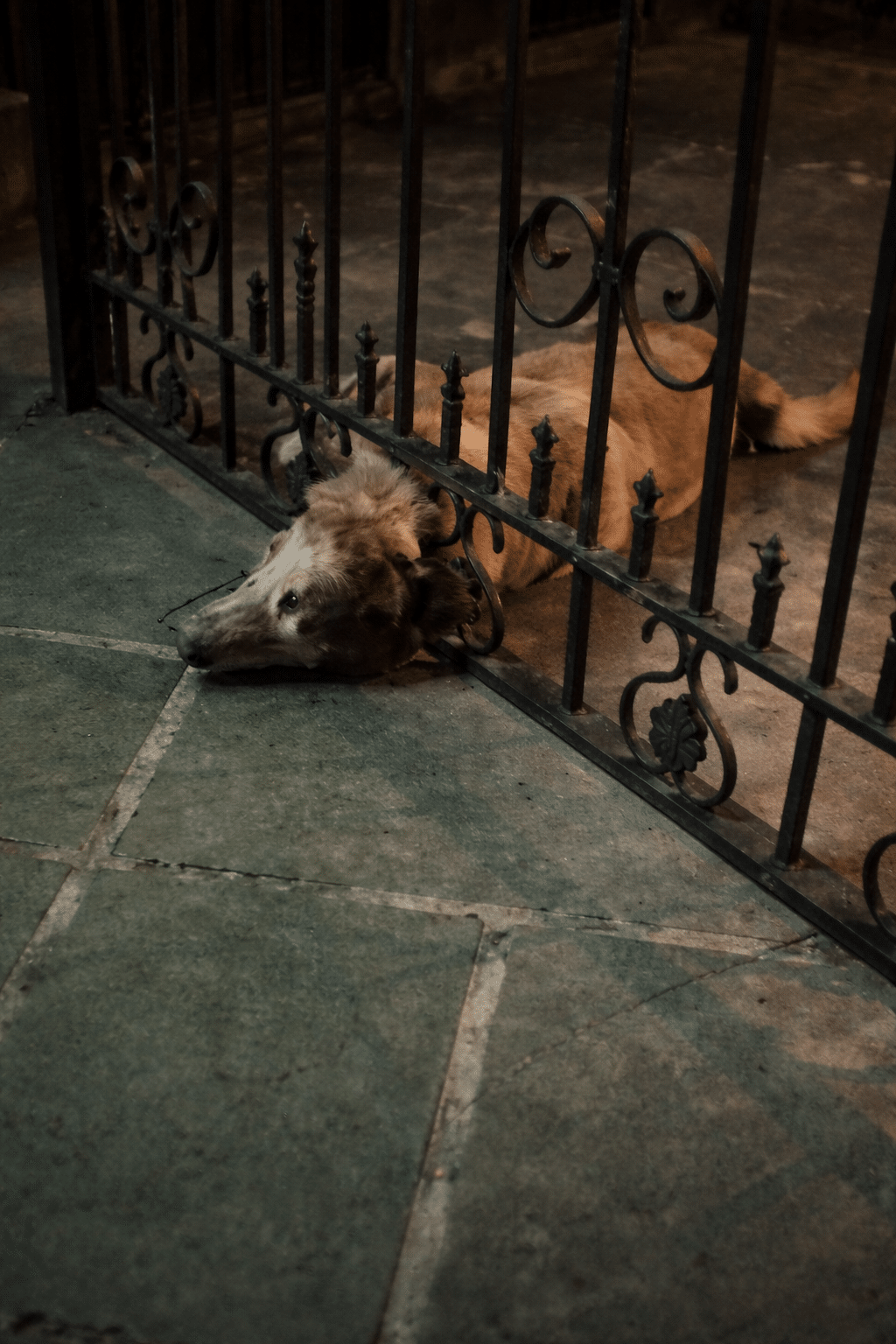
Under the weak glow of streetlights, a light-brown stray dog was caught in a metal gate.
He had managed to push part of his body between two iron bars.
But the opening was not wide enough.
When he tried to move forward, he could not.
When he tried to pull himself backward, he could not do that either.
The more he struggled, the tighter the position became.
By the time someone noticed him, the dog was exhausted.
And freeing him would turn out to be much harder than simply pulling him back through.
His Body Was Wedged Too Tightly to Move
The dog had already spent time trying to escape on his own.
He twisted.
He pushed.
He pulled.
But the metal bars did not give.
His body remained trapped in an awkward position, and repeated contact with the gate had left minor injuries around the neck area.
The danger was not only that he was stuck.
Continuing to struggle could have caused more injury.
The dog was breathing heavily and appeared increasingly tired.
Someone passing nearby realized the situation required help.
A call was made.
And despite the late hour, a rescue team responded.
Video: At 1:30 A.M., Rescuers Found a Stray Dog Wedged Between Iron Bars
Rescue Foundation Gujarat Arrived in the Middle of the Night
Members of Rescue Foundation Gujarat reached the scene with rescue equipment.
The dog was still trapped exactly where he had been found.
Because he was exhausted and frightened, the team approached carefully.
A trapped animal cannot create distance from strangers.
That means even a normally calm dog may react defensively when hands begin moving close to its body.
The rescuers did not rush.
First, they evaluated the position of the dog.
They needed to understand whether the same opening that had allowed him in could also be used to get him back out.
The simplest solution would be to reposition him.
So that was where they started.
The Team First Tried to Free Him Without Cutting the Gate
The rescuers gently lifted parts of the dog’s body and tried changing his angle.
A small rotation might have been enough.
They adjusted his position.
Lifted slightly.
Turned him carefully.
Then tried again.
But the gap between the iron bars was simply too narrow.
Each attempt caused more discomfort.
It became increasingly clear that pulling harder would not solve the problem.
Force could have injured the dog’s neck, spine, or limbs.
The team stopped before the situation became worse.
They needed another plan.
A Soft Rope Muzzle Helped Keep the Rescue Safe
Before using heavier equipment near the dog, the rescuers took another precaution.
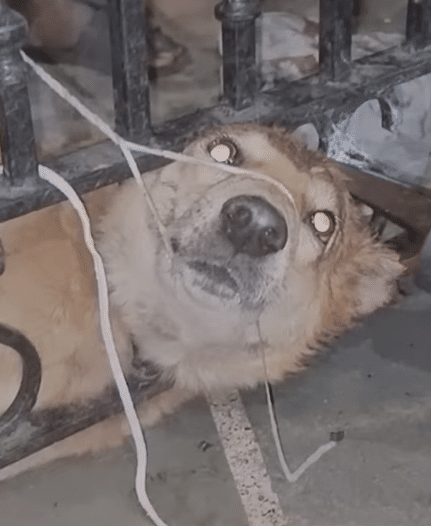
They placed a soft rope muzzle around his mouth.
The purpose was not to punish him.
It was simply to reduce the risk of an accidental bite while the team worked extremely close to his head and body.
The dog was already stressed.
There would soon be metal tools operating near him.
Keeping both the animal and rescuers safe was essential.
Once the muzzle was in place, the team turned its attention back to the gate.
Manual repositioning had failed.
The iron itself would have to move.
Then the Hydraulic Tool Came Out
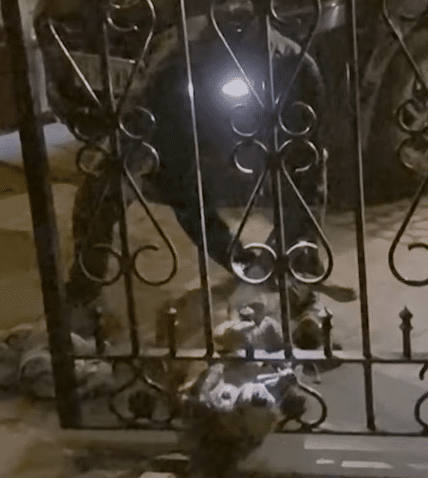
The rescuers brought in a hydraulic cutting tool.
Equipment like this is designed to apply much more force than a person could safely manage by hand.
But using it next to a trapped animal required precision.
The tool was carefully positioned between the bars.
The rescuers checked the dog’s location.
Then they began cutting.
Slowly.
Controlled.
With every movement kept as far from the dog’s body as possible.
The goal was to remove just enough metal to widen the opening.
Nothing more.
One Iron Bar Finally Gave Way
The hydraulic tool continued applying pressure.
Then the metal began to separate.
One of the bars was cut.
Suddenly, the opening became wider.
For the first time since the rescue began, there was enough space to move the dog without forcing his body through the original narrow gap.
The team guided him carefully.
One section at a time.
His body cleared the remaining metal.
And then he was out.
The problem that had kept him trapped for an unknown amount of time was finally gone.
The Muzzle Came Off — And the Dog Chose Distance
As soon as the dog was completely free, the rescuers removed the rope muzzle.
He remained near the scene only briefly.
Then he moved toward a nearby parked car.
For a few moments, he stayed beneath it.
The vehicle gave him a small place to create distance from the people and equipment surrounding him.
Shortly afterward, he came back out.
Then he ran down the street.
Within moments, he disappeared into the darkness.
There was no shelter intake documented afterward.
No adoption scene.
The dog simply left under his own power.
That was enough to show that the immediate emergency had ended.
A Simple Gate Required a Very Precise Rescue
At first glance, the situation looked straightforward.
A dog was stuck.
Pull him out.
But the rescue showed why trapped-animal cases can be more complicated than they appear.
The dog’s body was wedged too tightly.
Manual repositioning did not work.
More force would have increased the risk of injury.
So the team changed methods.
They secured the dog.
Used specialized equipment.
Cut only the metal necessary.
And widened the opening until he could be guided free.
The entire outcome depended on recognizing when the first approach was no longer safe.
At 1:30 A.M., Someone Was Still Willing to Answer the Call
The most striking part of the rescue may be how ordinary the beginning was.
A quiet street.
A metal gate.
One stray dog stuck where he could not escape.
And someone who noticed.
That observation led to a phone call.
The phone call brought Rescue Foundation Gujarat.
The rescuers tried the least invasive option first.
When that failed, they adapted.
A hydraulic cutter replaced manual force.
One bar came away.
And the dog was free.
The gate remained behind.
The street became quiet again.
But the dog who had been trapped there was already gone.
Running on his own.
Exactly as he should have been.


