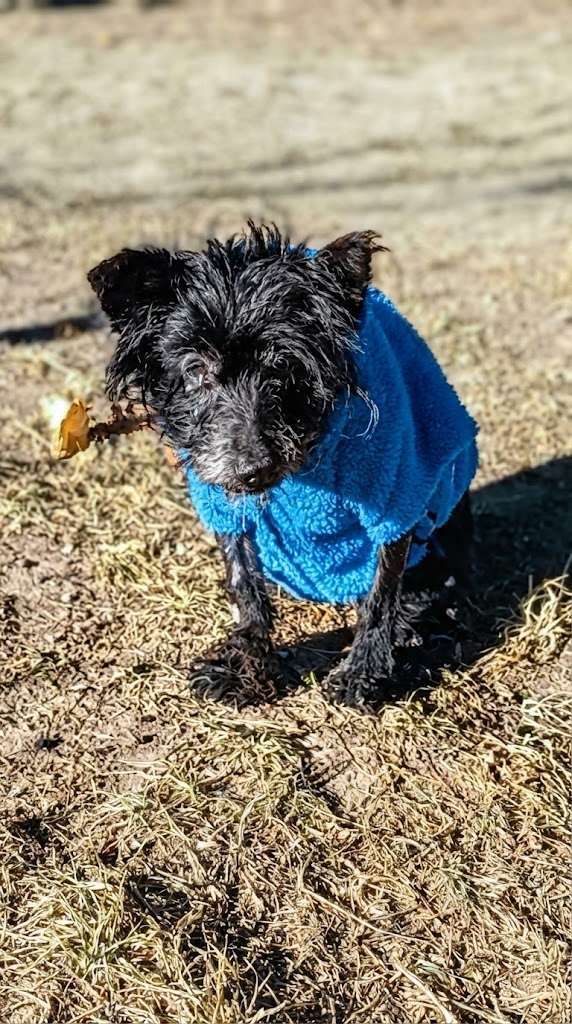
The garden was supposed to be empty.
That morning, the people who lived there stepped outside expecting nothing unusual.
Then something moved between the plants.
A small dog.
His coat was so tangled and dirty that it was difficult to see his face clearly. Thick mats hung from his body, and when someone tried to approach, he immediately moved away.
He did not bark for attention.
He did not come looking for affection.
He simply tried to keep his distance.
Food was placed nearby.
Only then did the people who found him notice another problem.
His breathing did not sound normal.
They had no idea where he had come from or how long he had been outside.
But this was clearly not a dog who could simply be given a meal and sent back onto the street.
He needed a veterinarian.
And before the day was over, they would learn something that made his appearance at the gate even harder to understand.
The little dog was nearly 17 years old.
The Stranger Hiding Inside the Garden
Getting close to the dog was not easy at first.
His heavily matted coat made him look larger and rougher than he really was.
Beneath it, however, was a frail senior body.
He appeared exhausted.
His movements were cautious and unsteady.
The people who found him initially had almost no information.
Was he lost?
Had he wandered away from an elderly owner?
Had someone been searching for him?
Those possibilities could not be ruled out simply by looking at him.
So they focused first on what they could observe.
He needed food.
He needed medical attention.
And he needed somewhere secure enough that he would not disappear before they could help him.
Once they were able to bring him inside and arrange a veterinary examination, the mystery of his past remained.
But the condition of his body began telling a much clearer story about his present.
VIDEO: Nearly 17 Years Old and Suddenly Alone — Security Cameras Reveal How Kuzya Reached the Gate
The Veterinarian Estimated He Was Nearly Seventeen
The veterinary examination brought one surprise after another.
The dog was not simply an adult stray in poor condition.
He was extremely old.
The veterinarian estimated his age at close to 17 years.
For a dog of that age, even ordinary health problems can become more complicated.
Kuzya— the name his rescuers eventually gave him—had several.
Once the thick mats were carefully removed, his thin frame became much easier to see.
His coat also contained fleas and ticks.
Many of his teeth were already gone.
His ears showed signs of chronic infection.
His heart was described as weak and unstable.
Additional testing reportedly identified tumors on his liver, while his breathing and lung condition also required attention.
None of those findings could be corrected with one simple procedure.
Kuzya was a geriatric dog with multiple medical concerns.
The goal was not to somehow turn him back into a young animal.
It was to understand what could be treated, what needed monitoring, and how to make the life still in front of him as comfortable as possible.
But one question remained unanswered.
How had a dog this old and unwell appeared inside their garden?
The Security Camera Had Recorded the Answer
The rescuers checked their security footage.
They hoped it might show whether Kuzya had wandered in from the road or followed someone through the area.
Instead, the footage reportedly showed a woman approaching the gate.
Her face was partly obscured by a mask and hat.
She did not appear to knock or speak with anyone at the property.
The elderly dog was left outside.
Afterward, Kuzya moved through an opening near the gate and made his way into the garden.
That was how he had been found among the plants the following morning.
The footage answered one question.
It did not answer all of them.
The rescuers did not know the woman’s circumstances.
They did not know exactly how long Kuzya had lived with her or what had led to the decision to leave him there.
What the camera did establish was simpler:
Kuzya had not simply wandered into the garden from an unknown street.
Someone had brought the elderly dog to the property and left him there.
At nearly 17, with medical problems that would soon require ongoing care, he had suddenly found himself in an unfamiliar place.
Fortunately, the place he entered belonged to people willing to keep looking for answers.
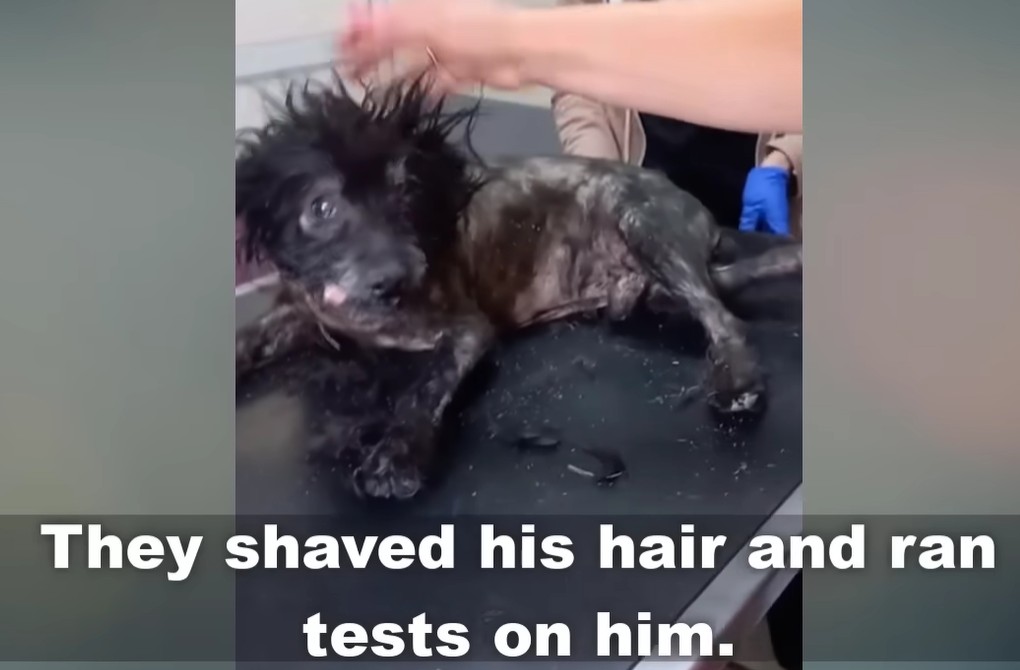
Beneath the Matted Coat Was a Very Fragile Old Dog
Before Kuzya could begin settling in, his coat needed attention.
The mats were thick and uncomfortable.
Removing them had to be done carefully because underneath all that fur was a very thin senior dog.
Clippers gradually worked through the tangled areas.
Fleas and ticks could finally be addressed properly.
His skin could be examined.
His ears could be treated.
For the people caring for him, the grooming process changed their first impression of Kuzya dramatically.
The unrecognizable little figure they had discovered in the garden began looking like an elderly companion dog again.
But grooming alone did not make him comfortable around people.
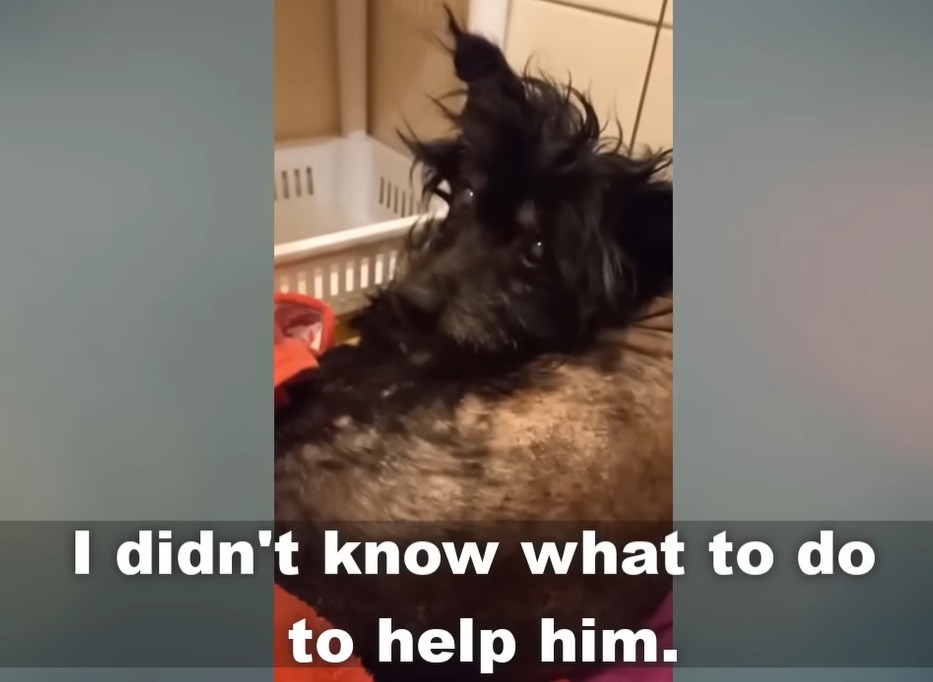
During those first days, Kuzya remained quiet.
He ate little.
He spent long stretches sitting or resting by himself.
At night, the rescuers observed him barking or twitching during sleep and sometimes waking abruptly.
They could not know what he was dreaming about or what experiences caused those reactions.
So they did not attempt to explain them.
They simply gave him a calm place to wake up.
Warm Water Became One of His First Moments of Rest
Kuzya also needed a bath.
His coat and skin carried dirt that had accumulated beneath the mats, and cleaning him was another part of making him comfortable.
Because of his age and health, the process was kept gentle.
Warm water.
Slow movements.
Hands supporting his fragile body.
No rushing.
As the dirt washed away, Kuzya gradually appeared more relaxed.
His caregivers noticed the tension in his body easing.
Eventually, he released a long breath and remained still while they continued.
It was a simple moment.
No dramatic medical breakthrough had occurred.
His heart was still fragile.
His liver tumors had not disappeared.
His age had not changed.
But comfort matters greatly for a dog whose medical options may be limited by time.
That bath gave Kuzya something he had not had on the morning he appeared in the garden.
Warmth.
Clean skin.
And people paying attention to whether he felt safe.
On the Fourth Day, Kuzya Walked Toward Them
The most important changes during Kuzya’s first week were not medical.
They were behavioral.
Initially, he had tried to move away whenever someone approached.
He preferred distance.
Then, on approximately the fourth day, something changed.
Instead of retreating, Kuzya slowly walked toward one of his caregivers.
He came close enough to place his head against the person’s hand.
And he remained there.
For an elderly dog who had spent his first days in the home avoiding contact, the gesture stood out immediately.
Nobody needed to claim Kuzya had suddenly forgotten what happened at the gate.
Nor did the moment prove that every fear or uncertainty had disappeared.
It showed something much more concrete.
He was beginning to choose proximity.
The same dog who had hidden among the plants was now approaching someone voluntarily.
From that point, the relationship continued developing through ordinary routines.
Meals.
Medication.
Quiet time.
Gentle touch.
The other dogs in the home also became part of Kuzya’s surroundings.
Gradually, the house stopped looking like a temporary rescue space and began looking like somewhere he knew.
They Considered Adoption — Then Decided Against Another Move
At first, the rescuers thought about finding Kuzya an adoptive family.
That would be the usual next step for many rescued dogs.
But Kuzya’s situation was different.
He was nearly 17.
He had multiple health concerns.
And after his first difficult days, he had started settling into the home where he was already receiving care.
He began following the other dogs.
He learned the household routines.
He grew increasingly comfortable with the people around him.
Moving him again would mean introducing another unfamiliar environment, another set of smells, another schedule, and another adjustment period.
The rescuers reconsidered.
Kuzya did not necessarily need the perfect adoption story.
He needed stability.
So they decided he could stay.
The garden where he had unexpectedly appeared was no longer simply the place where he was found.
It had become home.
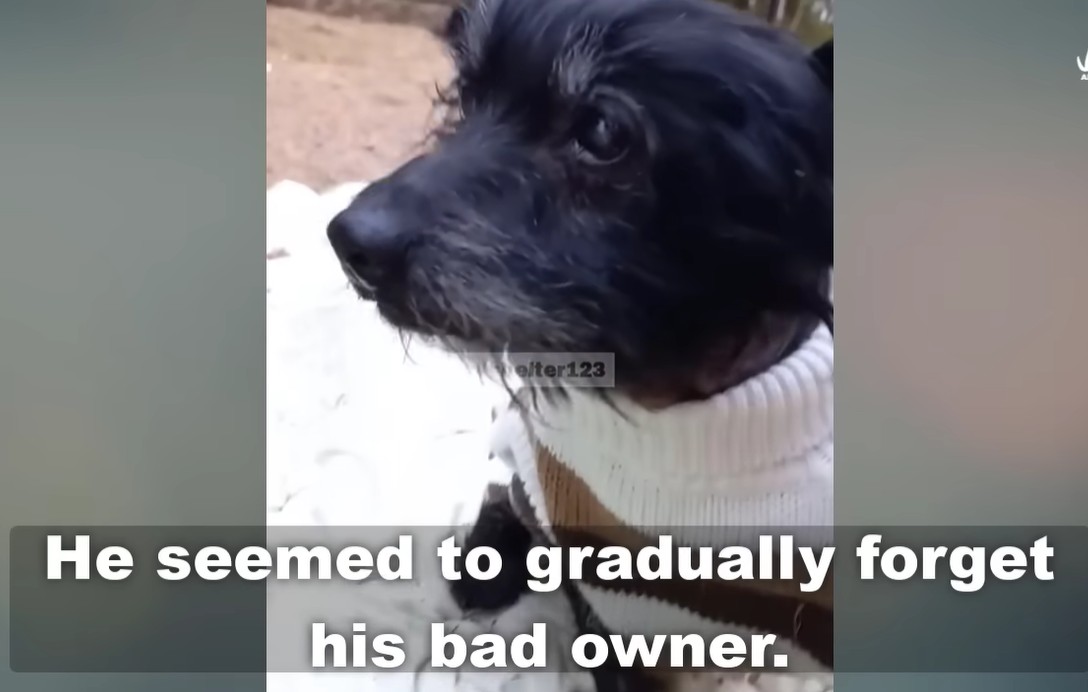
His Medical Problems Did Not Disappear
Keeping Kuzya did not create a miraculous cure.
He remained an elderly dog.
His heart still required careful monitoring.
The liver tumors discovered during his examination remained a concern, although the rescue account later reported that they had not shown growth during the period being described.
His caregivers understood that time with a dog of nearly 17 years could never be taken for granted.
That changed the goal of rescue.
With a young injured puppy, people often imagine years of recovery followed by a long future.
With Kuzya, the priority was different.
Comfort.
Regular veterinary attention.
Food he could manage despite having few teeth.
Treatment for conditions that could be treated.
A warm place to sleep.
And familiar people nearby.
Those things could not erase his medical problems.
They could change what living with those problems felt like.
Kuzya did not have to spend his senior years navigating them alone.
At Seventeen, He Did Not Need to Become Young Again
There is a particular kind of pressure surrounding senior rescue dogs.
People naturally want to see transformation.
The thin dog gains weight.
The sick dog becomes healthy.
The frightened dog runs happily through a yard.
But sometimes age places limits on what a transformation can look like.
Kuzya’s success did not require him to become a completely different dog.
He did not need a perfect set of teeth.
He did not need the body of a five-year-old.
He did not need every medical diagnosis to disappear.
His victory could be much quieter.
Sleeping somewhere warm.
Eating a meal without having to search for it.
Following another dog through the house.
Approaching a familiar hand.
Waking up in the same place tomorrow and recognizing the people around him.
For a dog approaching the end of a very long life, those ordinary things carried enormous value.
The Camera Recorded How Kuzya Arrived — Not How His Story Would End
Security footage preserved the moment Kuzya was left at the gate.
That image could easily have become the defining scene of his story.
An elderly dog.
Nearly 17.
Placed outside an unfamiliar property.
No explanation left with him.
But a camera captures only what happens inside its frame.
It did not record what came afterward.
It did not show the strangers discovering Kuzya among the plants the next morning.
It did not show the veterinary examination that revealed his age.
It did not show the mats being carefully removed.
The warm bath.
The treatment.
The fourth day when he walked toward a human hand instead of away from it.
Or the gradual realization that moving him into yet another unfamiliar home might not be what this elderly dog needed most.
Kuzya’s caregivers could not change how he arrived.
They could change what happened after he crossed that gate.
Now he has familiar rooms.
Other dogs around him.
People who understand his medical needs.
And a place where being old does not make him inconvenient.
No one can promise how much time a nearly 17-year-old dog has left.
Kuzya does not need that promise.
He needs today to be comfortable.
Tomorrow, if it comes, to feel familiar.
And the people beside him to remain there for however many mornings he still has.
Once, Kuzya entered that garden as a stranger.
Now, when he wakes up there, nobody has to wonder who he belongs with.
He is already home.


