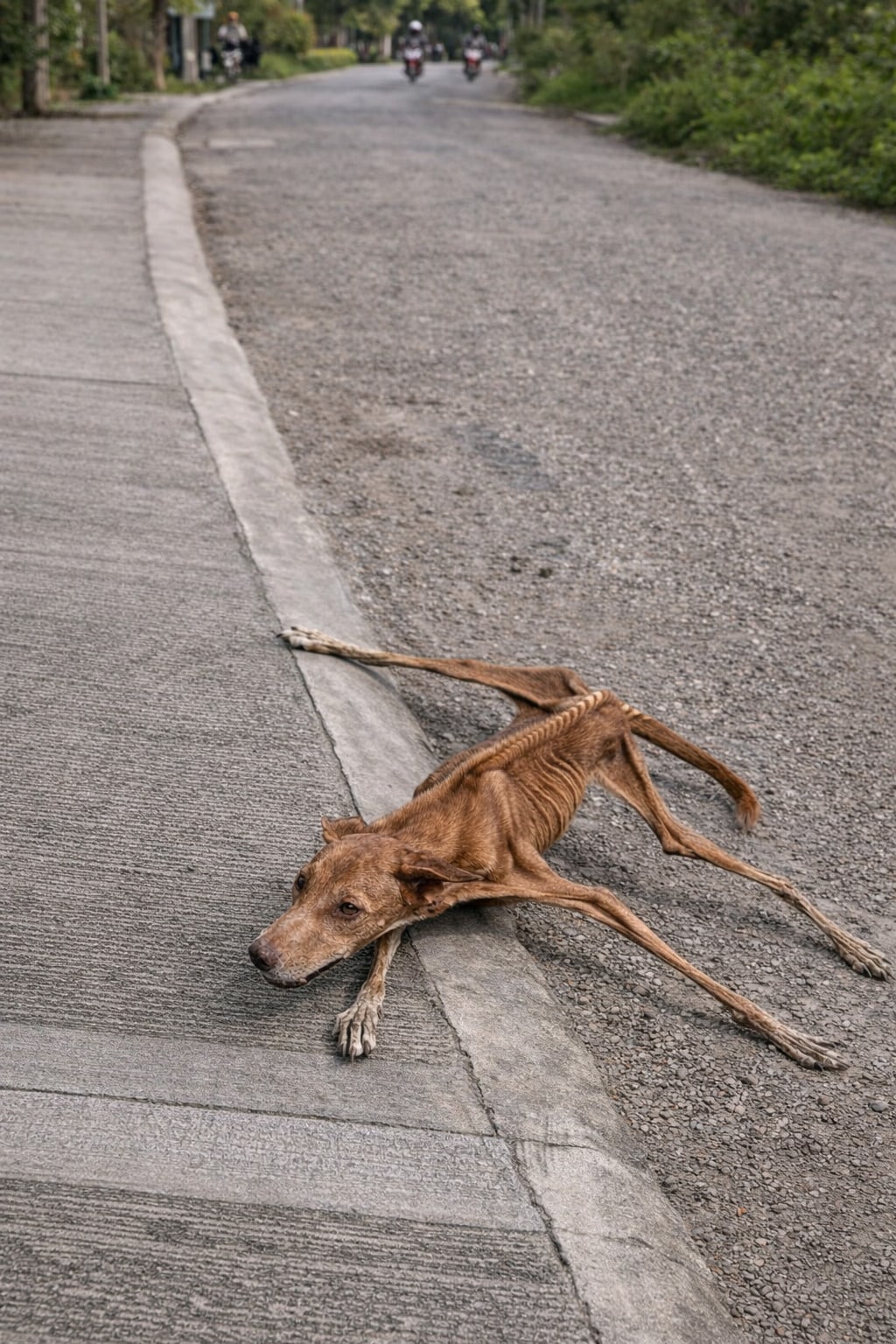
Blair did not look like a dog simply searching for his next meal.
He looked like a dog whose body had almost run out of ways to keep going.
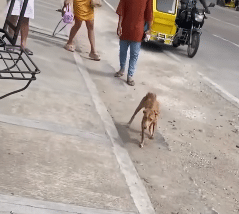
On a crowded street, surrounded by people moving through their ordinary routines, the painfully thin dog struggled forward with an unusual curve through his back. His legs appeared weak, and each step looked uncertain.
Sometimes he stumbled.
Sometimes he stopped.
There was so little weight on his frame that the shape of his body seemed almost distorted by hunger.
Yet Blair was still moving.
And one woman noticed.
She did not know where he had come from or how long he had been surviving this way.
She only knew that the dog in front of her needed something immediately.
So she placed food nearby.
Blair hesitated.
Then hunger made the decision for him.
He Ate as Though He Was Not Sure Another Meal Would Come
The woman did not rush toward Blair.
His body language made caution important.
He appeared frightened and tense, watching her carefully even while food sat within reach.
So she allowed him space.
Eventually, Blair approached.
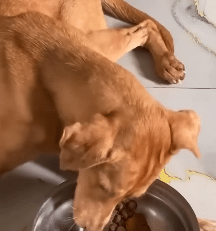
Then he began to eat.
He ate quickly, with the urgency of an animal that had gone without reliable food for too long.
But even while eating, he remained alert.
The meal was welcome.
The person offering it was still unfamiliar.
The woman stayed calm.
There was no attempt to force affection or turn the moment into something Blair was not ready for.
She simply remained nearby.
When he had eaten enough, she carefully wrapped his thin body in a blanket and placed him into a carrier.
Blair did not know where he was going.
But for the first time that day, he no longer had to keep walking on legs that could barely support him.
The crowded street disappeared behind them.
Ahead was a veterinary clinic — and answers about just how much his body had endured.
VIDEO: Blair Could Barely Walk When He Was Found — Then One Meal Became the Start of Everything
His Bent Back Looked Frightening, But the Examination Brought Hope
At the clinic, Blair could finally be examined properly.
His extreme thinness was impossible to miss.
His body had been deprived of adequate nutrition for long enough that even his posture had changed. His spine appeared unnaturally curved, giving him a hunched appearance whenever he tried to stand or move.
At first glance, the damage looked alarming.
But the veterinary assessment brought encouraging news.
According to the examination, the curvature was associated with Blair’s severe weakness rather than an irreversible spinal condition.
His body needed nourishment.
Hydration.
Rest.
And time to rebuild the strength it had lost.
That did not mean Blair could simply be given a large meal and expected to recover immediately.
After prolonged starvation, feeding had to be approached carefully.
His fragile system needed consistency without being overwhelmed.
So Blair was placed on a controlled feeding plan.
Small portions.
Regular intervals.
Careful observation.
He was also treated for dehydration.
For a dog whose life on the street appeared to have been defined by uncertainty, the new routine was almost painfully simple.
Food would come again.
Water would be available.
There would be another meal after this one.
And another tomorrow.
Blair no longer needed to consume everything as though it might be his last chance.
Recovery Came One Small Meal at a Time
The first days were not dramatic.
Blair did not wake up suddenly restored.
His body had reached such a depleted state that rebuilding it required patience.
So his caregivers paid attention to small things.
Was he finishing his food?
Could he stand a little more steadily?
Was he drinking normally?
Did he appear more comfortable when resting?
Every meal gave his body something it had been missing.
Energy.
Protein.
Consistency.
A reason to begin repairing itself.
Gradually, Blair’s weight started to increase.
The sharpness of his frame softened.
His movements became steadier.
And the unusual curve through his back began to improve as strength returned to the muscles supporting his body.
The dog who had stumbled through the street was becoming more stable on his feet.
There was no single day when everyone could point and say that Blair had changed completely.
Instead, recovery accumulated quietly.
One meal.
One night of rest.
One stronger step.
Then another.
Those small improvements began revealing something that starvation had hidden.
Blair was not a weak dog by nature.
He had simply been living in a body without enough resources to behave like himself.
Then Blair Began Doing Something He Had Not Done Before
As his physical condition improved, his behavior began changing too.
At first, Blair had seemed focused almost entirely on basic survival.
Food.
Distance.
Watching unfamiliar people.
Saving what little energy he had.
But as his strength returned, curiosity appeared.
He began looking around more.
He moved with greater confidence.
His tail started to wag.
Then he began to play.
For the people who remembered the dog struggling through the street, those ordinary behaviors felt significant.
Play requires energy.
Exploration requires confidence.
A relaxed tail requires enough comfort to stop treating every moment as a possible threat.
Blair was slowly gaining all three.
His coat also began to improve as proper nutrition continued.
The thin, exhausted street dog was becoming healthier enough that the difference could be seen not only in his weight, but in the way he carried himself.
He was standing differently.
Walking differently.
Responding differently.
The physical transformation was becoming obvious.
But the woman who had first stopped for Blair would soon discover that his relationship with her was changing as well.
The Woman Who Rescued Him Never Really Left His Story
Blair’s rescue could have ended when he reached medical care.
The woman could have helped him from the street, ensured he was safe, and then stepped away.
Instead, she remained part of his recovery.
Blair noticed.
As the days passed, he began staying close to her.
The frightened dog who had once watched her suspiciously over a bowl of food gradually began seeking her presence.
He followed.
He observed.
He settled nearby.
Trust did not arrive all at once.
It developed through repetition.
She brought food once.
Then there was another meal.
She carried him to safety.
Then she was still there afterward.
Nothing Blair experienced could guarantee that he understood these events the way a person might.
But his behavior changed around the woman who had consistently cared for him.
He became comfortable with her.
Then attached.
Eventually, the relationship that began beside a crowded street became permanent.
The woman who had rescued Blair decided to keep him.
He would not need to move on to another unfamiliar place once his recovery was complete.
He already had a home.
His Back Straightened as His World Became Bigger
With continued nutrition and care, Blair became increasingly difficult to recognize as the dog first seen on the street.
His weight returned.
His coat became healthier and softer.
His posture improved substantially as his weakened body regained strength.
Walking was no longer the uncertain task it had once been.
Blair could move confidently.
Then he could run.
The changes extended far beyond appearance.
His world had once seemed limited to whatever he needed to do to survive the next few hours.
Now there was room for ordinary dog experiences.
Exploring.
Playing.
Following the person he trusted.
Resting without having to remain alert.
Looking forward to meals instead of desperately searching for them.
Perhaps most importantly, Blair no longer had to wonder whether the kindness he received was temporary.
The person who had stopped for him was still there.
That consistency became the background of his new life.
The crowded street was no longer home.
It was simply where someone happened to see him before it was too late.
He Was Never Asking for a Perfect Life
When Blair was first discovered, it would have been easy to focus only on everything that appeared wrong with him.
He was painfully thin.
His back looked badly curved.
He stumbled when he walked.
He was frightened of the person trying to help him.
From the outside, recovery may have seemed like an enormous task.
But Blair’s needs began with things that were surprisingly ordinary.
Food provided carefully.
Water.
Medical attention.
A blanket.
A safe place to sleep.
And a person willing to approach without frightening him.
None of those things changed Blair instantly.
Together, they created the conditions that allowed his own body to recover.
His posture improved because strength returned.
His coat improved because he was properly nourished.
His confidence developed because his days became safer and more predictable.
And his relationship with his rescuer grew because she kept showing up.
There was no single miracle responsible for Blair’s transformation.
There was simply care that did not stop after the dramatic part of the rescue was over.
One Bowl of Food Led to an Entirely Different Life
Today, Blair bears little resemblance to the dog who once stumbled through that crowded street.
He runs.
He plays.
He stays close to the woman who first noticed him.
Meals are no longer moments of desperation.
They are simply part of the day.
His body has regained strength, and the pronounced curve that once made every step look difficult improved as he recovered from the extreme weakness that had affected him.
But perhaps the most meaningful difference cannot be measured on a scale or seen in his posture.
Blair belongs somewhere now.
The first time the woman approached him, he did not know whether he could trust her.
She answered that uncertainty in the only way that mattered.
Not with promises.
With actions.
She offered food.
She gave him space.
She carried him when he could not continue comfortably on his own.
She made sure he received veterinary care.
And when Blair became stronger, she did not disappear.
She brought him home.
There are rescue stories built around extraordinary circumstances.
Blair’s began with something much simpler.
A weak dog was struggling in a crowded place.
One person noticed him.
Instead of assuming someone else would help, she stopped and placed food within his reach.
Blair took the meal.
Then, cautiously, he took the chance that came with it.
That first bowl of food did not save him by itself.
But it opened the door to everything that followed.
Treatment.
Strength.
Trust.
A home.
And a life in which Blair would never again have to eat as though he feared there might not be another meal.


