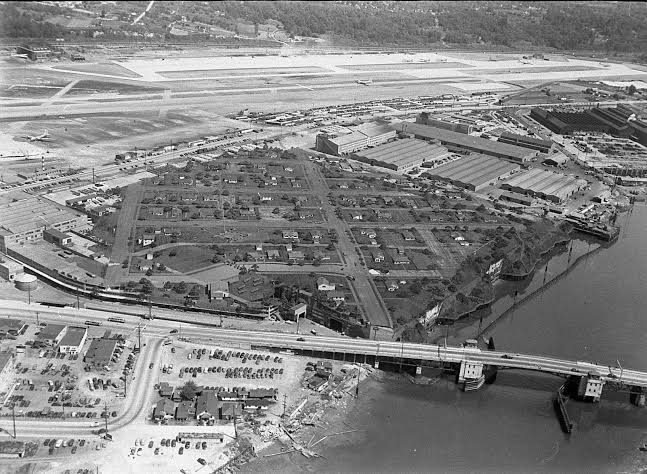
From a certain altitude, it looked like any other quiet American neighborhood — orderly rows of houses, tree-lined streets, the occasional car parked along the curb. Nothing about it suggested urgency, secrecy or the enormous machinery humming just below the surface.
But this neighborhood was not real. There were no families inside those houses, no roots beneath those trees, no foundations under those streets. Everything sat on a rooftop — a vast, carefully engineered illusion laid across one of the most important military manufacturing facilities in the United States.
The structure below was Boeing Plant 2 in Seattle, Washington, one of the primary production sites for American bombers during World War II. And the fake neighborhood sitting on top of it was one of the most ambitious camouflage projects in American wartime history.
The answer to how that disguise worked is documented in Boeing archives, Museum of Flight records and wartime engineering histories. The rooftop was not simply painted — it was built.
Why Boeing’s Factory Needed Camouflage
After the attack on Pearl Harbor in December 1941, the threat of enemy air raids on the American mainland became a genuine operational concern. The Pacific Coast was considered the most vulnerable stretch of the country, and Seattle sat squarely within range of potential long-distance strikes. The city’s position made it a logical target — it was home to Boeing, and Boeing was producing aircraft critical to the Allied war effort.
Plant 2, located along the Duwamish River just south of downtown Seattle, was the factory where Boeing assembled B-17 Flying Fortresses. The B-17 was the heavy bomber backbone of American air campaigns in Europe and the Pacific. Disrupting or destroying Plant 2 would have dealt a significant blow to production capacity at a time when the United States was still scaling up its industrial war effort.
The factory’s footprint made it easy to spot from the air. A large industrial roof, surrounded by roads and rail lines, presented a recognizable signature against the surrounding landscape. Military and civilian planners decided that concealment was the most practical form of protection available. The goal was not to make the building disappear — it was to make it unrecognizable from altitude.
How a Fake Neighborhood Was Built on the Roof
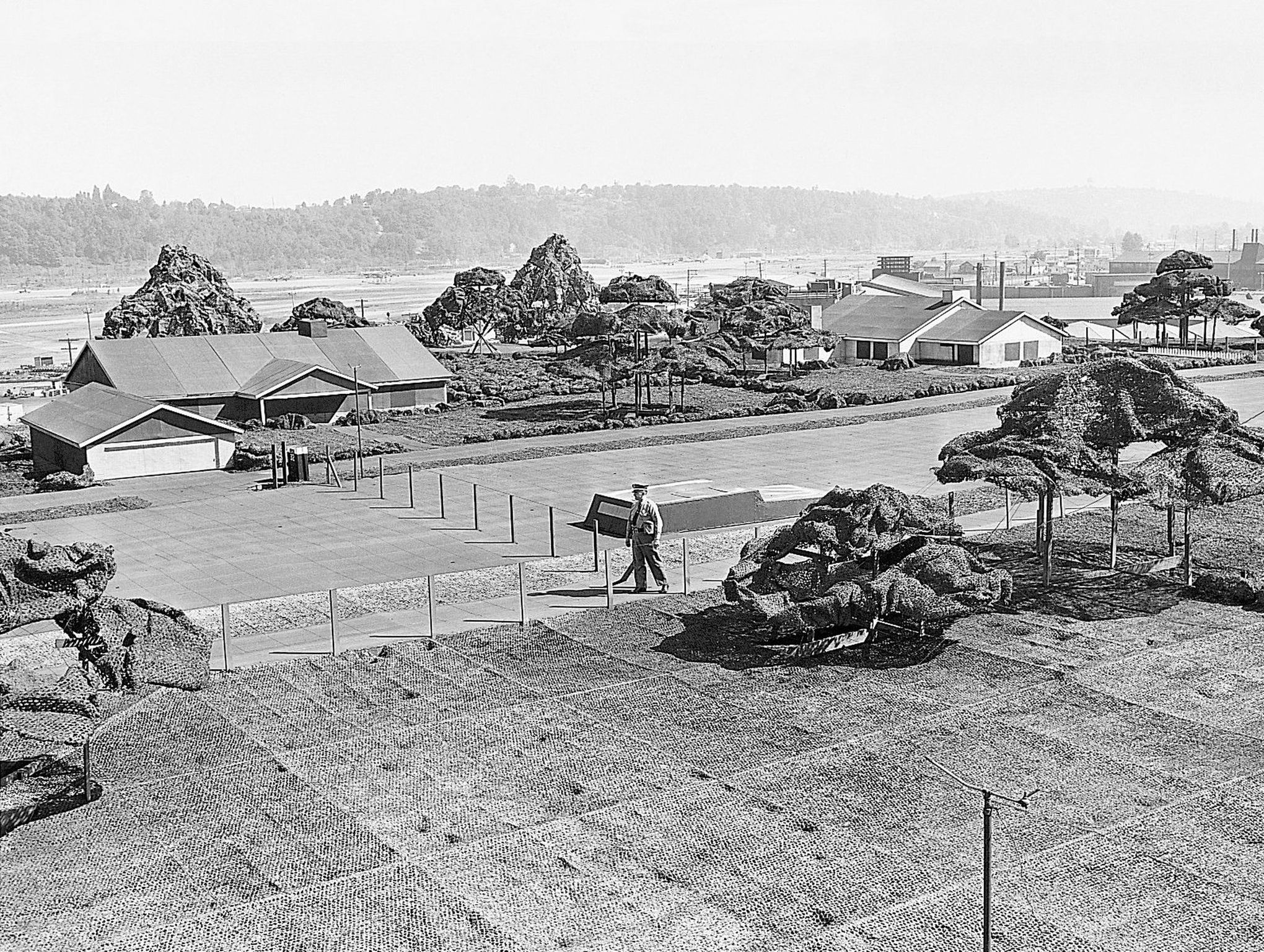
The camouflage project at Plant 2 was designed and overseen by John Stewart Detlie, a Hollywood art director who had been brought in to apply set-design expertise to military concealment work. Detlie and his team approached the problem the way a film production would approach a large outdoor set: with careful attention to how the finished scene would read from a specific viewpoint, in this case, a high-altitude aerial perspective.
The construction team built a lightweight framework across the roof of the plant and then covered it with burlap and wire netting. On top of that base, they placed false-front structures — simplified forms representing houses, garages and other residential buildings. The structures were built from materials light enough not to compromise the roof’s load-bearing capacity. Chicken wire, painted cloth and treated wood were used extensively.
Trees were represented by structures made from wire and painted burlap, designed to approximate the texture and shadow patterns of foliage when viewed from altitude. Streets were painted onto the surface or represented by strips of materials that would read as pavement in aerial photography. Parked cars — also artificial — were positioned to reinforce the residential impression.
The entire installation covered a significant portion of the factory’s roof area. Estimates cited in historical accounts suggest the camouflaged surface extended across hundreds of thousands of square feet, though the exact figure varied across sections of the facility that were treated at different times. Work was carried out in stages as the program expanded, and the rooftop landscape grew more detailed over time.
Lighting was also a consideration. The fake structures were designed to cast shadows that matched those of real buildings at typical Pacific Northwest latitudes and sun angles. The camouflage team used scale models and aerial photography to verify that the illusion held up under actual observation conditions before declaring sections complete.
What the Illusion Looked Like From the Air
Archival aerial photographs from the wartime period show the effect clearly. What appears in those images is not a flawless reproduction of a neighborhood — but it did not need to be. The target was aerial reconnaissance photography interpreted at speed, often under difficult conditions, by observers who were not looking for a hidden factory. The camouflage was engineered to introduce enough visual ambiguity that the roof would not immediately register as a large industrial structure.
The combination of residential-looking shapes, irregular textures and the absence of the flat, reflective industrial roof surface appears to have served its intended purpose. Contemporary military assessments treated the concealment as effective for the scale and technology of the threat being addressed.
It is worth being precise about what the camouflage did and did not accomplish. It did not make Plant 2 literally invisible from the air, and it could not have defeated modern reconnaissance methods. What it did was alter the facility’s aerial signature sufficiently to reduce its recognizability under the conditions that existed in the early 1940s. That distinction matters when reading accounts of the project — the camouflage was a practical wartime measure, not a perfect illusion.
YOUTUBE EMBED — PRIMARY SEARCH QUERY: “Boeing Plant 2 fake rooftop neighborhood camouflage footage”
Life and Production Beneath the Scenery
While the rooftop set was being built and maintained above, the factory floor below continued operating at full industrial pace. Workers at Plant 2 were producing B-17 Flying Fortresses in significant numbers throughout the war years. Boeing’s Seattle facilities collectively built thousands of these aircraft, and Plant 2 was a central node in that output.
Workers inside the plant generally understood that the camouflage existed above them, but the daily rhythm of the factory floor — shifts, assembly lines, parts deliveries — continued without interruption. The structure overhead added no meaningful light or noise to the interior. The plant relied on artificial lighting regardless, as the assembly process required controlled conditions that natural light alone could not provide.
The wartime workforce at Boeing’s Seattle facilities expanded dramatically after Pearl Harbor and included large numbers of women entering industrial manufacturing for the first time. The scale of the operation, combined with the visible effort to protect it from above, reflected how seriously both Boeing and the government treated the facility’s strategic importance.
Maintenance of the rooftop camouflage was an ongoing task. The Pacific Northwest climate — significant rainfall, wind and seasonal variation — meant that the lightweight materials required regular repair and replacement. A dedicated crew managed the rooftop installation throughout the period it remained in use.
YOUTUBE EMBED — SECONDARY SEARCH QUERY: “Museum of Flight Boeing Plant 2 camouflage”
What Happened to Plant 2 After the War
With the end of World War II in 1945, the immediate threat that had justified the camouflage program disappeared. The rooftop neighborhood was dismantled, and Boeing returned Plant 2 to standard peacetime operations. The facility continued to serve as an active manufacturing site for Boeing for decades after the war, used for various aircraft programs as the company transitioned from military to commercial aviation work.
Plant 2 was eventually decommissioned as Boeing consolidated and modernized its facilities. The site was demolished in 2010 after the building was determined to be structurally unsound and contaminated from decades of industrial use. The land along the Duwamish River, itself a designated Superfund cleanup area, became part of ongoing environmental remediation efforts.
The story of the rooftop camouflage has been preserved primarily through archival photographs held by Boeing and through the collections and programming of the Museum of Flight in Seattle. Those photographs remain among the most striking visual documents of American wartime industrial ingenuity — a full-scale neighborhood, built on a rooftop, designed to make one of the country’s most important factories disappear into the landscape from the sky.
When looking at images associated with this story, it is worth confirming that photographs are correctly captioned and sourced. Some images circulating online have been misidentified or misdated. Boeing’s official archive and the Museum of Flight are the most reliable sources for correctly attributed visual documentation of Plant 2 and its wartime camouflage installation.

