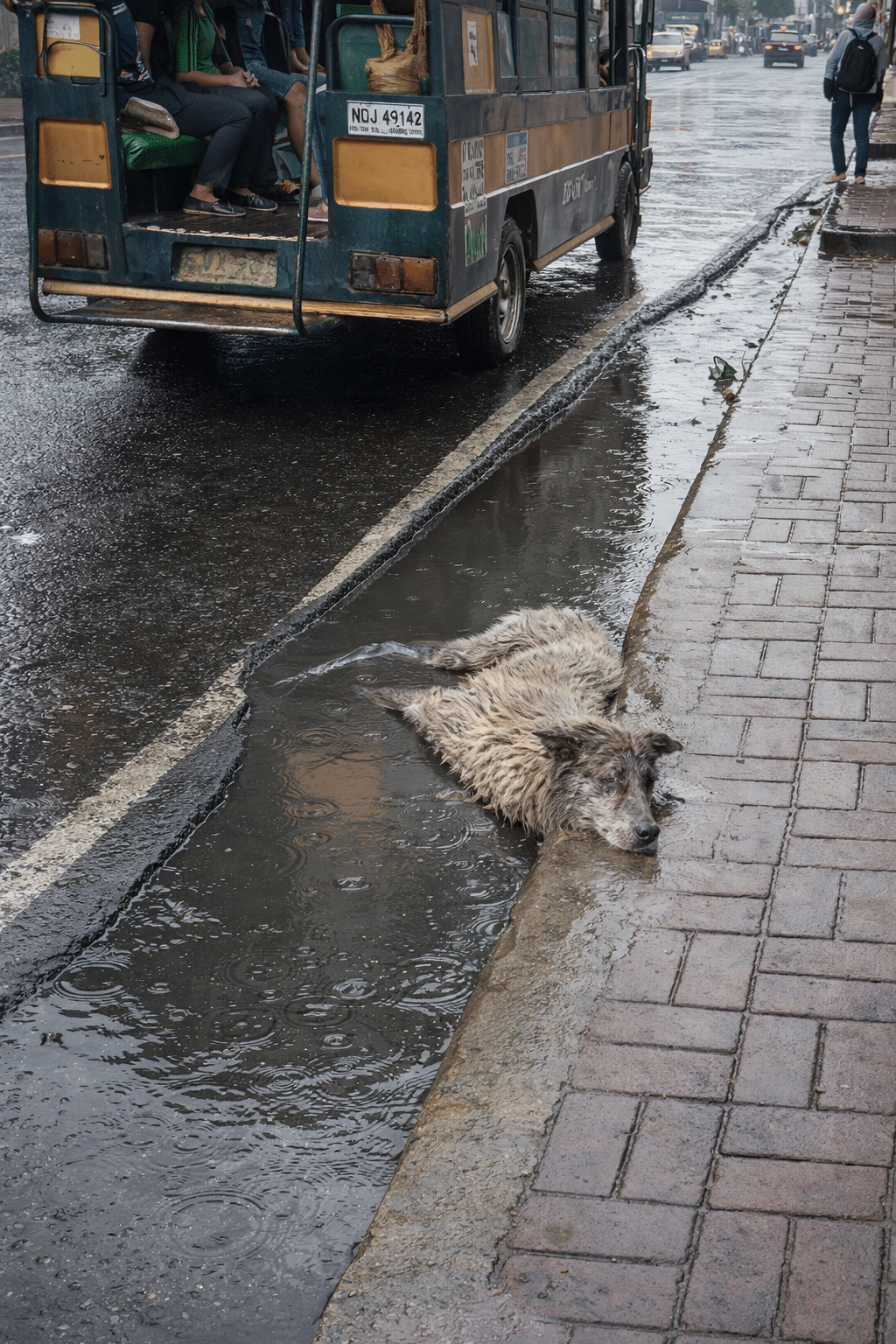
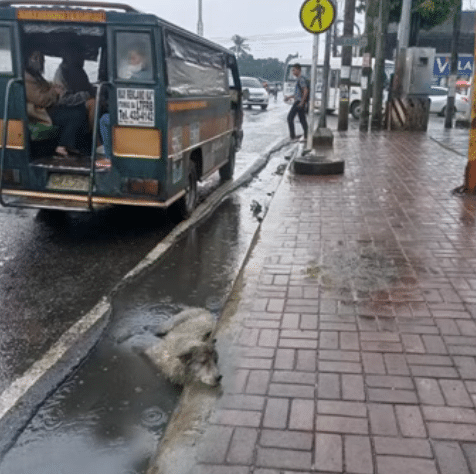
The rain kept falling, but the little dog beside the bus stop could no longer move away from it.
His body was soaked.
His back legs would not respond.
And each time he tried to shift himself from the shallow water beside the road, exhaustion seemed to pull him back down.
Sometime during the cold, rainy night, Borgie had been struck by a passing vehicle.
Morning arrived.
People began moving through the streets again.
And Borgie was still there.
Some commuters noticed the small dog curled beside the curb. Others passed through the bus stop focused on their morning routines.
But Borgie remained alone in the rain until someone finally called for help.
By the time rescuers reached him, they feared the accident might have changed his life forever.
What they did not yet know was that the X-rays would reveal something else entirely—evidence that Borgie had been carrying pain long before that rainy night.
He Had Spent the Night Unable to Escape the Rain
The accident happened near a quiet bus stop.
After being struck, Borgie apparently managed to reach the side of the road, but his body could go no farther.
His hind legs were not working properly.
He could not stand.
He could not simply shake off the rain and search for somewhere dry.
So he remained where he had fallen.
Part of his small body rested in a shallow puddle while rain continued soaking through his coat.
As the hours passed, the cold became another problem.
By morning, Borgie was still curled tightly near the curb.
People began arriving at the bus stop and moving through the wet streets.
Some noticed him.
The injured dog was difficult to miss.
His coat was drenched, his body trembled, and he occasionally made quiet sounds as he lay unable to move normally.
Yet help did not reach him immediately.
For Borgie, there was nothing to do but remain where he was.
Then rescuers arrived.
They approached carefully, unsure how a frightened, injured dog might react to strangers.
But Borgie did not growl.
He did not try to bite.
He barely had the strength to move.
Instead, he lifted his head and watched them.
The rescuers could see how cold and exhausted he had become.
Whatever had happened during the night, the little dog needed medical attention immediately.
They gently lifted him from the wet ground and placed him into their vehicle.
For the first time since the accident, Borgie was moving away from the bus stop.
But no one yet knew whether he would ever be able to move all four of his legs again.
Video: Borgie Was Found Shivering in the Rain—Then Rescuers Discovered Why His Back Legs Wouldn’t Move
The X-Rays Revealed More Than the Accident
At the veterinary hospital, the team began examining Borgie immediately.
The first concern was obvious.
His hind legs were not responding normally.
Because he had reportedly been hit by a vehicle, everyone feared fractures or severe spinal trauma.
X-rays were taken.
Then came the first surprise.
Despite the impact, Borgie had no broken bones.
That should have been reassuring.
Instead, another detail on the images raised new questions.
Several small metal pellets could be seen inside his back.
Their presence suggested that at some earlier point in Borgie’s life, he may have been struck by pellets from an air gun.
The rescuers had believed they were treating the consequences of one terrible night.
Now the images suggested Borgie had already experienced another injury before they ever met him.
Exactly when it happened was unknown.
What mattered immediately was the condition of his legs.
Borgie still could not move them.
Doctors were concerned that damage involving his spine or nerves might leave him with permanent mobility problems.
There were no promises.
No one could tell the rescue team that Borgie would simply rest for a few days and walk away.
His future remained uncertain.
Still, the medical team had something important to work with.
Borgie was alive.
There were no fractures.
And he had people willing to give him every reasonable opportunity to recover.
Recovery Began With the Smallest Movements
Borgie was placed under close observation.
His treatment focused on rebuilding the strength of a body that had endured injury, cold, and exhaustion.
He received nutritious meals along with calcium and vitamins as part of his supportive care.
But food alone would not determine whether Borgie walked again.
His hind legs needed rehabilitation.
Every day, caregivers worked gently with him.
They moved his legs through careful exercises.
They encouraged muscle activity.
They watched closely for any sign that his body might begin responding.
At first, there was very little to celebrate.
Borgie still could not use his back legs normally.
The caregivers could move them for him, but that was very different from Borgie choosing to move them himself.
So the exercises continued.
One day.
Then another.
The people around him did not know exactly what the outcome would be.
They simply repeated the routine.
Support his body.
Help him eat.
Keep him comfortable.
Exercise his legs.
Try again tomorrow.
Meanwhile, another kind of change was beginning.
Borgie started eating more willingly.
He became increasingly aware of the people caring for him.
The expression that had seemed so tired during his first hours began to soften.
When familiar caregivers approached, his tail started moving.
It was not walking.
But it was life returning to a dog who had been found soaked and nearly motionless beside the road.
Then, around the fifth day, something happened that everyone had been hoping to see.
Borgie tried to push himself upward.
Five Days After the Rescue, Borgie Tried to Stand
It began cautiously.
Borgie shifted his body.
His front legs supported him first.
Then, with help nearby, he tried to place weight on his hind legs.
For several days, those legs had seemed almost disconnected from the rest of him.
Now they were trying to participate.
Borgie pushed upward.
For a moment, he stood.
It was not steady.
It was not graceful.
And no one watching could assume that one attempt meant the danger had passed.
But Borgie was standing.
The dog who had been lifted from a puddle because he could not get up had placed his feet beneath himself again.
Then he attempted something even more difficult.
A step.
One small, uncertain movement.
Then another.
His legs were weak.
His balance was imperfect.
But they were responding.
For Borgie’s caregivers, the moment changed the atmosphere surrounding his recovery.
There was finally visible evidence that movement could return.
They continued helping him carefully, knowing that too much strain could undo progress.
Borgie rested.
Then practiced again.
Each successful attempt became a foundation for the next one.
A few steps became more.
Standing became less uncertain.
His muscles began strengthening through repeated use.
The recovery everyone had been afraid might never happen was beginning slowly in front of them.
Walking Again Was Only the Beginning
Borgie’s first steps did not mark the end of treatment.
They marked the beginning of a much longer rehabilitation.
His body still needed time.
Muscles weakened by immobility had to become stronger.
Coordination had to improve.
Confidence needed to follow physical ability.
So therapy continued.
Day after day, Borgie practiced using his legs.
Movement gradually became more natural.
He could remain upright longer.
He learned to trust his own body again.
Regular nutrition also began changing his appearance.
The thin, exhausted dog rescued from the rain slowly filled out.
His coat improved.
His energy increased.
And as Borgie felt better physically, his personality became easier to see.
He responded warmly to the people around him.
His tail wagged more often.
Instead of lying still and watching the world from the ground, Borgie became increasingly interested in participating in it.
The shift was important.
Rescue had started with an emergency.
Get him away from the road.
Get him warm.
Find out why he could not move.
But long-term recovery was built through ordinary repetition.
Another meal.
Another therapy session.
Another attempt to stand.
Another day in which no one gave up because progress seemed too slow.
There was no single treatment session that transformed Borgie.
His improvement accumulated.
Days became weeks.
Weeks became months.
And the little dog who had once seemed unable to control his hind legs kept getting stronger.
Seven Months Later, He Barely Resembled the Dog From the Bus Stop
Seven months passed after Borgie was rescued.
By then, the difference was striking.
His body had regained strength.
His coat appeared healthier.
His movements were no longer those of the helpless dog rescuers had carried from the rain.
He had become active.
Playful.
Energetic.
The comparison was difficult to ignore.
Seven months earlier, Borgie had been lying beside a road unable to stand.
Rainwater surrounded him.
Cold had left him trembling.
His rescuers did not know whether his back legs would work again.
Now Borgie could move freely.
Every run carried evidence of the work that had gone into his recovery.
The veterinary care mattered.
The physical therapy mattered.
The nutrition mattered.
But so did the decision to keep trying during those early days when there was almost no visible improvement.
Animals recovering from serious injuries do not understand treatment plans.
They do not know what an X-ray means.
They cannot be told that therapy may require weeks or months.
They simply experience what happens next.
For Borgie, what happened next was repetition.
People kept returning.
They moved his legs.
They fed him.
They encouraged him.
And slowly, his body answered.
But there was still something Borgie did not have.
A permanent family.
His rescuers had helped him survive.
Now they wanted the life he had fought so hard to regain to include a home of his own.
The Dog Who Couldn’t Stand Was Finally Running
Eventually, Borgie found a family.
After the accident, the uncertainty surrounding his legs, and months of rehabilitation, he finally had a place where his safety did not depend on the next rescue call.
He had a home.
A warm place to sleep.
People responsible for his care.
And space to enjoy the mobility he had worked so hard to regain.
The final images of Borgie’s journey make the contrast especially powerful.
There is no puddle.
No bus stop.
No rain-soaked dog unable to move.
Instead, Borgie runs across a grassy area.
His legs carry him forward.
His tail moves enthusiastically.
He plays near the people who became his family.
For anyone who had seen him during those first hours, watching Borgie run must have felt almost impossible.
But his transformation had not happened through one miraculous moment.
It had been built one uncertain step at a time.
The first time he ate willingly.
The first movement in his hind legs.
The first attempt to stand.
The first shaky steps.
The continued therapy.
The months of strengthening.
Every small milestone had led toward this version of Borgie.
Not simply alive.
Living.
Borgie’s Story Began With Someone Choosing to Stop
There is one part of Borgie’s rescue that is easy to overlook after seeing how well he eventually recovered.
Before the hospital.
Before the X-rays.
Before therapy.
Before he stood.
Someone had to notice that the dog beside the bus stop needed help.
Borgie could not move himself to safety.
He could not explain what had happened.
He could not tell anyone that he had spent the night in the rain or that his hind legs were not working.
His condition had to speak for him.
Eventually, someone listened.
That intervention opened the door to everything that followed.
Rescuers removed him from the cold.
Veterinarians discovered that there were no fractures and identified the pellets inside his back.
Caregivers committed themselves to rehabilitation even when improvement was slow.
And months later, a family gave Borgie the permanent home he needed.
None of those later chapters could have happened if the first one had ended beside the curb.
That is what makes stories like Borgie’s important.
They remind us that rescue often begins before anyone knows whether there will be a happy ending.
The people who lifted Borgie from the rain did not know he would walk.
They did not know that seven months later he would be running.
They certainly did not know that a family would eventually be waiting for him.
They only knew that an injured dog was lying outside in terrible weather and needed someone to act.
So they acted.
From a Rainy Roadside to a Life Surrounded by Care
Borgie’s past cannot be rewritten.
He was hit by a vehicle.
The X-rays suggested that pellets had already been lodged in his back from an earlier incident.
He spent hours injured in the rain.
For a time, he could not use his hind legs.
Those things remain part of his story.
But they are no longer where the story ends.
Today, the image of Borgie lying motionless beside the bus stop has been replaced by something entirely different.
A dog moving under his own strength.
A dog playing.
A dog surrounded by people who chose to keep him safe.
His recovery offers a simple reminder about injured and abandoned animals.
We cannot always know how much they have already endured.
We cannot always know whether treatment will work.
And we cannot promise every rescue will have the outcome we hope for.
What we can do is give them the opportunity.
Borgie received that opportunity because people were willing to carry him from the rain, investigate what was wrong, and continue working with him when his future remained uncertain.
Five days after being unable to move his hind legs, he began taking tentative steps.
Seven months later, he was a transformed dog.
And eventually, those recovering legs carried him into a life where he would no longer be left waiting beside the road for someone to notice him.
Once, Borgie could only lie in the rain and watch the world pass.
Now he can run toward the people who chose him.
And perhaps that is the most meaningful part of his journey.
He was not simply given the ability to walk again.
He was given somewhere worth walking toward.


