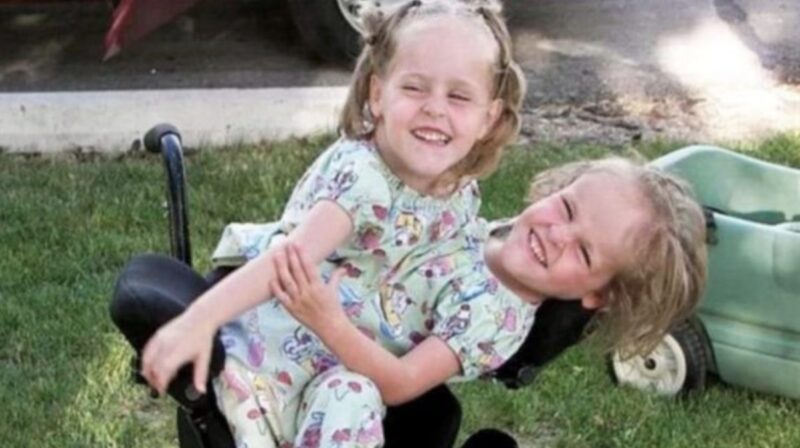
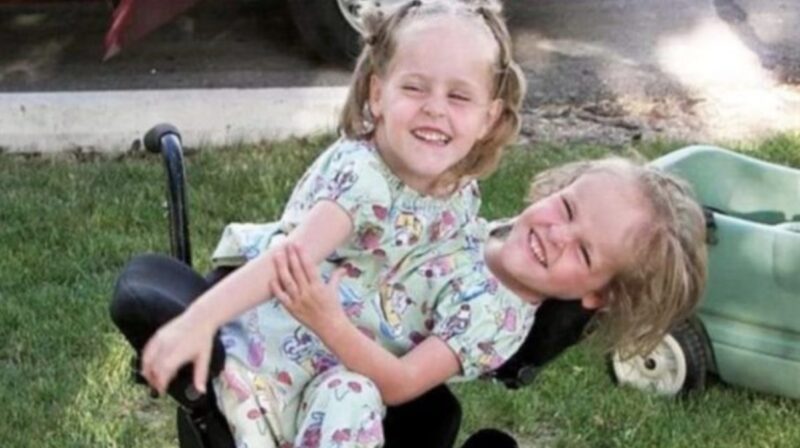
When Jake and Erin Herrin welcomed twin daughters Kendra and Maliyah into the world in February 2002, their happiness came with an overwhelming uncertainty about what the future might hold.
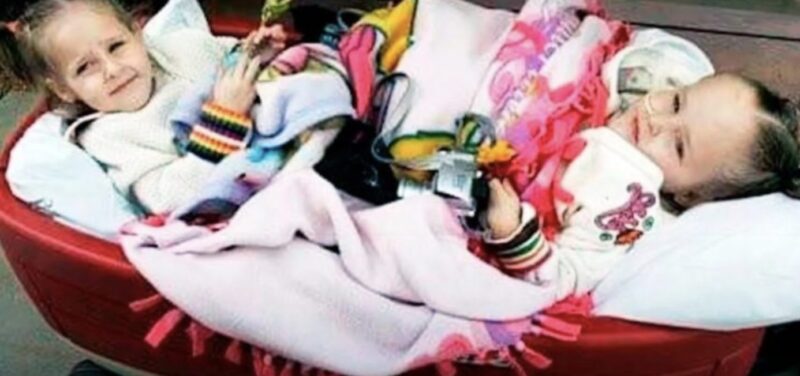
The girls were born conjoined at the abdomen and pelvis, facing one another in an almost permanent embrace.
Their bodies were connected in ways that made everyday life incredibly complicated. They shared several organs and parts of their lower body, including a liver, a kidney, a pelvis and two legs.
Each sister controlled one leg.
Yet from their earliest years, Kendra and Maliyah learned to do something extraordinary: work together as one team while developing two very different personalities.
Two Sisters Learning to Move Through the World Together
For the first four years of their lives, nearly every physical movement required cooperation.
If the girls wanted to move in one direction, both had to coordinate. If they wanted to play, sit or explore their surroundings, they had to understand what the other was doing.
What might have seemed impossible to outsiders simply became normal life for Kendra and Maliyah.
Their parents watched as the sisters developed their own interests, preferences and personalities, even though they remained physically connected.
But one enormous question remained.
Would it ever be possible for the girls to live independently?

Their Parents Faced an Almost Impossible Decision
Doctors and the Herrin family spent years considering whether separation was medically possible.
This was not a routine operation.
The twins shared vital anatomy, and separating them would mean dividing organs, reconstructing parts of their bodies and determining how each child could survive independently afterward.
There were serious risks.
But remaining conjoined would also shape nearly every aspect of their future.
Eventually, their parents made the difficult decision to move forward with separation surgery.
Kendra and Maliyah were four years old.
A Surgery That Captured International Attention
In August 2006, Kendra and Maliyah entered Primary Children’s Medical Center in Salt Lake City, Utah, for the operation that would change their lives forever.
A large medical team worked for approximately 26 hours.
Surgeons carefully separated their shared anatomy, divided portions of their liver and intestines, and reconstructed their pelvises and other organs.
Each girl was left with one leg.
There was another major challenge: the twins had shared only one functioning kidney.
Kendra kept that kidney, while Maliyah began dialysis and would later need a transplant.
When the operation was finally completed, something happened that their parents had never experienced before.
For the first time since birth, Kendra and Maliyah were placed in separate beds.
They were no longer physically connected.
They were two little girls beginning two separate lives.
Separation Was Only the Beginning
The surgery may have separated the sisters, but it did not instantly make life easy.
Both children faced a long recovery.
They had to learn how to balance and move with one leg. Everyday activities that other children learned almost automatically required patience, therapy and determination.
Maliyah faced an additional medical challenge because she no longer had a functioning kidney of her own.
She underwent dialysis for months before receiving a kidney donated by her mother in 2007.
Meanwhile, both sisters began adapting to prosthetic limbs, crutches and new ways of moving independently.
Progress came step by step.
Things that once required cooperation between two bodies now had to be relearned individually.
They Soon Returned to an Ordinary Childhood
Despite everything they had endured, Kendra and Maliyah did not want their lives to revolve entirely around hospitals and medical procedures.
They wanted what other children wanted.
School.
Friends.
Hobbies.
Family time.
The sisters eventually attended school and became increasingly independent. They enjoyed creative activities and continued to share the close relationship they had developed long before their separation.
Their story attracted enormous public attention, but at home they were still simply sisters growing up together.
The bond created during their first four years never disappeared.
Physical separation gave them independence, but it did not make them less connected emotionally.
Their Bond Remained Just as Strong
Years passed, and the little girls whose separation once made headlines grew into young women.
They learned to navigate life on their own terms and continued finding ways to overcome physical challenges that most people would never experience.
One of the most striking parts of their journey is how naturally they continued choosing to spend time together.
For four years, being together had not been optional.
Later, it became a choice.
And they kept choosing one another.
Their relationship evolved from two children physically connected from birth into two independent sisters who shared a history almost impossible for anyone else to fully understand.

More Than Two Decades After Their Birth
Kendra and Maliyah were born on February 26, 2002.
That means the sisters turned 24 years old in 2026.
It is a remarkable milestone when compared with the uncertainty surrounding their earliest years.
The photographs and stories of Kendra and Maliyah as adults are especially striking when placed beside images from their childhood.
The two little girls who once had to coordinate almost every movement eventually grew into young women capable of navigating the world separately.
Their medical journey was extraordinary.
But perhaps the most memorable part of their story has little to do with medicine.
It is the relationship between two sisters who spent the first years of their lives closer than almost any two human beings could possibly be — and who remained close even after they were finally given the freedom to live apart.
Two Separate Lives, One Extraordinary Connection
Kendra and Maliyah’s story began with enormous uncertainty.
Doctors faced difficult medical questions. Their parents faced decisions few families could imagine. And two very young girls faced a future that nobody could predict.
Yet the surgery that once seemed almost impossible opened the door to two independent lives.
Today, their journey remains an extraordinary example of medical progress, family devotion and resilience.
They entered the world physically joined together.
At four years old, they began learning how to live separately.
More than two decades later, they remain sisters connected by something surgery could never separate.