The landscape was almost completely silent.
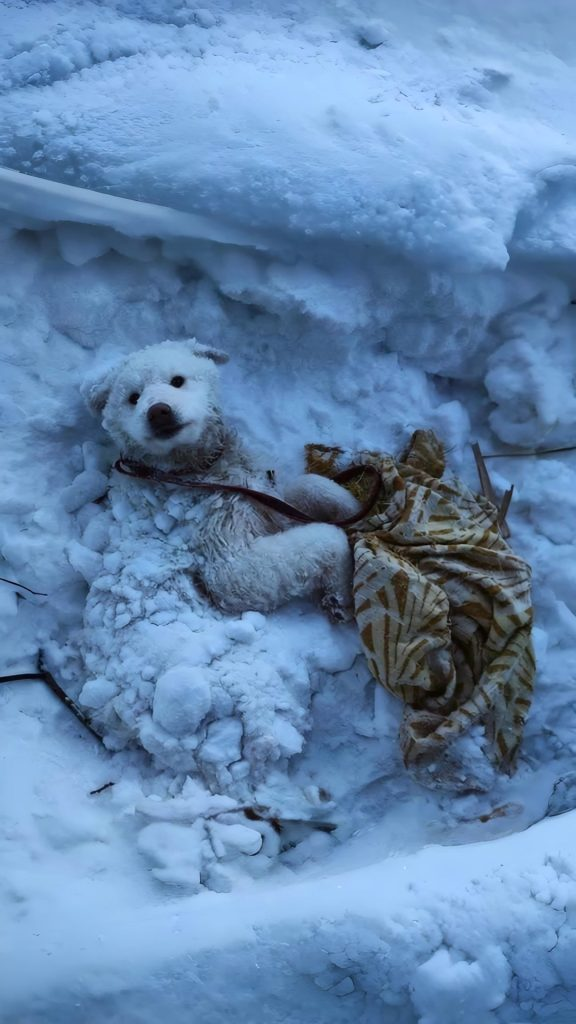
Snow covered the roads, the trees, and everything between them, turning the world into an endless stretch of white. A man was walking through the freezing landscape that morning for one reason—he was searching for his missing dog.
Then something beneath the snow caught his attention.
At first, it was difficult to understand what he was looking at.
A shape.
A slight movement.
Something that did not belong there.
He hurried closer and dropped to his knees.
As his hands brushed away the frozen layer, a white dog slowly emerged from beneath the snow.
A leash was still around his neck.
And somehow, he was still alive.
Beneath the Snow Was a Dog Who Could Barely Respond
The dog would later be named Bely.
When the man found him, much of Bely’s body was buried beneath the frozen surface. From the waist down, he was dangerously cold, and there was almost no visible response when the man touched him.
His breathing was shallow.
His body barely moved.
There was no time to determine how long he had been there or how he had ended up alone in such conditions.
What mattered was getting him somewhere warm.
The man lifted Bely from the snow and rushed him toward veterinary care.
At the clinic, the seriousness of his condition quickly became clear.
Bely was suffering from severe hypothermia and dehydration. His body had been pushed to a dangerous point, and his organs were beginning to struggle.
The veterinary team worked to stabilize him while monitoring every small change.
At that stage, no one could promise that he would recover.
They could only give him a chance.
VIDEO: Buried Beneath the Snow, Bely Was Barely Alive When a Stranger Found Him
The X-Rays Revealed Another Problem No One Could See
Once Bely was stable enough for further examination, veterinarians began looking for injuries beyond those caused by the cold.
The imaging revealed something far more serious.
His spine was fractured.
Suddenly, the rescue became more complicated.
Even if Bely survived the hypothermia and dehydration, the spinal injury threatened his ability to move normally again.
He was transferred to a larger medical facility where more advanced treatment could be provided.
There, the team faced a difficult decision.
Bely was extremely weak.
Surgery would be demanding.
But without intervention, his prospects were even more uncertain.
As long as his condition allowed them to continue, the team decided they would try.
The operation lasted approximately four hours.
For the veterinarians working around his damaged spine, every movement required care and precision.
Eventually, the procedure was completed.
Bely had survived the surgery.
But surviving the operating room was only the first step.
After Surgery, Even One Bite of Food Mattered
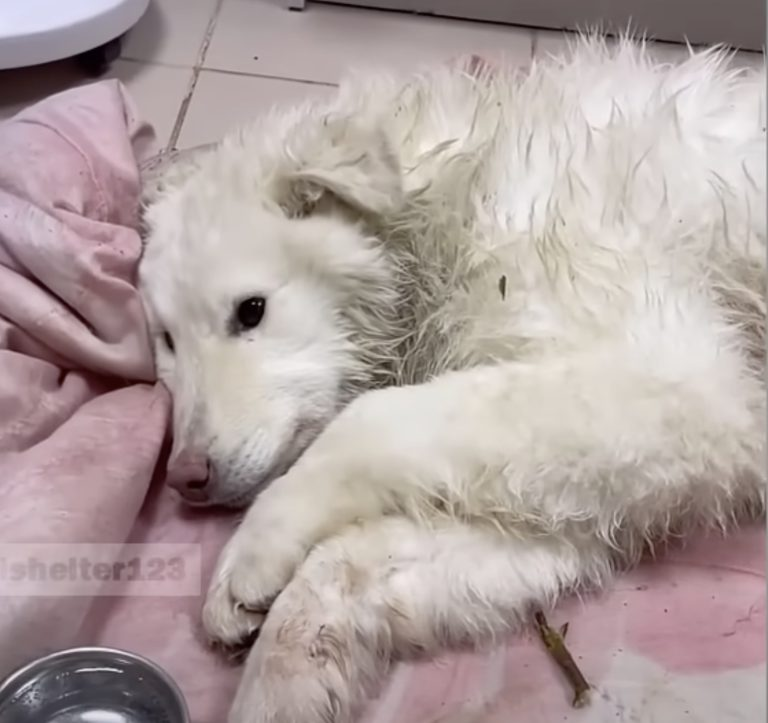
The days that followed were difficult.
Bely remained weak and showed little interest in food.
His body was recovering from the cold, dehydration, spinal trauma, and a major surgical procedure all at once.
Caregivers stayed nearby.
They offered food.
They spoke softly.
They watched for any indication that his strength was beginning to return.
For a while, very little changed.
Then Bely ate.
Not an entire meal.
Just a small bite.
Under ordinary circumstances, it would have seemed insignificant.
For Bely, it meant his body was beginning to respond.
That first bite became another.
Gradually, food returned to his routine, giving his body the nourishment it needed for the long recovery ahead.
There were still complications.
At one point, a painful bladder infection interrupted his progress and required additional treatment.
Recovery did not follow a straight line.
There were difficult days mixed between the encouraging ones.
But the small improvements continued.
Bely lifted his head more often.
His breathing became steadier.
His tail began to move.
Each change offered another reason to keep going.
Rehabilitation Asked Him to Learn Movement All Over Again
As Bely became medically stronger, attention shifted toward his damaged spine and mobility.
Standing was no longer something his body could take for granted.
He needed rehabilitation.
One part of that process involved an underwater treadmill.
The water helped support Bely’s weight while allowing him to practice moving his legs with less pressure on his recovering body.
At first, his movements were uncertain.
Every step required concentration.
Caregivers remained close as he worked through the exercises.
There was no sudden transformation.
Rehabilitation depended on repetition.
One attempt.
Then another.
And another.
Some sessions brought noticeable improvement.
Others simply gave Bely another opportunity to practice.
But over time, the efforts began adding up.
His legs became stronger.
His balance improved.
And slowly, a dog who had once been unable to support himself began discovering what his body could do again.
Then Came the Day Bely Stood on His Own
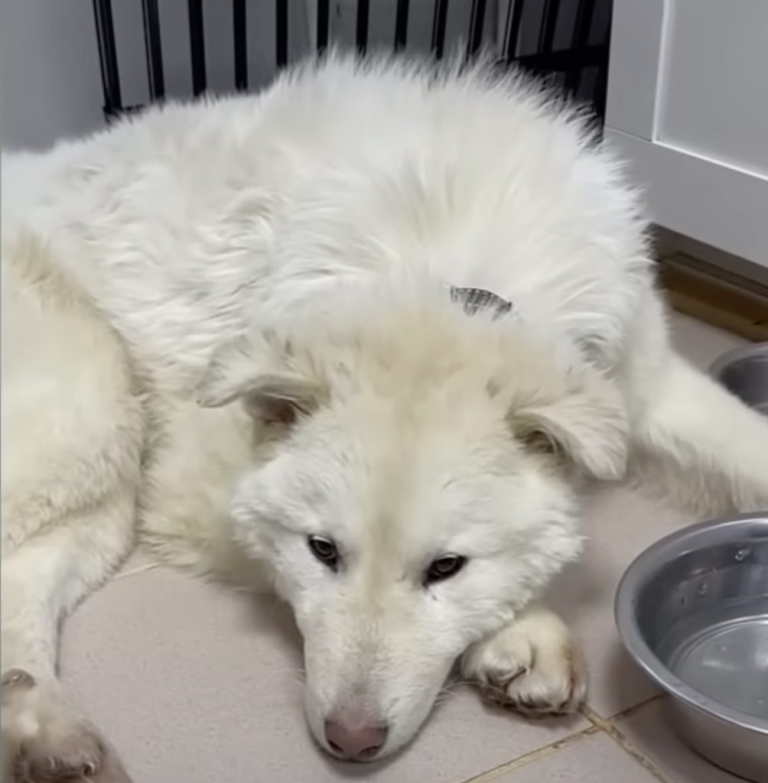
Weeks became months.
The dog who had once been carried from beneath the snow was now spending his days working toward a goal that once seemed far away.
Standing independently.
During rehabilitation, Bely kept trying to position his legs beneath him.
At first, he still needed support.
Then came a moment when the support became unnecessary.
Bely stood.
On his own.
For the people who had seen him at the beginning, the sight was difficult to reconcile with the dog they remembered.
That Bely had barely responded when lifted from the snow.
This one was holding himself upright.
Standing did not mean rehabilitation was finished.
His muscles still needed strengthening, and movement still required practice.
But a major barrier had been crossed.
Bely had gone from surviving one hour at a time to rebuilding the ability to move through the world again.
Ten Months Later, the Snow Looked Completely Different
Nearly ten months after his rescue, Bely returned to a landscape covered in snow.
Only this time, no one had to uncover him.
He was running across it.
His coat looked healthy.
His body was stronger.
His eyes were alert as he moved freely through the same kind of winter landscape where his life had nearly ended.
The contrast was remarkable.
Months earlier, the snow had hidden his nearly motionless body.
Now it scattered beneath his paws as he ran.
The cold landscape itself had not changed.
Bely had.
The recovery had required emergency treatment, spinal surgery, medication, careful feeding, rehabilitation, and months of patience.
There had been complications and moments when the outcome remained uncertain.
Yet eventually, Bely reached something far beyond simply surviving.
He could move again.
He could explore.
He could run.
Everything Began Because Someone Looked Twice
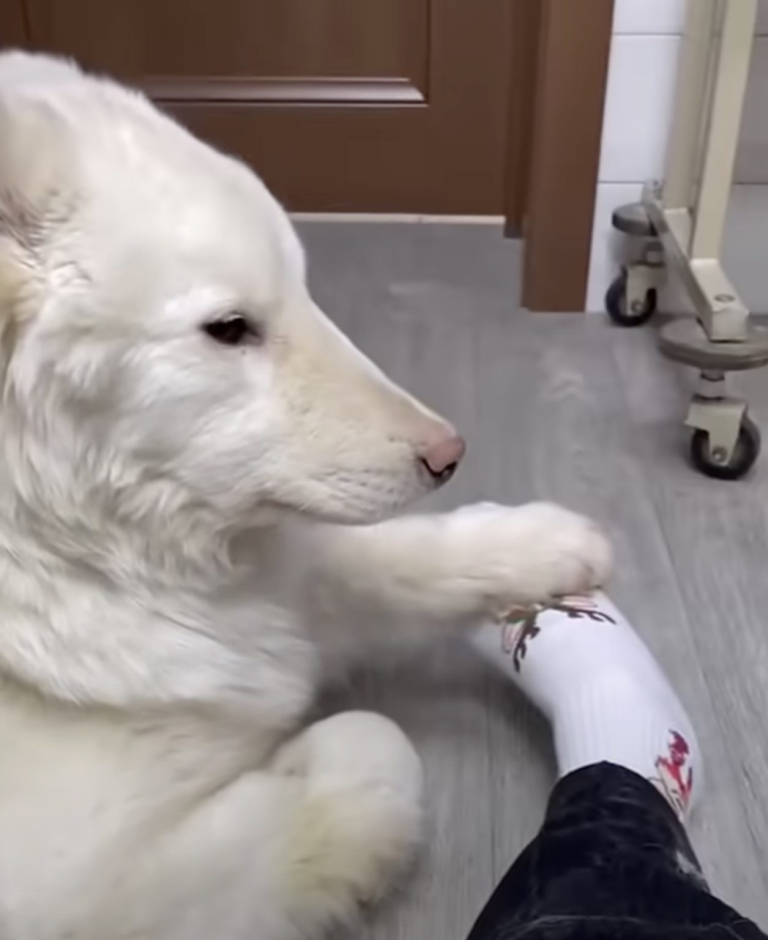
The man walking through the snow that morning had been searching for his own missing dog.
He could easily have mistaken the small white shape beneath the snow for part of the frozen landscape.
Instead, he noticed movement.
Then he stopped.
That decision began everything that followed.
The emergency clinic.
The discovery of the spinal fracture.
Four hours of surgery.
The first bite of food.
The difficult rehabilitation sessions.
The first time Bely stood.
And eventually, the sight of him running across the snow again.
Bely’s recovery was not created by one dramatic moment.
It was built from many people continuing to care after the initial rescue was over.
Veterinarians treated the injuries they could see.
Caregivers stayed through the days when progress was difficult to measure.
Rehabilitation gave his body time to relearn movements that had once been ordinary.
But none of those moments could have happened if someone had not noticed that tiny movement beneath the snow.
Once, Bely lay almost completely hidden beneath the frozen ground.
Ten months later, he was running across it.
And everything between those two moments began because one stranger chose to look closer.


