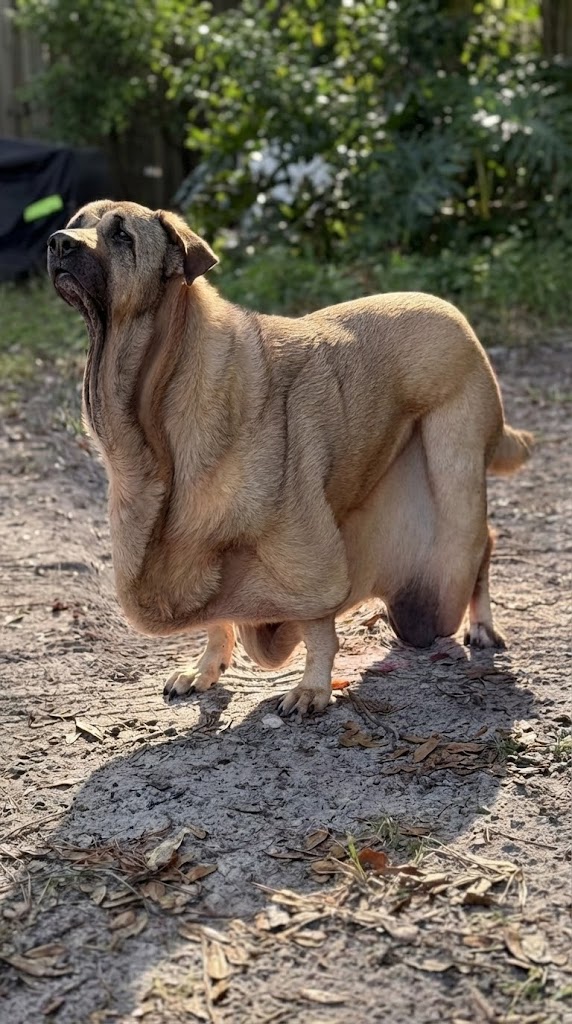
Caramel was not the kind of dog who rushed toward visitors.
While other dogs barked, bounced against kennel doors, or tried to attract attention, he usually remained farther back.
His body looked different too.
Loose folds of skin covered much of his small frame, giving him deep wrinkles that immediately caught the eye.
Some visitors stopped briefly.
Many kept walking.
And Caramel stayed where he was.
Then one family came through the shelter and did something simple.
They stopped long enough to meet him.
His Wrinkled Skin Made Him Look Different From the Other Dogs
Caramel’s appearance was not the result of recent injury.
According to the original rescue account, he had Ehlers-Danlos Syndrome, a genetic connective-tissue condition that can cause unusually loose and fragile skin.
That explained the folds covering his body.
It was not contagious.
And the source does not suggest that the condition affected his ability to be affectionate or live as a companion dog.
But in a shelter, first impressions matter.
Visitors often make choices quickly.
Caramel’s unusual appearance made him stand out physically while his quiet behavior made him easy to pass by.
Video: Caramel Hides in the Back of His Shelter Kennel Until One Family Finally Stops
He Rarely Tried to Compete for Attention
Shelter staff had grown familiar with Caramel’s routine.
He did not usually rush forward when someone entered.
He often stayed curled toward the back of the enclosure.
The original story describes him as increasingly withdrawn after being overlooked repeatedly.
We cannot know exactly what Caramel understood about visitors passing his kennel.
What could be observed was that he was quiet and hesitant around unfamiliar people.
He was not described as aggressive.
He simply did not advertise himself the way some shelter dogs naturally do.
That meant someone would have to notice him without being called over.
One Family Knelt Down Instead of Moving On
Eventually, a family came through the shelter.
They took their time with the dogs rather than moving quickly from enclosure to enclosure.
When they reached Caramel, they stopped.
They knelt near him.
Spoke softly.
And waited.
At first, Caramel did not immediately move toward them.
Then he looked up.
The family remained there.
They were willing to learn about his condition and meet the dog behind the unusual folds of skin.
Soon afterward, they chose to adopt him.
For Caramel, leaving the shelter was only the beginning of the adjustment.
Home Did Not Instantly Make Him Confident
A new house meant unfamiliar rooms, sounds, smells, and people.
Caramel did not immediately behave like a dog who had always lived there.
According to the source, he sometimes growled when uncertain.
Fast hand movements could make him flinch.
At times, he retreated to corners rather than joining the family.
Those reactions were not treated as a reason to return him.
His adopters gave him space.
They did not force petting.
They did not pull him out of hiding places.
Instead, they allowed him to observe the household at his own pace.
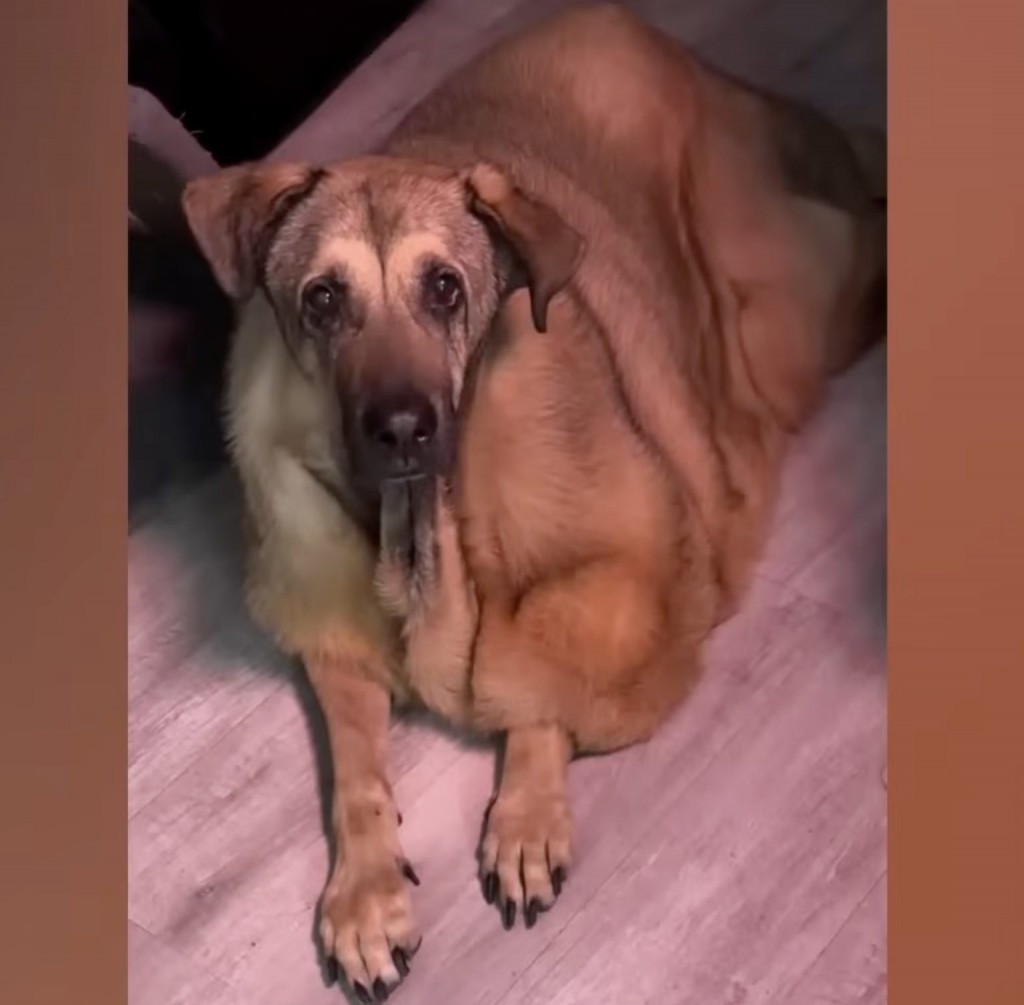
His Family Let Him Decide When to Come Closer
Progress appeared in small behaviors.
Caramel stayed in the same room for longer periods.
His posture became more relaxed.
He tolerated people moving near him without immediately backing away.
Then his tail moved when familiar family members approached.
Later, he began closing the distance himself.
A nose against a hand.
A quiet approach.
Remaining beside someone instead of returning to a corner.
Nothing needed to be rushed.
Each interaction that ended calmly gave Caramel another predictable experience in his new home.
Then He Started Playing
As the weeks passed, the family began seeing behaviors that had rarely appeared at the shelter.
Caramel explored.
He approached people for attention.
He became more comfortable around the other animals in the household.
Then he chased a toy.
For his family, that moment stood out because play requires energy and willingness to engage with the environment.
Soon, it was no longer an isolated event.
Caramel ran through the house.
Rolled outside.
Rested on the couch.
And spent more time near his animal companions.
The dog who had once remained in the back of a kennel was now choosing to be part of whatever was happening around him.
His Condition Never Needed to Disappear
Caramel’s skin still looked different.
The folds did not vanish after adoption.
Nor did they need to.
His Ehlers-Danlos Syndrome remained part of his medical condition and required the family to understand that his skin could be more delicate than that of other dogs.
But once he was home, his wrinkles stopped being the main story.
His personality became easier to notice.
He could be affectionate.
Playful.
Curious.
And comfortable enough to seek company.
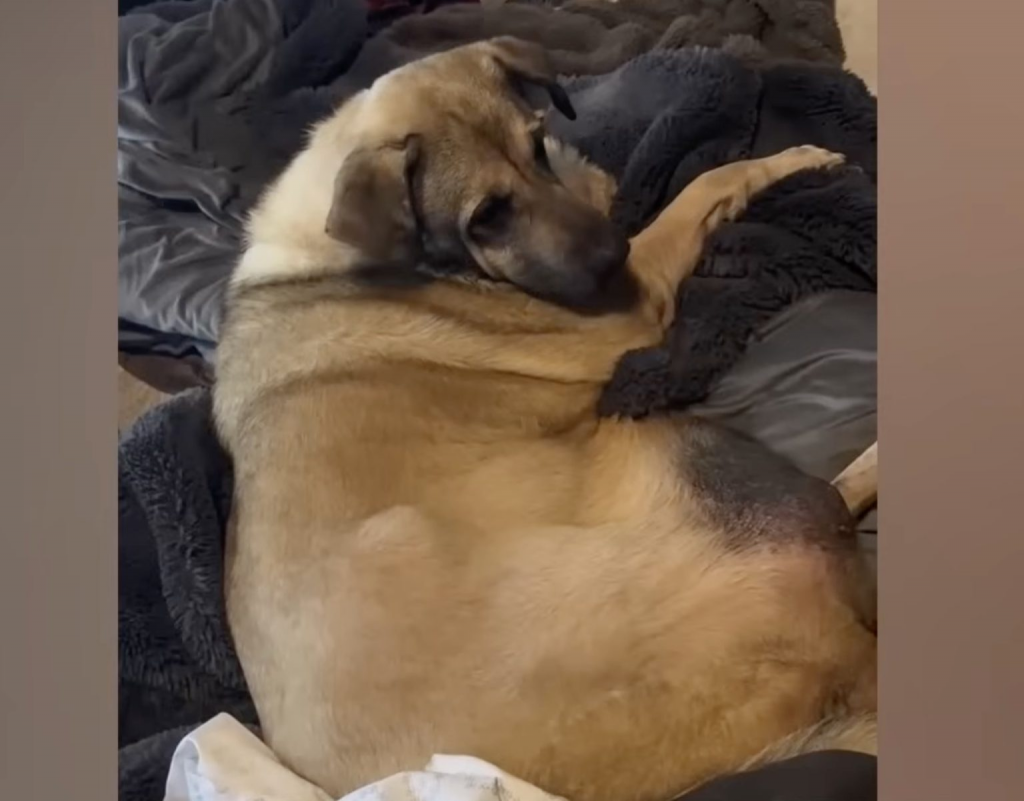
The Quiet Dog Became Part of the Household
Eventually, Caramel settled into routines that looked completely ordinary.
He had soft places to sleep.
People he recognized.
Other pets nearby.
And the freedom to move toward affection when he wanted it.
Instead of spending most of his time curled away from visitors, he began following his family from room to room.
He rested beside them.
Accepted gentle touch.
And joined in when it was time to play.
The biggest change was not that Caramel suddenly became a different dog.
It was that his environment finally gave him enough time to show more of who he already was.
Someone Had to Stop Long Enough to See Past the Wrinkles
Caramel’s story did not begin with an emergency rescue.
There was no roadside chase.
No dramatic medical procedure.
He was already inside a shelter.
He already had food and a roof.
What he still needed was a home.
His unusual skin condition made him physically memorable, but his quiet behavior made it easy for visitors to keep moving.
Then one family stopped.
They learned what caused the wrinkles.
They gave him time after adoption.
And when he responded cautiously, they did not demand that he change overnight.
Eventually, Caramel started approaching them on his own.
Playing.
Resting nearby.
Following people through the house.
He did not need to become less different to be chosen.
Someone simply had to stay at his kennel long enough to meet him.


