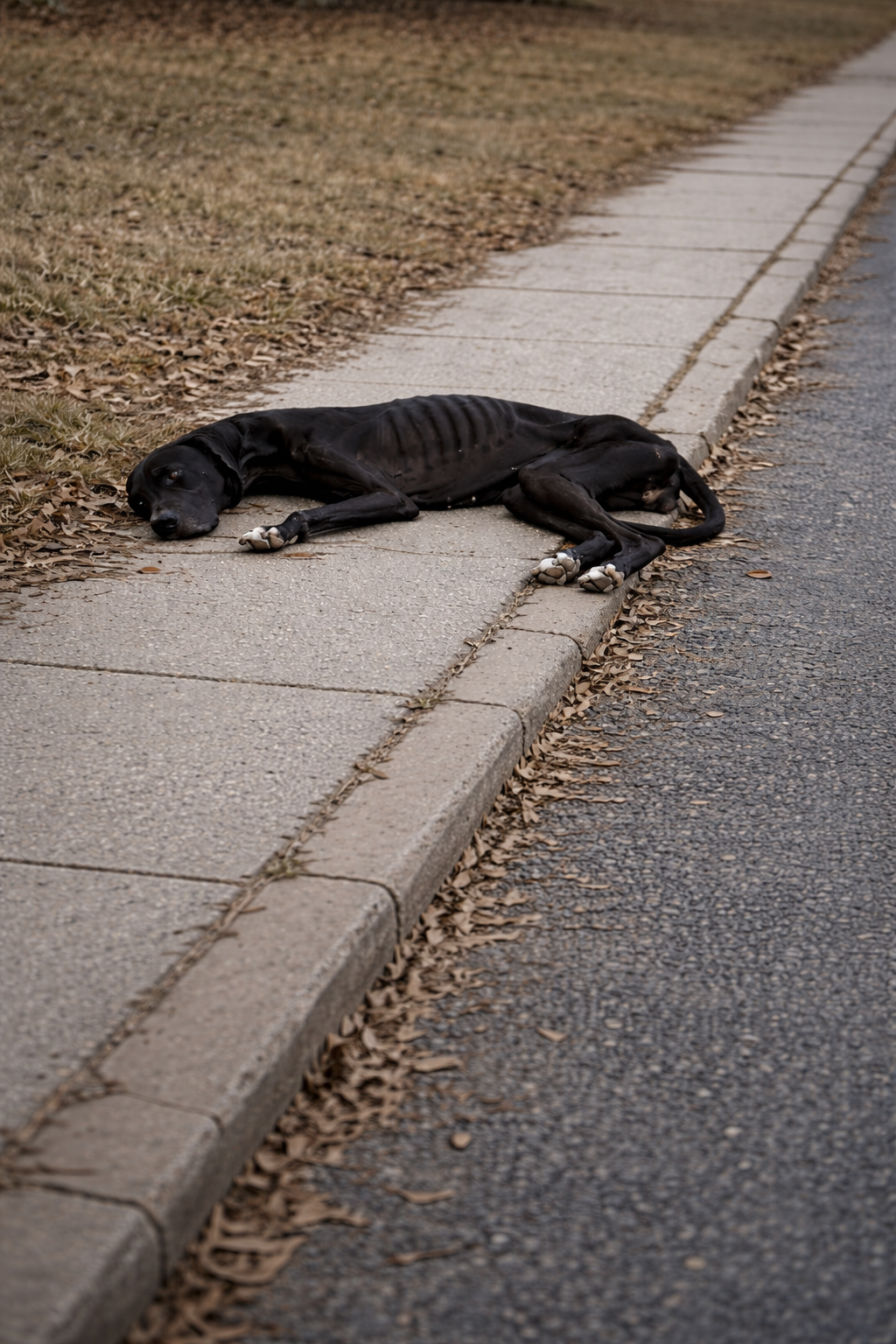
Lola was lying where no dog should ever be left.
In the middle of the road.
Cars moved around her.
People passed.
And the large black Great Dane remained almost motionless on the pavement.
At first glance, her size made her seem strong.
Then someone looked closer.
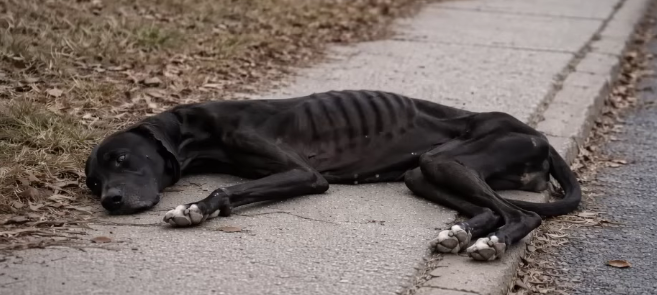
Her ribs stood out beneath her coat.
Her hips were sharply visible.
Her muscles had wasted away to the point that even lifting her head appeared difficult.
Lola was estimated to be only five or six years old.
Yet exhaustion made her look far older.
She did not have enough strength to move herself out of danger.
Eventually, rescuers reached her.
They lifted the dog who could no longer carry her own weight and rushed her toward veterinary care.
Only then did they discover that hunger was not the only thing Lola had been fighting.
Her Thin Body Was Hiding a Much Bigger Medical Crisis
At the clinic, Lola’s condition became even more concerning.
Her breathing was shallow.
Her body had lost an extreme amount of weight.
The muscles needed for standing and walking were badly depleted.
Every bone seemed visible beneath her skin.
The veterinary team began testing her.
The results revealed severe heartworm disease.
That diagnosis created a difficult situation.
Heartworm treatment requires careful medical management.
But Lola’s body was already profoundly weak.
She needed treatment.
She also needed enough physical stability to tolerate it.
During the first hours of care, additional problems appeared.
Her temperature rose.
She began vomiting.
Thick nasal discharge raised concern that her already weakened body was also dealing with infection.
The team could see that Lola had been struggling for a long time.
Now everything had to be handled carefully.
Nutrition.
Hydration.
Infection.
Heartworm.
Weakness.
And a body that had very little reserve left.
Yet whenever someone spoke gently near her, Lola did something they did not expect.
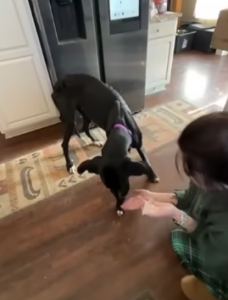
She tried to rise.
Video: Lola Tries to Stand Despite Being Too Weak to Support Her Own Body
Even When Her Legs Shook, Lola Kept Trying to Get Up
The veterinary team did not need Lola to prove anything.
She was sick.
Exhausted.
And entitled to rest.
But when familiar voices came near, she sometimes pushed against the floor as though trying to stand.
Her legs trembled beneath her.
The effort often lasted only moments.
Then her body needed help again.
She did not resist examinations.
She did not lash out when people handled her.
She simply watched what was happening around her.
The rescuers could not know what she had experienced before being found on the road.
They could only see what she was doing now.
Lola was still participating.
Still responding.
Still attempting movements her weakened body could barely complete.
That was encouraging enough for the team to keep working one small goal at a time.
She did not need to walk across a room.
She only needed to tolerate being supported.
Then perhaps stand for a moment.
Then try again tomorrow.
Her First Recovery Goal Was Only a Few Inches
Lola was moved into a quieter space where she could rest away from unnecessary noise and activity.
During those first nights, her rescuer stayed close.
Her breathing was watched carefully.
Her comfort was monitored.
There was no assumption that because she had reached safety, the medical danger had passed.
She still needed help with basic movement.
A support sling was placed beneath her abdomen so caregivers could lift some of her weight while she attempted to use her legs.
The first exercises were incredibly small.
Lola stood with assistance.
Then moved a paw.
Another paw followed.
Sometimes she traveled only a few inches.
But those inches mattered.
Her muscles had lost strength after prolonged deprivation.
Rebuilding them required repetition without forcing her beyond what her body could manage.
So each attempt followed the same quiet rhythm.
Support.
Step.
Rest.
Then try again later.
Food Became Another Measure of Progress
Lola also needed nutrition urgently.
But after prolonged starvation and illness, recovery could not simply mean placing a huge meal in front of her.
Her body needed careful support.
Caregivers prepared soft, appealing foods.
Small pieces of turkey.
Freshly cooked eggs.
Meals that were easy for her to accept.
At first, each bite mattered.
Lola’s appetite returned gradually.
She began showing more interest when food arrived.
Small meals became more consistent.
And as her intake improved, there were subtle changes elsewhere.
She lifted her head more often.
She paid closer attention to the people beside her.
Then came a moment that had nothing to do with a medical test.
Her tail moved.
A small wag.
Later, Lola gently licked her caregiver’s hand.
There was no need to interpret either gesture as proof that everything was suddenly better.
Her medical problems remained serious.
But Lola was beginning to interact with the world around her rather than simply lying inside it.
Sunlight Became Part of Her Rehabilitation
As Lola gained a little more stability, caregivers began taking her outside for short periods.
At first, she did very little.
She stood in the sunlight.
Rested.
Looked around.
The outdoor space was not about exercise alone.
It gave her another part of normal life back.
Fresh air.
Grass beneath her feet.
A world wider than the bedroom and veterinary clinic.
When her body allowed it, Lola began taking short supported walks around the yard.
Her steps remained careful.
There was no sudden transformation into the powerful gait people might expect from a Great Dane.
Her muscles still had to rebuild.
Her heartworm still required medical attention.
But the direction had changed.
The dog who had once been unable to remove herself from a roadway was beginning to move because she wanted to.
A few feet.
Then rest.
Another attempt later.
Progress came slowly enough that it could easily have been overlooked from one day to the next.
Across several days, however, it became undeniable.
Once Survival Took Less Energy, Her Personality Began to Appear
In the earliest days, nearly everything about Lola revolved around illness.
Was she breathing comfortably?
Could she keep food down?
Could she stand?
Was her temperature improving?
Those questions dominated every interaction.
As her condition became more stable, the caregivers began seeing something else.
Lola herself.
She was quiet.
Gentle.
Patient during handling.
She did not constantly demand attention.
But she appeared increasingly comfortable staying close to the people caring for her.
A soft lean against someone.
A relaxed moment beside a familiar person.
A tail wag when attention arrived.
These were not dramatic behaviors.
That made them feel particularly appropriate for Lola.
Her recovery was never loud.
It was a collection of modest changes.
A dog who could hold her head up longer.
A dog who wanted another bite of food.
A dog who could stand with less assistance.
A dog who began looking less like every ounce of energy was being spent simply remaining alive.
Treatment Was Only One Part of What Brought Her Back
There was no single thing that restored Lola.
Veterinary treatment mattered.
Nutrition mattered.
The sling mattered.
Rest mattered.
So did the person sitting beside her at night.
Recovery required all of those pieces working together.
Her body needed medical care for heartworm and the other problems discovered after her rescue.
It also needed calories to rebuild tissue.
Muscles needed controlled movement.
And none of that could happen successfully if Lola was constantly pushed beyond what she could tolerate.
So the process stayed slow.
No one demanded that the Great Dane stand tall simply because Great Danes are supposed to be powerful dogs.
Lola was allowed to be weak while strength returned.
That patience gave her body time to respond.
The Dog in the Road Was Not the Dog She Would Remain
Lola’s story began with an image difficult to forget.
A large black dog collapsed in public.
Too weak to move herself away.
Traffic continuing around her.
Then someone stopped.
That one decision opened the door to everything that followed.
The clinic.
The heartworm diagnosis.
Treatment.
Nighttime monitoring.
Supportive walking.
Tiny meals.
Sunlight.
Slow walks outside.
And a body gradually becoming capable of carrying itself again.
Today, the most meaningful part of Lola’s story is not that she suddenly became strong.
It is that strength returned in pieces.
One meal.
One supported stand.
One tail wag.
One small walk.
Each piece built on the last.
Someone Finally Stopped Long Enough to Help Her Rise
Perhaps that is what makes Lola’s rescue linger.
She was not hidden in an abandoned building.
She was not trapped somewhere impossible to see.
She was lying in the open.
People could pass her.
Vehicles could move around her.
And still, being visible did not automatically mean being helped.
Eventually, someone chose differently.
Lola was picked up from the road and taken somewhere her weakness became a reason for care rather than something to avoid.
Her body had a long way to go.
Heartworm could not be wished away.
Severe malnutrition could not be corrected with one meal.
Muscle loss could not be reversed with one walk.
But once someone stopped, all of those problems finally had a chance to be addressed.
The Great Dane who could barely lift her head began eating.
Then standing with support.
Then walking outside.
Her eyes became brighter.
Her movements steadier.
And the road where she had once collapsed became only the place where one chapter finally ended.
Lola did not rise because someone told her to be strong.
She rose because people gave her treatment, food, support, patience, and enough time for strength to return.
Sometimes rescue begins with pulling an animal from immediate danger.
Sometimes it begins with something even simpler.
Stopping the car.
Walking over.
And deciding that the life lying in front of you is worth helping back onto its feet.


