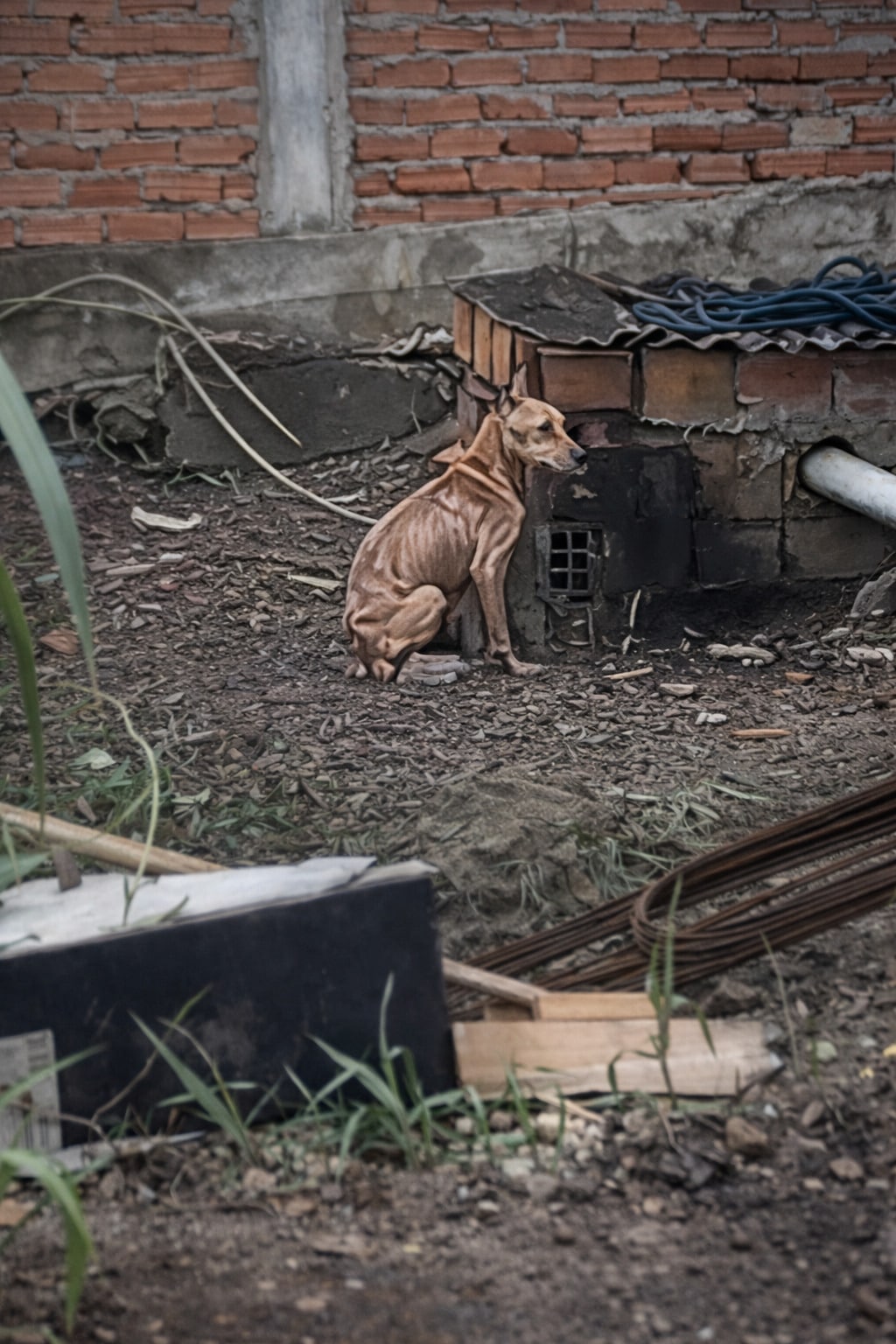
The yard looked as though no animal should have been living there.
Broken objects and scattered debris covered the ground.
In one corner, a female dog was attached to a post by a heavy metal chain.
Her body was extremely thin.
Her ribs were clearly visible beneath patchy fur, and irritated areas of skin could be seen across her fragile frame.
There was little around her that resembled proper shelter.
No comfortable place to rest.
No clear source of food or clean water nearby.
Rescuers had come after receiving a report about a dog in poor condition.
But when they finally walked toward her, something unexpected happened.
The dog looked at them.
Then her tail began to move.
The Chain Had Reduced Her World to One Small Corner
The dog could move only as far as the tether allowed.
Around her was a rough, cluttered patch of ground exposed to the weather.
Her condition immediately suggested that she needed help.
She was underweight.
Her coat was uneven.
Her skin appeared inflamed in several areas, and ticks could be seen on her body.
The rescuers could not know exactly how long she had been living this way.
What they could see was enough.
She needed food.
She needed water.
She needed veterinary attention.
And first, she needed to be released from the chain around her neck.
As the team approached, they prepared for fear or defensive behavior.
Instead, the thin dog wagged her tail.
She even gave a few small barks while watching them come closer.
Video: Luz Was Chained and Severely Underweight — Yet Her Tail Still Moved When Help Arrived
The First Thing Rescuers Did Was Remove the Chain
The team spoke with the people at the property and confronted the condition in which the dog had been found.
Local authorities were also contacted regarding the situation.
But before anything else could happen, the dog had to be removed.
The heavy chain was taken from her neck.
For the first time during the rescue, she was able to move without being pulled back toward the post.
Then food was placed in front of her.
Her reaction was immediate.
She began eating quickly.
The rescuers stayed close, gently touching her head while allowing her to finish.
There was no need for dramatic words.
Her body condition and appetite already showed how much support she needed.
When it was time to leave, the team helped lift her into a vehicle.
She was weak enough that walking normally appeared difficult.
The yard disappeared behind her.
The next stop was a veterinary clinic.
At the Clinic, She Was Given the Name Luz
Veterinarians began with a full physical examination.
The dog received a name.
Luz.
Testing showed severe malnutrition and dehydration.
Her skin problems also required treatment, including areas affected by infection and parasites.
The medical team examined her carefully for other complications.
According to the rescue account, they did not find evidence of critical internal injuries.
That was encouraging.
Luz was in poor condition, but there was still a clear path forward.
She needed nutrition.
Hydration.
Medication.
Skin treatment.
And time.
Recovery would not happen because of one meal or one night indoors.
Her body needed to rebuild gradually.
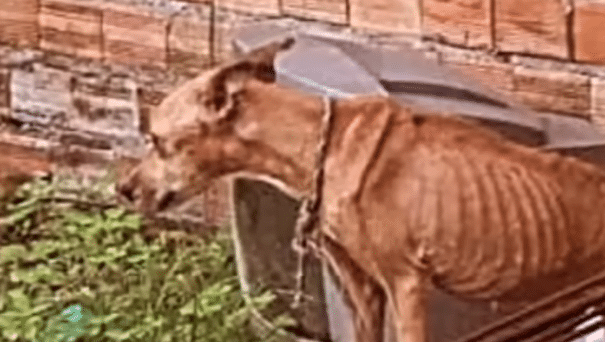
Her First Days Were About Stabilizing the Basics
Luz was placed on a careful nutrition plan rather than simply being given unlimited food.
For severely underweight animals, rebuilding strength safely can take time.
Her skin was cleaned and treated.
Medication was used to address infection and irritation.
Parasites were managed.
And volunteers spent time around her while she recovered.
They did not need to force interaction.
Luz was already showing interest in people.
As the days passed, she became more comfortable moving around the clinic.
Her energy began improving.
She stood more steadily.
Her tail continued to wag when familiar caregivers approached.
Then came a small milestone.
Only a few days after arriving, Luz was ready to leave the clinic setting and continue recovery elsewhere.
A Pink Sweater Marked a Very Different Day
When Luz walked down the hallway wearing a small pink sweater, she looked noticeably different from the dog first found beside the post.
She was still recovering.
She was still thin.
Her skin still needed time to heal.
But she was walking.
She was alert.
And her body language appeared more relaxed.
The sweater itself was a simple detail.
Yet it made the contrast hard to miss.
Days earlier, Luz had been standing among debris with a metal chain restricting her movements.
Now she was walking through a clean hallway surrounded by people responsible for her care.
The most important changes were still happening beneath the surface.
Her body was finally receiving consistent nutrition.
Her infections were being treated.
And there was no chain waiting at the end of the hallway.
The Weeks That Followed Changed Her Appearance Completely
Luz continued gaining strength.
Regular meals began filling out the frame that had once looked painfully thin.
Her coat started growing back in areas where the skin had been damaged.
The irritated patches became healthier.
Her energy increased.
Soon, she was moving with far more confidence than before.
Her caregivers began seeing more playful behavior.
She sought attention.
She spent time comfortably around people.
And the physical contrast became increasingly dramatic.
The dog who had once appeared exhausted beside a post now looked healthier, brighter, and more engaged with everything around her.
But her recovery was not a mysterious transformation.
It came from consistent care.
Nutrition.
Veterinary treatment.
Rest.
And enough time for her body to respond.
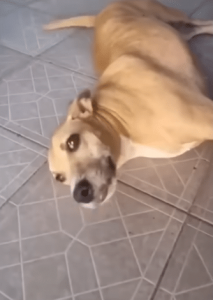
Her New Life Became Remarkably Ordinary
One of the final scenes of Luz’s story is quiet.
She is indoors.
She is lying comfortably while someone gently strokes her fur.
Nothing dramatic happens.
There are no rescuers rushing toward her.
No chain being removed.
No urgent drive to a clinic.
Just a dog resting.
That ordinary moment may be the clearest sign of how much her circumstances changed.
She no longer had to remain in one neglected corner of a yard.
She no longer had to search the ground around her for food.
She could rest without a heavy tether pulling at her neck.
Her days became filled with things that should never have been unusual in the first place.
Meals.
Clean water.
Shelter.
Medical care.
Human company.
Luz Was Finally More Than the Condition She Was Found In
It would be easy to remember Luz only as the thin dog on the chain.
That was the image that brought rescuers to her.
But it was only one moment in her life.
After treatment, the visible signs of her earlier condition slowly faded.
Her ribs became less prominent.
Her coat improved.
Her movements became stronger.
And her surroundings changed completely.
The most striking part of the rescue may still be what happened at the very beginning.
When strangers walked toward a dog who had every reason to be cautious, Luz moved her tail.
No one can know exactly what she understood in that moment.
But the response gave rescuers an opportunity to approach gently and get her out.
From there, everything depended on follow-through.
The chain came off.
She was taken to a clinic.
Treatment began.
Food became regular.
Her body recovered.
And eventually, the dog once found among debris could lie peacefully indoors while someone sat beside her.
Luz’s story is a reminder that rescue does not end when an animal is removed from danger.
That is only the first step.
What comes afterward—medical care, nourishment, patience, and a safe place to recover—is what turns one rescued moment into a completely different life.
For Luz, that process began the instant the chain was removed.
And this time, it was never put back on.


