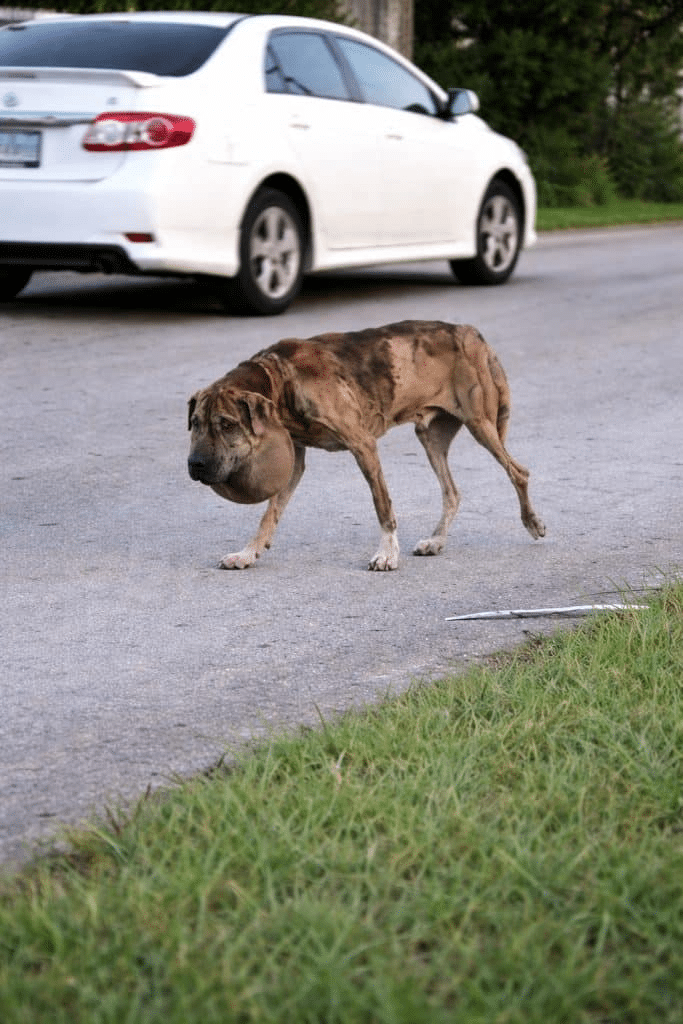
Cars kept moving around him.
One after another.
A young dog stepped carefully between them, his body tense and his head so severely swollen that it looked almost too large for his frame.
He did not bark.
He did not stop in the middle of the road.
He simply kept moving.
It was a summer afternoon near Houston, Texas, and most drivers had only a few seconds to understand what they were seeing before traffic carried them onward.
But one person looked long enough to realize this was not an ordinary stray.
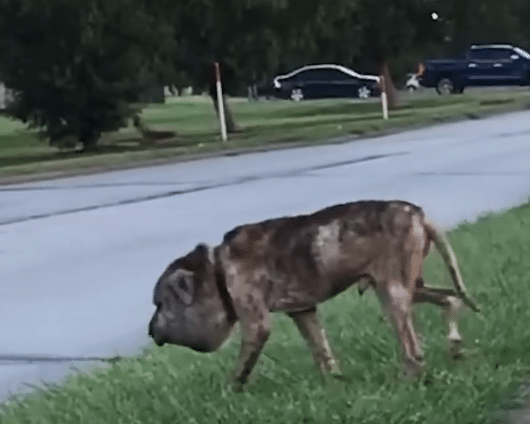
Laura Forma, an independent dog rescuer, saw the dog moving through the road and immediately pulled over.
Something was terribly wrong.
She tried to approach him.
The dog saw her coming.
And ran.
That might have been the end of the encounter.
Instead, it became the beginning of a search that would eventually change his life.
He Disappeared Before Anyone Could Reach Him
Laura followed from a distance, trying not to frighten the dog further.
Food did not persuade him to stop.
Soft voices did not bring him closer.
Every time the distance between them narrowed, he moved away again.
Whatever experiences had shaped his behavior, one thing was obvious.
He did not feel safe around people.
Eventually, the young dog slipped through the gate of a nearby housing complex.
Laura followed as far as she could.
She spoke with security guards.
Walked through the surrounding area.
Checked the places where a frightened dog might hide from heat, traffic, and strangers.
Minutes became hours.
There was still no dog.
Eventually, Laura had to leave.
But she did not leave the situation behind.
Once home, she shared what she had seen online, describing the young dog with the severely swollen head and asking people nearby to watch for him.
The message quickly reached Anna Barbosa, president and cofounder of Houston K-911 Rescue.
By chance, Anna was not far from the area.
She began searching too.
VIDEO: Gus’s Second Chance — How One Young Dog Overcame the Unthinkable and Learned to Trust Again
The Search Continued After He Seemed to Vanish
Anna checked surrounding streets.
She spoke with local residents.
She searched the quieter spaces around the neighborhood where a scared dog might retreat.
Still nothing.
The dog had somehow disappeared again.
It would have been easy to assume he had moved farther away.
Easy to tell themselves they had tried.
Laura did not.
Later that day, she returned with two volunteers.
They began the search again.
This time, their persistence finally led them to a small storage area near an apartment complex.
Inside was the dog.
He had squeezed himself into the confined space and was hiding quietly.
Up close, the swelling around his head looked even more serious than it had from the road.
The rescuers knew chasing him could send him back into traffic.
So they moved carefully.
A humane trap was positioned.
Food was used as an incentive.
Then they waited.
Eventually, the young dog stepped inside.
The trap closed safely behind him.
After hours of searching, the dog who had repeatedly slipped away was finally out of danger.
Now the question changed.
What had caused his head to swell so dramatically?
A Shoelace Was Buried Around His Neck
At the veterinary clinic, the answer became visible.
A thin cord—described in the rescue account as a shoelace—had been tied tightly around the dog’s neck.
It had likely been there as his body grew.
Instead of loosening, the material had become increasingly restrictive.
The tissue around it had swollen.
Normal circulation and fluid drainage had been severely affected.
That pressure appeared to explain the enormous swelling around the dog’s head.
The situation required immediate treatment.
Removing the constriction was essential, but veterinarians also had to assess the tissue damage and stabilize the dog before moving forward.
He was still very young.
Approximately eight months old.
Yet his body already showed signs of more than one serious injury.
Veterinary imaging revealed another troubling finding.
Pellets were lodged inside him.
The imaging suggested that at some point, the dog had likely been struck by pellet fire.
No one involved in the rescue knew exactly when it happened or who was responsible.
There was no useful story to invent around that discovery.
There was only the evidence inside his body.
And a young dog who needed help now.
The rescue team gave him a name.
Gus.
The First Goal Was Simply to Get Him Through the Crisis
During Gus’s early treatment, no one was thinking about adoption photos or happy endings.
His condition was too serious.
The veterinary team focused first on relieving the pressure around his neck and treating the damage caused by the constriction.
His swelling had become extreme.
His body was stressed.
He appeared uncomfortable and physically exhausted.
Treatment required close monitoring.
The team watched his breathing.
His circulation.
His response as pressure was relieved.
At first, progress was subtle.
The swelling did not disappear the moment the shoelace was removed.
His tissues needed time to respond.
But gradually, his face began changing.
The massive swelling started to come down.
His breathing became steadier.
The immediate danger began to lessen.
As the shape of his head slowly returned toward normal, caregivers could finally see more of the dog hidden beneath the medical crisis.
His eyes were easier to read.
His expression changed.
He became more aware of the people moving around him.
But physically stabilizing Gus was only one part of the work ahead.
The dog who had run from Laura in the street still had very little reason to believe unfamiliar people were safe.
A Quiet Foster Home Became His Next Step
When Gus was strong enough to leave the hospital, he did not immediately move into a busy adoption environment.
He went into foster care.
Volunteer Marina Harrison welcomed him into a quieter home where he could recover without constant noise or pressure.
For Gus, almost everything there was new.
The room.
The smells.
The people.
The routines.
He remained cautious.
He watched before approaching.
Unexpected sounds could make him uncertain.
No one forced interaction.
Marina allowed Gus to decide how quickly the relationship would develop.
Meals arrived consistently.
His resting area remained safe.
Hands did not reach for him simply because people wanted affection.
If he wanted space, he got it.
Little by little, Gus began responding.
He ate well.
He rested more comfortably.
His body appeared less tense during quiet moments.
Then came one of those changes that looked tiny from the outside but meant a great deal to the people caring for him.
His tail moved.
A small wag.
Then another later.
There was no dramatic transformation overnight.
But Gus was beginning to behave like a dog who no longer expected every unfamiliar moment to become dangerous.
The Other Dogs Helped Make the House Feel Normal
As Gus settled in, Marina began noticing parts of his personality that had been almost impossible to see during the rescue.
He was gentle.
Curious.
And increasingly interested in the other dogs in the home.
He watched them closely.
Followed their movements.
Rested near them.
Sometimes, Gus tried to squeeze himself into beds already occupied by another dog, apparently more interested in companionship than personal space.
Those ordinary interactions mattered.
The other dogs moved around the house without fear.
They approached people.
They rested openly.
They behaved as though meals, beds, and gentle hands were simply part of daily life.
Gus could observe all of it.
Over time, he began participating more.
Instead of hiding whenever someone entered, he stayed.
Instead of keeping constant distance, he moved closer.
He began accepting affection.
Then seeking it.
The dog who once ran every time a rescuer approached was slowly learning a completely different pattern.
A person could enter the room and nothing bad would happen.
A hand could reach toward him and stop if he was uncomfortable.
A voice calling his name could mean food, attention, or companionship.
Trust grew through repetition.
Not through one big moment.
Soon Gus Was Asking for the Attention He Once Avoided
Weeks passed.
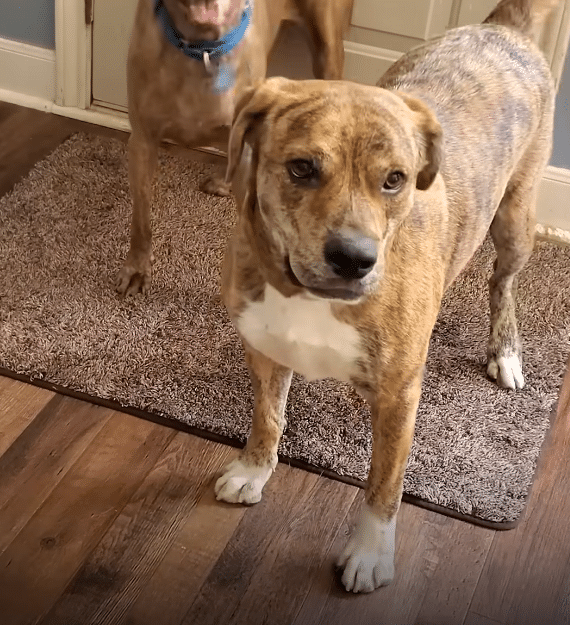
The physical swelling that had made Gus almost unrecognizable continued to improve.
So did his behavior.
Visitors who met him later saw a dog very different from the one weaving through traffic.
Gus began approaching people.
He leaned into gentle contact.
He accepted hugs.
He gave small kisses.
And he increasingly sought attention instead of avoiding it.
That change was especially striking for the rescuers who remembered the first day.
Laura had barely been able to get near him.
Food had not been enough.
A calm voice had not been enough.
He had chosen distance every time.
Now he was choosing proximity.
The important part was not that Gus had somehow forgotten what happened before his rescue.
No one could know what memories remained with him.
What caregivers could see was that new experiences were giving him alternatives.
Not every person chased.
Not every hand caused pain.
Not every unfamiliar place was dangerous.
Gus was building a new set of expectations one safe interaction at a time.
His Recovery Was Still Not the End of the Story
Gus’s transformation was impressive, but his journey was not finished.
He still needed continued recovery.
He still needed time to become fully ready for adoption.
And eventually, he would need the right family.
Not simply someone moved by how he looked in his rescue photos.
Not someone who wanted a dramatic story.
He needed people willing to continue what his foster home had started.
Routine.
Patience.
Safety.
Affection without pressure.
Those who spent time with Gus believed he had the potential to become an extremely loving companion.
They had already watched him form bonds.
Seek closeness.
Enjoy other dogs.
Respond warmly to familiar people.
The dog once described mainly by his swollen head was becoming known for something entirely different.
His personality.
That was perhaps one of the clearest signs of recovery.
Gus was no longer just a medical case.
He was becoming himself.
The Woman Who Saw Him in Traffic Could Have Kept Driving
The beginning of Gus’s story came down to a few seconds on a busy road.
A young dog appeared between moving cars.
His head was badly swollen.
Traffic continued.
Laura could have noticed him and driven on.
Instead, she stopped.
When Gus ran, she searched.
When she lost him, she shared his story.
When the first search failed, other rescuers joined.
When they still could not find him, Laura returned.
Then someone checked a storage unit.
A humane trap closed.
Veterinarians discovered the shoelace.
Imaging revealed the pellets.
Treatment reduced the swelling.
A foster home gave him time.
And eventually, the dog who had spent so much effort avoiding human contact began walking toward people on his own.
None of those individual moments was enough by itself.
Gus’s rescue happened because people kept continuing after the previous step failed.
He ran.
They searched again.
He disappeared.
They returned.
His medical condition was complicated.
They treated it.
He was afraid.
They gave him time.
That persistence changed the direction of his life.
Gus No Longer Has to Keep Moving Just to Survive
The image that first brought attention to Gus was difficult to forget.
A young dog walking through traffic with an enormously swollen head.
He did not know which cars would stop.
He did not know which people were safe.
He simply kept moving.
Today, his life looks very different.
The pressure around his neck is gone.
The swelling has decreased dramatically.
He has learned the routines of a home.
He rests beside other dogs.
He approaches people for affection.
He gives kisses.
And instead of using movement only to escape, he can move toward the things he wants.
A bed.
A familiar person.
Another dog.
A gentle hand.
Gus still has another chapter ahead of him.
A permanent home.
A family willing to take everything he has learned in foster care and keep building on it.
But he is no longer the frightened dog disappearing through traffic while rescuers struggle to keep him in sight.
People know his name now.
They know where he is.
They know what he needs.
And because several people refused to stop searching when it would have been easier to give up, Gus finally has something he did not have on that Houston road.
He has somewhere safe to stop.


