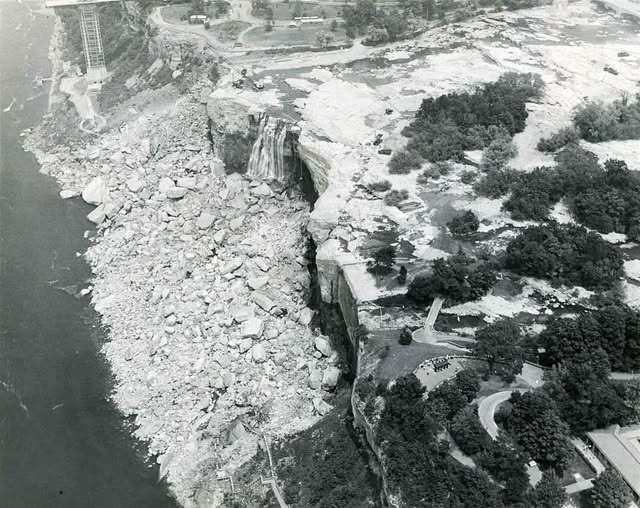
In the summer of 1969, tourists arriving at the American side of Niagara Falls found something that stopped them cold. Where a curtain of white water should have been thundering over the edge, there was only silence. A wide, bare cliff of brown and gray rock stood exposed in the open air, streaked with moisture but bone dry at the base. No mist. No roar. Just stone.
Visitors could walk to overlook platforms and stare at a waterfall that wasn’t falling. Some assumed something had gone wrong. Others thought they had the date wrong, or had taken the wrong path. In reality, everything was going exactly as planned.
The American Falls had been deliberately shut down. Engineers had built a dam across the Niagara River to divert its flow away from the American Falls entirely, redirecting it to the Canadian Horseshoe Falls on the other side of Goat Island. The project ran from June to November 1969 — roughly five months — and it remains one of the most unusual engineering feats in American history.
The Year the American Falls Went Quiet
The decision to dewater the American Falls came from a practical concern, not spectacle. By the 1960s, geological surveys had noted that large chunks of rock were breaking off the face of the falls and accumulating at the base. The pile of loose rock debris — called talus — had grown substantial enough that, in some places, it was nearly reaching the lip of the falls itself. Officials worried that continued erosion could dramatically change or permanently diminish the appearance of the falls.
The U.S. Army Corps of Engineers, working with the International Joint Commission — a U.S.-Canada body overseeing shared waterways — determined that the only way to properly study the problem was to stop the water entirely and inspect the rock face up close. A visual survey from a distance couldn’t capture what was happening beneath the surface. Engineers needed to walk the riverbed, document every crack and fissure, and assess how much talus had accumulated and what it would take to remove it.
Congress authorized the project, and by early 1969, planning was underway. The goal was straightforward in concept and enormous in execution: build a temporary dam strong enough to hold back the Niagara River, keep it in place long enough to conduct a thorough study, and then remove it without causing damage to the surrounding environment or infrastructure.
How a Cofferdam Redirected the River
The structure that made it all possible was a cofferdam — a temporary dam constructed specifically to block water from a work area. Engineers selected the stretch of river that fed the American Falls on the U.S. side and began construction in the spring of 1969. The cofferdam stretched approximately 600 feet across the Niagara River, built from roughly 27,800 tons of rock and earthen fill.
Once the cofferdam was complete and sealed, the Niagara River had nowhere to go on that side. The flow that normally poured over the American Falls was rerouted entirely to the Horseshoe Falls, which sits along the Canadian side and already carries the majority of Niagara’s total water volume. From the Canadian vantage point, tourists noticed little change. From the American side, the transformation was total.
On June 12, 1969, the last trickle of water ran off the American Falls, and the cliff went dry. Workers and engineers moved in almost immediately. Geologists mapped the exposed rock face, documenting erosion patterns, structural fractures, and the depth and spread of the talus pile at the base. Surveyors measured. Photographers recorded. Scientists who had spent careers studying Niagara from the outside were now standing in it.
For visitors, the experience was genuinely surreal. The overlook platforms remained open to the public throughout the summer, and thousands of people came specifically to see the dry falls. Some described it as seeing a skeleton — the underlying structure of something that had always been wrapped in motion and noise, suddenly and completely still.
What the Dry Cliff Revealed
The exposed rock face confirmed what had been suspected. The talus at the base of the American Falls was extensive — a massive pile of boulders and broken rock that had accumulated over decades of natural erosion. Some of the larger blocks weighed hundreds of tons. The face of the cliff showed clear fracture lines and zones where future rock falls were likely, given enough time and water pressure.
Engineers and geologists documented everything they found. The study also examined the underlying structure of the falls itself — the dolomite cap rock that forms the lip of the falls and the softer shale and limestone beneath it. Over geological time, water undercuts the softer layers, which eventually causes the harder cap rock to break away in large pieces. That process is what created Niagara and continues to shape it today, though much more slowly than it did in previous centuries.
The findings were detailed and valuable. But they led to a decision that surprised many observers.
YOUTUBE EMBED — PRIMARY SEARCH QUERY: “1969 Niagara Falls dewatering archival footage”
Why Engineers Left the Fallen Rock in Place
After reviewing the full survey, the International Joint Commission faced a choice: remove the talus, reshape the falls to a more dramatic profile, and potentially slow the erosion — or leave everything as it was and restore the water.
The commission ultimately recommended leaving the talus in place. The reasoning involved both cost and philosophical restraint. Removing the rock debris would have required an industrial-scale operation with significant expense and no guarantee that the underlying erosion problem would be meaningfully slowed. There was also the question of whether it was appropriate to artificially reshape a natural landmark on that scale. Critics of removal argued that the talus pile was itself a natural feature, the product of geological forces that had been at work for thousands of years.
The decision was also shaped by what the study couldn’t fully resolve. Even with the falls dry, there were uncertainties about how the rock structure would respond to intervention, and engineers were cautious about recommending changes they couldn’t predict with confidence. In the end, the recommendation was to restore the flow and monitor the falls using conventional survey methods over time.
Congress accepted the commission’s recommendation. The talus would stay. The falls would be returned to its natural state.
YOUTUBE EMBED — SECONDARY SEARCH QUERY: “Niagara Falls National Heritage Area dewatering”
How the Water Was Restored
On November 25, 1969, workers began removing the cofferdam. Unlike its construction, the dismantling was designed to be gradual, allowing the water to return in a controlled way rather than rushing back all at once. Heavy equipment broke apart sections of the rock and earthen fill, and the Niagara River slowly reclaimed the channel.
As the cofferdam came down, the water level at the top of the American Falls began to rise. The thin sheet of water returned first — a trickle across the lip of the rock face, then a growing flow, and finally the full curtain of water crashing back into the plunge pool below. By the time the cofferdam was fully removed, the American Falls was indistinguishable from the landmark it had always been.
The workers, the equipment, the survey markers and the months of documentation all disappeared back into the administrative record. Tourists arriving the following spring saw exactly what tourists had seen for generations: a wide, roaring waterfall fed by one of the largest freshwater systems on the planet.
What remained was the archive. Photographs from the summer of 1969 show the exposed cliff in full detail — the layered rock, the talus field, the dry riverbed stretching up toward the cofferdam. Film footage from the project captures workers moving across the bare falls face at angles that seem almost impossible given what the site normally looks like. For anyone familiar with Niagara, the images carry a quiet strangeness that is difficult to explain. The same landmark, stripped of the thing that defines it, looks like a different place entirely.
The 1969 dewatering remains the only time the American Falls has been deliberately stopped since modern records began. The engineering study it produced informed long-term monitoring of the falls, and the decision not to remove the talus has largely been left undisturbed in the decades since. Today, the project is documented through the Niagara Falls National Heritage Area and Army Corps of Engineers historical records — a months-long engineering study that answered some questions, raised others, and left one of America’s most famous natural landmarks exactly where it found it.

