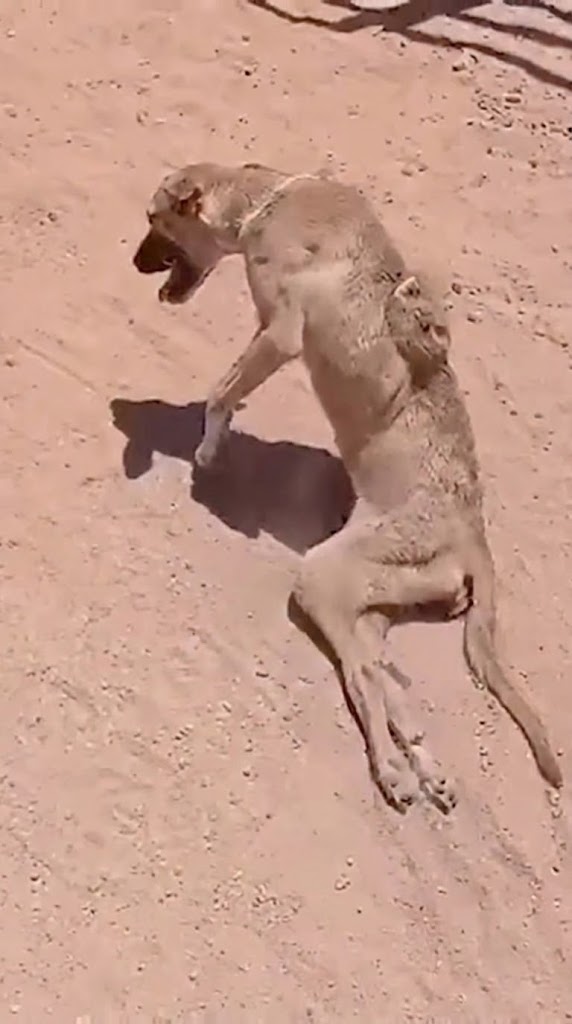
Eva was lying on the pavement when someone finally stopped.
She was small.
Exhausted.
And when she tried to move, only her front legs carried her forward.
Her hind legs dragged behind.
There was also a serious wound along her back that clearly needed medical attention.
A woman nearby approached slowly, wrapped the dog in a blanket, and lifted her into a vehicle.
At the clinic, veterinarians discovered that this was not simply weakness.
The little dog had suffered a major spinal injury.
They would name her Eva Victoria.
Her Front Legs Were Doing All the Work
When Eva was first found, she could not use her hind legs normally.
She tried to move by pulling herself forward with her front legs.
Her body was dirty and visibly tired.
The source does not establish exactly how long she had been living with the injury or what caused it.
What was obvious was that she could not safely remain on the street.
The woman who found her approached without forcing Eva to move.
She wrapped her in a blanket and transported her directly for veterinary care.
Video: Eva Is Found Dragging Her Hind Legs Before Doctors Discover a Severe Spinal Injury
The Examination Found a Serious Injury Along Her Spine
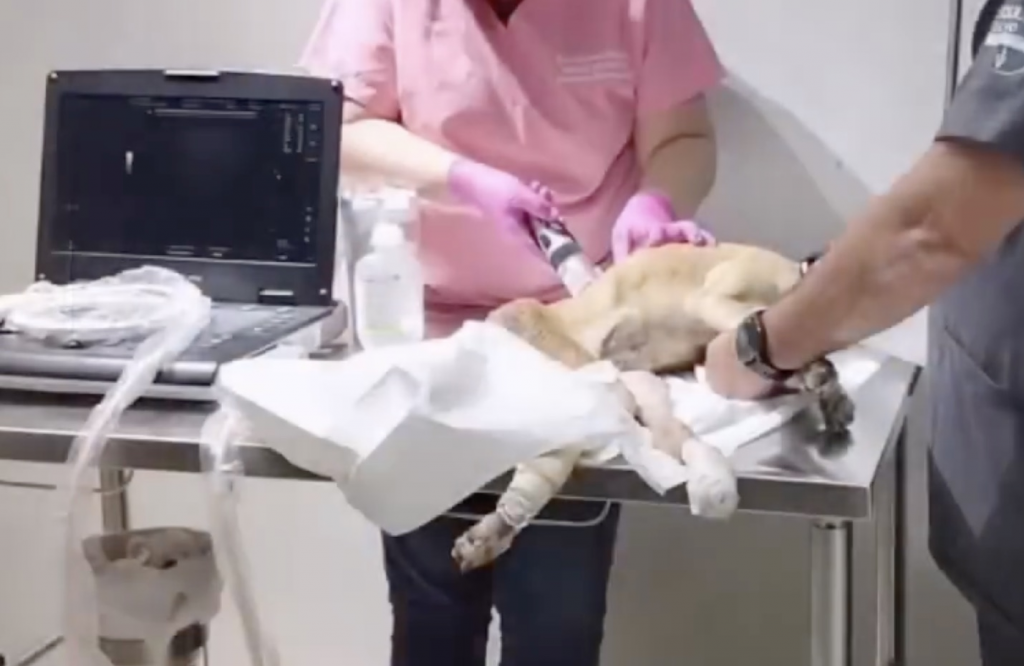
Veterinarians began with imaging and a physical examination.
According to the original rescue account, Eva had a severe spinal injury.
There was also an infected wound in the same general area that required treatment.
The source does not provide enough technical detail to identify the exact vertebrae involved or the precise neurological diagnosis.
But the damage was serious enough that surgery was recommended.
Eva’s inability to use her hind legs also meant there were no guarantees that normal movement would return afterward.
The team could treat the injury.
They could reduce infection.
They could support her recovery.
But they could not promise what her mobility would eventually look like.
Surgery Took Nearly Six Hours
Eva underwent a long operation.
The source states that the procedure lasted close to six hours.
During that time, the veterinary team treated the infected area and addressed the spinal damage.
The article describes the procedure as an attempt to stabilize the injury, though it does not provide a detailed surgical report.
When the operation ended, Eva moved into the next stage of care.
Recovery.
She was still unable to stand normally.
Her body was weak from both the original injury and the procedure.
The surgery had addressed an immediate medical problem.
It had not instantly restored the use of her hind legs.
Recovery Began With Very Small Movements
Eva required close monitoring after surgery.
At first, much of her time was spent resting.
Then caregivers began noticing small responses.
A tail movement.
Changes in muscle tone.
Occasional motion in the hind limbs.
Those signs did not necessarily mean she would eventually walk normally.
But they gave the rehabilitation team something to work with.
Physical therapy was introduced gradually.
Massage.
Gentle stretching.
Supported movement.
And exercises intended to preserve muscle function and help Eva use whatever movement remained.
Therapy Helped Her Become Stronger — Even Without Full Mobility
Weeks passed.
Then months.
Eva’s front half became stronger.
Her balance improved.
She learned how to reposition herself more effectively.
Her hind legs, however, still did not support normal independent walking.
That changed the goal of rehabilitation.
Recovery no longer had to mean restoring the exact movement she had before the injury.
It could mean helping Eva move safely with the body she had now.
That led to another solution.
A custom wheelchair.
A Wheelchair Gave Eva Independent Movement Again
Eva was fitted with a mobility cart designed to support her hindquarters.
The first sessions required adjustment.
She had to learn how wide the device was.
How to turn.
How much force to use with her front legs.
Gradually, the movement became more natural.
Soon she could travel across open areas without dragging her hind legs on the ground.
The wheelchair did not “cure” her spinal injury.
It gave her another way to move.
That distinction mattered.
Eva no longer had to wait for someone to carry her every time she wanted to explore.
Then She Met Lila
During rehabilitation, Eva was introduced to another dog named Lila.
Lila also had limited or absent use of her hind legs.
The source describes the two dogs spending more and more time together.
They rested near each other.
Moved through the same areas.
And became comfortable sharing space.
The article interprets that relationship as a bond formed through similar experiences.
We cannot know whether the dogs understood that similarity.
What could be seen was that Eva and Lila were highly compatible.
That would later influence what happened next.
One Family Asked to Take Both Dogs
When adoption discussions began, a family came forward.
They did not want to choose between Eva and Lila.
According to the rescue account, they asked to adopt both dogs together.
That meant accepting the practical realities that came with them.
Mobility equipment.
Extra attention.
Different exercise needs.
And long-term management of physical limitations.
The family agreed.
Eva and Lila left rescue care together.
Eva Did Not Need to Walk Normally to Have a Full Life
In her new home, Eva continued using her wheelchair.
She could move through the yard.
Explore.
Rest indoors.
And participate in daily routines with the family.
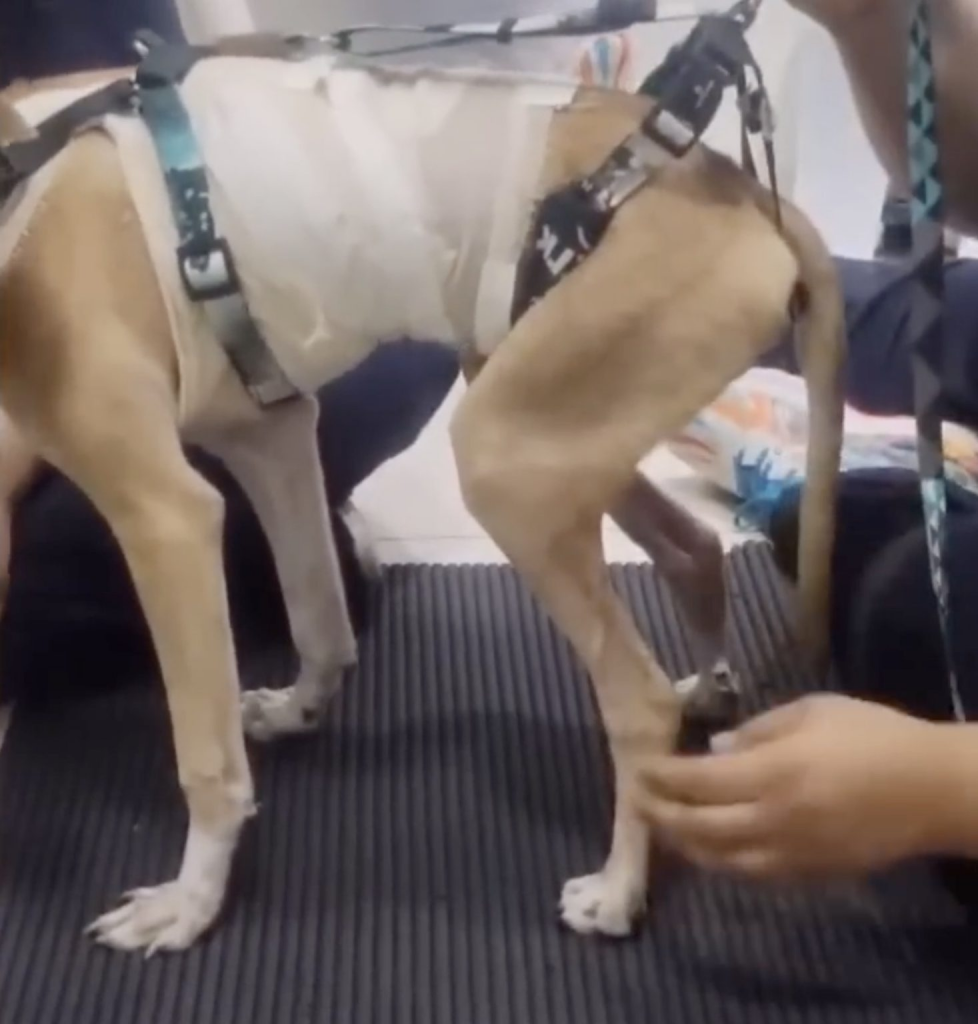
Her spinal injury remained part of her life.
So did the limited function in her hind legs.
But those things no longer determined whether she could move through the world.
Eva’s story began with a dog dragging herself across pavement using only her front legs.
The medical team could not simply restore everything that had been lost.
Instead, they treated the injury, supported rehabilitation, and eventually gave her equipment that worked around what could not be recovered.
Then a family chose her exactly that way.
Not after she became physically “normal.”
Not because every problem disappeared.
They chose Eva with the wheelchair, the history, and the limitations included.
For her, recovery did not mean going back to the body she had before.
It meant finding a way forward with the one she still had.


