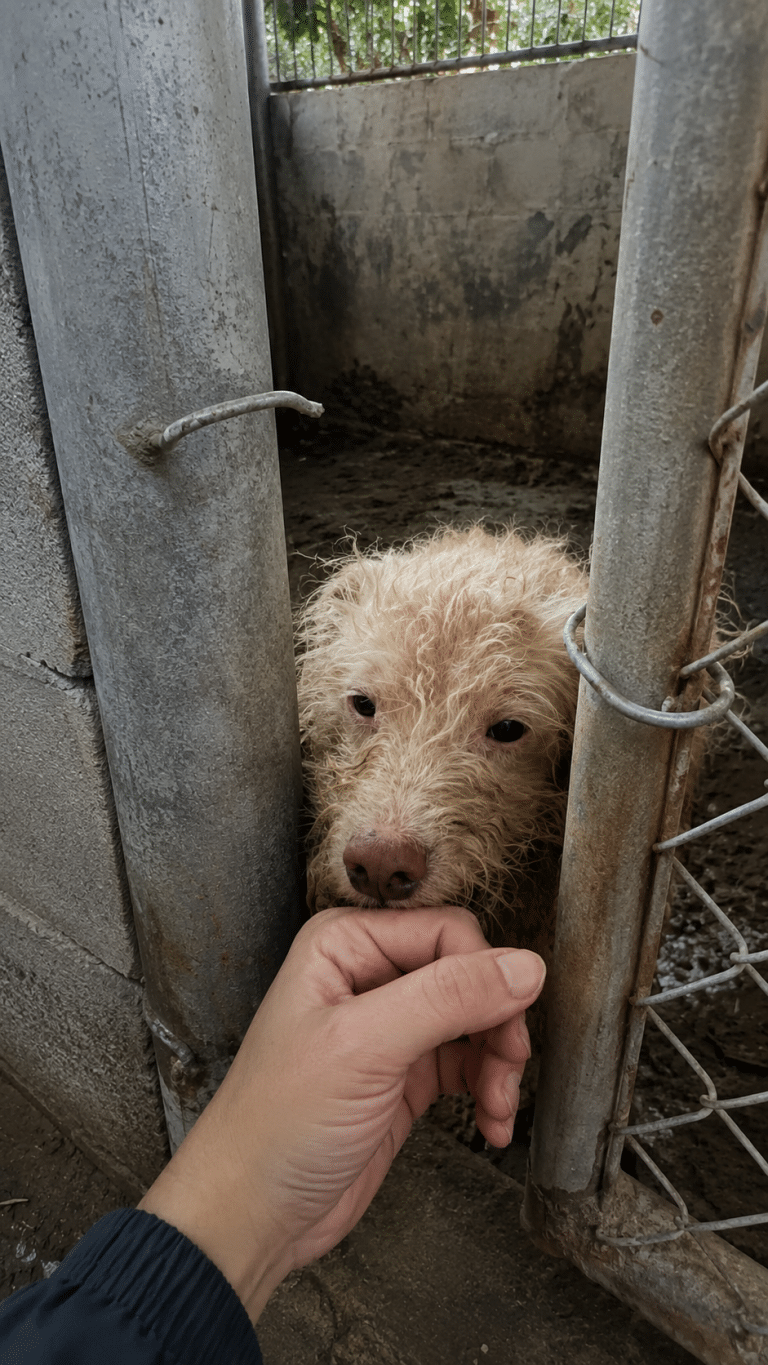
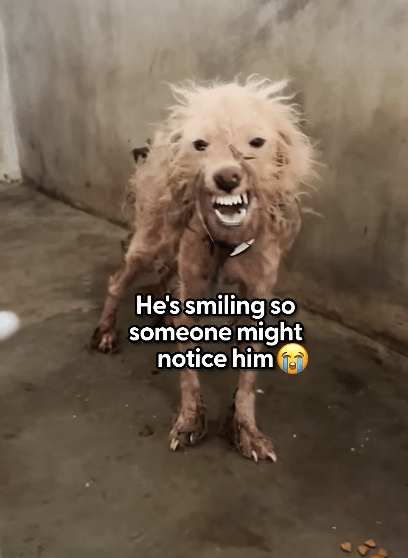
Whenever someone approached Mort’s kennel, he showed them every tooth in his mouth.
Most people stopped immediately.
To an unfamiliar visitor, the expression looked like a warning from a dog who did not want anyone coming closer. Combined with his thin body, irritated skin, and missing patches of fur, it gave people another reason to continue walking.
But they were looking only at his face.
They had not noticed his constantly wagging tail—or the hopeful way he leaned toward anyone willing to stay.
Mort was not asking people to leave.
He was trying, in the only way he knew, to ask them not to pass him by.
The Expression That Kept People Away
Mort arrived at an animal shelter in Saipan carrying visible signs of prolonged neglect.
He was severely underweight.
Large areas of his coat were missing, exposing skin that appeared irritated and uncomfortable. His body needed medical attention, proper nutrition, and time to recover.
Yet it was his unusual facial expression that caused the greatest misunderstanding.
Each time a person came near the kennel, Mort pulled back his lips and revealed his teeth.
Visitors often interpreted the display as aggression.
Some hesitated.
Others maintained their distance.
A few may have decided almost immediately that he was not the kind of dog they could safely approach.
But the shelter workers who spent more time observing him began noticing details that did not match that first impression.
Mort was not lunging at the bars.
He was not retreating into the back of the kennel.
Instead, he moved closer.
His tail wagged rapidly behind him. His body appeared eager rather than defensive, and his eyes followed people as they walked past.
When someone reached toward him carefully, Mort leaned in for contact.
The expression that looked frightening from a distance was simply part of the way he greeted people.
Mort was smiling.
Unfortunately, his smile was keeping many of them from discovering the affectionate dog behind it.
Video: Shelter Dog’s Frightening “Smile” Reveals a Gentle Soul Asking for Affection
One Rescuer Watched More Than His Face
Among the people who met Mort was a rescuer named Aria.
She knew that a dog’s behavior could not be understood by looking at one expression alone. The position of the body, movement of the tail, willingness to approach, and response to touch all offered important information.
So Aria did not judge Mort by his exposed teeth.
She slowed down and watched him.
Mort tried to move closer whenever she approached.
He leaned into gentle touch.
When she gave him attention, he appeared reluctant for the interaction to end.
There was no sign that he wanted to drive her away. Everything about the rest of his behavior suggested that he had been waiting for someone to notice him.
Beneath the damaged coat and misunderstood expression was a highly social dog who seemed to crave human companionship.
Aria could also see that Mort’s medical condition would require commitment.
Removing him from the shelter would not instantly make him healthy. He needed treatment for his skin, consistent meals, grooming, and a safe place where his body could begin rebuilding.
There would be appointments.
There would be uncertainty.
There would likely be days when progress was difficult to see.
But Mort had already shown her something important.
Despite everything he had experienced, he still wanted to be close to people.
Aria decided that he deserved the opportunity to recover.
For the first time, someone had looked beyond his smile and understood what he was trying to say.
His First Bath Was More Than a Cleaning
Leaving the shelter marked the beginning of Mort’s second chance, not the end of his difficulties.
One of his first experiences in care was an ordinary part of life for many dogs.
A bath.
For Mort, it represented something much larger.
Dirt was carefully washed from his skin. His neglected nails were trimmed, and the damaged areas of his coat were examined and treated.
The caregivers moved slowly, paying attention to his comfort throughout the process.
Mort remained remarkably cooperative.
He allowed them to clean him.
He stood patiently while they cared for his paws.
He accepted the unfamiliar hands around him without trying to pull away.
No one could know exactly what Mort understood in those moments. But his calm behavior suggested that he was beginning to recognize that these people were not there to hurt him.
The bath could not erase his past.
It could not immediately replace the missing fur or restore the weight he had lost.
But it was one of the first times his body was being handled with deliberate gentleness.
Afterward, Mort was wrapped in something clean and soft.
He was given food.
He had a protected place to rest.
The changes were simple, but for a dog accustomed to neglect, they introduced an entirely different way of living.
Care was no longer something he had to search for through the bars of a kennel.
It was finally surrounding him.
The World Outside the Shelter Was New to Him
As Mort’s treatment continued, Aria began introducing him to experiences beyond medical care.
He went outside for walks.
He felt fresh air moving across his skin.
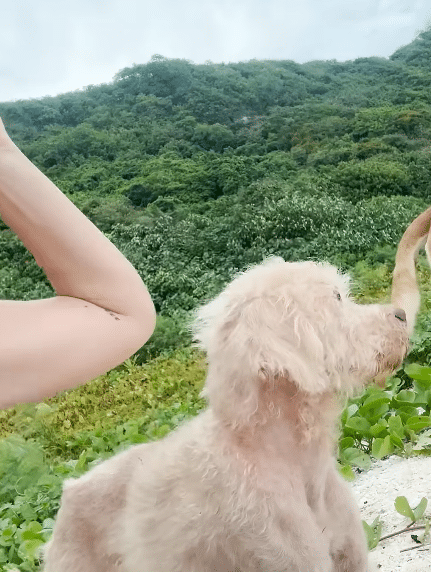
He explored unfamiliar scents and places, including the shoreline near the ocean.
At first, the wider world seemed overwhelming.
Mort had spent so much time focused on survival that ordinary surroundings could feel unfamiliar. Walking comfortably on a leash required practice, and new sights or sounds sometimes caused him to hesitate.
His caregivers did not force him forward.
They allowed him to pause.
They offered reassurance.
Then they continued when he appeared ready.
With every outing, Mort became a little more curious.
He learned that the leash did not mean confinement.
It meant he was going somewhere with a person who would remain beside him.
He began sniffing the ground instead of watching every movement around him. His steps became more relaxed, and his attention shifted toward the new world he was finally being allowed to experience.
There were ocean breezes.
Quiet paths.
Interesting smells.
Moments when nothing was expected of him except to walk, explore, and enjoy being outside.
These experiences might have seemed ordinary to another dog.
For Mort, they were evidence that life could contain more than waiting behind shelter bars.
He was learning how to be a dog rather than merely surviving as one.
The Dog Beneath the Missing Fur Slowly Appeared
Mort’s physical recovery happened gradually.
Proper meals helped restore weight to his body.
Treatment soothed his skin.
Small areas of fur began appearing where his coat had once been bare.
Week by week, the change became easier to see.
The sharp outline of his thin frame softened. His coat grew fuller, and the dog who once appeared so fragile began looking healthier and stronger.
Yet his most meaningful transformation could not be measured by weight or photographed through the growth of his fur.
Mort became confident.
He started approaching new experiences with curiosity instead of hesitation. His playful side emerged, and he formed close bonds with the people caring for him.
He loved attention.
He enjoyed remaining near his caregivers.
And the smile that had once caused strangers to avoid him became one of his most recognizable features.
Now, when Mort displayed his teeth, the people around him understood the rest of the message.
They saw the wagging tail.
They noticed his relaxed body.
They knew he was hoping for affection.
The expression had not changed.
The way people understood him had.
Mort had always been a loving dog.
He simply needed someone willing to spend enough time with him to see it.
A Dog Once Avoided Was Ready to Be Chosen
After receiving medical treatment and weeks of patient care, Mort reached an important milestone.
His body was stronger.
His skin and coat had improved.
He had learned to walk confidently beside people and had shown that companionship was one of the things he valued most.
Mort was ready for a permanent family.
The same dog visitors once hesitated to approach had become an affectionate companion eager to share his life with someone.
His journey offered an important reminder about shelter animals.
The dog seen inside a kennel is often living through the most confusing and stressful chapter of his life.
The surroundings are unfamiliar.
The sounds are constant.
The animal may be uncomfortable, frightened, or recovering from experiences no one fully understands.
A single expression cannot reveal an entire personality.
Neither can missing fur, a thin body, or cautious behavior during a brief meeting.
Mort’s exposed teeth appeared to tell people that he was angry.
His full body was saying something else.
His tail was wagging.
His eyes followed every visitor.
And whenever someone offered a gentle hand, he moved closer rather than away.
Behind the shelter bars was not a dangerous dog demanding to be left alone.
There was a neglected dog doing everything he could to connect.
Mort did not need someone to change who he was.
He needed someone to understand him.
Once Aria did, his life began moving in a new direction—toward healing, confidence, and the family he had always deserved.
Many people saw only the teeth in Mort’s smile.
One person stayed long enough to see the love behind them.


