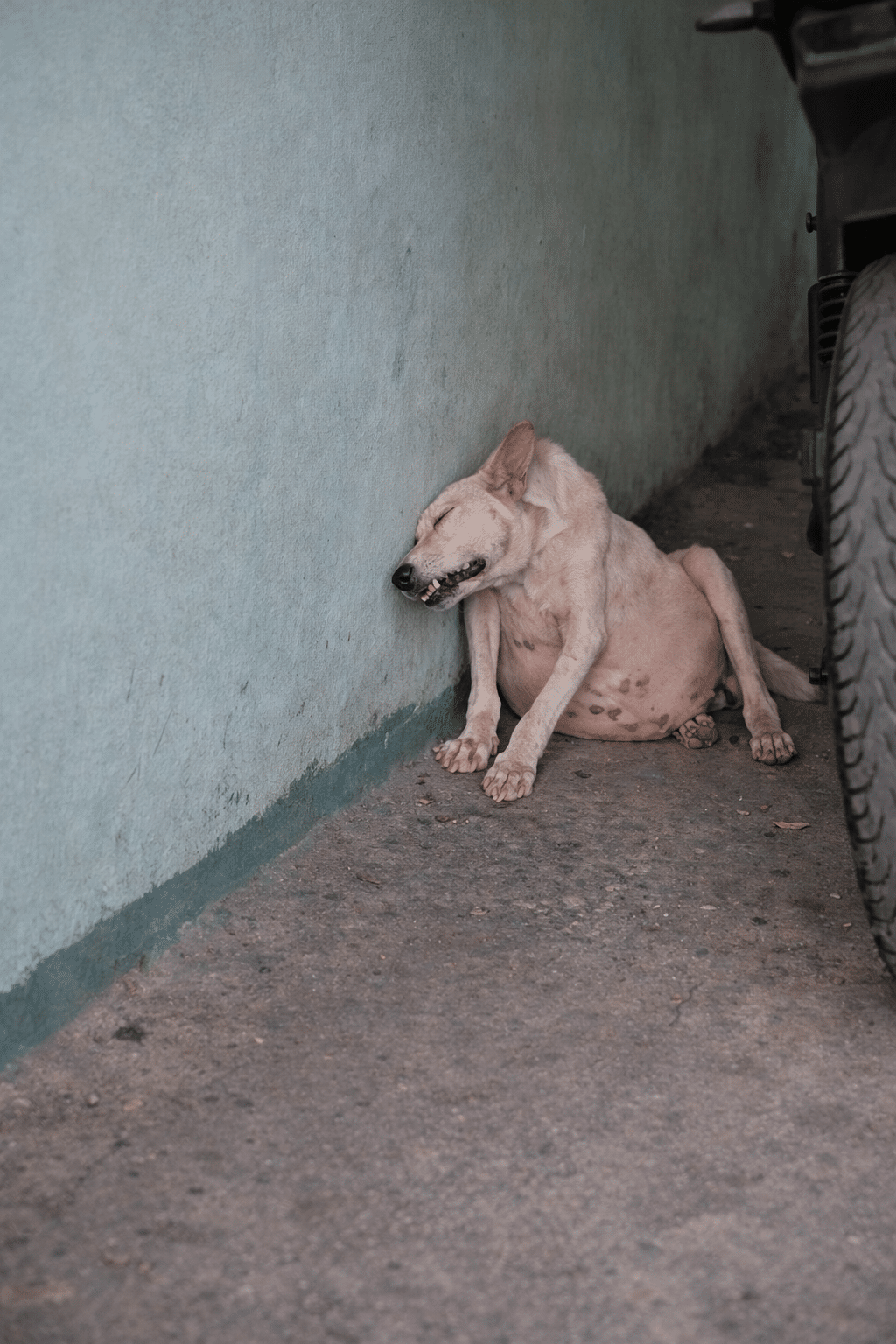
At first glance, there seemed to be an obvious explanation for Leila’s enormous belly.
Pregnancy.
But the dog hiding beside the bicycles did not look like an expectant mother preparing to give birth.
She was restless.
She struggled to settle into a comfortable position.
Her breathing appeared heavy.
And instead of quietly resting, she was crying.
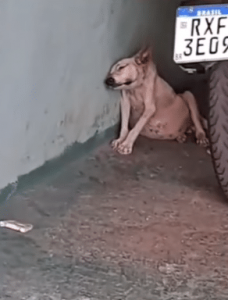
On October 4th in Brazil, one security guard noticed the dog tucked inside a bicycle parking area and realized something was wrong.
He could have assumed she belonged to someone nearby.
He could have continued with his day.
Instead, he stopped long enough to look again.
That second look changed everything.
Because Leila was not carrying puppies.
She was carrying something that was placing dangerous pressure on her body.
The Dog Crying Beside the Bicycles
Leila had chosen a quiet corner of the bicycle parking area.
It offered some shelter and distance from the movement around her, but it was hardly a safe place for a sick dog.
Her abdomen was so enlarged that pregnancy seemed like the most reasonable explanation.
Yet her behavior did not fit.
She shifted repeatedly as though no position brought relief.
Her swollen belly made her body appear unbalanced.
She seemed uncomfortable even while lying still.
Most concerning of all, she cried.
The security guard who noticed her did not know her history.
He did not know how long her abdomen had been swelling or whether anyone had been caring for her before she appeared there.
He only knew that the dog in front of him needed more than a quiet place to hide.
So he called for help.
It was a simple decision.
No dramatic rescue equipment.
No complicated chase.
Just one person recognizing that something was wrong and refusing to ignore it.
Soon, Leila was on her way to a veterinary clinic.
Everyone still had the same question.
Was she about to have puppies?
The examination would reveal something very different.
Video: From a Swollen Abdomen in a Parking Lot to Her First Steps After Surgery — Leila’s Turning Point
The Swelling Was Not Pregnancy
Once Leila reached the clinic, veterinarians began examining the unusually large abdomen.
The initial assumption did not hold.
Leila was not pregnant.
The swelling was caused by ascites—an abnormal accumulation of fluid inside the abdominal cavity.
What had looked from the outside like a belly filled with puppies was actually a body struggling under internal pressure.
The discovery changed the urgency of the situation.
This was not a dog simply waiting to give birth.
Leila needed medical treatment.
The fluid had stretched her abdomen dramatically, and her posture showed how uncomfortable carrying that weight had become.
Even ordinary movements appeared difficult.
Lying down did not seem to bring much relief.
Standing meant supporting the additional burden.
And every time she shifted her body, the swollen abdomen moved with her.
Veterinarians first focused on making her more comfortable.
Leila was given medication for pain.
The change was noticeable.
Her tense posture began to soften.
Her face appeared more relaxed.
For the first time since she had been found beside the bicycles, she seemed able to rest without constantly repositioning herself.
But easing her discomfort could only be the beginning.
Pain medication did not remove the fluid.
It did not solve the medical problem responsible for her enormous abdomen.
The team determined that Leila needed further treatment, including surgery.
What had begun as a security guard noticing a crying dog had now become a much more serious medical case.
Her Body Had Been Carrying More Than It Could Comfortably Hold
Ascites is not something that can be understood simply by looking at the size of a dog’s abdomen.
For Leila, what mattered most was what the veterinary team could observe and treat.
Her abdomen was dramatically distended.
The fluid inside was creating significant pressure.
Her movements had become difficult.
And she was clearly uncomfortable.
The source account does not identify the exact underlying illness that caused Leila’s ascites, so her rescuers could only move forward based on the medical findings available to them.
The veterinary team carefully planned the next stage of treatment.
Handling a severely swollen abdomen required control and close observation.
The goal was not simply to make Leila look thinner.
It was to relieve the burden her body was carrying while addressing her condition safely.
Every decision had to take into account how weakened and uncomfortable she had already become.
Leila could not explain where the pain was strongest.
She could not tell them when the swelling had started.
She could not describe the days that had led her to hide beside a row of bicycles.
Her body had to tell that story instead.
The distended abdomen.
The repeated crying.
The heavy breathing.
The inability to become comfortable.
Those signs had been enough for one security guard to make the call.
Now they were enough for a medical team to act.
Surgery Became the Next Critical Step
Leila needed more than observation.
Veterinarians prepared her for a procedure intended to address the serious fluid buildup and investigate her condition.
The work had to be done carefully.
Her abdomen had been under considerable strain.
The veterinary team managed the accumulated fluid while continuing to monitor her closely.
There was no instant transformation in the operating room.
There was a patient.
A medical team.
And a sequence of careful decisions intended to give that patient the best chance of recovering.
For the people who had helped bring Leila to the clinic, the waiting was difficult.
Only hours earlier, she had been a nameless dog crying in a parking area.
Now she was undergoing treatment that could determine whether she would have the opportunity to begin again.
The procedure continued.
The veterinary team worked methodically.
And Leila made it through.
When she eventually woke, the physical difference was immediately visible.
The enormous abdominal swelling that had dominated her appearance was gone.
Her body no longer looked stretched and burdened by the same volume of fluid.
For the first time since rescuers had met her, they could see what Leila looked like without the swollen abdomen changing the shape of her entire body.
But surviving the procedure was only one milestone.
She still had to recover.
And after carrying such a heavy internal burden, even something as basic as standing would take adjustment.
Her First Steps Looked Uncertain — But She Kept Trying
Leila’s body had become accustomed to moving with a severely enlarged abdomen.
After surgery, everything felt different.
Her center of balance had changed.
The pressure was reduced.
The weight she had been carrying was no longer there in the same way.
When she attempted to stand, her first movements were hesitant.
She did not immediately walk across the room as though nothing had happened.
Her steps were cautious.
Her legs seemed to search for stability.
But she tried.
One step.
Then another.
Those early movements were not dramatic, yet they represented something important.
Leila was beginning to use her body without the enormous swollen abdomen that had made every position uncomfortable.
The caregivers remained close.
There was no reason to rush her.
Recovery would happen at the pace her body could tolerate.
Day by day, the uncertainty in her steps began to lessen.
She stood more comfortably.
Her movement became steadier.
Her posture changed.
And as her body settled into recovery, another encouraging sign appeared.
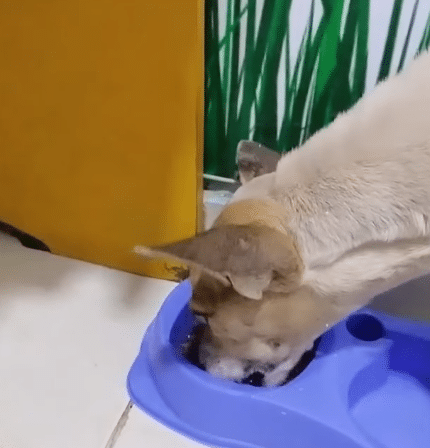
Leila wanted to eat.
Her appetite returned strongly.
She approached meals with enthusiasm, giving her weakened body the nourishment it needed to continue rebuilding strength.
For the people watching her recovery, those ordinary moments became milestones.
A full meal.
A few more steps.
A peaceful period of rest.
Each was evidence that Leila was moving farther from the frightened dog found crying beside the bicycles.
Then Her Tail Began to Move
Physical healing was easy to notice in Leila.
The swollen abdomen was gone.
Her walking improved.
Her appetite returned.
But gradually, the people caring for her began noticing smaller changes too.
Leila started responding differently when someone approached.
Instead of remaining focused only on discomfort, she became curious about the people around her.
She accepted attention.
She watched caregivers move through the room.
And then her tail began to wag.
It may have seemed like a small gesture.
For Leila, it marked another stage in her recovery.
The dog who had first been found crying and unable to settle was now beginning to engage with her surroundings.
She no longer spent every moment trying to find relief from the pressure inside her abdomen.
There was space for something else.
Food.
Movement.
Rest.
Human attention.
Her eyes appeared brighter.
Her body looked more comfortable.
She began seeking interaction instead of remaining hidden.
No one could know exactly what Leila understood about everything that had happened.
But her behavior showed a dog becoming increasingly comfortable in a place where her needs were being noticed.
When she moved, someone watched.
When she needed food, it arrived.
When she rested, she had somewhere soft to lie down.
The bicycle parking area had been replaced by a much safer routine.
The Dog Found With an Enormous Belly Became Almost Unrecognizable
By the later stages of Leila’s recovery, the contrast with the day she was found was striking.
The abdomen that once made people assume she was pregnant had returned to a far more normal appearance.
She could move without carrying the same enormous internal burden.
Her steps became stronger.
She ate full meals.
She rested comfortably.
And the constant distress that had first drawn attention to her was no longer defining every moment.
One of the most meaningful changes was also one of the simplest.
Leila had a soft bed.
For most dogs, sleeping somewhere comfortable may seem completely ordinary.
But compare that image with the beginning of her story.
A dog hiding between bicycles.
Crying.
Unable to settle.
Her abdomen stretched dramatically.
People passing nearby without knowing what was happening inside her body.
Now, when Leila needed to rest, she could lower herself onto something soft.
When she became hungry, she did not need to search the parking area for food.
When she needed attention, there were people nearby who recognized her signals.
Her life was beginning to look ordinary.
And sometimes, after a rescue, ordinary is exactly what makes the transformation so meaningful.
One Security Guard Changed the Direction of Her Story
Leila’s rescue did not begin in a veterinary hospital.
It began in a bicycle parking area.
It began because one person noticed that the dog lying there did not look comfortable.
The security guard could not diagnose ascites.
He did not need to.
He only needed to recognize that something was wrong.
He looked at Leila’s swollen abdomen.
He heard her crying.
He watched the way she struggled to settle.
And instead of deciding that someone else would eventually handle the situation, he made a phone call.
That call connected Leila with veterinary care.
The veterinary examination revealed that she was not pregnant.
The swelling was fluid.
Medication gave her relief.
The medical team determined that surgery was necessary.
The procedure reduced the burden that had been placing so much strain on her body.
Then came recovery.
First uncertain steps.
A returning appetite.
Growing strength.
A wagging tail.
A soft place to sleep.
None of those later moments could have happened if the first person had simply walked away.
Leila’s Story Began With Someone Looking Twice
There are rescue stories built around dramatic moments.
Leila’s began with attention.
A dog was hiding beside bicycles with a belly so large that people could easily have mistaken her condition for pregnancy and continued walking.
One person did not.
He noticed that her behavior did not look normal.
He noticed the crying.
He noticed the discomfort.
And he acted.
What veterinarians later discovered showed why that decision mattered.
Leila was suffering from ascites.
The dramatic swelling was not a sign that puppies were coming.
It was a medical problem that required intervention.
After pain relief, careful treatment, and surgery, the shape of her life began changing alongside the shape of her body.
The dog who could barely find a comfortable position began walking again.
The dog whose abdomen had dominated every movement began moving more freely.
Her appetite returned.
Her tail moved.
She sought attention.
And the parking area where she had once hidden became part of a story she no longer had to live every day.
Leila’s journey is a reminder that helping an animal does not always begin with knowing exactly what is wrong.
Sometimes it begins with noticing that something is wrong.
You do not need a diagnosis to make the call.
You do not need to understand every medical detail to recognize distress.
Sometimes the most important thing a person can do is stop long enough to look again.
On October 4th, someone did that for Leila.
And because he did, a dog people initially thought was simply pregnant received the medical care she urgently needed.
Her second chance did not begin with surgery.
It began beside a row of bicycles, when one person heard her crying and decided she should not have to face whatever was happening alone.


