The emergency call was supposed to be about a fire.
An abandoned building on the outskirts of Chicago was burning, sending thick smoke through broken windows as firefighters moved in to search the unstable structure.
Inside, visibility was poor.
Heat pressed through the rooms.
Parts of the building were already badly damaged.
Then one firefighter noticed movement near a wall.
Not a person.
Something much smaller.
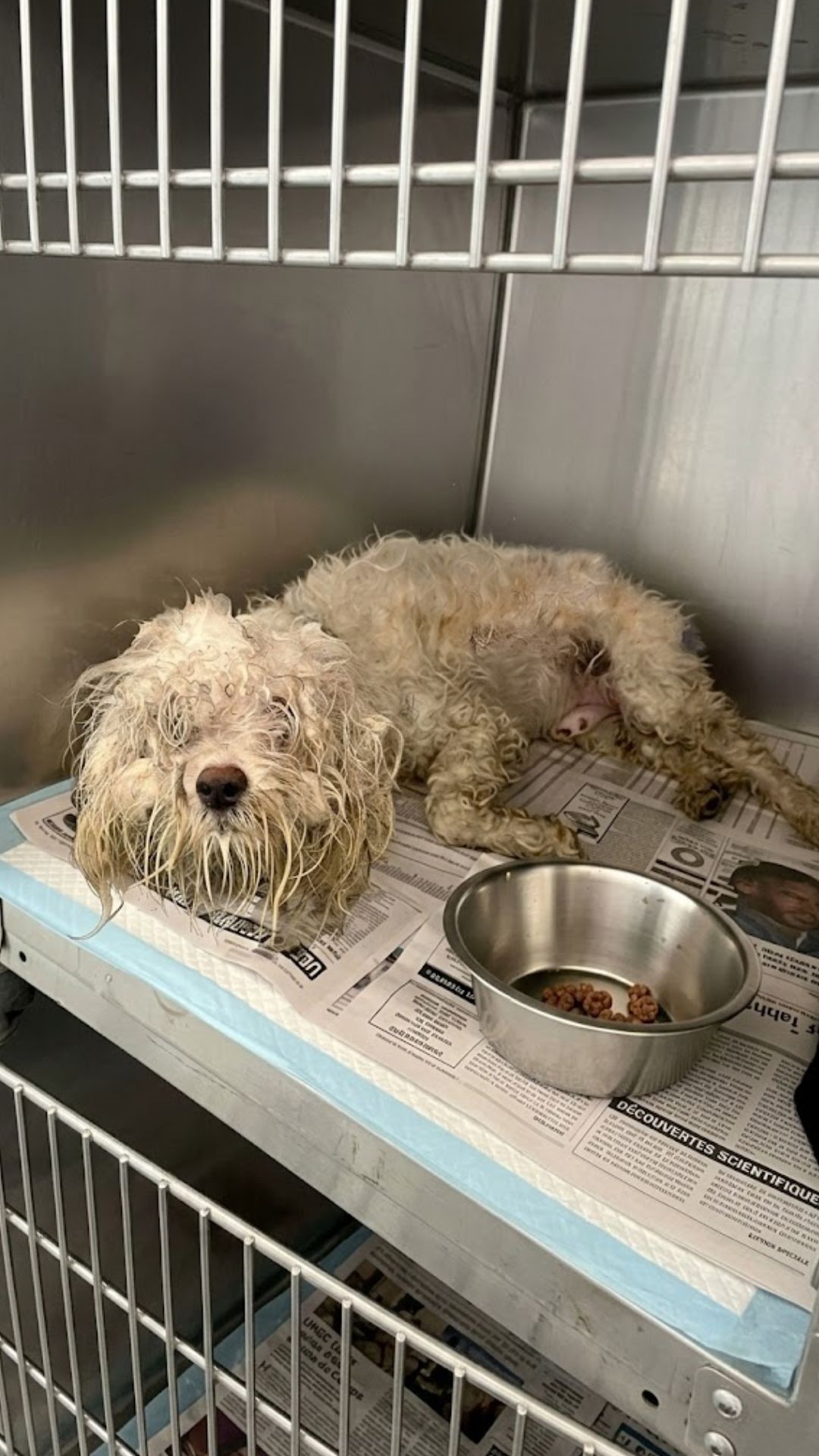
Curled low against the floor was a tiny dog.
She was thin enough that her body seemed to disappear beneath tangled fur. She barely moved as the firefighters approached.
They lifted her and carried her outside.
Only after the smoke was behind them did everyone begin to understand something unsettling.
The fire was not the beginning of this dog’s emergency.
She had apparently been struggling to survive long before the building caught flames.
And when veterinarians later discovered pieces of plastic that had passed through her digestive system, they realized just how desperate that survival had become.
Something Moved Through the Smoke
Firefighters had entered the abandoned structure expecting the dangers that come with any serious building fire.
Smoke.
Heat.
Unstable walls.
Limited visibility.
Their first responsibility was to search the property and make sure no one remained trapped inside.
Then, through the haze, someone noticed a small shape near one of the walls.
At first, it was difficult to identify.
The dog was so still that she could have been mistaken for debris.
When firefighters moved closer, they saw her clearly.
She was alive.
But barely active.
Her coat was heavily matted.
Her body underneath was alarmingly thin.
Nothing about her condition suggested she had simply wandered into the building during the fire.
The state of her body indicated that she had been living with severe neglect and lack of nutrition for some time.
The firefighters did not hesitate.
They picked her up and carried her out.
The dog had escaped one immediate danger.
But outside, away from the smoke and flames, another question became more urgent.
How had she become so weak?
Video: Rescued From a Burning Building—Phoenix’s Fight to Become Strong Again
At the Emergency Clinic, Her Weight Was Only Part of the Problem
The dog was taken for emergency veterinary care.
The medical team could now examine what the smoke had partially hidden.
She was severely underweight.
Her ribs and other bones were prominent beneath her skin.
Heavy mats covered portions of her coat and pulled against already delicate skin.
Her breathing was also concerning after being inside the smoke-filled building.
She was placed in an oxygen chamber while the team monitored her.
They gave her a name.
Phoenix.
The name reflected the circumstances of her rescue, but no one assumed that surviving the fire meant she was out of danger.
Bloodwork showed that her body had been under significant strain.
Her liver values were markedly abnormal.
For the veterinary team, the results reinforced what Phoenix’s appearance already suggested.
This was not a dog who had become weak in a single day.
Her body had been trying to function without adequate nutrition for a prolonged period.
Then another discovery revealed more about what she may have been doing to survive.
The Plastic Fragments Told Their Own Story
To properly examine Phoenix’s skin, the veterinary team had to remove the heavy mats from her coat.
The process frightened her.
During her care, staff later noticed small pieces of plastic and other debris in her stool.
The implication was difficult to ignore.
Phoenix had been ingesting material that was not food.
No one could know exactly what she had eaten or how often.
But in an abandoned building with no dependable food source, the presence of plastic fragments suggested that she had been scavenging whatever she could find.
For the rescuers, it changed the way they looked at the little dog in front of them.
Her extreme thinness was not simply an appearance.
It reflected a long period in which her body had been deprived of what it needed.
The medical team performed an ultrasound to check for additional foreign material that might still be inside her digestive system.
Thankfully, they did not find anything that required surgery.
Phoenix needed food.
But there was a complication.
Giving her too much too quickly could create another medical emergency.

Even Feeding Her Had to Be Done Slowly
When a severely malnourished animal begins eating again, recovery cannot always start with a full bowl.
Phoenix was at risk for refeeding syndrome, a potentially dangerous metabolic complication that can occur when nutrition is reintroduced too rapidly after prolonged starvation.
So the team designed a careful feeding schedule.
Small portions.
Specific intervals.
Close monitoring.
For Phoenix, restraint was difficult.
The smell of food immediately got her attention.
When a meal appeared, she wanted it quickly.
Her caregivers could see how powerful her hunger remained.
Instead of allowing her to gulp everything at once, they used tools such as a lick mat to slow her eating.
The goal was not to deny her food.
It was to help her weakened body adjust safely to receiving it again.
Meal after meal, Phoenix began tolerating the nutrition.
Her blood sugar became more stable.
Her liver values began moving in a better direction.
And gradually, the tiny dog who had been carried from the burning building became more alert.
The changes were not dramatic from one day to the next.
But they were measurable.
Her body was finally receiving what it had been missing.
At 9.8 Pounds, Recovery Had Only Just Begun
Once Phoenix was stable enough to leave the emergency setting, she moved into medical foster care with rescue coordinator Liz.
There, recovery became less about crisis and more about routine.
Food.
Rest.
Medication.
Monitoring.
Warmth.
During her early days in foster care, Phoenix often slept wrapped snugly in a soft blanket.
Her body had spent so much energy simply surviving that rest became an important part of rebuilding.
The scale offered one simple way to track her progress.
At one point, Phoenix weighed approximately 9.8 pounds.
Then the number began rising.
A few ounces at a time.
Three ounces.
Five ounces.
Small gains that meant her body was finally holding onto nutrition.
Eventually, she reached about 12 pounds.
But Liz noticed something else happening that no scale could capture.
Phoenix’s personality was beginning to emerge.

The Dog Who Barely Moved Became Liz’s Shadow
As Phoenix gained strength, she began moving through the foster home differently.
Her eyes became more alert.
She showed interest in what people were doing.
And she developed a strong attachment to Liz.
Rescuers affectionately described her as a “velcro dog.”
Phoenix wanted to stay nearby.
If Liz moved through the house, Phoenix followed.
She sought cuddles.
She curled up close on the couch.
She began interacting with the other dogs in the home.
At times, she playfully nibbled at their ears.
She also discovered toys.
These behaviors stood in sharp contrast to the dog firefighters had found curled inside the smoke-filled building.
Then, Phoenix had barely enough energy to respond.
Now she was following people from room to room.
Playing.
Seeking attention.
Participating in ordinary household life.
The shift was important because recovery from severe neglect is not only about gaining weight.
It is about having enough physical security to do something beyond survive.
Phoenix was beginning to have that space.
Not Every Part of Recovery Moved Forward at the Same Speed
Phoenix’s progress was encouraging, but it was not perfectly smooth.
At one point, a persistent sore on her ear refused to heal as quickly as expected.
Because of that issue, parts of her routine medical care—including vaccinations and her planned spay procedure—had to be postponed.
It was a reminder that recovery does not follow a straight line.
An animal can gain weight while another medical concern needs attention.
Energy can return before every wound has healed.
For Phoenix, the ear problem meant more vet visits, bandage changes, and continued care.
But her behavior showed how different she had become.
She ran through the house.
Chased toys.
Stayed close to the people she trusted.
Her tail moved frequently.
As the heavily matted coat was replaced by new growth, Phoenix’s appearance also began changing.
The new fur initially grew in unevenly.
That was fine.
The goal was never to make her look perfect as quickly as possible.
It was to make her healthy.

Her Transformation Happened in Ordinary Moments
Looking only at the beginning and end of Phoenix’s story can make the change feel almost impossible.
In the beginning:
An abandoned building.
A fire.
Heavy smoke.
A dangerously thin dog.
Matted fur.
Abnormal bloodwork.
Plastic fragments passing through her body.
Then later:
A blanket.
A foster home.
A food schedule.
Toys scattered through a room.
Another dog nearby.
Phoenix following Liz from place to place.
The difference was enormous.
But the transformation itself happened through small, repetitive moments.
One carefully measured meal.
Then another.
One safe night.
Another pound gained.
A veterinary recheck.
A toy she decided to investigate.
A person she learned to follow.
A couch where she could curl up beside someone.
These are not dramatic rescue scenes.
They are the things that make rescue last.
Removing Phoenix from a burning structure may have saved her from the flames.
Everything afterward taught her body how to live beyond survival.
Eventually, Phoenix Found a Permanent Home
After everything Phoenix had endured, the final stage of her journey was not another hospital room.
It was a home.
The dog who had once been found inside an abandoned building eventually moved into a permanent family where her basic needs no longer depended on chance.
She had regular food.
Warm places to rest.
People responsible for her care.
And the security of knowing that the next meal would come without having to search through discarded material.
That ending matters because hunger had shaped so much of Phoenix’s earlier life.
When food first appeared during treatment, she approached it with desperation.
She ate as though scarcity might return at any moment.
Her caregivers had to teach her body something new.
Meals could be small because another one was coming later.
Then another tomorrow.
Consistency replaced urgency.
By the time Phoenix reached her forever home, food had become part of a routine rather than a race for survival.
The Firefighters Saved More Than a Dog From the Flames
If no one had noticed the small movement through the smoke, Phoenix’s story might have ended inside that building.
But the firefighter who looked closer saw something worth investigating.
That moment opened the way to everything that followed.
Emergency care.
Oxygen.
Blood tests.
The ultrasound.
Careful feeding.
Medical foster.
Weight gain.
Toys.
Affection.
And eventually a permanent home.
Still, Phoenix’s story is not simply about escaping a fire.
The condition in which she was found suggests that her struggle began much earlier.
The building fire only made her visible.
Once she was seen, people were finally able to respond to the hunger, weakness, and medical problems that had already been developing.
There is an important distinction there.
Sometimes rescue arrives because an animal cries loudly enough for someone to hear.
Sometimes a neighbor calls.
Sometimes a passerby stops.
And sometimes it takes a completely unrelated emergency for a hidden life to finally be discovered.
Phoenix happened to be inside a building firefighters were already searching.
They saw movement.
They looked closer.
And beneath all the smoke, they found a dog who still had enough life left to be saved.
She could not tell anyone how long she had been hungry.
She could not explain why she had swallowed plastic.
Her body told that story for her.
The people around her answered with something far more practical than sympathy.
Treatment.
Food given at the pace her body could handle.
A foster home.
Time.
And eventually, permanence.
Phoenix did not rise from her circumstances all at once.
She gained strength ounce by ounce.
Meal by meal.
Day by day.
The dog who had once been found curled against the wall of a burning building eventually learned something very different about the world around her.
Food did not have to come from trash.
Human hands could bring comfort.
A blanket could mean rest.
And a home could be somewhere she was expected to stay.
The flames brought firefighters to the building.
But compassion carried Phoenix the rest of the way.


