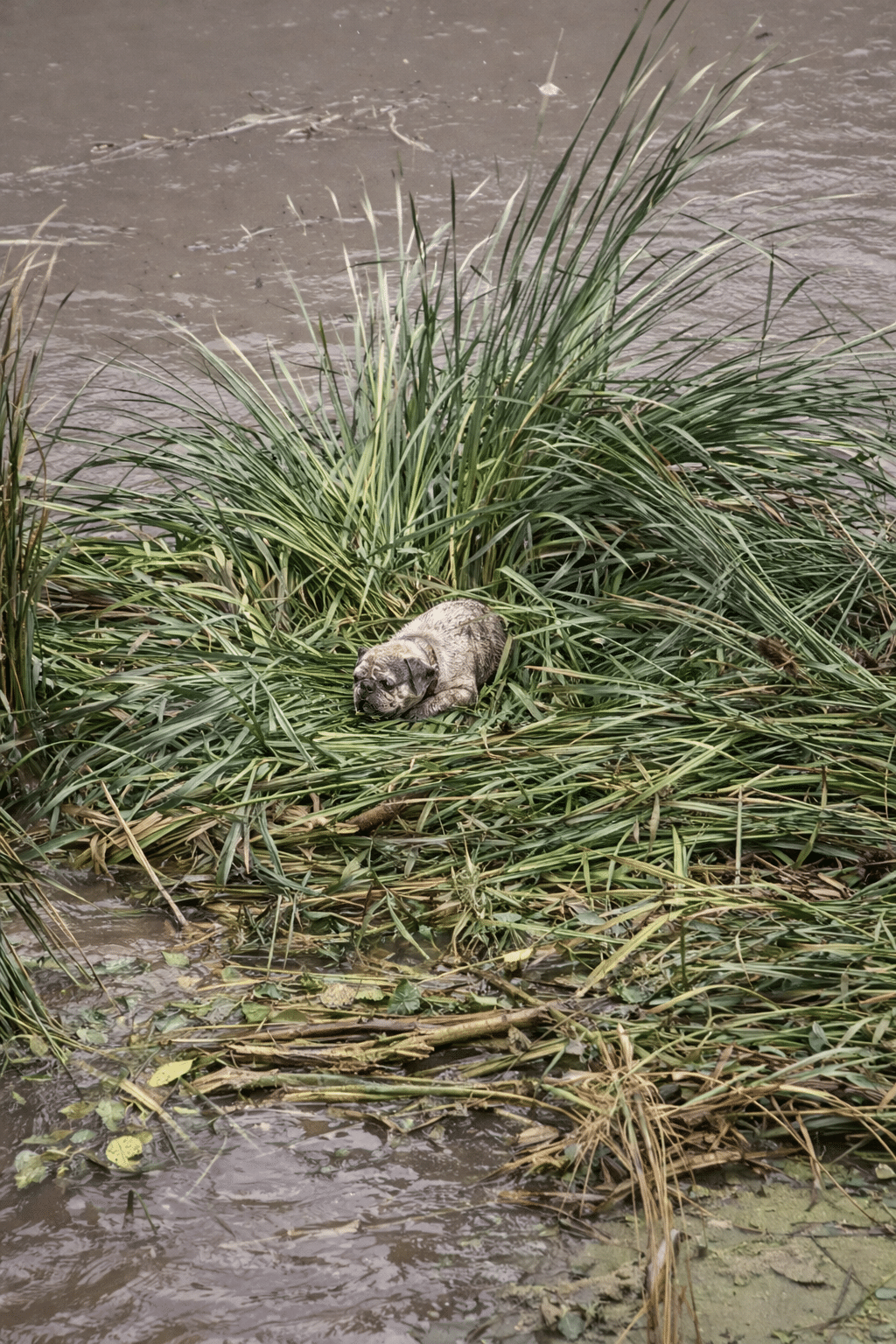
At first, the field looked almost still.
Rainwater covered the low ground in a wide gray sheet, pushing through tall grass and hiding whatever lay beneath the surface.
Then someone noticed a small shape.
A dog.
He was barely visible among the flooded vegetation.
Believed to be a Pug or Pug mix, the little dog had nowhere obvious to go. Water surrounded him, and the patch of ground beneath his body was shrinking as the flood continued to rise.
He stayed low.
Wet.
Motionless.
There was no safe path back to dry land.
Then firefighters arrived.
And instead of rushing blindly into the water, one of them built a narrow way toward him.
The Water Had Taken Away His Route Back
Hours of heavy rain had transformed the low-lying area into something far more dangerous than it looked from a distance.
Grass disappeared beneath murky water.
The ground became difficult to read.
What might appear shallow could suddenly drop.
And somewhere inside that flooded stretch, the little dog had become trapped.
He could not simply run toward the road.
There was water in every direction.
As the level rose, the amount of safe ground around him became smaller.
The dog remained still, possibly because moving through the unknown water would have been just as dangerous as staying where he was.
From shore, rescuers could see him.
But reaching him required caution.
A hurried approach could create another emergency.
So the Ventura County Fire Department crew began planning a safer route.
VIDEO: Floodwater Surrounded a Small Dog — Watch the Moment Firefighters Finally Reached Him
A Firefighter Turned a Ladder Into a Path
One firefighter prepared to enter the flooded area.
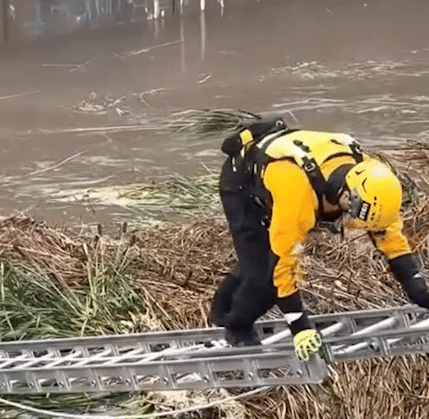
Instead of depending entirely on the submerged ground, the crew positioned a ladder across part of the flooded stretch.
It became a narrow bridge.
Not a perfect one.
But something more reliable than stepping blindly through water and thick grass.
The firefighter moved slowly.
One step at a time.
The surrounding water made every movement deliberate.
Tall grass had to be pushed aside.
The ground underneath could not always be seen.
The dog remained ahead of him.
Small.
Soaked.
Waiting.
There was no dramatic chase.
No frantic attempt to capture him.
The entire rescue depended on patience.
Get close.
Stay balanced.
Do not startle the dog into deeper water.
Then reach him safely.
When the Firefighter Reached Him, the Dog Did Not Fight
Eventually, the distance disappeared.
The firefighter crouched near the little dog.
For an animal trapped in unfamiliar surroundings, this could easily have become another frightening moment.
But the dog did not bolt.
He did not snap.
He allowed the firefighter to move closer.
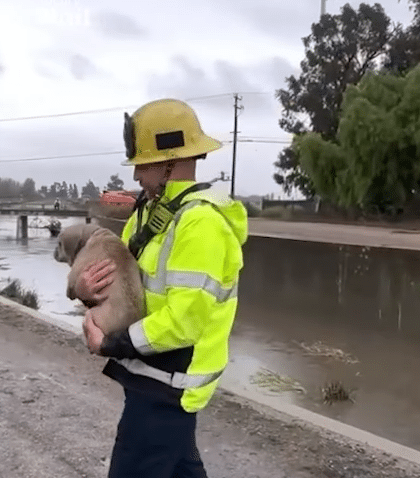
Then he was lifted.
His paws tucked near his body as he was held securely against the firefighter’s chest.
For the first time since the flooding had surrounded him, the dog no longer had to choose where to step.
Someone else was carrying him.
The rescue was only halfway finished.
The firefighter still had to return across the flooded area while holding a living animal.
So he turned back toward shore.
Carefully.
Slowly.
Following the same narrow route that had brought him out.
The Walk Back Was Just as Important as Reaching Him
Rescue footage often focuses on the moment an animal is picked up.
But getting the dog back safely mattered just as much.
The firefighter had limited room to move.
One arm needed to keep the dog secure.
His footing still had to remain controlled.
The ladder offered support, but the surrounding water had not become less dangerous simply because the dog was now in his arms.
So the return continued at the same measured pace.
Step.
Balance.
Adjust.
Then another step.
The little dog remained close against him.
No struggling.
No sudden movement.
Until finally, the flooded stretch was behind them.
Dry ground was within reach.
And the small dog was carried out of the water.
Once His Paws Reached Solid Ground, the Urgency Changed
On shore, the situation became immediately easier to assess.
The dog was alert.
He was responsive.
And importantly, rescuers did not identify any serious injury from the incident.
That did not mean he had experienced nothing frightening.
He had been stranded in rising water without an obvious escape route.
But physically, he appeared to have come through the rescue well.
The focus could now move away from immediate danger.
He needed warmth.
Food.
A dry place to rest.
And people who could determine where he belonged.
The small dog was transferred into the care of local animal control and rescue personnel.
For the first time since the water rose around him, his next hours would not depend on the weather.
The Next Question Was Simple: Did Someone Belong to Him?
Once the flood emergency had passed, another part of the story remained unresolved.
Who was this dog?
Had he wandered away during the storm?
Had flood conditions separated him from a nearby home?
Was someone already searching for him?
At the time of the rescue, efforts were underway to identify and locate his owner.
That meant the story did not end at the water’s edge.
The dog was safe.
But his background remained uncertain.
Local animal control and rescue teams would handle that next step.
Until then, he had something far more immediate.
Shelter.
Dry ground.
Food.
And time to recover from the ordeal.
There Was Nothing Flashy About the Rescue
The scene itself was simple.
A flooded field.
Tall grass.
A ladder.
One firefighter moving slowly toward a dog who could not get himself out.
There was no need for dramatic speed.
In fact, rushing could have made the situation worse.
What saved the dog was controlled action.
A plan.
Steady footing.
And a willingness to enter an unstable area because a small animal had nowhere else to go.
That kind of rescue rarely looks spectacular while it is happening.
It looks careful.
It looks slow.
It looks like someone testing the next step before taking it.
But sometimes that is exactly what heroism requires.
A Small Dog Was Safe Because Someone Chose to Cross the Water
The dog could not call for help.
He could not explain where he had come from.
He could not tell rescuers whether the water was still rising beneath him.
All he could do was remain where he was.
Someone else had to notice.
Then someone had to decide the risk was manageable.
Someone had to place the ladder.
Someone had to step out across it.
And someone had to carry him back.
The rescue did not give the dog a dramatic new life story.
Not yet.
His owner still had to be found.
His future had not been fully written.
What it gave him was something more immediate.
A way out.
One moment, floodwater surrounded him on every side.
The next, he was being carried toward dry ground.
That is sometimes what rescue looks like.
Not a grand transformation.
Just one frightened animal.
One careful approach.
And one pair of steady arms reaching him before the water had the chance to rise any farther.


