The first thing the rescuers noticed wasn’t his painfully thin body.
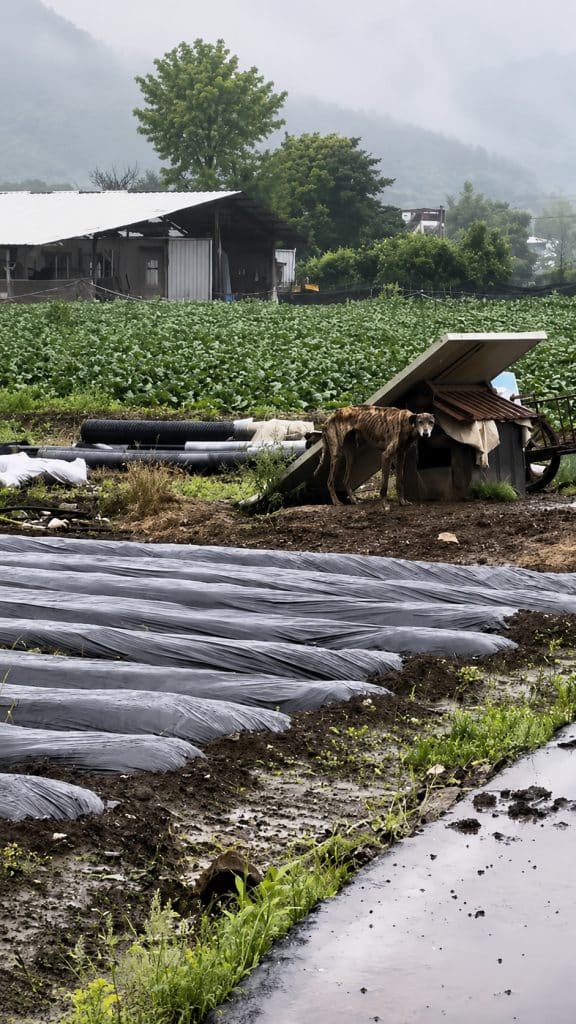
It wasn’t the muddy ground, the chain, or the makeshift shelter that had been his home for so many years.
It was his tail.
As strangers approached, the elderly Greyhound lifted his tired head and began to wag it, greeting them with a gentleness that seemed almost impossible after everything he had endured.
His ribs were clearly visible. His legs looked weak, and his aging body bore the signs of prolonged neglect.
For an estimated 11 to 12 years, he had lived chained in this difficult environment.
But now, as the rescuers knelt beside him, they saw something beyond his fragile condition.
He was still reaching for human affection.
And before long, the old dog would receive a name that reflected everything his rescuers wanted to give him.
Hope.
The Old Dog Who Had Forgotten What Comfort Felt Like
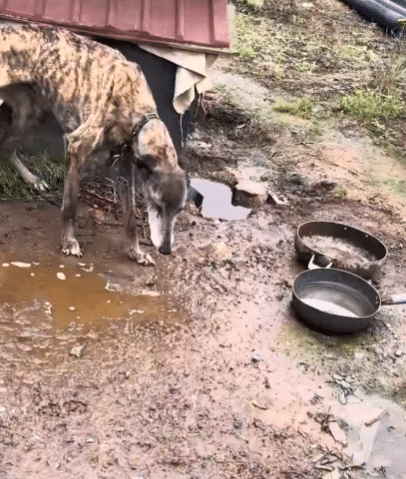
The yard was muddy and uneven, with little to offer an elderly dog seeking somewhere comfortable to rest.
Beside a rough, makeshift shelter stood a Greyhound whose body had become alarmingly thin.
His bones were easy to see beneath his skin.
His legs appeared frail.
And the chain restricted his ability to move freely through the place where he had spent so much of his life.
There was no soft bed waiting for him.
No clean, sheltered resting area suited to his age and condition.
For a dog who had reportedly lived this way for more than a decade, the physical consequences were painfully apparent.
Yet his response to the approaching rescuers was unexpected.
Instead of retreating, he wagged his tail.
He appeared receptive to their presence, allowing them to come close and offer the gentle attention he so desperately needed.
One of the most touching details was his willingness to greet people despite his circumstances.
His body was exhausted, but he still responded to kindness.
The rescuers could see that removing him from the yard was only the beginning. His condition suggested that he needed urgent veterinary attention, proper nutrition, and a safer environment.
First, however, they had to obtain permission to take him.
And that meant having a difficult conversation with his owner.
VIDEO: After 12 Years Chained in the Mud, an Elderly Greyhound Finally Meets His Rescuers
The Conversation That Finally Opened the Door
The rescuers approached the dog’s owner to discuss his condition.
According to the rescue account, the man initially insisted that the Greyhound was receiving proper care.
But the rescuers were deeply concerned by what they had seen.
The elderly dog’s severe thinness, restricted living conditions, and overall weakness indicated that his needs were not being adequately met.
They explained why he required help.
They continued the conversation rather than walking away when the owner initially resisted.
Their goal was simple.
Get the dog somewhere safe.
After further discussion, the owner eventually agreed to release him.
It was the decision the rescuers had been hoping for.
The team could finally begin preparing the fragile Greyhound for transport.
They handled him carefully, mindful of his weak body, and placed him into a transport crate.
For the first time in the rescue account, he was leaving the place where he had spent so many years.
The muddy yard was behind him.
So was the chain.
But the rescuers knew that the elderly dog’s situation was far more serious than the conditions they could see from the outside.
They needed to understand what was happening inside his body.
And at the veterinary hospital, the examination would reveal just how much medical attention he required.
At the Hospital, He Finally Received a Name
The rescue team gave the elderly Greyhound a simple, meaningful name.
Hope.
It was a name that reflected their wish to make the next chapter of his life different from the years he had already endured.
At the veterinary hospital, the team began assessing his condition.
The findings were deeply concerning.
Hope was severely anemic, meaning his blood did not have enough healthy red blood cells to meet his body’s needs. His condition was serious enough that he required a blood transfusion.
He also had a substantial pressure sore on his rear.
Because he had so little protective body tissue, pressure against his skin while resting had contributed to an area of damage that needed treatment.
His eyes were cloudy with cataracts.
His nails had become overgrown and deformed.
And additional testing revealed two further health problems: heartworm infection and anaplasmosis, a tick-borne disease.
These findings explained why the rescuers could not simply feed him a good meal and expect him to recover.
Hope was dealing with several significant medical problems at once.
His body needed stabilization.
His pain and discomfort needed attention.
And his treatment would have to be planned carefully around his age and fragile condition.
For an elderly dog who had spent so long without adequate care, recovery was unlikely to be quick.
But now, for the first time in this account, he had a veterinary team working to address his needs.
He was no longer just a thin dog standing beside a shelter in the mud.
He was Hope.
A patient.
A life receiving the medical attention he had needed for far too long.
A Blood Transfusion Became His First Major Step Toward Recovery
Hope’s severe anemia was among the most urgent concerns identified during his examination.
The veterinary team determined that he needed a blood transfusion to help stabilize his condition.
For a dog already weakened by malnutrition and multiple illnesses, the situation required close monitoring.
But the transfusion was only one part of his treatment.
The sore on his rear needed wound care.
His overgrown nails required attention to help improve his comfort and mobility.
The heartworm infection and anaplasmosis would also need veterinary management.
Meanwhile, his severely underweight body required a carefully managed nutritional plan.
Hope had many needs, and they could not all be resolved in a single afternoon.
The team had to work through them according to medical priorities, giving his fragile body time to respond.
There would be examinations.
Treatment.
Rest.
And continued monitoring to assess how he was progressing.
The rescue account does not provide a complete medical timeline or confirm the final outcome of each condition.
But it does describe a dog whose serious health problems were finally being identified and addressed.
After so many years in the muddy yard, that was an important change.
Hope now had people who recognized his discomfort and were taking steps to ease it.
And through the early stages of care, another part of his personality continued to emerge.
He wanted to be close to people.
Even After Everything, He Still Leaned Into Gentle Hands
Hope’s physical condition was difficult to witness.
But his behavior around the people caring for him revealed a remarkably affectionate side.
He responded to their attention.
He leaned toward them.
And when someone reached out gently, he pressed his head into their hands.
These quiet interactions became some of the most memorable moments of his rescue.
The old Greyhound did not need an elaborate display of affection.
He seemed content simply to be near someone who was treating him kindly.
There was something especially moving about seeing him seek contact while his body remained so fragile.
The rescuers could not know exactly what he remembered from his years in the yard or how he understood the sudden change in his surroundings.
But they could see that he welcomed gentle touch.
A hand resting against his head.
A familiar person sitting beside him.
A moment of attention given without asking anything in return.
For Hope, these interactions became part of his new daily experience.
He was receiving medical treatment, but he was also being given something that medicine alone could not provide.
Comfort.
Companionship.
The reassurance of people who noticed when he needed help.
His affectionate behavior made it easier to see the individual behind the painful medical findings.
Hope was not simply an elderly dog with anemia, infections, and a wounded body.
He was a gentle companion who still enjoyed being close to people.
And now, those people were doing everything they could to make him comfortable.
A Soft Bed Replaced the Mud Beneath His Body
For most dogs, resting on clean bedding is an ordinary part of daily life.
For Hope, it represented an important improvement in his living conditions.
His rescuers and veterinary caregivers provided a clean, sheltered environment where he could rest while receiving treatment.
No muddy ground.
No chain restricting his movement in the yard.
No rough shelter serving as his only place of refuge.
Instead, he had bedding, food, medical attention, and people monitoring his condition.
These changes were particularly important because of the pressure sore on his rear.
An elderly, severely underweight dog needs appropriate support and careful positioning to help protect vulnerable areas of skin.
The hospital team had to consider his comfort alongside the treatment of his other health problems.
Even something as simple as lying down required attention.
Hope’s body had been depleted of the muscle and fat that would normally help cushion him while resting.
His caregivers could not instantly restore what he had lost.
But they could provide a cleaner, more comfortable place where his recovery could begin.
They could make sure he received appropriate nourishment.
They could treat his wound and monitor his response.
And they could offer the gentle human contact he continued to welcome.
These ordinary comforts may seem small when compared with a blood transfusion or treatment for heartworm.
But for a vulnerable senior dog, daily comfort is an essential part of humane care.
Hope needed more than survival.
He needed the opportunity to rest without unnecessary discomfort.
And at last, people were making that a priority.
His Age Made Every Small Improvement Matter
At an estimated 11 to 12 years old, Hope was already a senior dog.
His age, combined with severe malnutrition and multiple medical conditions, made his recovery particularly challenging.
The goal could not simply be to put weight on him as quickly as possible.
His caregivers needed to support his body while allowing the veterinary team to manage his illnesses and monitor his response to treatment.
Progress would have to be measured carefully.
Was he becoming more comfortable?
Was his body responding to medical care?
Could he rest without aggravating his sore?
Was his nutrition helping him regain strength?
These were the kinds of questions that would guide the next stages of his care.
The rescue account does not document a full recovery, and it would be premature to assume that Hope’s serious conditions had been resolved.
But it does show why the rescuers considered his care so important.
He was an elderly dog who had already lived through many difficult years.
Every opportunity to improve his comfort mattered.
Every day of appropriate treatment gave the veterinary team another chance to address his needs.
And every gentle interaction reminded his caregivers that the affectionate personality they had seen in the muddy yard was still very much present.
Hope did not need to become a young dog again.
He did not need a dramatic transformation to prove that he deserved help.
He needed a life in which his age and medical conditions were met with patience rather than neglect.
That was the future his rescuers wanted to make possible.
The Years Behind Him Could Not Be Returned
There was no way to give Hope back the years he had spent chained in the yard.
No treatment could erase the time he had passed on muddy ground.
No comfortable bed could undo every difficult day.
The rescuers understood that his past could not be changed.
But his present could.
They could remove him from the conditions in which he had been living.
They could arrange veterinary treatment.
They could provide proper nutrition and a more suitable place to rest.
And they could make sure that his remaining years were approached with the compassion an elderly dog deserved.
The medical challenges ahead remained significant.
Hope would need continued veterinary care, particularly for his infections, anemia, wound, and age-related conditions.
His progress would depend on how his body responded.
Still, he was no longer facing those problems without professional help.
A team of people had recognized his condition and intervened.
They had spoken with his owner, secured his release, transported him to a hospital, and begun addressing the health problems revealed by his examination.
That was already a profound change from the life he had been living.
And throughout it all, the memory of his first greeting remained.
An elderly Greyhound.
A painfully thin body.
A muddy yard.
And a tail that began to wag when strangers approached.
It was a small gesture that made the rescuers want to give him something better.
The Name Hope Was a Promise Worth Keeping
When the rescuers first met him, he was an unnamed elderly Greyhound living in conditions that had taken a serious toll on his health.
By the time they brought him to the hospital, he had a name.
Hope.
It was a fitting name for a dog whose future was still uncertain but whose circumstances had finally begun to change.
His story did not end with an instant recovery.
The available account does not confirm that he was completely healed or that he had already found a permanent home.
What it does show is an elderly dog being removed from prolonged neglect and receiving urgently needed veterinary care.
It shows a team of rescuers who continued speaking with his owner until they were able to bring him to safety.
And it shows an affectionate Greyhound who responded to gentle attention despite his severely weakened condition.
Perhaps the most unforgettable part of Hope’s story will always be that first moment in the yard.
He had so little strength.
His body was painfully thin.
The chain and muddy shelter were all the rescuers could see around him.
Yet when they came close, his tail moved.
He greeted them.
And someone finally answered that greeting with more than a passing touch.
They brought him to safety.
They gave him a name.
They began the difficult work of helping his fragile body.
For Hope, the road ahead still required patience and medical care.
But one important thing had already changed.
He no longer had to remain the forgotten old dog beside a chain.
He was a life worth protecting, a gentle companion worth caring for, and an elderly Greyhound whose remaining years mattered just as much as the years he had already lost.
After more than a decade in the mud, Hope was finally being given the chance to experience something every dog deserves.
A safe place to rest.
Gentle hands to lean into.
And people willing to stand beside him, whatever the next chapter might bring.


