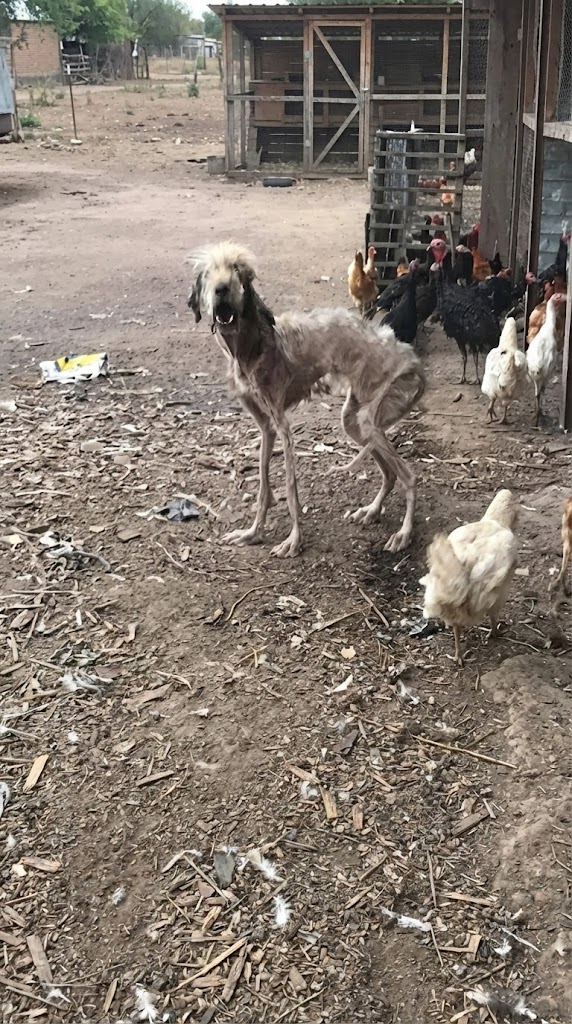
Most people at the crowded marketplace learned not to look beneath the parked cars.
That was where he stayed.
A thin dog with large patches of missing fur would press himself into the shadows beneath vehicles, emerging only when the noise faded and fewer people were around.
His skin was inflamed.
One leg did not move normally.
And whenever someone came too close, he disappeared deeper underneath the nearest car.
To strangers passing through, he was easy to misunderstand.
Some kept their distance because of how sick he looked. Others tried to drive him away.
But people who had known the area longer remembered something important.
He had not always looked like this.
Once, they said, he had curly fur and a friendly temperament.
And according to those who remembered his arrival, there was a reason he had remained near that marketplace for so long.
More than a year earlier, someone had driven there with him.
Then the car left.
The dog did not.
He Learned That the Safest Place Was Underneath a Car
Life around the marketplace was loud and unpredictable.
Vehicles arrived and departed throughout the day.
People moved constantly between stalls.
For a healthy, socialized dog, the activity might have offered opportunities for food or attention.
For this dog, it became something to avoid.
His physical condition made him noticeable, and attention was not always kind.
So he adapted.
During busy hours, he squeezed himself beneath parked cars where people had difficulty reaching him.
The narrow space gave him distance.
It also gave him shade and a place to remain unnoticed.
At night, when the marketplace grew quieter, he ventured out.
He searched for whatever food he could find and then returned to the places where he felt safest.
This routine continued month after month.
Meanwhile, his health deteriorated.
His coat disappeared in large areas.
His skin became increasingly irritated.
An injured leg changed the way he walked.
The dog who had once reportedly been curly-coated and approachable was becoming almost unrecognizable.
People saw the result.
Few knew the history behind it.
VIDEO: He Hid Beneath Parked Cars for More Than a Year — Until Rescuers Learned Why He Never Left
People Remembered the Day He Was Left Behind
Eventually, rescuers began asking questions.
That was when fragments of the dog’s earlier life emerged.
People familiar with the area remembered him before the illness had taken such a visible toll.
“He used to be beautiful,” one person recalled.
Curly fur.
A healthier body.
A much different dog from the one now hiding beneath vehicles.
According to the account shared with rescuers, he had once arrived at the marketplace with an owner.
The person stopped there.
The dog got out.
Then the vehicle drove away without him.
There was no way for rescuers to know exactly what the dog understood about that moment or why he continued remaining in the same general area afterward.
What they could observe was simpler.
He stayed.
Even as his condition worsened, he did not establish a new life somewhere far away.
The marketplace became his territory.
The parked cars became his shelters.
The surrounding streets became the places where he searched for food.
For more than a year, that was enough to keep him alive.
But it was not enough to keep him healthy.
His Skin Was Getting Worse — And One Leg Had Been Injured for a Long Time
By the time rescuers began closely observing him, the dog was living with more than hunger.
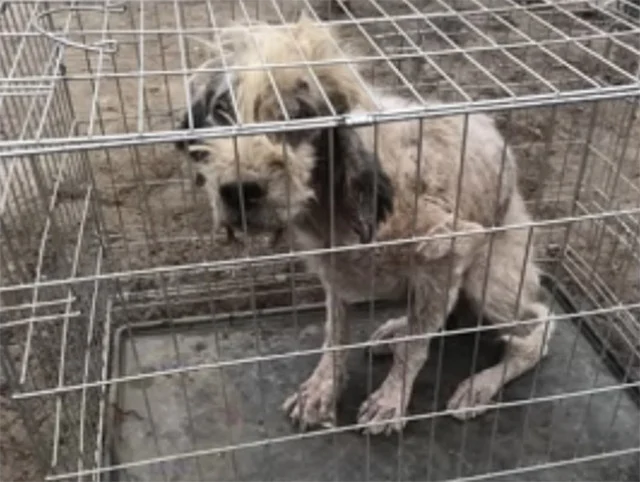
His skin was badly affected.
He scratched repeatedly, sometimes with such intensity that already-irritated areas became more damaged.
Much of his fur was gone.
The exposed skin looked inflamed and uncomfortable.
Then there was his leg.
He limped as he moved through the marketplace, and the problem did not appear recent.
Whatever had happened to the limb had gone untreated long enough for his body to adapt around it.
Still, the dog continued his nightly routine.
He emerged.
Searched.
Ate whatever scraps were available.
Then disappeared again beneath the cars before the busy hours returned.
His behavior toward people also became increasingly defensive.
That did not necessarily mean aggression.
It meant that approaching him had become difficult.
When someone moved too close, he retreated.
If escape routes remained open, he used them.
Rescuers could not simply walk toward him with a leash and expect him to follow.
Before they could begin treating his body, they first had to reach him.
Then the weather made the situation more urgent.
Heavy Rain Took Away the Little Protection He Had
The rainy period changed the conditions around the marketplace.
The places beneath vehicles were no longer reliably dry.
Water reached the ground where the dog usually hid.
His damaged skin was repeatedly exposed to moisture and dirt.
And rescuers began seeing him outside his usual hiding places more often.
He scratched constantly.
His gait looked increasingly uncomfortable.
His body appeared exhausted.
The rain did not create the underlying problems.
Those had been building for months.
But it made clear how little margin he had left.
He could not recover from severe skin disease while continuing to live beneath cars.
He could not rebuild strength while depending on scraps.
And his injured leg was not going to correct itself after such a long period without treatment.
The dog had survived by avoiding people.
Now the same survival strategy was making rescue extremely difficult.
The team decided they could not keep waiting.
They would have to catch him.
The Rescue Did Not Feel Like Rescue to Him
When the team finally moved in, the dog did exactly what they expected.
He ran for cover.
The nearest vehicle became his refuge.
Rescuers approached from different directions, carefully limiting the spaces through which he could escape.
There was no benefit in chasing him recklessly through traffic or frightening him into another dangerous area.
So the process was slow.
One route was blocked.
Then another.
The space around him gradually became smaller.
The dog did not appear relieved that people had finally come to help.
He had no reason to understand their intentions.
He trembled.
He resisted.
At moments, he snapped when frightened hands came too close.
His reaction made sense in the context of what rescuers had observed.
For more than a year, distance from people had been one of the few things he could control.
Now strangers were taking that distance away.
Eventually, the team managed to secure him.
For the first time in more than a year, he was leaving the marketplace not to search for food, but because someone was taking responsibility for his care.
The parked cars disappeared behind him.
What came next would reveal just how much his body had endured.
At Five Years Old, His Body Already Carried Long-Term Damage
Veterinary examination showed that the dog was only about five years old.
His condition made him appear far older.
The skin problem was diagnosed as severe sarcoptic mange, an intensely irritating condition that explained much of the fur loss, inflammation, and constant scratching rescuers had witnessed.
He was also weak from prolonged inadequate nutrition.
Testing showed anemia.
His body needed time and consistent feeding to rebuild what months on the street had depleted.
Then veterinarians examined the injured leg.
The fracture was old.
It had already healed incorrectly.
Too much time had passed without treatment for the limb to simply be restored to the way it had been before the injury.
That finding was difficult.
But another test brought encouraging news.
He was negative for heartworm.
There were significant medical problems ahead, but the team now had something they had not possessed while watching him beneath the cars:
a clearer path forward.
The mange could be treated.
His nutrition could improve.
His anemia could be monitored.
His discomfort could be reduced.
And even if the old fracture could not be undone, his future did not have to resemble the year behind him.
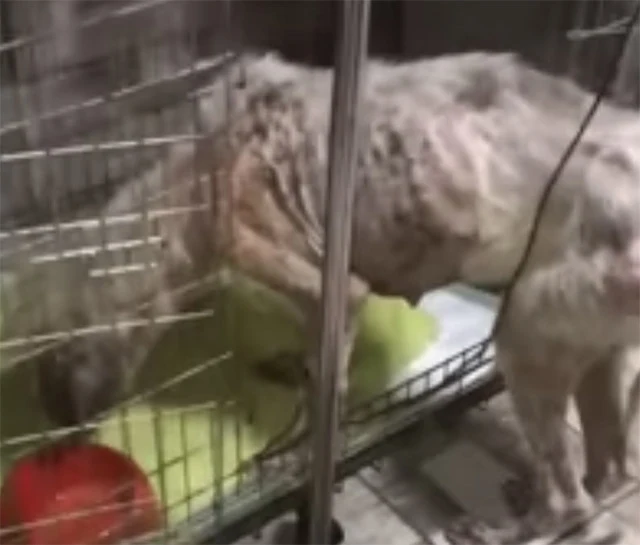
His Skin Began Healing Before His Fear Did
Removing the dog from the marketplace did not instantly make him comfortable around people.
During his first days in safety, he remained extremely cautious.
He chose corners.
He watched caregivers closely.
And he preferred eating when people were no longer standing nearby.
A bowl could be placed in front of him, but he often waited.
Only after the room became quiet would he approach.
The rescue team did not force interaction.
Medical treatment could be administered as necessary, but affection was not something they could prescribe.
That part needed time.
So they focused on creating a predictable environment.
Food appeared regularly.
His skin received treatment.
He had somewhere clean to rest.
No one threw anything at him.
No one chased him from beneath a car.
And no vehicle suddenly pulled away while leaving him behind.
During those early days, the first visible improvements happened physically.
The constant itching began to ease.
The inflammation gradually became less severe.
His body received proper nutrition.
Areas of damaged skin finally had an opportunity to recover without constant exposure to the street.
Emotionally, he remained guarded.
That was okay.
The caregivers did not need him to become affectionate immediately.
They needed him to feel safe enough to eat.
Then safe enough to rest.
Then, eventually, safe enough to become curious.
Recovery could move at his pace.
Beneath the Missing Fur Was the Same Dog People Remembered
For a long time, the marketplace had defined him by what people saw.
The patchy coat.
The inflamed skin.
The smell of illness.
The unusual walk.
The frightened animal disappearing beneath cars.
Those visible signs made it easy for strangers to decide what kind of dog he was before getting anywhere near him.
But none of them described his personality.
They described his condition.
Mange was treatable.
Malnutrition could improve.
Damaged skin could heal.
Even the fear that kept him distant from people was not proof that he had always been afraid.
People who remembered his earlier life had already provided one clue.
Once, he had been friendly.
That dog had not necessarily disappeared.
He had simply spent more than a year learning behaviors that helped him survive.
Hide during the day.
Search for food when the streets became quiet.
Move away when people approached.
Protect the little space available to him.
Now rescue meant teaching him an entirely different set of expectations.
People could bring food instead of taking it away.
Hands could provide treatment instead of harm.
A room could remain his even after he fell asleep.
Not every person approaching him meant he needed to disappear.
Those lessons would take longer than treating the mange.
But for the first time, he had enough time to learn them.
He No Longer Has to Wait Beneath the Cars
The dog who once spent his days hiding beneath vehicles is now somewhere people can actually care for him.
His recovery is still a process.
The old fracture remains part of his body.
His skin needs time.
His coat will not return overnight.
And rebuilding confidence after such a long period of avoidance cannot be rushed.
But the most dangerous part of his routine has already changed.
He no longer wakes beneath a parked car wondering where food might come from.
He no longer needs darkness before feeling safe enough to move through the streets.
He no longer has to scratch at untreated skin while rain falls onto the places where he hides.
Most importantly, he does not have to remain in the location where his life changed more than a year earlier.
No one can know exactly what kept him there.
Perhaps the area had simply become familiar.
Perhaps he learned where scraps could be found and where cars offered shelter.
Whatever the reason, the marketplace was the only life he had for a very long time.
Now there is something beyond it.
Regular meals.
Treatment.
A dry place to rest.
And people willing to wait while he discovers that not every human encounter ends with him being driven away.
Once, people saw a frightening-looking animal beneath the cars and kept walking.
Rescuers looked longer.
They found a five-year-old dog living with treatable disease, an old injury, and behaviors shaped by more than a year of survival.
He was never the strange creature people imagined from a distance.
He was a dog who needed help.
And eventually, someone stayed long enough to give it.


