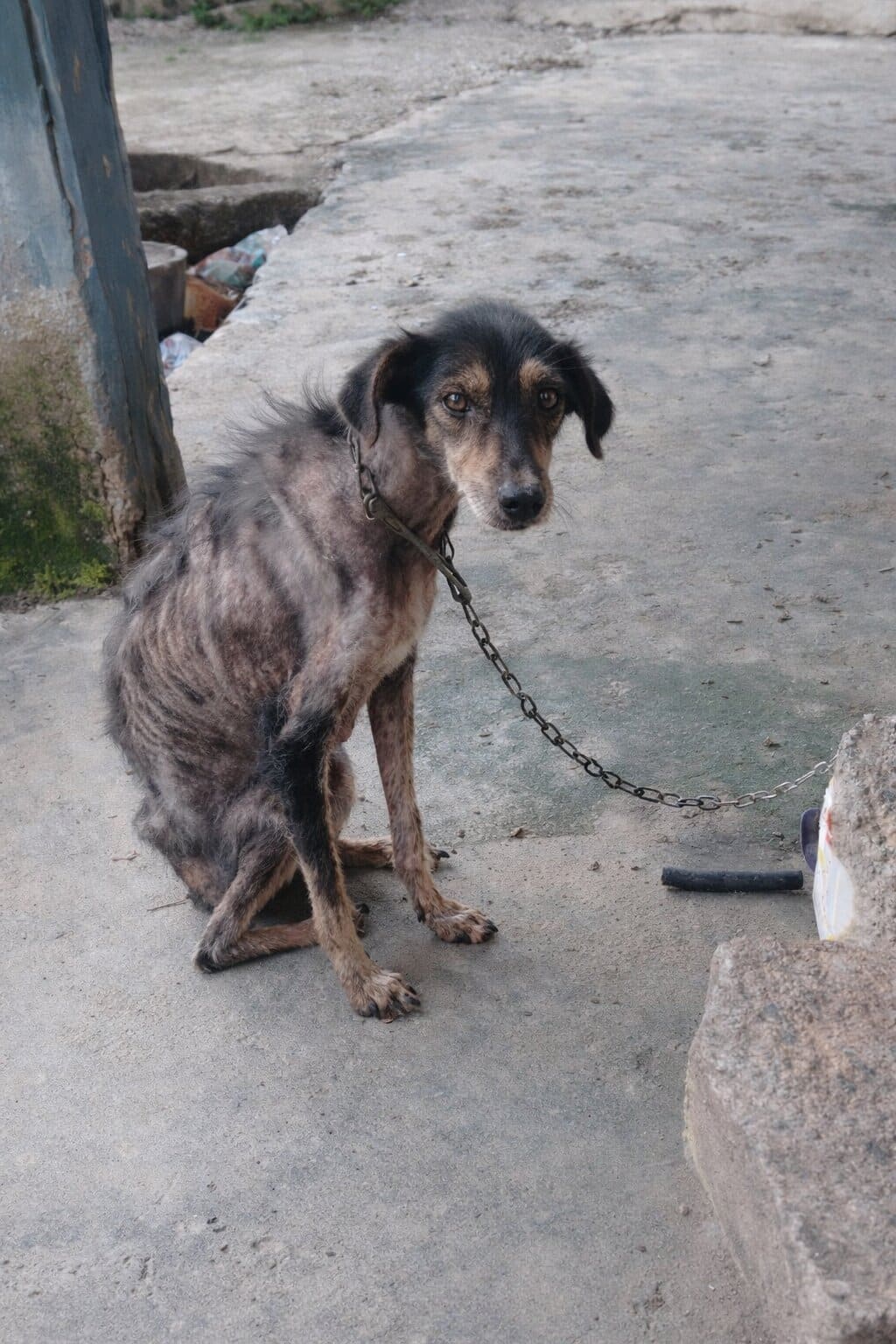
For years, Maya’s world was measured in only a few steps.
Forward until the chain tightened.
Back toward the same patch of ground.
Turn around.
Lie down.
Then repeat it all again the next day.
According to the rescue account, Maya had spent roughly five years tethered in the same place.
Five summers.
Five winters.
Thousands of mornings without the freedom to simply choose where she wanted to go.
By the time rescuers reached her, the effects were visible.
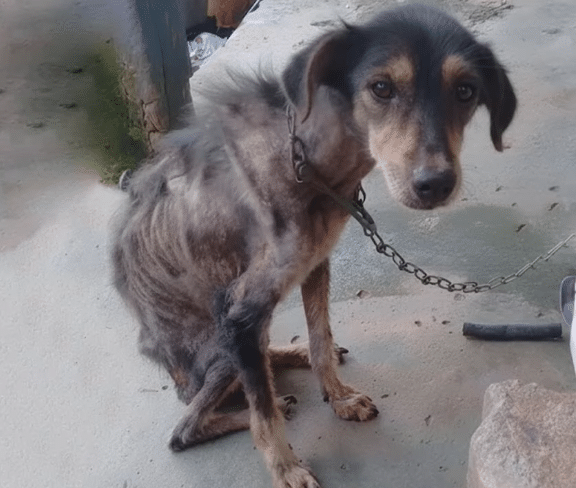
Maya was thin.
Her body looked weak.
Standing required effort, and when she tried to move, her legs did not carry her with the confidence of a dog accustomed to walking freely.
She did not lunge toward the people approaching.
She did not bark.
She simply watched.
Then, for the first time in years, someone reached toward the chain not to attach it—
but to remove it.
The First Steps Away Were Harder Than Anyone Expected
Freedom did not immediately look like running.
Maya had spent so long with her movement restricted that simply leaving the place where she had lived was difficult.
Her legs were weak.
Her body appeared depleted.
And the open space beyond the chain was unfamiliar.
Rescuers moved slowly around her.
There was no reason to expect Maya to understand what was happening.
One moment, she was standing inside the same limited radius she had known for years.
The next, unfamiliar people were touching her and preparing to take her somewhere else.
So they supported her.
When walking became too difficult, they lifted her.
For Maya, that meant surrendering control to people she did not yet know.
Still, she allowed herself to be carried.
The place that had defined most of her life began disappearing behind her.
A vehicle waited.
Then a veterinary clinic.
For the rescuers, removing the chain had taken only moments.
Helping Maya recover from the years attached to it would take much longer.
Video: After Five Years on a Chain, Maya Is Finally Lifted Away — Too Weak to Walk Normally
At the Clinic, Her Body Revealed How Much Care She Needed
Once Maya arrived at the veterinary clinic, the team could examine her properly.
Her thin frame was impossible to ignore.
She lacked strength.
Her coat and skin showed signs that regular care had been missing.
Even basic movement seemed tiring.
The original rescue story does not provide enough detailed veterinary information to responsibly assign diagnoses that were not documented.
What it does make clear is that Maya needed rehabilitation rather than a quick fix.
Nutrition had to be restored.
Her body needed rest.
Medical concerns had to be treated.
And muscles that had spent years with limited opportunity for normal exercise needed time to grow stronger.
The team began with those basics.
Food.
Water.
Warmth.
Treatment.
A clean place to rest.
No one expected Maya to transform overnight.
For a dog who had lived within the same small space for so long, even the clinic represented an enormous amount of change.
New smells.
New voices.
New surfaces beneath her paws.
New hands.
So her caregivers kept interactions gentle and predictable.
Maya had already spent years having almost no control over where she could go.
The last thing she needed was for rescue to become another experience in which everything happened too quickly.
At First, Progress Looked Like Finishing a Meal
The early days were quiet.
Maya rested for long periods.
Her caregivers brought meals and monitored how much she could eat.
At first, even food required patience.
Her weakened body needed nourishment, but recovery from prolonged deprivation cannot be forced simply by filling a bowl.
So portions were managed carefully.
Then came a small milestone.
Maya finished a meal.
It would have been completely ordinary for another dog.
For the people watching her recovery, it mattered.
Another meal followed later.
Then another.
With regular nutrition, her body finally had the raw material it needed to begin rebuilding.
Her head stayed lifted for longer periods.
She became more attentive when familiar caregivers entered.
Instead of remaining almost completely still, Maya started adjusting her position on her own.
Then one day, someone noticed her tail.
It moved.
Only slightly.
A small motion.
Easy to miss.
But it was one of the first visible signs that Maya was beginning to respond to more than simply her immediate physical needs.
Standing Became Something She Had to Learn Again
Strength returned slowly.
Maya could not go directly from years of restricted movement to confidently walking across an open yard.
Her body was not prepared for that.
At first, caregivers helped support her as she stood.
Her legs trembled.
She shifted her weight uncertainly.
Sometimes she could stay upright only briefly before needing to rest again.
That was fine.
There was no deadline.
Stand.
Rest.
Eat.
Try again another day.
Little by little, the attempts became more successful.
Maya began holding herself upright for longer.
Then she took a step.
Another followed.
The movements were cautious, but they were hers.
For perhaps the first time in years, there was no chain deciding where that step had to stop.
She could move forward.
Turn.
Investigate.
Choose another direction.
Those choices sound trivial until you remember that Maya had spent years without them.
The physical rehabilitation was strengthening her body.
At the same time, she was learning an entirely different relationship with space.
The world no longer ended where metal pulled tight against her collar.
Open Space Was New — So Maya Explored It Slowly
When Maya became strong enough to spend more time outside, caregivers introduced her to larger areas.
Grass replaced the small patch of ground she had known.
There were smells in every direction.
Nothing forced her to stay within a fixed circle.
At first, Maya did not race away.
She explored cautiously.
A few steps.
Stop.
Sniff.
Look toward the person nearby.
Then another few steps.
Her caregivers allowed her to decide the pace.
The purpose was not to create an emotional video of a dog suddenly sprinting toward freedom.
It was to help Maya become comfortable with freedom itself.
For years, her environment had been predictable because it was extremely limited.
Now there were choices everywhere.
That could be exciting.
It could also be overwhelming.
So the people around her remained close without constantly directing her.
Eventually, curiosity became stronger.
Maya began walking farther.
Her steps became steadier.
She investigated corners of the yard.
She followed familiar people.
Then she began showing something that had been almost absent at the beginning.
Playfulness.
Play Meant Her World Had Become Bigger Than Survival
The first playful moments were simple.
A little movement toward someone.
Interest in something nearby.
A quicker step.
Perhaps nothing that would draw attention from someone who had never seen Maya before.
But play requires something important.
Enough comfort to spend energy on something unnecessary.
When Maya was first rescued, nearly everything her body did appeared connected to immediate need.
Stand.
Eat.
Rest.
Recover.
Now she could do something simply because it interested her.
Her body continued growing stronger.
Her coat began improving.
Her posture changed.
The dog who had once seemed exhausted by a few steps could now move through the yard without immediately needing support.
And the more capable she became physically, the more personality her caregivers were able to see.
Maya responded to voices.
She sought interaction.
She rested comfortably near people.
Gentle touch became part of normal life.
Those changes did not mean that every memory or learned behavior from her earlier life disappeared.
There was no need for them to.
Recovery does not require pretending the past never happened.
It requires building enough safer experiences that the present becomes different.
Maya was receiving those experiences every day.
The Chain Was Gone, but Trust Took Longer to Build
Removing a physical restraint is simple compared with changing what an animal has learned through years of routine.
Maya had known the same restricted environment for a very long time.
Now people were asking her to understand something completely new.
Hands could bring comfort.
A person walking away could return later.
A bowl would be filled again.
A bed could still be hers tomorrow morning.
A door opening did not mean she was being returned to the chain.
Those lessons came through repetition.
Not words.
The same caregiver arrived.
Food appeared.
Treatment happened gently.
Then the person returned the next day.
Over time, Maya became increasingly comfortable with closeness.
She no longer seemed as uncertain about every interaction.
She began leaning toward affection rather than merely tolerating it.
Her body relaxed around familiar people.
Trust was not a dramatic moment in which Maya suddenly decided humans were wonderful.
It was a collection of ordinary days that ended safely.
Enough of those days eventually changed her expectations.
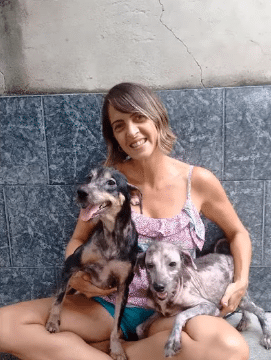
Her New Life Became Remarkably Ordinary
Weeks into recovery, Maya could do things that once seemed far away.
Walk where she wanted.
Explore.
Rest somewhere soft.
Eat without uncertainty.
Spend time with people.
Play.
Those are not extraordinary activities for a dog.
That is exactly what makes them meaningful.
The goal of rescue is not for an animal to remain permanently defined by the dramatic circumstances in which she was found.
Eventually, Maya deserved to become simply Maya.
Not “the chained dog.”
Not “the dog who suffered for five years.”
Just a dog with a routine.
A favorite place to rest.
People she recognized.
Space to move.
And enough security that tomorrow did not need to feel uncertain.
Her earlier life would always be part of her history.
It no longer needed to control the size of her world.
Five Years of Restriction Were Changed by One Decision
There is something difficult about thinking about the length of time Maya reportedly remained tethered.
Five years is not one bad day.
It is not one winter.
It is enough time for restriction to become normal.
Enough time for a dog to stop knowing anything else.
And yet the first physical step toward changing all of it was remarkably simple.
Someone unfastened the chain.
That action did not heal Maya.
It did not restore her strength.
It did not teach her to trust.
But it made every later step possible.
Without the chain, she could leave.
Once she left, she could receive veterinary care.
With treatment and food, her body could strengthen.
With stronger legs, she could walk farther.
With safe routines, she could begin interacting.
With time, she could play.
One change opened the door to another.
Then another.
Until eventually the small circle that had once defined her life existed only in the past.
Maya Did Not Need a Miracle — She Needed Time Outside the Chain
Before rescue, Maya’s life had been shaped by limitation.
After rescue, her recovery was shaped by repetition.
A meal.
A rest.
A supported attempt to stand.
Another meal.
Another day.
A step.
A tail wag.
A longer walk.
A moment of play.
None of these things alone was miraculous.
Together, they became a transformation.
That is perhaps the most important thing Maya’s story leaves behind.
Helping an animal does not always require one extraordinary gesture.
Sometimes it requires doing the ordinary things long enough for them to matter.
Feed her again tomorrow.
Treat her gently again tomorrow.
Give her space again tomorrow.
Let her walk a little farther when she is ready.
Stay long enough for a dog whose life barely changed for years to discover that change can now be safe.
Today, Maya no longer lives at the end of a chain.
She can move where curiosity takes her.
She can rest without metal deciding how far away she may lie.
She can approach people because she wants to.
And when she walks forward, nothing pulls her back to the same patch of ground.
For years, Maya knew exactly how far her world extended.
Only as far as the chain allowed.
Then someone finally reached down and opened it.
What came afterward took patience, food, medical care, and countless ordinary days.
But every part of that new life began with the same quiet moment:
The chain fell away.
And this time, Maya was allowed to keep going.


