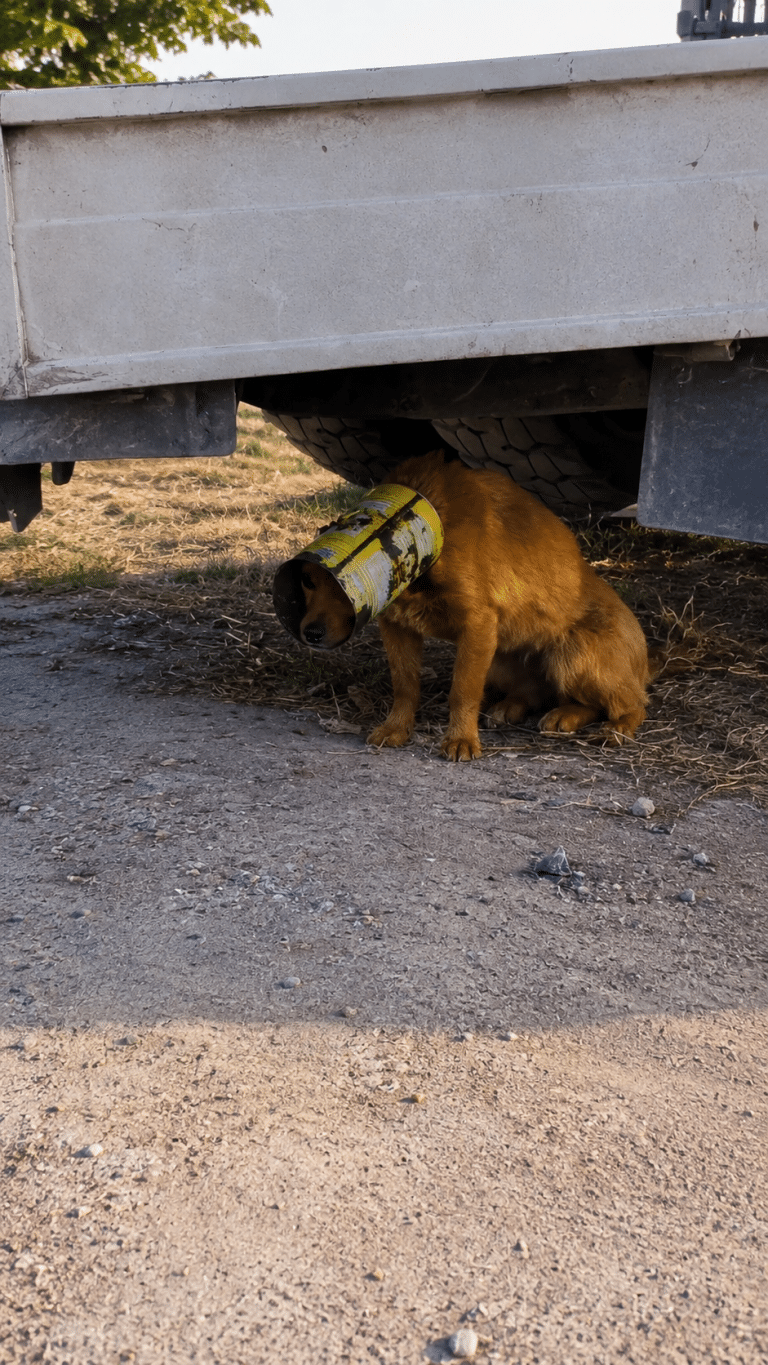
People rarely saw him for more than a few seconds.
A frightened stray dog would suddenly appear at the end of an alley or between parked cars, running blindly with a yellow metal bucket trapped around his head. Before anyone could move closer, he would disappear again—dragging the heavy object into another dark corner of the neighborhood.
He could barely see where he was going.
He could not eat or drink normally.
And with every passing day, rescuers feared the terrified dog was moving closer to the moment when his exhausted body could no longer continue.
The Yellow Bucket Had Become His Prison
No one knew exactly how the bucket became trapped around the dog’s head and neck.
Perhaps he had been searching for scraps when he pushed his face too deeply inside. Perhaps the container had been discarded somewhere accessible to hungry stray animals.
Whatever happened, the dog could not pull himself free.
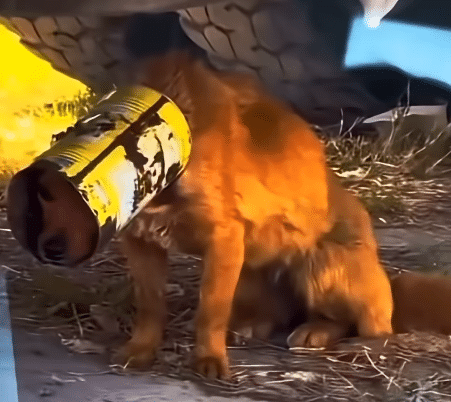
The metal opening had become lodged around his neck, leaving the larger part of the bucket covering his face. His vision was severely restricted, forcing him to navigate through sound, scent, and instinct.
Every ordinary task became nearly impossible.
He struggled to find food.
He could not lower his mouth easily toward water.
Even walking through a narrow passage carried the risk of striking the bucket against a wall, vehicle, or piece of debris.
The metal repeatedly rubbed against the same area of his neck as he moved. Over time, the pressure caused painful irritation beneath the rim.
Yet the dog kept wandering.
He moved through alleyways, parking areas, and quiet corners where he hoped no one would follow. When footsteps approached, he ran immediately.
He clearly needed help.
But fear would not allow him to accept it.
Video: Terrified Stray Dog Is Finally Freed After Wandering With a Metal Bucket Trapped Around His Head
Every Attempt to Help Sent Him Running
Once the rescue team learned about the dog, they began searching the neighborhood with a veterinarian.
Finding him was only the first challenge.
Rescuers followed reports from people who had spotted a yellow bucket moving between buildings or heard metal scraping along the pavement. By the time the team arrived, the dog was often gone.
When they did manage to locate him, approaching safely was extremely difficult.
The dog could not clearly see who was coming toward him. A hand reaching out from the side might appear without warning. A sudden sound could make him spin around and flee in the opposite direction.
Even weakened by hunger and dehydration, he continued running whenever anyone came close.
The rescuers understood why.
For a stray surviving alone, avoiding people may once have helped keep him safe. Now that same instinct was preventing him from receiving the assistance he desperately needed.
They could not chase him aggressively. Doing so might push him into traffic or cause him to collide with something he could not see.
Instead, they followed patiently.
They watched where he hid.
They learned the paths he used.
And each time he escaped, they returned to search again.
The Search Ended in an Underground Garage
After several difficult days, rescuers tracked the dog into a crowded underground parking garage.
Rows of vehicles and concrete pillars created countless places for him to hide. The sound of the bucket striking the ground echoed through the enclosed space as he tried to escape.
But this time, he was slowing down.
His body had become extremely thin. His movements lacked the strength they once carried, and the weight around his head appeared increasingly difficult to drag.
Eventually, the rescuers were able to block the safest exits without surrounding him too suddenly.
The dog backed into a corner.
He trembled as the team approached.
Only days earlier, he might have found enough energy to run again. Now he appeared too exhausted to continue.
That realization brought relief, but it also made the moment more painful.
The rescuers had finally reached him because his body was beginning to give up.
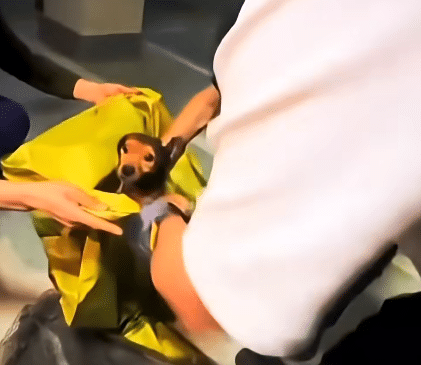
They spoke softly as they moved closer, allowing him to hear their voices before their hands touched him. He did not understand that the strangers intended to help.
He only knew that he could no longer escape.
Removing the Metal Required Patience
Once the dog was safely restrained, the team examined the bucket.
It could not simply be pulled over his head.
The metal had become tightly lodged around his neck, and forcing it could have caused further injury. The rescuers would need to cut through the container while protecting the frightened dog beneath it.
They positioned him carefully and began working piece by piece.
Every movement had to be controlled.
The cutting tool could not be allowed to slip.
The metal could not be bent inward toward his skin.
And the dog needed to remain as still as possible despite the unfamiliar sounds vibrating around his head.
For several tense minutes, the team focused entirely on the narrow section of metal separating the dog from freedom.
A small opening appeared.
Then another.
The bucket slowly began to loosen.
Finally, the last section gave way.
The yellow container fell onto the concrete floor.
For the first time in what rescuers believed had been a very long time, the dog’s face was completely visible.
He blinked beneath the garage lights.
Then he lifted his head without the weight of the bucket pulling it back down.
Beneath the Metal Was an Exhausted Dog
With the bucket removed, the effects of his ordeal became clearer.
The fur around his neck was dirty and tangled. The area beneath the metal rim was badly irritated from repeated friction, and several wounds required immediate cleaning and treatment.
His body was also dangerously thin.
Unable to eat and drink normally, the dog had survived on whatever small amounts he could somehow reach. Each day spent running from people had consumed energy he could not replace.
But the rescuers noticed something else once they could finally see his face.
He looked completely exhausted.
The frantic animal people had watched darting through the streets was now standing quietly in front of them. There was no bucket hiding his eyes and no metal wall separating him from the people nearby.
For months, those who spotted him had seen only a frightening image—a stray dog running with a yellow object covering his head.
Now they could see the life trapped beneath it.
A tired dog.
A frightened dog.
A dog who had been trying to survive the only way he knew how.
Gentle Care Began Replacing Fear
At the rescue center, the dog received the basic comforts he had been missing.
Clean water was placed within easy reach.
Food was offered in small, manageable portions.
His neck was carefully cleaned and treated while the veterinary team checked for infection, dehydration, and other complications caused by prolonged hunger.
At first, the dog remained tense whenever someone approached.
That reaction was not surprising.
During his time on the streets, footsteps had often meant he needed to run. Hands reaching toward him had been something to avoid. Even the people trying to rescue him had appeared frightening through the narrow darkness inside the bucket.
The caregivers did not expect him to understand kindness immediately.
They moved slowly.
They spoke quietly.
They allowed him to observe from a safe distance.
Over time, the dog began to realize that food arrived without competition. Water remained available. The hands near his neck were cleaning his wounds rather than causing more pain.
His body started to recover.
And gradually, the fear that had controlled every movement began to loosen too.
He No Longer Had to Run
By the end of the rescue footage, the dog looked very different from the terrified figure people had chased through the streets.
He was still thin.
His neck still needed time to heal.
And rebuilding trust would require far more than a few peaceful days.
But the bucket was gone.
He could see the room around him.
He could lower his head toward a bowl of food and drink freely whenever he felt thirsty. He could rest without the sound of metal scraping against the ground each time he moved.
Most importantly, he no longer needed to run from one hiding place to another.
His rescue did not happen because he suddenly stopped being afraid.
It happened because the people searching for him understood that fear and refused to mistake it for rejection.
They returned each time he escaped.
They followed carefully instead of giving up.
And when his strength finally failed him inside that underground garage, they were there to make sure exhaustion did not become the end of his story.
For months, people saw a yellow bucket moving through the streets.
Beneath it was a dog silently waiting for the day someone patient enough would finally reach him.
That day came.
And for the first time in a very long while, he was able to lift his head, see the people around him, and begin learning that he was safe.


