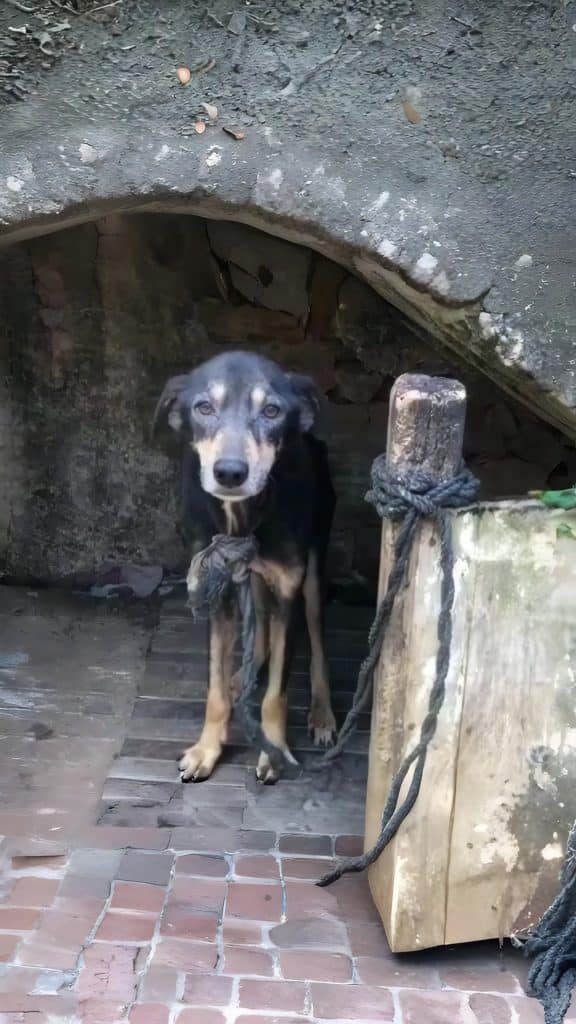
For seven long years, a dog lived beneath a staircase, confined to a small corner by a short chain. There were no daily walks, no soft bed, and no comfortable space where he could move freely.
An old shovel served as his food container. His body had grown painfully thin, his coat was unhealthy, and the world beyond that cramped space remained largely out of reach.
Then, one day, a concerned neighbor made a phone call.
When rescuers arrived, they found a quiet, fragile dog who watched their every movement. He did not know what would happen next, but the people standing before him were determined to change his circumstances.
They would name him Black. And over the next three months, the dog who had spent seven years beneath the stairs would undergo a transformation that began with something incredibly simple.
Someone finally gave him the chance to walk away.
Seven Years Beneath a Staircase
The space beneath the stairs was small, uncomfortable, and painfully bare.
It was where Black had spent seven years of his life, restrained by a short chain that severely limited how far he could move.
There was no soft bedding.
No comfortable area where he could stretch out and rest.
And no opportunity to explore the world beyond the small corner that had become his home.
When rescuers finally arrived, the dog’s physical condition immediately concerned them.
His body was thin, and his coat appeared unhealthy. His movements were slow and uncertain, suggesting that even ordinary activities had become difficult.
Nearby sat an old shovel.
It had been used as a container for his food.
For the rescue team, the scene made it clear that Black had been living in conditions that did not meet his basic needs.
They could not know everything he had experienced over those seven years.
But they could see what remained.
A weakened dog.
A short chain.
And a living space that offered almost none of the comforts a dog needs for a healthy life.
Black watched the unfamiliar people who had entered his surroundings.
He did not immediately approach them or respond with excitement.
Instead, he remained cautious, following their movements with his eyes.
The rescuers understood that removing him from the staircase would be only the beginning.
He needed veterinary care, proper nourishment, and somewhere safe to recover.
But first, they had to approach a dog who had spent nearly his entire life in a very limited environment.
They moved slowly.
They spoke gently.
And they gave Black time to become familiar with their presence.
The chain was still holding him beneath the stairs.
But for the first time in seven years, there were people standing beside him who intended to take him somewhere better.
VIDEO: Chained Beneath a Staircase for Seven Years—Black’s First Rescue and the Bath That Followed
One Neighbor’s Phone Call Changed His Future
Black’s rescue began because someone living nearby recognized that his circumstances needed attention.
The concerned neighbor contacted a rescue team and reported the situation.
That phone call brought people to a place where Black had spent years largely separated from the world around him.
When the rescuers approached, they understood that handling him would require patience.
He was physically weak and appeared uncertain around unfamiliar people.
Rushing toward him could have made the experience more stressful.
So they allowed him time to observe them.
Their voices remained calm.
Their movements were deliberate.
And they avoided forcing him into immediate interaction.
Then they offered him food.
Black responded quickly.
He began eating with an urgency that concerned the people watching him.
They could not determine his entire feeding history from that single moment, but his thin condition and eager response to food reinforced how badly he needed consistent nourishment.
The rescuers knew he could not remain in the same circumstances.
He needed to be freed from the chain and brought somewhere he could receive appropriate care.
They continued working gently with him as they prepared to remove him from the confined space.
It was a significant moment.
For seven years, Black’s movements had been restricted by the short restraint beneath the staircase.
Now, he was finally leaving that place.
The rescuers gave him a name.
Black.
A simple name for a dog who was about to experience an entirely different life.
But his physical condition remained worrying.
The team understood that reaching safety did not mean his recovery would be easy.
He needed a thorough veterinary examination.
And the results would reveal just how much help he required.
The Veterinary Examination Revealed the Cost of Neglect
Once Black reached the veterinary clinic, the medical team began examining him.
His condition confirmed that he had been struggling with several serious health problems.
He was severely underweight.
He was anemic.
And he had untreated parasites.
The combination of these issues explained why his body appeared so weakened when the rescuers discovered him.
Anemia meant his blood was not carrying oxygen as effectively as it should, while parasites and poor nutritional condition created additional challenges for his recovery.
The veterinary team needed to address these medical problems carefully.
Black could not regain his health simply by receiving one large meal or spending a night somewhere comfortable.
His body required treatment, appropriate nutrition, and time to recover from prolonged deprivation.
The rescuers understood that his progress would need to be monitored.
They began providing the medical attention he had been missing, along with regular meals and a protected environment where he could rest.
For Black, the change in circumstances was enormous.
He was no longer confined beneath the staircase.
Food was available through a consistent routine.
And people were paying attention to his physical condition.
But the effects of his earlier circumstances could not disappear overnight.
His body remained weak.
His coat needed care.
And he was still adjusting to unfamiliar surroundings.
The veterinary team continued treating him while the caregivers worked to make him comfortable.
Every meal was an opportunity to help him regain strength.
Every treatment addressed a problem that had gone unattended.
And every day in the new environment gave him another chance to become familiar with the people helping him.
Then came a particularly memorable moment.
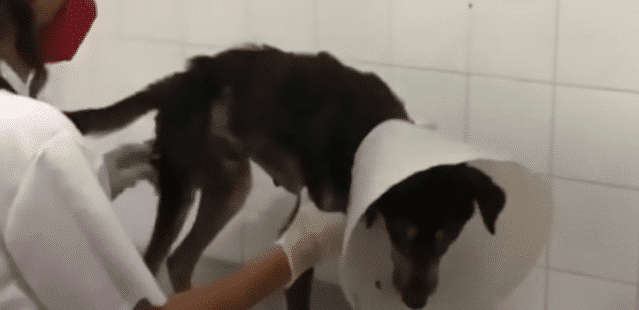
Black was going to receive his first proper bath.
For a dog who had spent seven years in such poor conditions, even this ordinary experience was a significant part of his recovery.
His First Proper Bath Was a Moment No One Forgot
Bathing a dog is an ordinary part of caring for many household pets.
For Black, it was an unfamiliar experience.
His coat was unhealthy, and years of poor living conditions had left him needing careful grooming and cleaning.
The caregivers prepared warm water and began washing him gently.
They understood that the process needed to be comfortable, particularly because Black was still physically weak and adjusting to human attention.
The water flowed over his coat.
Gentle hands worked to clean away the dirt.
And Black stood quietly as the caregivers continued.
He appeared uncertain about the unfamiliar experience, but he allowed them to help him.
There was no need to rush.
The team took their time, making sure the process remained gentle.
For the people who had seen him beneath the staircase, the scene carried particular meaning.
Only a short time earlier, he had been living in a cramped corner with an old shovel serving as his food container.
Now, someone was carefully washing him with warm water.
Someone was attending to his comfort.
Someone was making sure that his coat received the care it needed.
The bath was not a cure for his anemia or the other medical problems affecting him.
Those conditions still required veterinary treatment.
But grooming was another part of helping Black become healthier and more comfortable.
When the process was finished, he could rest in a cleaner, safer environment.
It was a simple act of care.
Yet it represented a profound change in the way Black’s needs were being addressed.
He was no longer simply receiving whatever was available beneath the stairs.
He was being cared for as an individual.
And as his recovery continued, those ordinary acts of attention would begin producing increasingly visible results.
The First Small Signs That Black Was Growing Stronger
Black’s recovery unfolded gradually.
The veterinary team continued treating his medical problems while his caregivers provided consistent nourishment and a comfortable place to rest.
During the earliest days, his weakened body needed time to respond.
There was no immediate transformation.
But little by little, changes began appearing.
His appetite improved.
He began regaining strength.
And the condition of his coat gradually became healthier.
These were important developments for a dog who had arrived severely underweight and suffering from anemia and parasites.
His caregivers continued monitoring his progress, ensuring he received the treatment and nourishment necessary for recovery.
As his physical condition improved, Black also became more interested in his surroundings.
The dog who had spent years confined to a small corner now had the opportunity to experience a much larger environment.
At first, his movements remained cautious.
He was still adjusting to the freedom of being able to walk beyond the short distance his chain had once allowed.
But he began exploring.
He became more responsive to familiar caregivers.
And his behavior gradually revealed a dog who was becoming increasingly comfortable in his new surroundings.
The changes were encouraging.
Black was not merely gaining weight.
He was regaining the strength needed to participate in ordinary activities.
His caregivers could begin thinking beyond his immediate medical problems.
He needed opportunities to move.
To explore.
And to become familiar with a world that had been largely inaccessible to him for so long.
Soon, those opportunities would introduce him to something remarkably simple.
Grass beneath his paws.
Discovering the World Beyond the Staircase
For seven years, Black’s world had been defined by a short chain and a confined space.
He had not been able to enjoy the ordinary freedom that many dogs experience every day.
Now, with his health improving, he was beginning to discover what life outside that corner could offer.
The first experiences were simple.
Walking across the grass.
Feeling sunlight on his back.
Moving without the restriction of the chain that had once controlled how far he could go.
For the caregivers watching him, these moments were deeply meaningful.
They remembered the weakened dog they had found beneath the stairs.
His thin body.
His slow movements.
The unhealthy coat.
And the empty surroundings that had offered so little comfort.
Now, they were seeing him explore.
Black began showing curiosity about the environment around him.
He could move from one place to another.
He could investigate unfamiliar surroundings.
And he could rest when he became tired.
The ability to choose where to go was a completely different experience from living within the limited reach of a short chain.
His caregivers continued allowing him time to adjust.
There was no need to demand immediate confidence or enthusiasm.
Black had spent years in a restricted environment, and becoming comfortable with a larger world would naturally require patience.
But as his strength returned, he became increasingly active.
He started enjoying walks.
He showed interest in the outdoors.
And his personality began emerging through the ordinary activities that had once been unavailable to him.
The dog who had been so quiet during his rescue was gradually revealing a different side of himself.
He was curious.
He was becoming more energetic.
And he was beginning to enjoy the freedom his caregivers had worked so hard to provide.
The most striking changes, however, would become apparent over the next three months.
Three Months Later, He Was Almost Unrecognizable
Three months after Black’s rescue, the difference in his appearance and behavior was remarkable.
The dog who had once stood weakly beneath the staircase had regained considerable strength.
His body was healthier.
His coat had improved.
And the slow, uncertain movements that concerned his rescuers had given way to a much more energetic way of moving.
Black was becoming playful.
He explored his surroundings with curiosity and enjoyed spending time outdoors.
The most memorable sight was watching him run across the grass.
For the caregivers who had seen his earlier confinement, it was an extraordinary contrast.
The dog whose movements had been restricted by a short chain for seven years was now moving freely.
His ears moved in the wind as he ran.
He appeared enthusiastic about exploring the open space around him.
And activities that many dogs experience as part of an ordinary day had become part of Black’s new routine.
A walk.
An afternoon outdoors.
A chance to investigate something interesting in the grass.
These were not complicated experiences.
But they were opportunities Black had been denied for a very long time.
His caregivers continued providing nourishment, appropriate care, and opportunities to remain active.
As his physical condition improved, his behavior became increasingly relaxed and affectionate.
He was no longer the silent, withdrawn dog they had first encountered.
He was showing the energy and curiosity of a much healthier animal.
The transformation had taken time.
His anemia and parasite problems had required treatment.
His severely underweight body needed consistent nutrition.
And his adjustment to a new environment required patience.
But those efforts had brought him to a completely different stage of life.
Three months earlier, Black had been confined beneath a staircase.
Now, he was running across the grass.
And the changes were not limited to his physical health.
His relationship with people was changing, too.
The Quiet Dog Began Seeking Affection
When the rescuers first approached Black, he had watched them cautiously.
He did not immediately seek attention.
His body was weak, and the unfamiliar people entering his confined space gave him plenty to observe.
The rescue team had understood that helping him become comfortable around people would require time.
They approached gently.
They provided regular care.
And they allowed him to become familiar with his new surroundings without demanding affection.
As the weeks passed, Black’s behavior began changing.
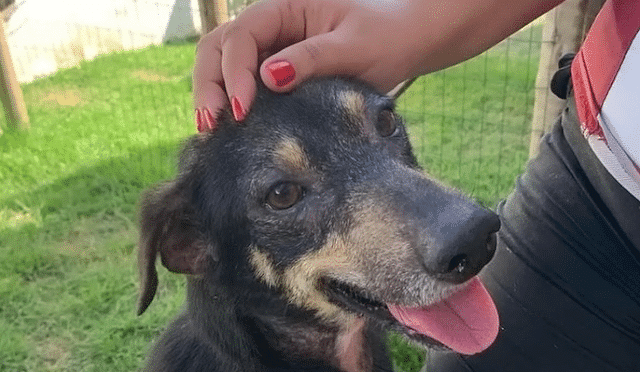
He grew more responsive to the people who cared for him.
He became comfortable with gentle attention.
And eventually, he began seeking companionship.
It was a significant change from the quiet dog found beneath the staircase.
Black was now showing interest in interacting with familiar people.
He enjoyed affection.
He responded positively to the caregivers who had supported his recovery.
And he appeared increasingly comfortable participating in the daily routines around him.
His transformation illustrated how important a stable environment can be for an animal adjusting after prolonged confinement.
Medical treatment helped restore his physical health.
Regular meals supported his recovery.
And patient interactions gave him opportunities to become accustomed to receiving gentle care.
There was no single moment when every trace of his earlier caution disappeared.
His progress had been gradual.
But the dog who had once watched strangers with uncertainty was now approaching familiar people for affection.
He no longer needed to spend his days in isolation.
He had companionship.
He had opportunities to play.
And he had people who noticed when he wanted attention.
For Black, the new life was not simply about being free from a chain.
It was about having the opportunity to enjoy the world and interact with the people around him.
And that change was visible every day.
A Safe Place, Regular Meals, and a Life Beyond Survival
Black’s life today bears little resemblance to the circumstances in which he was discovered.
The small space beneath the staircase is no longer where he spends his days.
He has a safe place to sleep.
He receives regular meals.
And he has toys and opportunities to enjoy the outdoors.
His caregivers continue providing the attention and companionship he needs.
The changes in his physical condition are striking.
He has regained strength, his coat has become healthier, and he is far more active than he was when the rescuers first arrived.
But perhaps the most rewarding part of his recovery is seeing how he behaves in his new environment.
Black enjoys companionship.
He seeks affection.
And he can move freely rather than remaining confined to a small corner.
His days now include activities that were absent from his earlier life.
Walks.
Playtime.
Comfortable rest.
And time spent with people who treat him gently.
The original account does not confirm whether Black has been adopted into a permanent home. What it does establish is that he has been rescued, received treatment, and made a substantial recovery in a safe environment.
That progress is meaningful in its own right.
For seven years, Black’s life had been restricted by a short chain.
The rescuers could not change the fact that he had spent so much time in those conditions.
But they could change what happened afterward.
They removed him from the confined space.
They brought him to veterinary care.
And they provided the consistent support that allowed him to regain his health and become a more active, affectionate dog.
His earlier life had been defined by restriction.
His new life offers something different.
Freedom to move.
People to interact with.
And the opportunity to enjoy ordinary experiences without being held in place by a chain.
Seven Years of Waiting Ended Because Someone Chose to Notice
Black’s story began with a neighbor who recognized that a dog needed help.
For seven years, he had lived beneath a staircase, confined by a short chain in a space that offered little comfort.
His body had become severely underweight.
His coat was unhealthy.
And the veterinary examination later revealed anemia and untreated parasites.
The rescue team could not undo those seven years.
But when the neighbor called, they came.
They approached Black patiently, offered him food, and brought him out of the confined space.
At the veterinary clinic, he received the treatment and nourishment he needed.
His caregivers gave him his first proper bath, carefully washing his coat and helping him become more comfortable.
Then came the long process of recovery.
His appetite improved.
His body grew stronger.
And his coat gradually became healthier.
As his condition improved, Black began exploring the world beyond the staircase.
He discovered grass beneath his paws and sunlight on his back.
He learned to move freely through open spaces.
And over time, he began seeking affection from the people who cared for him.
Three months after his rescue, Black had become a playful, energetic dog who enjoyed running across the grass.
The difference was extraordinary.
But his transformation did not happen because someone simply removed a chain.
It required medical treatment, regular nourishment, a safe environment, and the patience to help a dog adjust after years of confinement.
Each part of that care mattered.
The neighbor’s phone call brought attention to his situation.
The rescue team brought him to safety.
The veterinarians addressed his health problems.
And his caregivers continued helping him recover long after the initial rescue was over.
Black’s journey is a reminder that even after years of poor living conditions, an animal may still have the opportunity to regain health, confidence, and enjoyment of everyday life when appropriate care becomes available.
His past cannot be erased.
Seven years is a long time to spend in such a small space.
But those years are no longer the only part of his story.
Today, Black has room to move, people who care for him, and opportunities to enjoy the simple pleasures that were once beyond his reach.
The dog who once stood silently beneath a staircase is now running through the grass.
And perhaps that is the most moving part of his transformation.
For seven years, a short chain decided how far Black could go. Today, he can finally take another step simply because he wants to.


