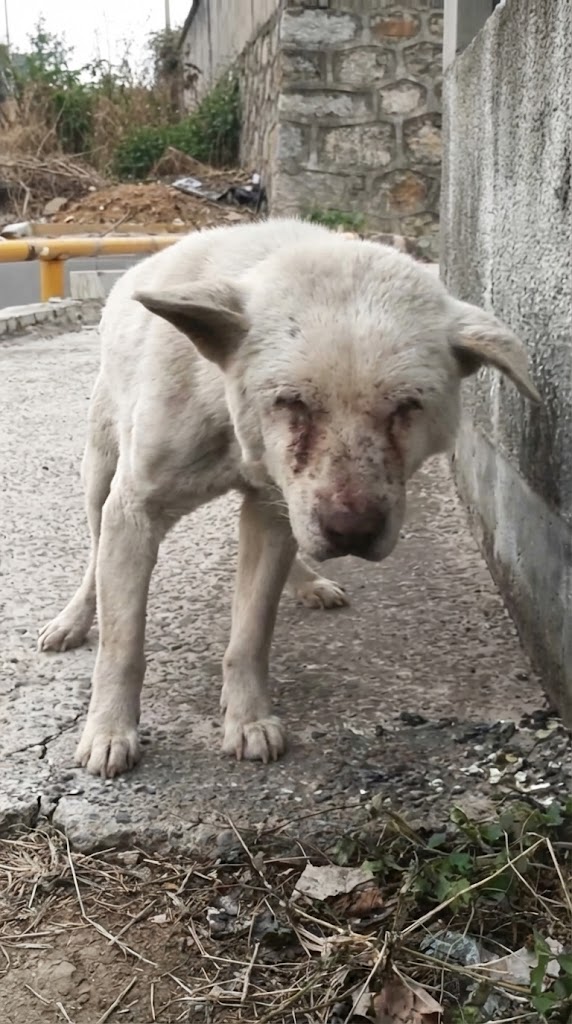
Every morning, the same white dog appeared on the road.
He was easy to recognize.
His coat had lost some of its brightness. His body had grown thin. His steps were slow and uneven, yet he continued moving with a strange determination that made people in the village notice him again and again.
Cars passed.
People called to him.
Sometimes someone tried to get his attention.
The dog rarely seemed interested.
He followed the road as though he already knew exactly where he wanted to go.
Then, hours later, he would return home.
The next morning, he would begin again.
At first, the walks looked like ordinary wandering.
But when someone finally followed him, a different story began to emerge.
The dog had a name.
Jindol.
And for nearly two years, he had been returning to places connected to one person who was no longer there.
The Dog Who Refused to Stay Home
Jindol was not homeless.
That was the first surprise.
He had a house to return to.
There were people who knew him.
There was food.
There was shelter.
Yet whenever the door remained closed, Jindol became restless.
He wanted outside.
According to his family, he would scratch at the door and continue trying until someone allowed him to leave.
Once outside, he did not simply wander without direction.
He followed familiar roads.
Again.
And again.
And again.
It had become such a predictable routine that people living nearby had grown accustomed to seeing the frail white dog pass through the neighborhood.
Some probably assumed he was simply an aging dog who preferred being outdoors.
But Jindol’s family knew that his routine had started after a major change in the household.
Two years earlier, the elderly woman who had cared for him had died.
She had been the person most closely connected to his daily life.
She fed him.
Spoke to him.
Walked with him.
And for Jindol, many of the places outside the house had once been places they visited together.
After she was gone, Jindol began walking those routes without her.
VIDEO: For Two Years, Jindol Returned to the Same Roads After the Woman Who Raised Him Was Gone
The House Was the Same — But Someone Was Missing
People understand death through explanations, rituals, and time.
A dog experiences absence differently.
No one could know exactly what Jindol understood about the death of the woman who raised him.
What his family could observe was what happened afterward.
She stopped coming home.
Her voice disappeared from the house.
The routines Jindol had known changed.
And the person who had accompanied him through so much of his daily life was suddenly absent.
On the day of the funeral, Jindol was reportedly nearby.
Those who knew him noticed how quiet he seemed.
Afterward, his behavior changed.
He began wanting to leave the house more often.
When he was allowed out, he returned to places associated with the woman.
The pattern continued long after the rest of the household had begun adjusting to life without her.
For Jindol, the old routes remained.
So he kept walking them.
He Kept Returning to the Places They Once Shared
Following Jindol made the pattern difficult to dismiss.
He visited several familiar locations.
A small shop.
A temple.
Roads he had traveled many times before.
And one place in particular carried special meaning for the family.
The hospital.
At one point, Jindol had waited outside while the elderly woman was receiving medical care.
The entrance had once been a place where he expected her to appear again.
Even after she was gone, he continued returning there.
He would stand nearby.
Look around.
Then move on.
Perhaps it was memory.
Perhaps it was habit.
Perhaps familiar scents and places still pulled him toward routines established over years.
No one could ask Jindol what he expected to find.
But his actions were consistent.
The same roads.
The same stops.
The same return home afterward.
And then, when another morning came, he would repeat the journey.
Rain and Exhaustion Rarely Stopped Him
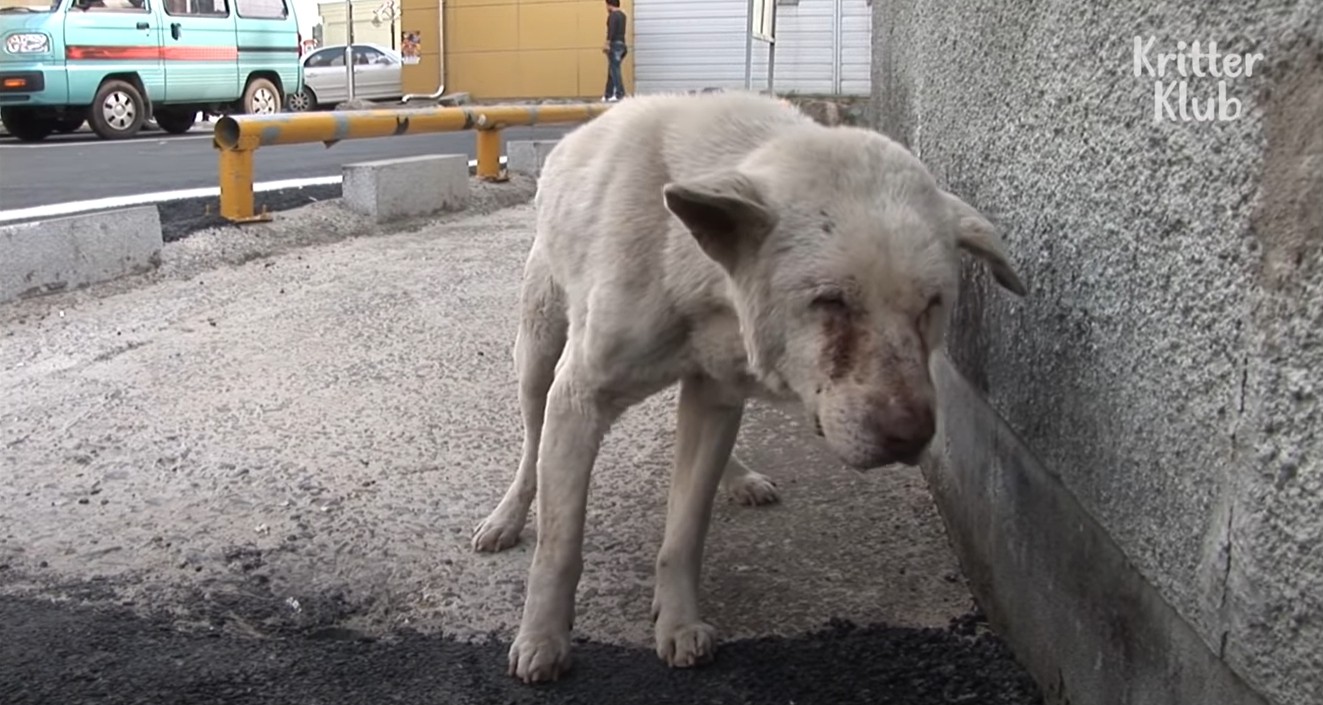
Age was beginning to show in Jindol’s body.
His steps were no longer light.
He did not move like a young dog exploring the neighborhood for entertainment.
Walking required effort.
His body had become noticeably thin.
Still, when he wanted to leave, he persisted.
Cold weather did not always stop him.
Rain did not erase the routine.
Even after a tiring walk, there was a good chance he would want to return to the road again later.
That persistence began worrying the family.
What had once looked like unusual behavior was becoming a serious health concern.
Jindol was aging.
He looked weaker.
And despite having a home, he was spending long periods wandering outside by himself.
Eventually, the family brought him for a veterinary evaluation.
What they learned made the situation much more urgent.
The Veterinary Exam Revealed a Serious Illness
Jindol was not simply thin because he walked too much.
Veterinary testing showed that he was suffering from advanced kidney disease.
His body was already under significant strain.
Kidney disease can affect appetite, hydration, energy, and overall physical condition, and Jindol needed much closer care than he had been receiving during his long solitary walks.
Suddenly, every trip outside carried more concern.
His family wanted to protect him.
The simplest solution seemed obvious.
Keep him indoors.
Stop the wandering.
Make him rest.
But that solution created another problem.
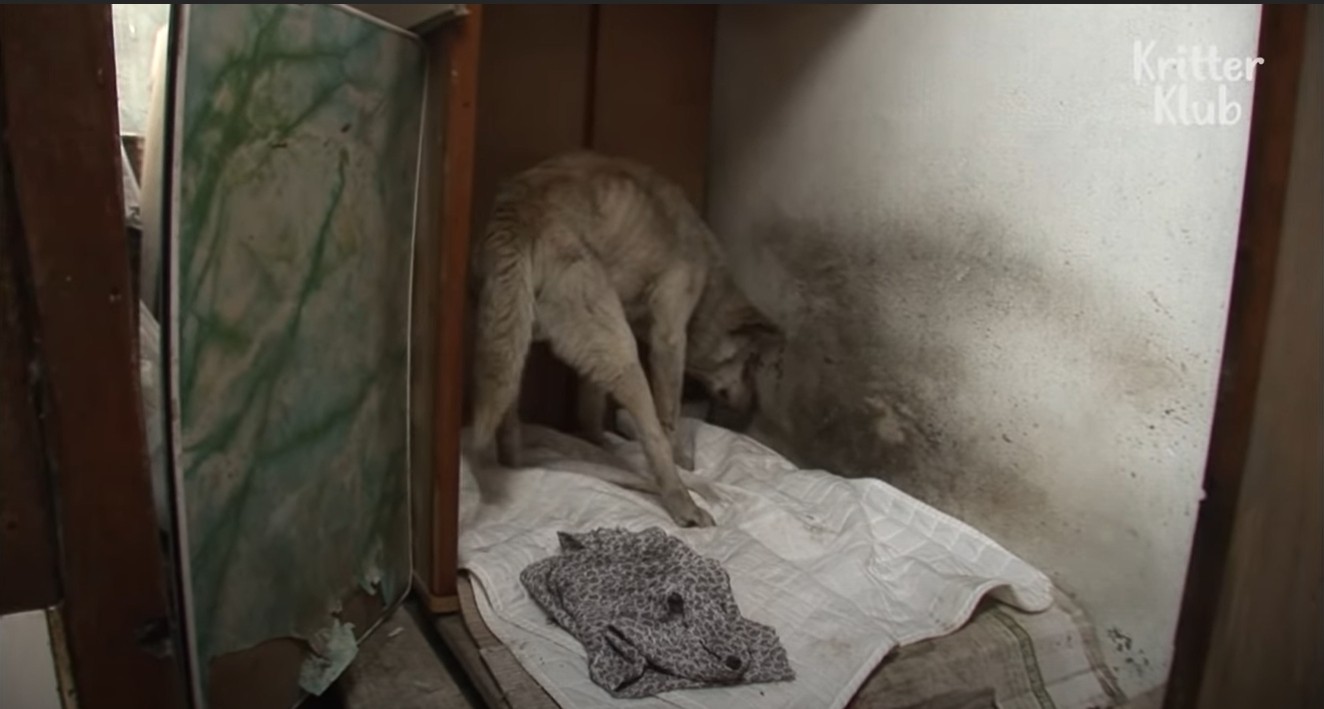
Jindol did not settle comfortably when prevented from leaving.
He became anxious and repeatedly tried to get outside.
The family now faced a difficult question.
How could they protect his failing body without taking away the routine that seemed so important to him?
The answer would not come from forcing him to stop.
It would come from changing how he walked.
His Family Finally Began Walking Beside Him
For a long time, Jindol had made those journeys mostly on his own.
That changed.
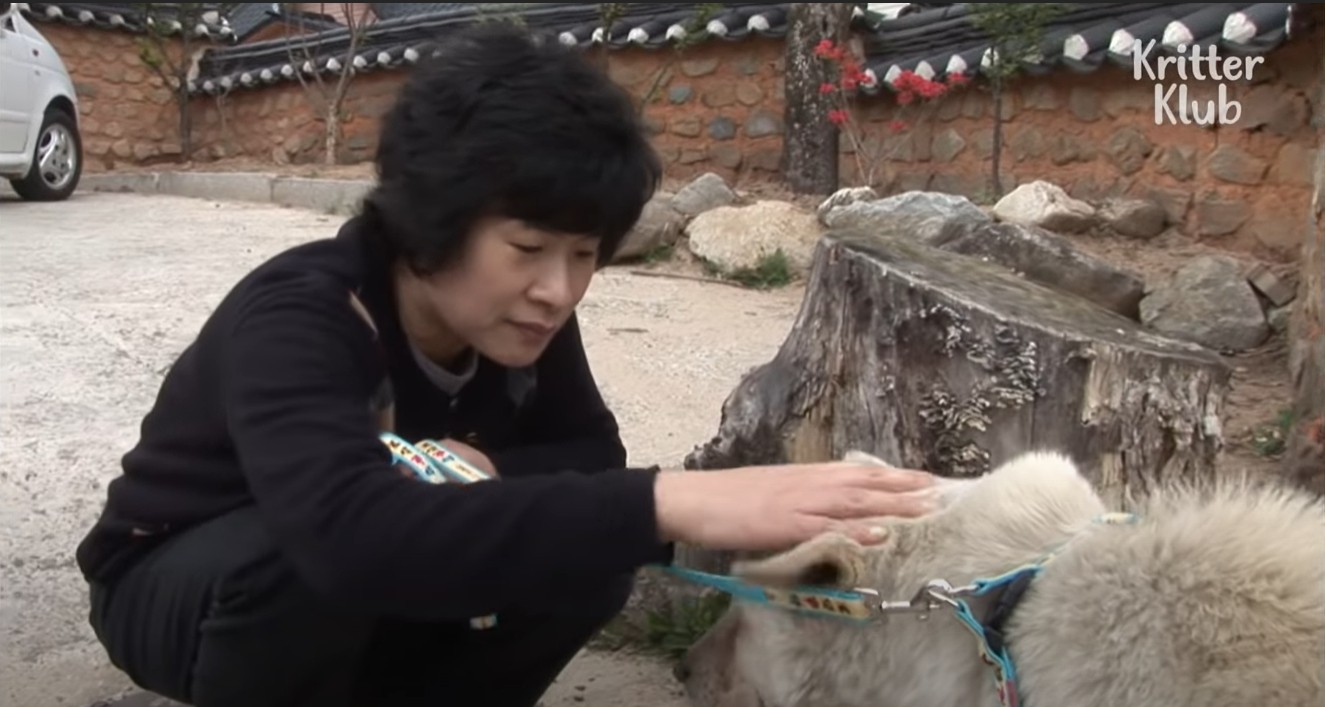
His family began accompanying him.
Instead of opening the door and watching him disappear down the road, someone took the leash and went with him.
The pace was slow.
Jindol decided when to stop.
When he became tired, they waited.
When he wanted to look toward a familiar place, no one immediately pulled him away.
The purpose of the walk changed.
Before, Jindol had been a frail dog moving alone through traffic and village streets.
Now there was someone beside him.
Watching his breathing.
Watching his steps.
Making sure he did not become lost or exhausted too far from home.
According to the story, the daughter-in-law made a major change to her own routine so she could devote more time to caring for him.
The family could not restore his kidney function completely.
They could not bring back the woman who had once accompanied him.
But they could make sure Jindol no longer had to travel those familiar roads alone.
The Same Roads Began to Mean Something Different
Jindol still wanted to walk.
That did not disappear simply because someone understood his health problems.
He still paused at familiar places.
He still seemed drawn toward routes connected with years of old routines.
But there was one important difference.
A person now matched his pace.
The road was no longer something he traveled entirely by himself.
The walks also became safer.
If Jindol tired, someone noticed.
If traffic approached, someone was beside him.
If his frail body needed rest, there was no need to keep moving simply to find his way home again.
In a story centered on absence, companionship became the one thing the family could still give him.
They did not need to know exactly what Jindol believed about the woman he had lost.
They only needed to recognize that these walks mattered to him.
So instead of taking them away completely, they joined him.
Animals May Not Explain Loss — But Their Routines Can Change
Stories like Jindol’s often lead people to ask whether dogs grieve.
Animals cannot describe their emotions in words, and it is important not to pretend we can know every thought behind a behavior.
But we can observe change.
A familiar person disappears.
A dog searches rooms.
Waits near a door.
Returns repeatedly to a familiar location.
Changes sleeping or eating habits.
Becomes unusually restless or withdrawn.
Those behaviors matter even when we cannot translate them into human language.
With Jindol, the strongest evidence was not a dramatic moment.
It was repetition.
Two years of familiar roads.
Two years of returning to places associated with the person who had once walked beside him.
Two years of refusing to simply remain inside while those old routines existed beyond the door.
Whether driven by memory, habit, attachment, or some combination of all three, Jindol’s behavior made one thing clear:
The disappearance of his longtime caregiver had changed his life.
His Body Was Failing, but the Walk Still Mattered
Advanced kidney disease meant Jindol’s future could not be taken for granted.
His family knew that.
The goal was no longer to make him young again.
It was not to restore every lost year.
It was to make the time he still had as comfortable and meaningful as possible.
That required balancing medical care with quality of life.
Rest mattered.
Food and hydration mattered.
Veterinary supervision mattered.
But so did the things that made Jindol want to get up each morning.
For him, one of those things appeared to be walking.
So the family adapted.
A shorter route when necessary.
A slower pace.
Someone beside him.
More attention to when his body had had enough.
It was a simple change, but perhaps that was exactly what Jindol needed.
Not someone telling him to forget the road.
Someone willing to walk it with him.
He May Never Stop Looking Toward Familiar Places
There is no dramatic ending to Jindol’s story.
No moment when he suddenly understands everything and decides never to search again.
Real life rarely works that way.
He remains an elderly dog with serious health problems.
He still carries habits formed during a life shared with someone who is no longer present.
He may continue stopping at the places they once visited.
He may continue looking toward doors where she once appeared.
Those familiar roads are part of his world.
But Jindol’s family now sees those walks differently.
What once looked like stubborn wandering has become something they approach with patience.
They cannot answer the question Jindol may be carrying.
They cannot place the missing person back at the end of the road.
They can only make sure that when he begins walking, someone goes too.
And sometimes, care looks exactly like that.
Not fixing what cannot be fixed.
Not forcing someone to move on faster.
Simply noticing what matters to them—and staying close.
This Time, Jindol Does Not Walk Alone
Every story about loyalty risks becoming larger than the animal at its center.
Jindol does not need to become a symbol.
He is simply an old dog.
A dog who spent years beside one person.
A dog whose routines changed when she disappeared.
A dog who continued returning to familiar roads until his own health began failing.
And a dog whose remaining family eventually realized that protecting him did not necessarily mean closing the door.
Sometimes it meant opening it carefully.
Attaching a leash.
And stepping outside beside him.
Jindol may still pause at the old shop.
He may still stop near the temple.
He may still look toward the hospital entrance that once meant someone might come back through the doors.
No one can tell him why that person never appears.
But now, when he turns away and begins the slow walk home, there are footsteps beside his own.
Once, Jindol traveled those roads by himself.
Now someone matches his tired pace.
And although the person he remembers cannot return, the old white dog no longer has to carry the journey alone.


