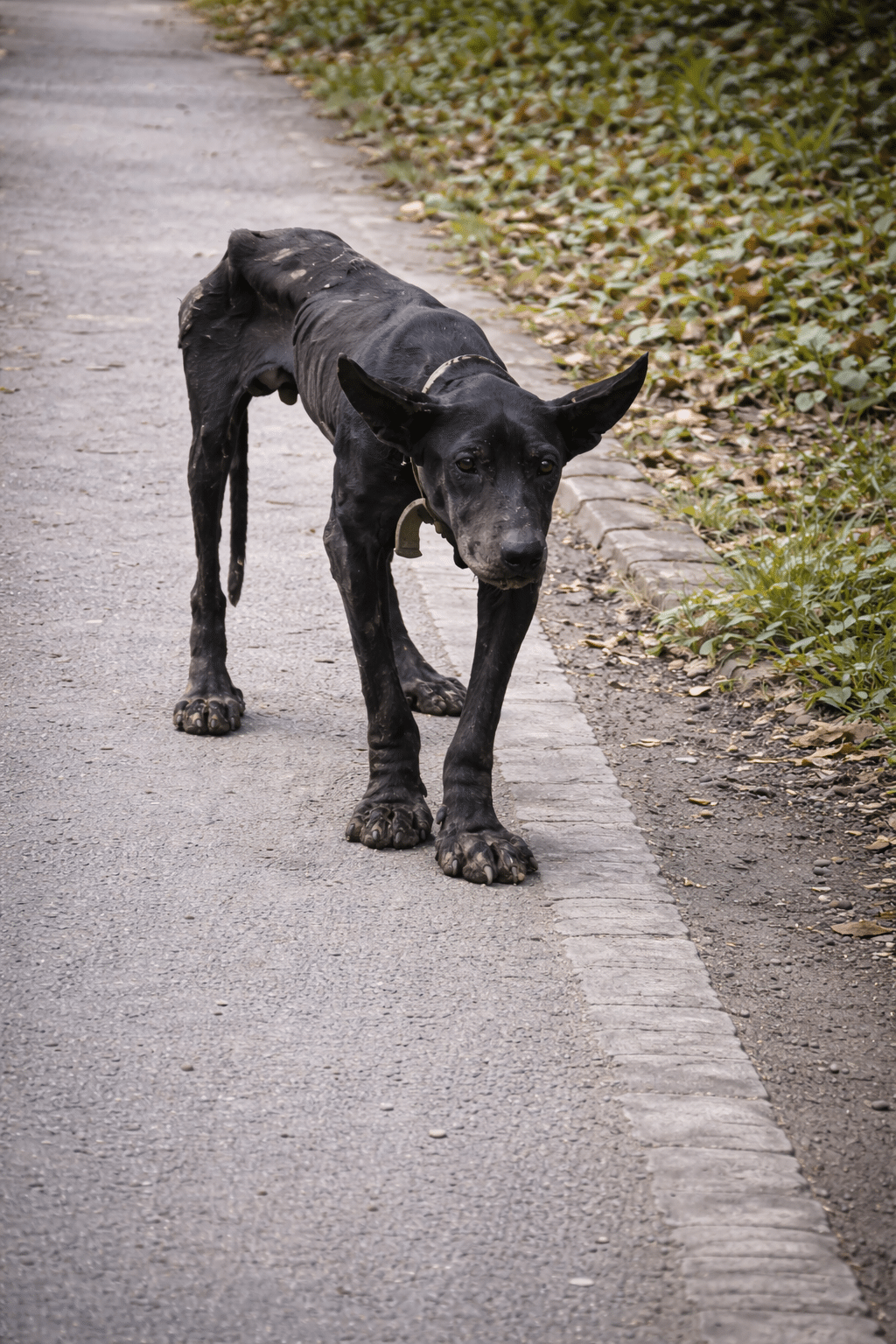
The first photograph of Billy did not look like the beginning of a happy story.
On a quiet stretch of coastline in Greece, a black dog moved slowly near the water.
His ribs were sharply visible.
Large areas of fur were missing.
Severe mange had left his skin irritated and exposed.
And when he tried to walk, his weakened legs seemed to struggle with every step.
Later, people would know him as Billy.
That morning, he was simply an unidentified stray on a beach, thin enough that anyone looking at the photograph could see he needed help quickly.
Most people first encountered Billy the same way.
On a screen.
Someone had taken his picture and posted it online.
Many people saw it.
One volunteer decided seeing it was not enough.
She went looking for him.
One Photograph Sent a Volunteer Searching Along the Coast
Billy might easily have disappeared after that photograph was taken.
A stray dog can move.
Hide.
Cross roads.
Leave the place where someone last saw him.
The volunteer from a local rescue group understood that finding him would matter more than sharing his image again.
So she began searching.
When Billy was finally located and brought into care, his behavior reflected just how depleted he had become.
He did not fight the people helping him.
He did not spend his first hours pacing or trying to escape.
He lay down.
Then he slept.
For long stretches, his body barely moved except for breathing.
It was as though reaching a safe place had finally allowed exhaustion to take over completely.
Up close, Billy’s condition looked even more serious than it had in the photograph.
He was severely underweight.
The mange affecting his skin was advanced.
His energy reserves appeared extremely low.
There would be no immediate transformation.
The first question was much more basic.
Could his weakened body respond to treatment at all?
Video: From a Skeleton on the Sand to Racing Across Swiss Snow — Billy’s Stunning Transformation
His Condition Raised a Difficult Question at the Clinic
Billy’s medical situation was serious enough that the people caring for him had to consider what treatment would mean.
He was profoundly emaciated.
His skin required extensive care.
He had very little energy.
According to the rescue account, there were conversations about whether continuing treatment was truly the kindest option or whether his suffering had already become too great.
It was not an easy discussion.
There was no guarantee that feeding him and treating the mange would lead to recovery.
A severely weakened dog can require intensive care while still having an uncertain outcome.
But the veterinarian continued watching Billy closely.
There were responses.
When someone spoke to him, Billy could still lift his head slightly.
When gentle hands touched him, he sometimes leaned toward the contact.
Those small reactions did not guarantee anything.
They simply showed that Billy was still engaging with the people around him.
The veterinary team decided to give treatment a chance.
That choice marked the beginning of a recovery that would eventually carry Billy far beyond the Greek coastline.
But first, his body had to survive the next several days.
The First Stage of Treatment Was Deliberately Slow
Billy could not simply be given unlimited food and expected to regain his weight immediately.
His body was too depleted for that approach.
Nutrition had to be managed carefully.
Meals were measured.
His response was monitored.
He received treatment for the severe mange affecting his skin, including medicated bathing and continued skin care.
Warmth became part of his routine.
So did sleep.
Lots of it.
In the beginning, recovery looked almost uneventful from the outside.
Billy ate.
Billy rested.
Caregivers treated his skin.
Then the process repeated.
There were no dramatic first-day runs through a yard.
No instant return of his coat.
His body needed time to use the nutrition it was finally receiving.
The medical team also needed to see whether he could tolerate continued treatment.
Day after day, they watched.
And gradually, Billy started giving them reasons to continue.
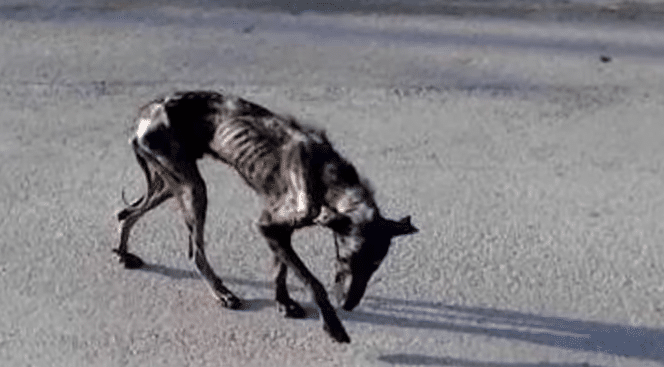
Around Day 10, Small Changes Became Visible
Approximately ten days into treatment, Billy was not suddenly a healthy dog.
But he was different.
He could remain standing longer.
His walks extended a little farther.
His eyes appeared clearer and more attentive when people approached.
For a dog who had initially spent long periods sleeping because he seemed to have almost no energy available, these were meaningful changes.
He was beginning to participate more in his surroundings.
One extra step did not look dramatic.
Neither did standing for another few seconds.
But those small improvements accumulated.
His appetite supported his body.
Treatment helped his irritated skin.
Rest gave him time to rebuild.
And each day Billy managed a little more than before.
The team still could not rush him.
His thin frame showed how much recovery remained ahead.
His coat would take time to return.
His muscles needed nutrition and movement before they could become strong again.
But the question had changed.
At first, people had wondered whether Billy had enough strength left to recover.
Now they were watching recovery actually begin.
Two Months Later, the Dog From the Beach Was Hard to Recognize
By approximately the two-month mark, the change was no longer subtle.
Billy’s body had filled out significantly.
Where sharply visible bones had once dominated his appearance, healthier weight and muscle now gave his frame a completely different shape.
His skin had improved.
Most dramatically, his coat returned.
Thick black fur covered the areas that had once been bare from mange.
Under the light, that coat looked glossy and healthy.
Billy also carried himself differently.
His head was upright.
His walk was steady.
He moved through his surroundings without the same visible weakness that had defined his first days in care.
Anyone who had only seen the original beach photograph could have struggled to identify him.
It was still Billy.
But now the black dog beneath the illness and starvation was finally visible.
The change did not come from a single treatment.
It came from weeks of consistency.
Meals.
Skin care.
Monitoring.
Rest.
Movement.
And people deciding every day that recovery was still worth pursuing.
As Billy became healthier, another question emerged.
Where would he go next?
Billy’s Story Reached Far Beyond Greece
People had followed Billy’s recovery from the first photograph onward.
The severely thin dog on the Greek coast had drawn attention from people far outside the local area.
Updates showed him gradually standing longer.
Walking more comfortably.
Regaining weight.
Growing back his black coat.
The transformation connected with people who had never met him.
Eventually, that attention helped lead to something Billy still needed.
A permanent family.
The family who chose him was not in Greece.
Billy would begin the next stage of his life in Switzerland.
The geography alone made his final chapter visually striking.
His story had begun beside the sea.
Warm coastal light.
Sand.
A weakened black dog barely managing his steps.
His new life would include something completely different.
Winter.
Wide fields.
Snow.
And a body strong enough to run through it.
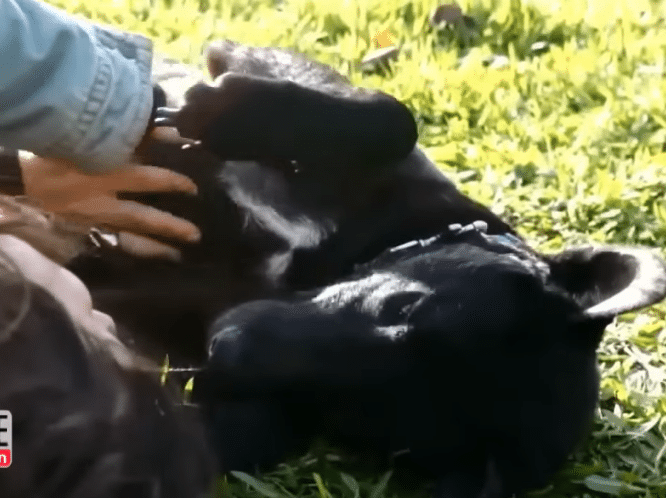
In Switzerland, Billy Was Finally Running Instead of Struggling to Stand
The later images of Billy are difficult to reconcile with the first ones.
His dark coat stands out against the snow.
Instead of moving cautiously along a beach, he runs across open ground.
He pushes through snowdrifts.
He plays.
He explores.
His legs carry him with energy that had been completely absent during his rescue.
These are ordinary behaviors for a healthy dog.
For Billy, they reveal the distance his recovery covered.
At the beginning, staying upright was difficult.
Now he could sprint.
At the beginning, his coat had been heavily damaged by mange.
Now thick black fur protected him from a Swiss winter.
At the beginning, the question was whether his weakened body could respond to treatment.
Now his family watched him use that recovered strength simply because running was fun.
There is an important difference between surviving and reaching this stage.
Billy did not merely gain enough weight to stay alive.
He gained enough health to participate fully in his new life.
The Most Important Decision Came Before Anyone Knew the Ending
Billy’s story is easy to appreciate once the ending is known.
Of course treatment seems worthwhile when you can already picture the healthy black dog running through Swiss snow.
But the people caring for Billy did not have that image when they made their earliest decisions.
They had the dog in front of them.
Extremely thin.
Affected by severe mange.
Sleeping for long stretches.
With little strength available.
The outcome was uncertain.
That is what makes the decision to continue care meaningful.
The veterinarian could not promise the future.
The volunteer who searched for Billy could not know that a family in Switzerland would eventually adopt him.
No one could know that two months later he would look almost unrecognizable.
They simply responded to what Billy showed them at the time.
He still lifted his head.
He still responded.
He still accepted gentle contact.
So they tried.
Treatment began before success was guaranteed.
And success arrived gradually enough that every small improvement mattered.
From a Greek Shore to Swiss Snow
Billy’s transformation can be told through two very different landscapes.
The first is a beach in Greece.
There, a severely emaciated dog walked close to the water with much of his fur missing.
His ribs were visible.
His steps were weak.
Someone photographed him.
Then a volunteer saw that photograph and went searching.
The second landscape is Switzerland.
Snow covers the ground.
A healthy black dog runs across it.
His coat is thick.
His legs are strong.
And he has a family waiting for him when the play is over.
Between those two scenes were the parts that photographs cannot always show.
The difficult veterinary conversations.
The carefully measured meals.
The medicated baths.
The long periods of rest.
Day 10, when he could stand a little longer.
The weeks required for muscle and fur to return.
The people continuing treatment even when there was no guarantee of a perfect ending.
Billy’s recovery did not happen because someone knew exactly what his future would become.
It happened because someone acted before they knew.
A photograph appeared online.
One volunteer stopped scrolling.
She searched for the dog in it.
And months later, the fragile figure from that Greek coastline was no longer struggling simply to remain upright.
He was running through snow.
Sometimes the distance between those two lives begins with something very small.
Someone sees.
Someone cares.
And instead of scrolling past, they go looking.


