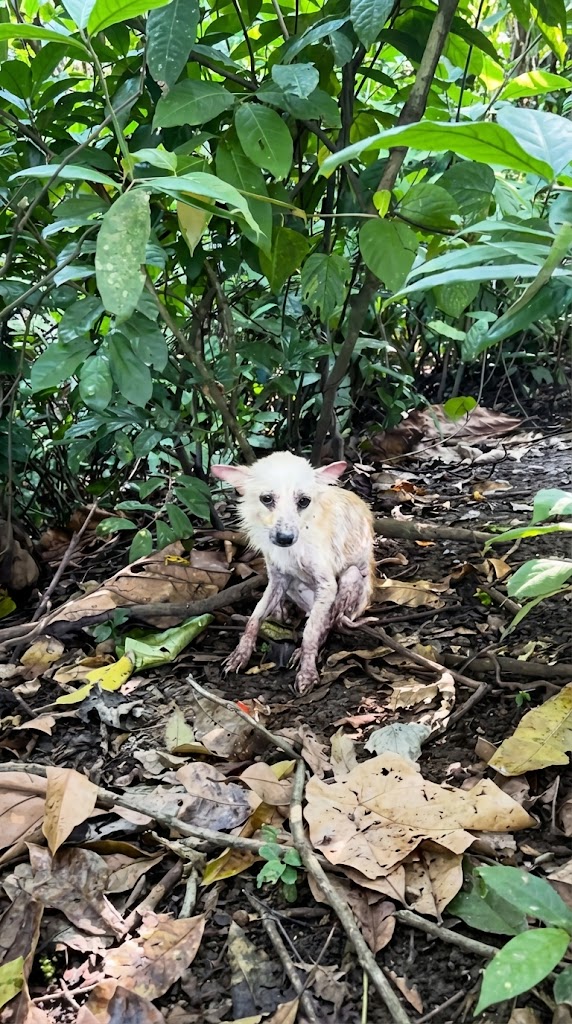
At first, Sabine Kaufmann almost saw only mud.
Then something moved.
While walking rescue dogs through a quiet stretch of forest in Bali, she noticed a tiny shape crouched close to the ground.
It was a dog.
Barely.
Her body was almost completely hairless. Her skin was exposed, her frame looked painfully weak, and she was trembling so badly that even lifting herself seemed difficult.
Her back curved in an unusual way.
She stayed low to the ground as though making herself smaller might help her disappear into the forest floor.
In that moment, the little dog looked less like a healthy animal and more like a pale shadow among the trees.
Later, she would be given a name that sounded almost impossibly optimistic.
Hope.
And over the next four months, that name would begin to fit her in ways no one could have predicted on the day she was found.
Sabine Saw a Tiny Shape Trembling in the Mud
The forest was quiet when Sabine noticed her.
Hope was not running toward people.
She was not barking for attention.
She was crouched in the mud, trembling and visibly weak.
Her lack of fur made every part of her fragile body easy to see.
Her thin frame.
The curve of her back.
The way she held herself low.
Sabine could not know exactly how long the dog had been there or what had happened before that moment.
What she could see was enough.
This was not a dog who could simply be left where she was.
Hope needed medical care.
She needed warmth.
She needed food.
And most urgently, she needed someone to take responsibility for what happened next.
Sabine brought her out of the forest and toward help.
The muddy, frightened dog was taken to a veterinary clinic, where doctors could finally examine what was happening beneath the surface.
That examination revealed that Hope’s condition was not only about hair loss or poor nutrition.
Her body had deeper medical problems.
And although she was only around four years old, she had already been living with conditions that appeared to have gone untreated for a long time.
Video: From Hairless to Heavenly — Watch Hope’s Journey from Forest Mud to a Forever Home
The Vet Found More Than Hair Loss
At the clinic, the medical team began evaluating Hope carefully.
Her body was extremely fragile.
But two findings stood out in particular.
Hope had a severely curved spine.
She also had a painful hernia.
These problems went far beyond her appearance.
The curve in her back affected the way she carried herself, while the hernia required medical attention that could not simply be delayed indefinitely.
According to the rescue account, Hope would need major surgery.
But before anything complicated could happen, the veterinary team first had to make sure her body was stable enough to handle treatment.
She remained hospitalized for approximately one week.
During that time, the focus was on stabilization and medical support.
A dog in such poor condition could not be expected to recover simply because she had been removed from the forest.
Her body needed time.
Nourishment.
Monitoring.
Treatment.
And rest.
For Hope, that first week was not about transformation.
It was about getting through one day and then the next.
By the end of that period, she was considered strong enough to leave the hospital and continue recovering in a foster environment.
That was when Krista entered her story.
Krista Did Not Ask Hope to Trust Her Immediately
Hope’s foster home was safe.
But safety does not always feel safe immediately to an animal whose recent experience has been shaped by illness and fear.
When Hope first arrived, she did not behave like a dog eager to explore her new surroundings.
She stayed quiet.
She avoided unnecessary movement.
She often kept her head low.
At times, she tried to hide behind her own thin legs.
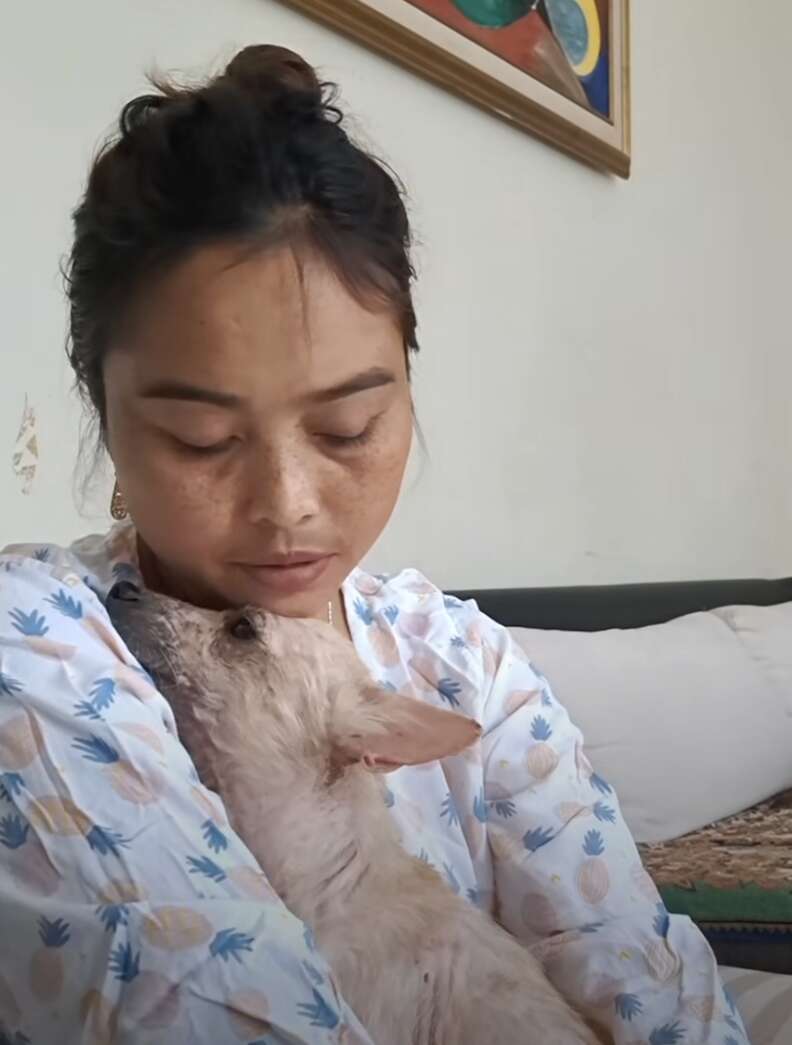
Krista did not force interaction.
There was no expectation that Hope should immediately wag her tail, play, or enjoy being held simply because she had reached a better place.
Instead, Krista reduced the pressure around her.
She offered small meals by hand.
She moved slowly.
Baths were warm and careful.
When Hope trembled, Krista stayed close.
The routine remained gentle and predictable.
Food arrived.
Water arrived.
A quiet voice returned.
No one demanded anything from her.
That consistency mattered.
For a frightened dog, learning that nothing bad happens after a person approaches can be an important part of recovery.
And over time, Hope’s responses began to change.
Not dramatically.
At first, the changes were small enough that someone could easily miss them.
Her eyes followed movement around the room.
She seemed less tense during touch.
She became more curious about what was happening nearby.
Then came another sign of recovery that was impossible to overlook.
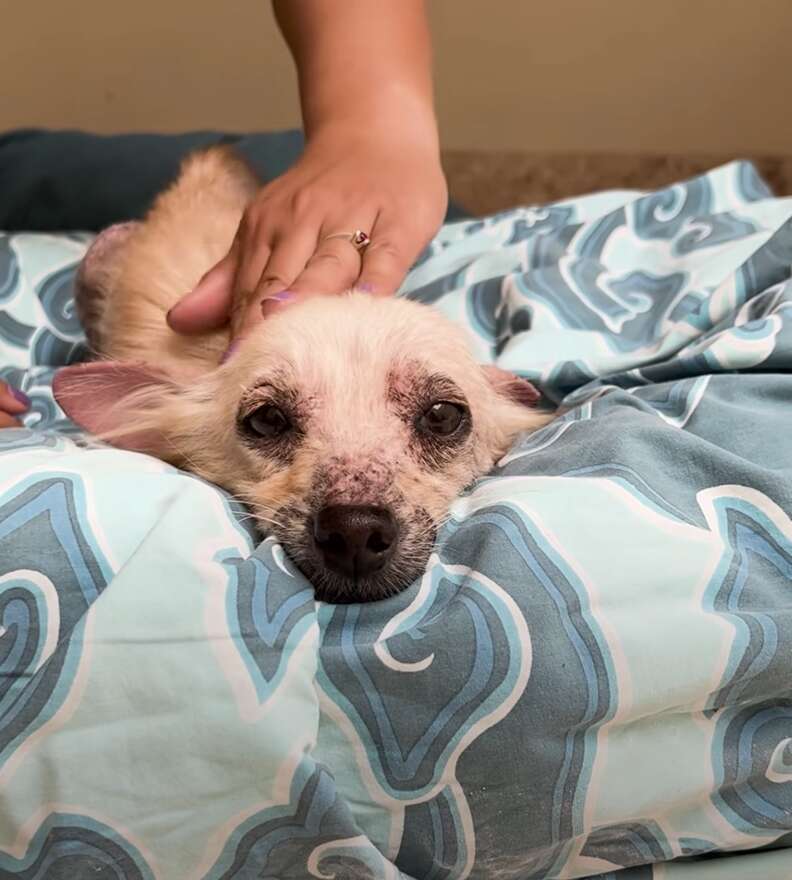
Her fur began growing back.
The “Little Ghost” Started Turning Golden
When Hope was found in the forest, she was almost completely hairless.
That appearance had made her look strangely ghostlike among the trees.
As treatment and proper care continued, the bare skin began to change.
Tiny areas of new fur appeared.
Then more.
The coat did not remain sparse.
It became thicker.
Softer.
And noticeably golden.
Week after week, the physical transformation became easier to see.
The dog who had once looked exposed and fragile was gradually being covered by a warm coat.
Her body was changing along with it.
Proper food helped restore weight.
Medical care addressed the problems affecting her health.
Regular bathing and attention helped improve her skin.
And the more comfortable she became physically, the more willing she seemed to engage with the world around her.
After roughly four months, the difference was extraordinary.
Someone seeing Hope for the first time at that stage might never have guessed what she looked like in the forest.
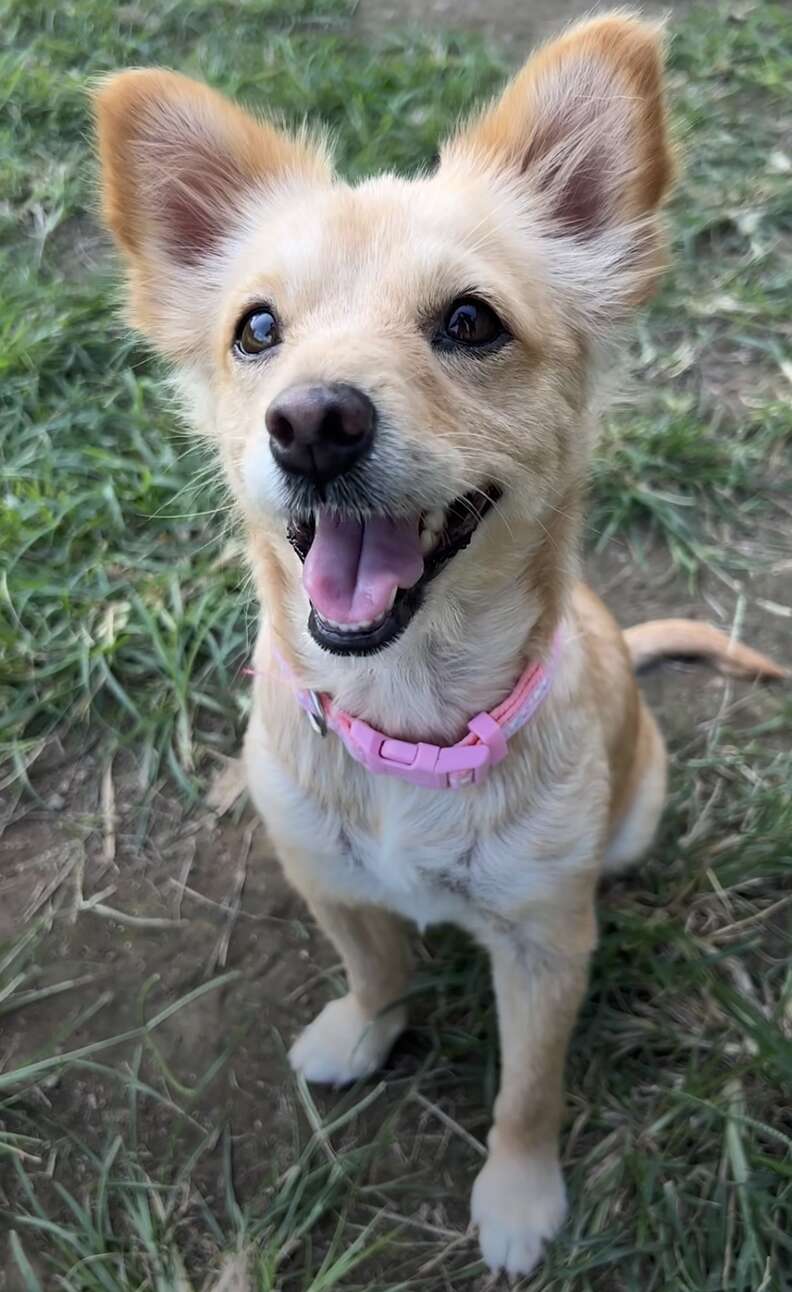
The almost naked dog was now fluffy.
The trembling posture had eased.
Her tail moved freely.
She became interested in toys.
She sought affection.
She gave kisses.
Her transformation was not simply about becoming prettier.
The returning coat was one visible sign of a much larger recovery.
Hope finally had enough stability for her body to repair itself.
Four Months Changed More Than Her Appearance
Before-and-after photographs can make rescue recovery seem immediate.
Hope’s was not.
The golden coat took time.
So did everything else.
During those months, Krista continued helping her adjust to ordinary life.
Meals became routine rather than an emergency.
Baths became part of care rather than something unfamiliar.
Human hands became associated with food, warmth, and comfort.
Hope gradually began moving around her foster environment with more confidence.
She no longer spent all of her time trying to stay unnoticed.
Toys became interesting.
Attention became welcome.
Her tail became more expressive.
And the little dog who once crouched in mud began participating in daily life.
There is no single moment that can explain that change.
It was built through repetition.
One meal.
One bath.
One calm interaction.
One quiet night.
Then the same thing again the following day.
Physical recovery and behavioral recovery happened side by side.
Medicine helped address the conditions affecting Hope’s body.
Her foster environment gave her the time and consistency needed to become comfortable around people.
By the end of those four months, Hope was no longer only recovering.
She was ready for something else.
A permanent home.
Then Hope Found a Family — And a Brother Named Tofu
Eventually, Hope’s foster chapter came to an end for the best possible reason.
A family chose her.
The dog who had once been found alone in a Bali forest now had people who wanted her to stay permanently.
And she would not be the only dog in the household.
Hope gained a canine brother named Tofu.
That relationship added another dimension to her new life.
The two dogs could walk together.
Explore together.
Spend ordinary days side by side.
For Hope, those simple routines represented an enormous contrast with the beginning of her story.
She had once been crouched alone in mud.
Now she had a companion walking beside her.
She had once been almost completely hairless.
Now her golden coat covered her body.
She had once tried to remain small and still.
Now she could move through the world with far more confidence.
The forest remained part of her history.
But it was no longer the place determining what happened next.
Her family did.
And so did the safe life surrounding her.
The Biggest Change Was Seeing Hope Behave Like a Dog Again
The most striking part of Hope’s transformation may be her appearance.
The photographs make that almost unavoidable.
Hairless.
Then golden.
Fragile.
Then fluffy.
But the behavioral changes tell another important part of the story.
Hope began playing.
She wagged her tail.
She gave kisses.
She explored.
She went on walks.
Those are ordinary things for many dogs.
For Hope, they showed how much her daily life had changed.
When Sabine first saw her, Hope’s energy appeared focused entirely on getting through the moment in front of her.
There was little room for play or curiosity.
Recovery changed that.
Once food, medical treatment, shelter, and routine became dependable, Hope could begin using her energy for something beyond immediate survival.
She could investigate a toy.
Follow another dog.
Lean toward a familiar person.
Walk outside without having to search for somewhere to hide.
That is why the final images of Hope feel so different from the first ones.
The change is not only in the coat.
It is in what she is able to do with her life.
Hope’s Recovery Was Built One Safe Day at a Time
It would be easy to describe Hope’s transformation as a miracle.
The contrast certainly looks dramatic enough.
A nearly hairless dog trembling in forest mud eventually became a golden, affectionate companion living with a family.
But between those two images was a long sequence of ordinary care.
Sabine noticed her.
A veterinary team examined her.
Her curved spine and hernia were identified.
She remained hospitalized for a week while her condition was stabilized.
Then Krista took over the daily work of foster recovery.
Small meals.
Warm baths.
Quiet handling.
Patience when Hope wanted to hide.
Space when she needed it.
Treatment when her body required it.
Weeks passed.
Fur returned.
Strength returned.
Curiosity appeared.
Then play.
Then affection.
Eventually, adoption.
No single one of those steps created the entire transformation.
Together, they did.
Hope’s story shows why rescue often continues long after an animal is physically removed from danger.
Finding a dog is only the beginning.
There is still the medical work.
The feeding.
The monitoring.
The rehabilitation.
The slow process of making daily life predictable enough that a frightened animal can begin responding differently.
Hope had all of that.
And slowly, the forest dog disappeared into the past.
Once She Looked Like a Ghost in the Mud — Now She Walks Beside Tofu
There is a powerful contrast between the first and final chapters of Hope’s story.
In the beginning, Sabine saw a tiny dog almost hidden in the mud.
No coat protected her skin.
Her body trembled.
Her back curved noticeably.
She had no obvious safe place to go.
Four months later, that same dog looked almost unrecognizable.
Golden fur covered her body.
Her tail wagged.
She played.
She accepted affection.
And eventually, she walked into a permanent home where another dog named Tofu would become part of her everyday life.
Hope did not need to become perfect to deserve that ending.
She did not have to erase the physical effects of everything she had experienced.
She only needed someone to recognize that the fragile dog in the forest was still worth helping.
Sabine stopped.
The veterinary team treated her.
Krista gave her time.
And a family eventually gave her permanence.
The dog who once looked like a little ghost among the trees became something much simpler.
A beloved dog with a golden coat, a brother to walk beside, and people expecting her to come home.
Her name had been Hope from the beginning.
It just took a little time for the rest of her life to catch up.


