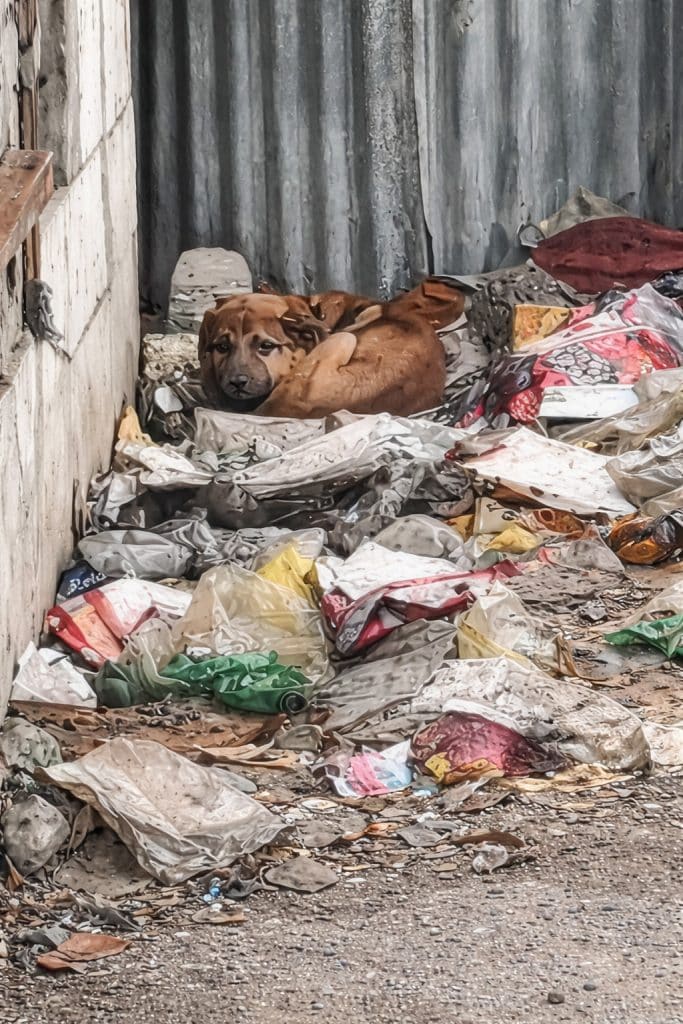
At first, he looked like another dark shape among the trash.
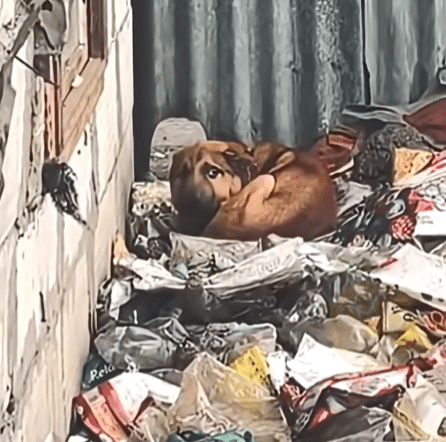
Galileo was curled tightly inside a landfill, surrounded by discarded debris and dirt. He barely moved when rescuers came closer.
Then they noticed his head.
It was severely swollen.
Something was wrong around his neck too, though the cause was partly hidden beneath damaged skin and grime.
When they finally saw it clearly, the situation became urgent.
A thick rubber band had tightened around Galileo’s neck and gradually cut into his flesh.
It had been there long enough to leave a deep wound.
And with every passing hour, the pressure continued.
The Swelling Around His Head Made Rescuers Look Closer
Galileo had almost disappeared into the landfill.
He was weak enough that he did not bark or attempt to run when people approached.
His body remained curled close to the ground.
But the unnatural swelling around his head immediately stood out.
Rescuers examined his neck carefully.
That was when they found the rubber band.
It was no longer simply resting against his fur.
The material had tightened into the skin and become embedded in the tissue beneath it.
The wound surrounding it was raw and badly damaged.
According to the rescue account, the pressure was also affecting his airway, making breathing increasingly difficult.
Galileo needed veterinary treatment immediately.
He was lifted carefully from the debris and taken away from the place where he had been found.
VIDEO: Galileo Was Found in a Landfill With a Rubber Band Embedded Deep Around His Neck
Removing the Band Was Only the Beginning
At the clinic, the veterinary team focused first on freeing Galileo from the object that had been causing continuous damage.
The rubber band had to be removed carefully.
Once it came away, the full extent of the wound underneath became visible.
Skin had been torn.
Deeper tissue was damaged.
The injury was far beyond something that could simply be cleaned and left to heal on its own.
But removing the band accomplished something important.
The pressure was finally gone.
For however long it had been around Galileo’s neck, the injury had continued worsening every day.
Now that process had stopped.
The team could finally begin repairing what had already been damaged.
Surgery Gave the Wound a Chance to Heal
Galileo required further treatment to repair the injury around his neck.
The veterinary team cleaned the damaged area thoroughly and performed surgery to address the deeper tissue damage.
The wound was closed where possible.
Medication helped control infection and discomfort.
Fluids supported his weakened body.
Then came the part that could not be rushed.
Recovery.
The severe swelling around Galileo’s head did not disappear instantly.
It eased gradually as the pressure around his neck remained gone and treatment began working.
His breathing also became easier.
For the dog who had been found lying almost motionless among the trash, those were meaningful first steps.
At First, Galileo Did Little More Than Rest and Eat
His body had been through too much to suddenly become energetic.
Galileo spent much of his early recovery resting.
Food was offered in manageable portions.
Caregivers watched the wound closely and continued medication while his body repaired itself.
He allowed people to handle him.
There was no need to demand anything more.
If Galileo wanted to sleep, he slept.
If he managed a little more food, that was progress.
Days passed.
The swelling continued to decrease.
His eyes appeared more alert.
Then he began lifting his head higher when people approached.
The change was subtle.
But the dog who had once remained curled among landfill debris was beginning to notice the world around him again.
Standing Became Another Small Victory
As Galileo regained strength, he attempted something that had once seemed difficult.
He stood.
His body was not fully recovered.
The wound still required care.
But he now had enough energy to support himself and begin moving around.
His appetite improved.
He became more responsive.
Then his tail began to move when familiar people came near.
None of these moments alone were dramatic.
Together, they showed how much had changed.
Galileo was no longer spending all of his strength coping with the pressure and injury around his neck.
His body finally had room to recover.
Then He Began Paying Attention to Other Dogs
Weeks passed.
Galileo grew stronger.
As his physical condition improved, caregivers noticed another change.
He became interested in other dogs.
At first, he observed cautiously.
Then curiosity brought him closer.
Eventually, that curiosity became play.
The dog who had once lain almost completely still in a landfill now had enough energy to interact, explore, and move simply because he wanted to.
His tail moved more often.
His body became stronger.
The severe swelling around his head disappeared.
And little by little, the injury that had dominated the beginning of his rescue became something he was recovering from rather than something still controlling every moment.
Adelka Gave Him Somewhere Recovery Could Become a Life
Galileo’s story did not end when his wound closed.
Someone named Adelka saw the dog he had become and chose to give him a home.
The change meant that safety was no longer limited to a clinic or temporary rescue space.
Galileo now had somewhere permanent to rest.
Regular meals.
People who knew him.
Room to move.
And routines that did not disappear when treatment ended.
For a dog found among discarded objects, the contrast was enormous.
He was no longer another shape hidden in a place people rarely looked.
He belonged somewhere.
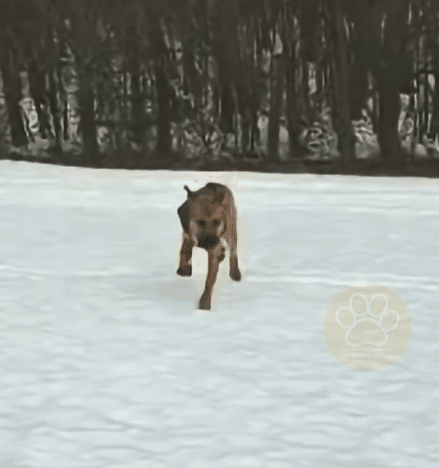
The Dog Who Once Struggled Beneath That Band Now Runs Through Snow
Today, Galileo looks remarkably different from the dog first discovered in the landfill.
His head is no longer swollen.
The pressure around his neck is gone.
He moves freely.
And according to the rescue account, he now runs across open snow with an energy that would have been difficult to imagine at the beginning.
Once, each breath and movement appeared difficult.
Now he can run.
The difference was created through a series of decisions.
Someone noticed him among the debris.
Someone looked closely enough to find the rubber band.
Veterinarians removed it.
They treated the wound.
Caregivers stayed through the slow recovery.
And eventually, Adelka gave him a home.
Galileo had been left in a place filled with things people no longer wanted.
But he was never one of those things.
He was a living dog in urgent need of help.
Fortunately, someone saw the difference before it was too late.


