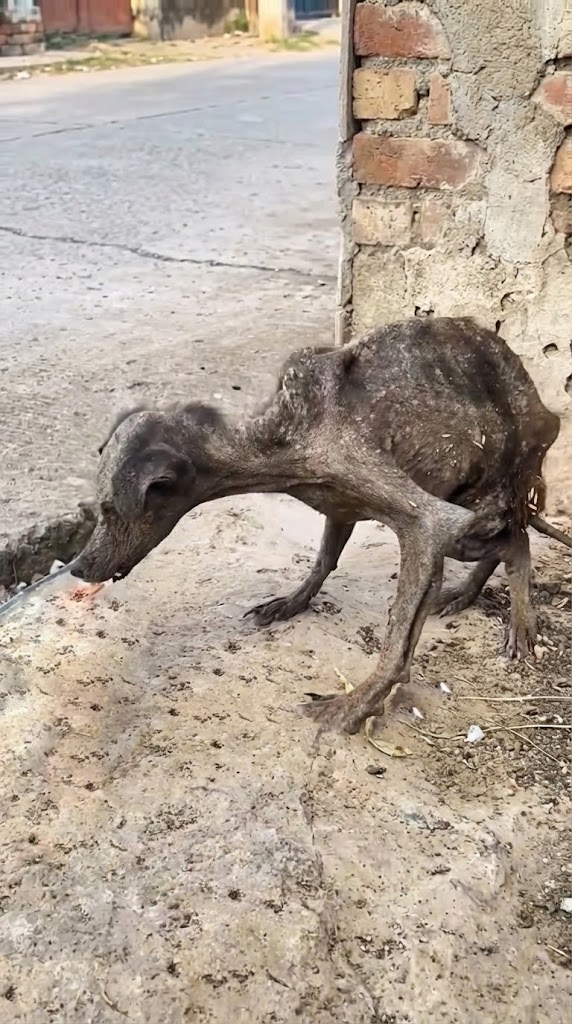
Hattie was so small that rescuers could almost hold her in one hand.
She was only a few weeks old when she was found inside a plastic container beside the road, separated from the warmth and protection a puppy that young should have had.
There was no food beside her.
No bedding.
No mother.
Her tiny body shook constantly.
When someone finally reached into the container and tried to lift her, Hattie cried out and pulled away from the unfamiliar touch.
She did not know who these people were.
She only knew that, until that moment, she had been alone.
Someone Had Left a Tiny Puppy With Almost Nothing
The container offered little protection from the world around her.
At Hattie’s age, puppies normally depend heavily on their mother and littermates for warmth, nourishment, and reassurance.
Instead, she had been left beside a road.
Rescuers did not know exactly how long she had been there.
They could only see the condition she was already in.
Hattie was extremely thin.
Her skin appeared inflamed.
Her body trembled whenever someone moved close.
Even being picked up seemed frightening.
So the rescuer handling her slowed down.
Rather than gripping her tightly, they wrapped Hattie in something soft and held her carefully against their body.
At first, the puppy continued trembling.
Then, little by little, she became quieter.
For the first time since being found, Hattie was somewhere warm.
But comfort alone would not be enough.
Her physical condition needed immediate attention.
VIDEO: Hattie Was Found Alone in a Plastic Container—Then One Gentle Hold Finally Calmed Her Trembling
The Veterinary Exam Showed How Fragile She Really Was
At the clinic, Hattie’s condition became clearer.
Her skin was badly irritated.
Parasites were present across her tiny body.
Blood tests reportedly showed significant anemia, while her low weight confirmed how badly she needed nutritional support.
For such a young puppy, those problems were especially concerning.
Her body had very little reserve.
The veterinary team began treatment carefully.
Medicated baths helped address the skin irritation and parasites.
Meals were provided in small, controlled portions so her weakened system could adjust.
Caregivers monitored her closely, looking for signs that her energy and hydration were improving.
There was no overnight transformation.
During the first days, Hattie mostly needed rest.
Warmth.
Food.
Treatment.
And a quiet place where nothing frightened her unnecessarily.
The people caring for her understood that gaining weight would solve only part of the problem.
Hattie also needed to learn that the humans coming toward her were there to help.
Trust Began With the Same Small Routine Every Day
Hattie’s caregivers did not expect immediate affection.
They approached slowly.
Spoke softly.
Handled her gently during baths and medical care.
Meals arrived consistently.
Clean bedding replaced the plastic container.
And when Hattie became nervous, no one forced her into more contact than necessary.
Day after day, the routine repeated.
Someone entered.
Food appeared.
Hands stayed gentle.
Then Hattie was allowed to rest.
The change was almost invisible at first.
She stopped tensing quite as quickly.
She watched people instead of immediately shrinking away.
Her breathing settled sooner after being handled.
Those were small details.
But for a puppy whose earliest experiences with the world had given her little reason to feel secure, they mattered.
Then, around ten days into treatment, Hattie did something no one had seen before.
On Day Ten, Her Tail Gave the Smallest Flick
A caregiver entered the room.
Hattie looked up.
Then her tail moved.
It was not a dramatic wag.
Just a tiny flick.
Almost easy to miss.
But everyone noticed.
Until then, most of Hattie’s responses to human contact had been shaped by caution.
This was different.
The movement suggested that she was beginning to associate a familiar person with something positive.
From there, the changes became easier to see.
Her appetite improved.
Her body grew stronger.
Healthy fur slowly began appearing over areas where irritated skin had once been exposed.
Her shaky movements became steadier.
And curiosity started replacing some of the fear.
Hattie noticed toys.
She investigated new spaces.
She began interacting more freely with the people caring for her.
The puppy from the roadside container was starting to behave less like an animal simply enduring each day.
She was beginning to enjoy one.
Toys Became Part of a World She Had Never Known
As Hattie became healthier, ordinary puppy experiences started appearing in her life.
She could play.
Explore.
Follow people around.
Rest without trembling.
One memorable milestone came when caregivers took her to a pet store.
For another puppy, walking between shelves of toys might have been completely ordinary.
For Hattie, it represented how much larger her world had become.
Not long before, her surroundings had been limited to a plastic container beside a road.
Now there were sounds, smells, people, and rows of unfamiliar things to investigate.
Hattie explored with growing confidence.
Eventually, she selected a stuffed toy and carried it along with her.
Her tail kept moving.
It was a simple scene.
But it showed a puppy who no longer responded to every new experience with fear.
Hattie had learned that unfamiliar did not always mean unsafe.
The Family Following Her Story Eventually Became Her Family
As Hattie recovered, people began following her progress.
Among them was a family who became especially interested in the little puppy’s journey.
Eventually, they were able to offer her something more permanent than veterinary care or temporary rescue.
A home.
The transition meant another new environment for Hattie.
But this time, she entered it with far more confidence than the puppy first lifted from the roadside.
There was food waiting.
A comfortable place to sleep.
Toys.
People who already knew what she had been through and were prepared to let her settle in at her own pace.
Hattie began building new routines.
She played.
Ran around her home.
Rested near the people caring for her.
And when she wanted affection, she no longer seemed afraid to approach and ask for it.
The trust that had started with a tiny tail movement now had somewhere permanent to grow.
The Plastic Container Became Only the Beginning of Her Story
Hattie’s transformation was easy to see in photographs.
A frightened, underweight puppy with irritated skin.
Then a healthier little dog with growing fur, brighter eyes, and a toy in her mouth.
But the more meaningful change happened in the way she responded to the world.
At first, touch made her cry out.
Later, she sought closeness.
At first, unfamiliar surroundings made her tremble.
Later, she explored.
At first, her life had been reduced to whatever was inside a plastic container.
Now she had an entire home to move through.
Hattie did not need one dramatic miracle.
Her second chance was built through smaller things.
One warm embrace.
One carefully measured meal.
One medicated bath.
One safe night.
Then another.
And eventually, one tiny movement of her tail.
That was how Hattie began moving away from the fear she had known so early in life.
Today, she is no longer the puppy waiting beside a road for someone to notice her.
She has people who know when she is hungry.
People who notice when she wants to play.
People who expect her to be there tomorrow.
Her story began inside something meant to hold objects.
But Hattie was never an object to be discarded.
She was a living little puppy who needed someone to recognize that she was still worth reaching for.
Someone finally did.
And from that moment forward, her world kept getting bigger.


