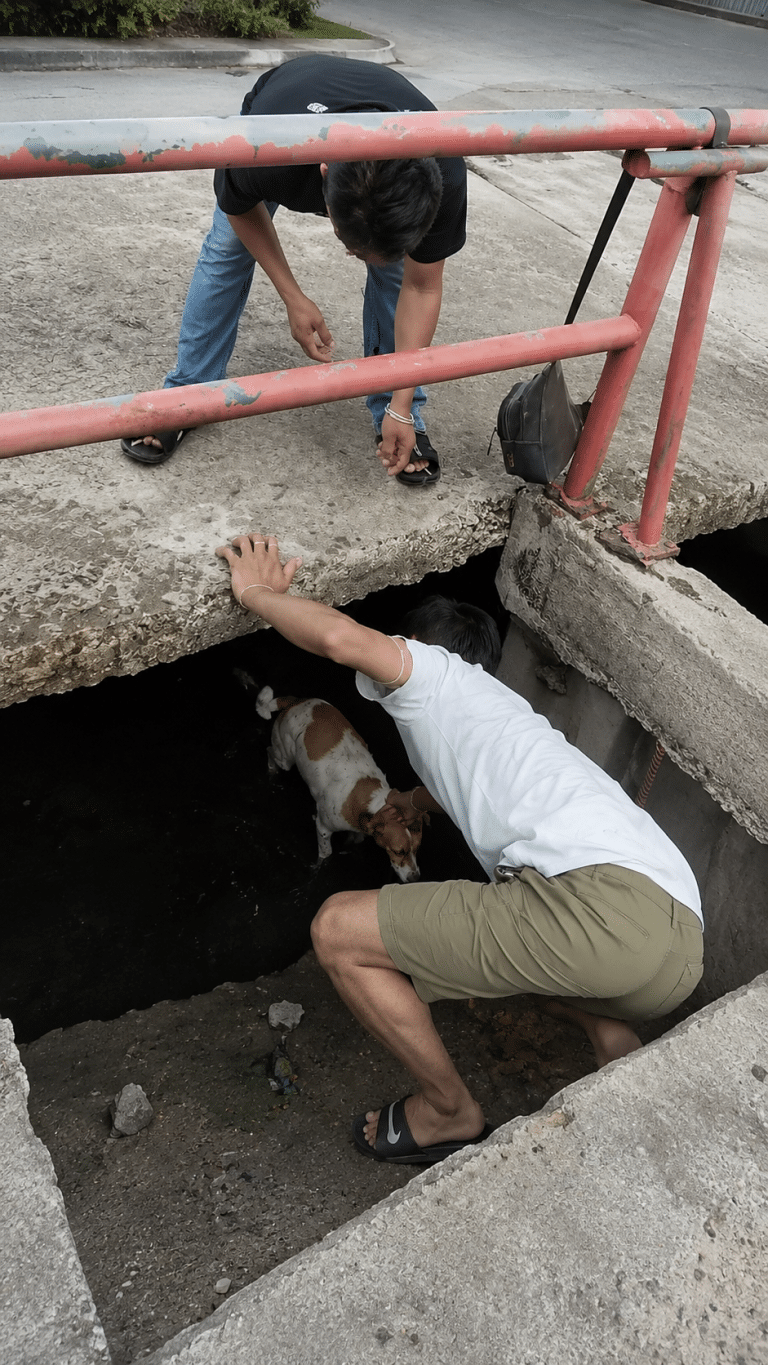
The dog had nowhere left to go.
Far below street level, he stood trapped inside a concrete canal, pacing along a narrow edge beside dark water and barking up toward the world above him. The walls around him were too steep to climb, and every direction seemed to lead back to the same dead end.
He could see open space above.
He just couldn’t reach it.
Then two strangers stopped at the edge, looked down, and realized that if they left, the dog would still be there.
The Canal Gave Him No Way Out
From the top, the canal looked like a harsh place for any animal to end up.
Its concrete walls rose sharply on both sides, offering no easy foothold and no slope gentle enough for a dog to climb. At the bottom, the brown-and-white dog moved back and forth along a narrow strip near the water, barking over and over as if hoping someone might finally hear him.
His voice echoed against the walls.
There was no visible exit.
No ramp.
No opening.
No dry path leading upward.
The dog appeared agitated and exhausted at the same time. He kept moving, kept barking, kept looking up—yet nothing in the canal gave him a realistic way to save himself.
That was when two men approached the edge and saw the situation clearly.
They did not keep walking.
They stayed.
Video: Two Strangers Work Together to Lift a Trapped Dog Out of a Concrete Canal
One Man Went Down While the Other Held On
The rescue did not come with equipment, barriers, or a formal plan.
It came with two people deciding to do what they could.
One of the men, wearing a white T-shirt, carefully lowered himself over the edge of the canal. The drop was steep enough that he could not simply climb down and stand comfortably beside the dog. Instead, he had to ease his body downward while reaching for the frightened animal below.
At the top, the second man took on an equally important role.
He held tightly to the rescuer’s arm and upper body, acting as a human anchor to keep him from slipping farther over the edge. Every inch the first man moved downward depended on the strength and stability of the person above him.
Neither could have done it alone.
One reached.
One held.
And both understood that the dog’s only chance now depended on their coordination.
The Dog Was Frightened and Unsure
From the dog’s point of view, the situation must have been confusing.
He had been trapped below for an unknown length of time, barking for help from a place no animal should have had to navigate. By the time the rescuer came closer, the dog appeared tense and uncertain, still reacting to the stress of being stranded in such a confined, exposed space.
The man did not lunge at him.
He did not rush the contact.
Instead, he moved slowly, reaching downward with as much control as the awkward position allowed. The second man above continued holding firm, giving him enough stability to stretch a little farther each time.
The dog barked, shifted, and hesitated.
He seemed unsure whether to move closer or keep his distance.
That made the rescue even more delicate. A frightened dog in a confined place can panic easily, and one sudden movement in the wrong direction could have made the situation much harder.
So the rescuer kept trying patiently.
He reached.
Paused.
Adjusted.
Then reached again.
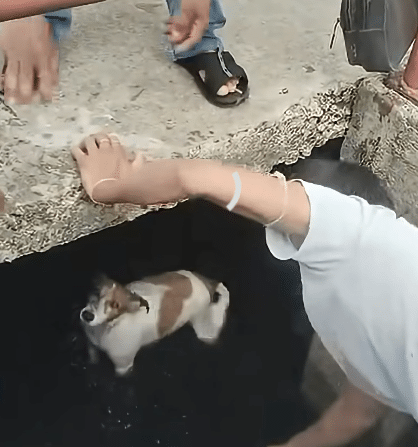
A Careful Grip Changed Everything
After several tense attempts, the moment finally came.
The man lowering himself into the canal managed to secure a hold on the dog.
For a few seconds, everything seemed to stop there—man, dog, and the steady effort of the person above who continued holding them both in position. It was not enough simply to touch the dog.
Now they had to lift him.
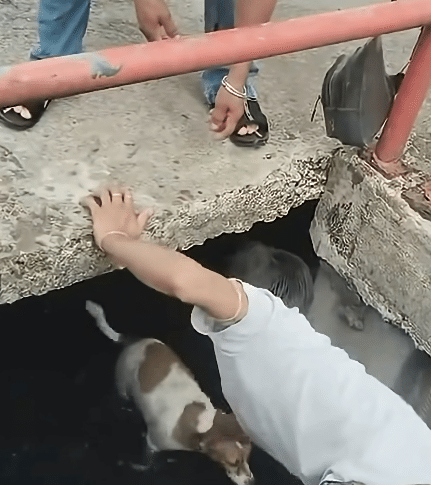
The rescuer tightened his hold.
The second man pulled from above.
Together, they guided the dog upward, carefully bringing his body closer to the top edge of the canal. The movement had to be controlled. The dog was frightened, the footing was limited, and there was no room for error.
Then, little by little, the dog rose high enough to be pulled onto solid ground.
He was out.
After being trapped below the concrete walls with no route to freedom, he was finally back where he belonged.
The Barking Stopped Once He Reached Safety
The change was immediate.
The frantic energy that had filled the canal moments earlier seemed to settle once the dog stood above it. He was no longer pacing beside the water or crying upward for help. He had ground beneath his paws again, open space around him, and two people beside him who had chosen not to ignore what they saw.
For viewers, that contrast is what makes the rescue so memorable.
Only moments earlier, the dog had appeared completely stuck in a place built of hard surfaces and dead ends.
Then, because two strangers were willing to stop and work together, the scene changed entirely.
The barking stopped.
The struggle ended.
And the dog who had seemed unreachable was standing safely above the canal.
Two Ordinary People Became His Way Out
What stays with people after watching a rescue like this is not only the danger of the setting.
It is the decision that came first.
The men did not have to get involved.
They could have assumed someone else would come.
They could have called for help and walked away.
Instead, they stayed long enough to become the help.
That is often how meaningful rescues begin—not with perfect preparation, but with the refusal to leave a vulnerable animal behind.
The canal was steep.
The situation was awkward.
The dog was distressed.
None of it made helping easy.
But compassion is most visible when it asks something of us—our time, our effort, our patience, or our courage.
The Difference Between Being Trapped and Being Safe
At the beginning of this story, the dog had only one thing going for him:
someone heard him.
By the end, he had something even more important.
A second chance.
The canal that had trapped him was still there.
The steep walls had not changed.
The danger had been real from the start.
What changed was that two people decided the dog’s life mattered enough to act.
That is the part worth remembering.
Not just the lift itself.
Not only the image of the dog being pulled over the edge.
But the choice to stop, lean down, and help when it would have been easier to pass by.
The frightened dog at the bottom of the canal could not climb out on his own.
In the end, he didn’t have to.
Two strangers saw him, worked together, and brought him back up into safety.


