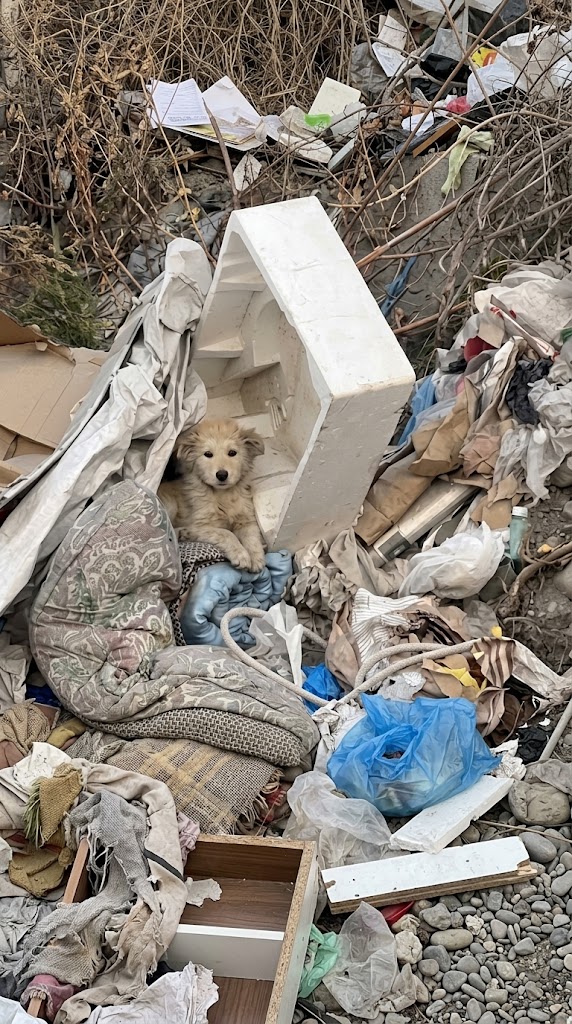
At first, the dumping ground appeared empty.
Rain-darkened waste covered the earth in uneven piles. Torn fabric, plastic, branches, and discarded household items stretched across the open area beneath a gray sky.
Then something moved.
Deep inside a hollow between two piles of trash, a tiny puppy was curled beneath several pieces of old blanket. The fabric had formed a rough covering above his body, offering only the smallest protection from the cold and damp ground.
He was dirty, trembling, and almost perfectly hidden.
Had he remained still for a few more seconds, the person passing nearby might never have known he was there.
A Tiny Shape Beneath the Torn Blankets
The puppy had chosen one of the few enclosed spaces available.
Pieces of waste rose around him like walls, while torn blankets rested across the opening. Whether he had pulled the fabric into place himself or simply discovered a sheltered gap beneath it could not be known for certain.
What was clear was that he had been using the space as a den.
It was not dry.
It was not clean.
And it offered little protection from rain, sharp debris, insects, or changing temperatures.
But for a small animal with nowhere else to go, it may have been the safest place he could find.
The puppy kept his body pressed tightly against the ground when someone approached. Burrs and small pieces of vegetation were tangled through his fur, and dirt covered much of his coat.
He did not bark.
He did not step forward.
He simply watched from beneath the blankets, unsure whether the person standing nearby represented help or another reason to hide.
Video: Rescuer Finds a Tiny Puppy Living Beneath Torn Blankets in a Garbage Dump
A Small Bell Revealed an Important Clue
As the rescuer moved closer, a faint jingling sound came from beneath the debris.
The puppy was wearing a collar with a small bell attached.
The discovery raised immediate questions.
A collar suggested that the puppy had likely been around people at some point. He may once have belonged to someone, wandered away from a nearby home, or been left in the area.
The collar alone could not explain how he arrived at the dumping ground.
It did show that his life may not always have been spent among the trash.
There was no identification visible in the account, and no owner appeared while the rescuer remained at the site.
For the moment, the most urgent concern was not solving his past.
It was getting him away from the cold, contaminated environment surrounding him.
The puppy was still young.
His small size, uncertain movements, and dependence on the makeshift den made it clear that he was not equipped to survive there safely for long.
Trust Could Not Be Rushed
The rescuer lowered their body rather than reaching down from above.
Sudden movements could have sent the puppy deeper into the waste, where broken objects or unstable piles might make reaching him more dangerous.
For several moments, nothing changed.
The puppy remained low beneath the blanket. His eyes followed each movement, and his body tightened whenever a hand came closer.
The rescuer waited.
A hand was extended slowly and then held still, giving him time to smell without being grabbed.
The puppy leaned forward slightly.
Then he pulled back.
The process repeated.
There was no attempt to chase him or drag him from the hiding place. The goal was to let him understand that the person nearby would not force contact before he was ready.
Eventually, the puppy stopped retreating.
He allowed the hand to come closer.
Then he accepted a gentle touch along his head.
The change was not instant or complete. He remained cautious, but his posture began to soften. His body was no longer pressed quite as firmly against the ground.
That small adjustment created the first safe opening.
Video: The Frightened Puppy Steps Out of His Trash-Side Shelter and Accepts a Gentle Hand
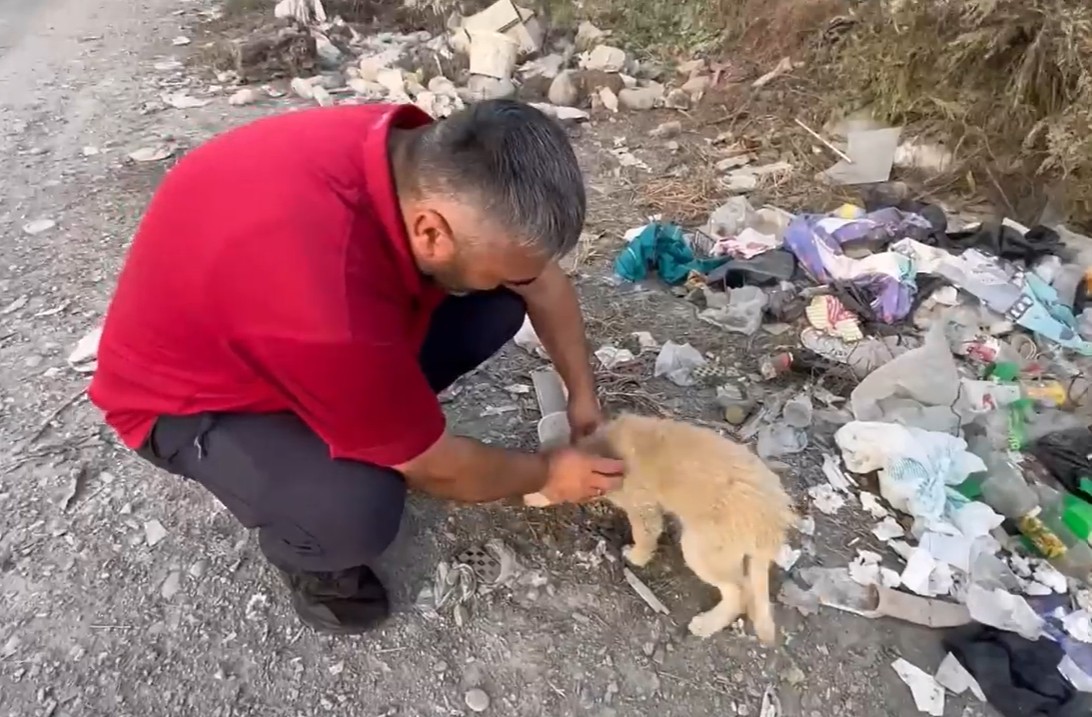
The Puppy Beneath the Fear Began to Appear
Once the puppy moved beyond the blankets, more of his condition became visible.
His fur was tangled with dirt and burrs.
His small body suggested that he had not been receiving consistent food.
He appeared tired, yet once he realized he was not being chased, his behavior began to change.
He took a few cautious steps.
Then he returned toward the rescuer.
His movements became quicker as he explored the small area around them. He sniffed the extended hands, moved in a short circle, and began following whenever the rescuer shifted position.
Minutes earlier, he had been hiding so completely that he nearly blended into the waste.
Now he was showing the familiar curiosity of a young dog.
The fear had not disappeared simply because someone touched him kindly once. But it was no longer controlling every movement.
The puppy had been given enough space to make his own first approach.
That choice mattered.
It allowed the rescue to begin without turning the encounter into another frightening experience.
Leaving the Dumping Ground Behind
Before leaving, the rescuer checked the puppy as carefully as the location allowed.
There were no graphic visible injuries described, but his coat needed cleaning, and his condition required closer evaluation somewhere safe.
The dumping ground posed too many dangers for him to remain.
Sharp materials could cut his paws.
Contaminated water and spoiled waste could make him ill.
Heavy piles might shift.
And the torn blankets offered no reliable protection from another night of rain or cold.
The puppy was lifted gently and carried away from the den.
He did not struggle.
During the ride, he rested against the person holding him. His body gradually became less tense as the noise and smell of the dumping area disappeared behind them.
The transition was simple but profound.
A few minutes earlier, his only shelter had been a hollow beneath discarded fabric.
Now he was being held above the ground, protected from the weather and taken toward warmth.
The blankets remained behind.
The puppy did not.
Warm Water Revealed the Little Dog Underneath
Once indoors, the puppy received a careful bath.
Warm water loosened the dirt clinging to his coat. Burrs and tangled debris were removed gradually so that his skin would not be pulled or irritated unnecessarily.
As the grime washed away, the dog underneath became easier to see.
He was small.
Young.
And far more alert than he had appeared beneath the trash.
A bath could not answer how long he had been living outside or why no one had come looking for him.
It could, however, remove part of what he had been carrying.
The puppy was dried and given a warm place to rest. Food and water could be offered safely, and his body could be checked more thoroughly for parasites, skin irritation, dehydration, or other health concerns.
He no longer needed to press himself into a pile of blankets to escape the wind.
He no longer had to remain silent to avoid being noticed.
For the first time in the story, rest did not require hiding.
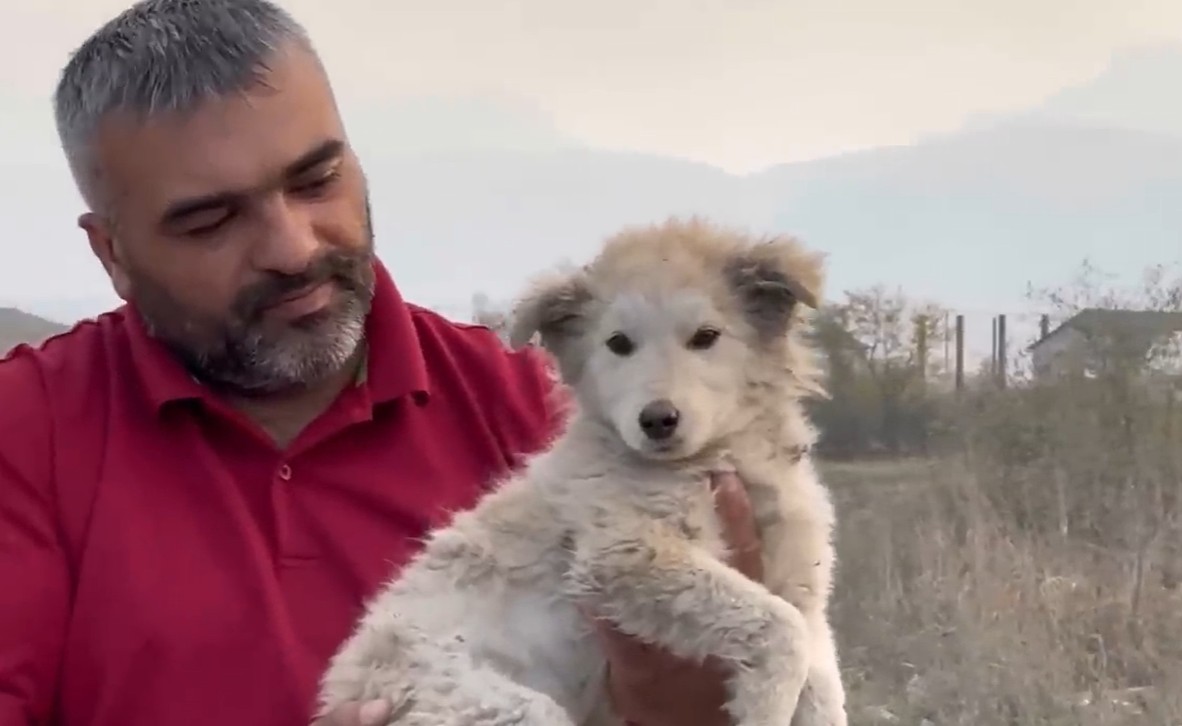
A Safe Beginning, Even Without Every Answer
The source account does not provide every detail about what happened after the rescue.
It does not confirm whether an owner was located or whether the puppy was formally adopted into a permanent family.
What it does show is the moment his immediate circumstances changed.
Someone noticed movement where others might have seen only garbage.
Someone approached without frightening him farther into danger.
Someone carried him away from a place never meant to support a young life.
That intervention gave him the things he needed first:
Warmth.
Clean water.
Food.
A safe place to sleep.
And people able to determine what care should come next.
A permanent home may require time, veterinary evaluation, and responsible efforts to identify any previous owner.
But every safe future begins with surviving the present.
For this puppy, that beginning came when one person stopped and looked more closely.
The Shelter He Should Never Have Needed
The small space beneath the blankets showed how strongly animals can adapt when basic safety is missing.
The puppy had found protection wherever he could.
He used the surrounding waste as walls.
He remained still when uncertain.
He made himself difficult to see.
Those behaviors helped him endure the dumping ground, but they should never have been necessary for such a young dog.
Puppies need consistent food, clean water, shelter from weather, medical care, and human supervision. A hollow inside a garbage pile cannot provide those things, no matter how cleverly hidden it may be.
His story is not remarkable because trash became a suitable home.
It is remarkable because he was discovered before that dangerous shelter became the final place anyone saw him.
Beneath the blankets was not simply a frightened animal surviving among discarded objects.
There was a curious young puppy still capable of approaching a gentle hand, following someone he had just met, and resting when he finally felt secure enough to close his eyes.
The dumping ground had taught him to hide.
A patient rescue gave him a reason to come out.
And when he left in someone’s arms, the tiny shelter made from torn blankets was empty at last.


