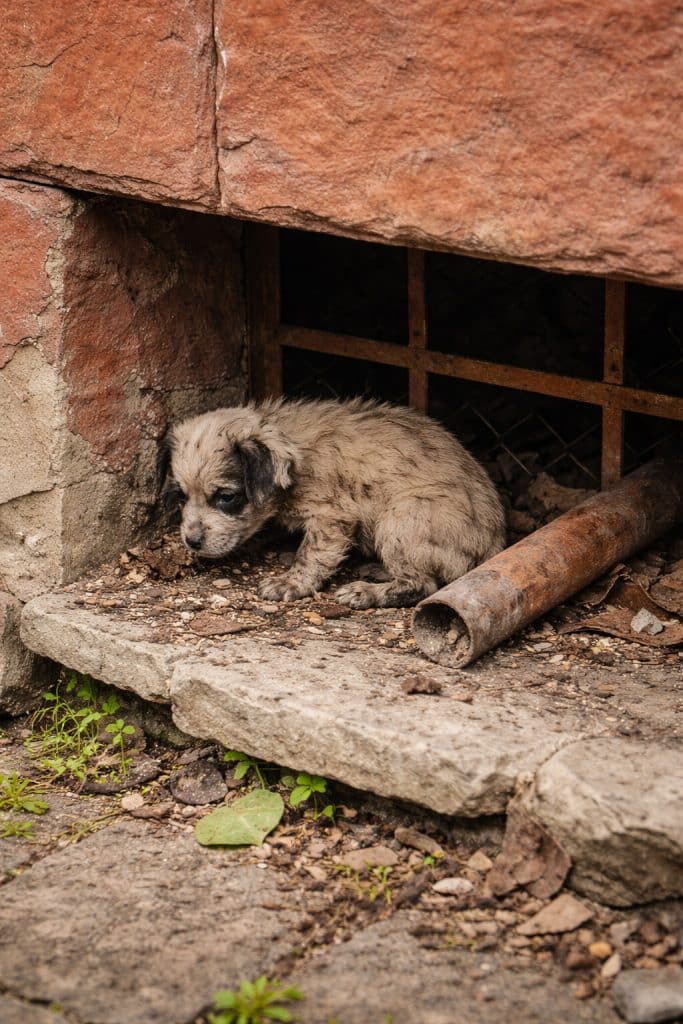
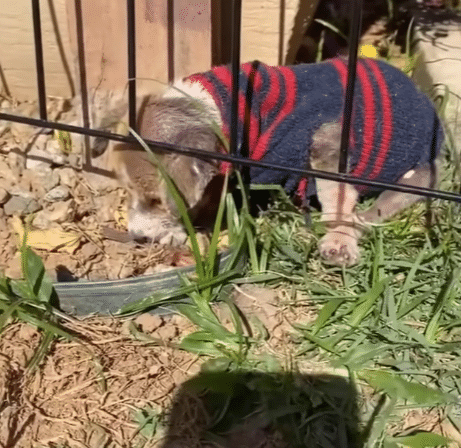
The striped sweater made him look as though someone had once cared.
But on that cold November afternoon, the tiny dog was wandering alone beside an abandoned building near a quiet park.
There was no owner calling his name.
No warm home waiting nearby.
Only freezing air, damp grass, and a fragile body that could barely continue moving.
The little dog trembled continuously as he searched the empty area around him. His sweater covered much of his body, but it was no longer enough to protect him from the cold.
When a passerby noticed him and began moving closer, the dog immediately tried to escape.
He managed only a few weak steps.
Then his legs folded beneath him.
The tiny dog collapsed silently onto the grass, too exhausted to keep running from the person who was trying to help.
That was the moment everything changed.
A Small Dog Alone in the November Cold
At first, the passerby approached carefully.
A frightened stray can react unpredictably when cornered, especially if previous contact with people has not felt safe. The last thing anyone wanted was to increase the little dog’s panic or cause him to use the last of his strength trying to escape.
But after collapsing, he did not attempt to rise again.
He remained on the cold ground, his body shaking beneath the striped sweater.
Up close, his condition appeared even more concerning.
The dog did not bark.
He did not growl or show his teeth.
He did not struggle when gentle hands reached toward him.
Instead, he remained unusually still.
His eyes followed the person lifting him, but his body offered almost no resistance. Whether from exhaustion, fear, or both, he seemed unable to continue protecting himself.
The passerby wrapped him carefully and carried him away from the park.
The small dog was finally leaving the freezing grass, but the rescue had only just begun.
No one yet understood what was happening beneath the sweater.
They could see that he was weak.
They could feel how cold his body had become.
They could tell that he needed veterinary attention immediately.
What they could not see was the painful condition hidden beneath the fabric.
The sweater may once have been intended to provide warmth. By the time rescuers found him, however, it had become part of a much more serious problem.
Video: Left Shivering in a Park—Rescuers Discover the Pain Hidden Beneath His Sweater
The Sweater Could Not Simply Be Removed
At the veterinary clinic, the team began by stabilizing the little dog.
He needed warmth, hydration, and careful monitoring. His body had been weakened by exposure, exhaustion, and a condition that had apparently gone untreated for some time.
The veterinary staff worked slowly.
Sudden warming can place additional stress on an already fragile animal, so his temperature needed to be raised carefully. Warm fluids were provided, and the team watched his breathing and responsiveness closely.
Then they attempted to remove the striped sweater.
It did not slide off normally.
Parts of the fabric had become stuck against damaged skin beneath it.
The discovery immediately changed the nature of the examination.
Rather than pulling the sweater away and risking further pain, the veterinary team began cutting and loosening the material section by section.
Underneath, they found severe irritation, infection, and wounds that required immediate treatment.
The fabric had remained in contact with the damaged areas for so long that removing it had to be done with extraordinary care.
No one at the clinic could know precisely how the injuries had begun or how long the dog had been wearing the sweater. What was clear was that the skin underneath had not received the care it needed.
The veterinary team trimmed fur around the affected areas.
They cleaned the damaged skin.
Medication was started to control infection and discomfort.
Every movement was deliberate because the little dog was still extremely weak.
Although the sight was difficult for rescuers to witness, the removal of the sweater marked an important turning point.
For the first time, the true extent of his condition could be treated.
The garment that had hidden the problem was gone.
Clean bandages could be applied.
Medication could reach the infected areas.
And the dog could begin receiving something he had apparently been without for far too long: consistent care.
Another Little Dog Was Still Waiting Near the Park
Several days after the rescue, the team returned to the same area.
They wanted to look for information, check whether anyone recognized the dog, and make sure no other animals had been left near the abandoned building.
That was when they noticed another small dog wandering nearby.
This second dog appeared somewhat stronger, but the location and behavior raised immediate concerns. Like the first dog, he was alone and seemed uncertain about the people approaching him.
Rescuers believed the two dogs may have been abandoned together.
There was no way to confirm every part of their past, but the possibility could not be ignored.
The second dog was brought to safety and examined.
Fortunately, his physical condition did not appear as critical. He still needed food, shelter, and veterinary attention, but he had not reached the same level of exhaustion as the dog found in the sweater.
The rescuers then allowed the two dogs to see each other.
The reaction was immediate.
The first dog, who had remained tense and withdrawn during much of his early treatment, appeared to relax in the presence of the newcomer.
The two moved close together.
They curled beside one another in the warm recovery area, their small bodies resting against the same blankets.
For the rescue team, the change was deeply meaningful.
The frightened dog still did not understand everything happening around him. The clinic was unfamiliar. The caregivers were strangers. The treatments, though necessary, could be uncomfortable and confusing.
But the other dog was familiar.
That familiarity seemed to provide a kind of reassurance no person could immediately replace.
The dogs rested together quietly, sharing warmth and space.
For the first time since being found in the park, the little dog no longer appeared completely alone.
Healing Began With Small, Uneven Steps
The most urgent medical problems could be treated with medication, cleaning, warmth, and nutrition.
Emotional recovery was less predictable.
During the first days, the little dog spent long periods curled tightly in his bedding.
He avoided direct eye contact.
When unfamiliar people entered, he often turned away or tried to make himself smaller.
Food was offered, but he did not always show interest.
The rescue team did not interpret this as stubbornness.
His body had been through a severe ordeal, and everything around him had changed in a very short time. He needed time to understand that the new environment was safe.
Caregivers followed a consistent routine.
Meals arrived at regular hours.
His bandages were changed gently.
Medication was administered without unnecessary restraint.
People spoke softly before approaching so he would not be startled by a hand appearing suddenly above him.
The second dog often remained nearby.
Some days, progress was difficult to see.
The little dog continued hiding his face.
He remained cautious during treatment.
He rarely showed the lively behavior normally associated with a young, small dog.
Still, his caregivers returned.
Their patience did not depend on him responding affectionately.
He did not need to wag his tail to receive food.
He did not need to approach anyone to deserve comfort.
He was allowed to heal without being pressured to perform happiness for the people helping him.
Then small changes began appearing.
He ate a little more.
He lifted his head when familiar voices entered.
Instead of turning away immediately, he watched caregivers from his bed.
His skin slowly improved as the infection responded to treatment.
The trembling decreased.
His posture became less guarded.
One day, a caregiver spoke to him, and the tip of his tail moved.
It was only a brief wag.
But everyone noticed.
A few days later, it happened again.
The little dog was beginning to recognize that some people brought food, warmth, and relief rather than fear.
Video: After Days of Hiding, the Little Dog Stands Up and Runs for the First Time
The First Few Steps That Changed the Room
As his skin healed and his strength returned, the little dog became more interested in moving around.
At first, he stood only long enough to change positions.
Then he began taking short walks across the recovery area.
His steps were careful, and his body still appeared weak. The team watched him closely, ready to help if his legs gave way again.
But each day, he remained standing a little longer.
He began exploring the room.
He sniffed the edges of his blankets.
He walked toward the second dog.
He occasionally approached the food bowl before anyone placed it directly beside him.
These changes may have looked ordinary to someone unfamiliar with his rescue.
To the people who had seen him collapse in the frozen grass, they meant everything.
Then one afternoon, the little dog did something no one had yet seen him do.
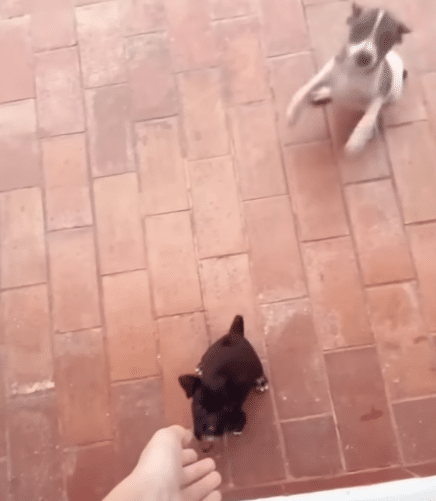
He ran.
It lasted only a few seconds.
His paws moved quickly across the floor before he slowed again, still lacking the endurance of a fully recovered dog.
But for those brief moments, the animal in front of them no longer resembled the dog who had been unable to take more than a few steps in the park.
His legs supported him.
His body moved with purpose.
His attention was focused ahead rather than entirely on the possibility of danger.
The room filled with relief.
The run did not mean his recovery was complete. His skin still needed time to heal, and his fear of unfamiliar people remained obvious.
But those few steps showed that his body was responding.
Strength was returning.
The cold afternoon in the park had not become the final chapter of his life.
There was now a future in front of him.
Trust Took Longer Than His Wounds to Heal
As the weeks passed, the dog’s physical progress became easier to measure.
The infected areas closed.
Healthy skin began replacing the damaged tissue.
His appetite improved, and proper nutrition added strength to his small frame.
His coat started looking cleaner and healthier.
Emotionally, however, he remained cautious.
When familiar caregivers entered, he could relax.
When strangers approached, his behavior changed.
He sometimes backed away.
He searched for a place to hide.
His body lowered, and the old uncertainty returned to his eyes.
The rescue team understood that this part of recovery could not be hurried.
A wound can be cleaned and bandaged according to a schedule.
Trust does not follow the same timetable.
The caregivers continued offering positive experiences without forcing interaction.
Visitors were asked to sit quietly rather than reach toward him immediately.
Treats were placed nearby.
The little dog was allowed to decide whether to approach.
Some days, he remained at a distance.
Other days, curiosity brought him a little closer.
The team celebrated progress but did not treat hesitation as failure.
Then a young boy came to visit.
He did not rush toward the dog.
He did not surround him with excited movement or attempt to pick him up.
The boy stayed calm and gave the little dog space.
At first, the dog watched him from a distance.
His posture remained cautious, but he did not retreat.
After several moments, he took a step forward.
Then another.
The boy remained still.
The dog approached closely enough to investigate him.
There was no sudden panic.
No immediate attempt to hide.
For the rescuers, the interaction represented a significant change.
The little dog was meeting someone unfamiliar and choosing curiosity rather than escape.
It did not mean every fear had disappeared.
It meant he had gained enough positive experiences to consider that a new person might also be kind.
That possibility opened the door to the next stage of his life.
A Family Prepared to Let Him Heal at His Own Pace
A suitable home for the little dog needed to offer more than food and shelter.
He required people who understood that recovery would continue after adoption.
There might be days when an unfamiliar sound frightened him.
New visitors could cause him to retreat.
Certain movements might remind his body of a time when he did not feel safe.
A patient family would need to respect those reactions rather than punish them.
Eventually, the right home was found.
The family was prepared to move slowly.
They gave him a quiet place to rest and allowed him to explore without pressure. They maintained regular routines so meals, walks, and bedtime became predictable.
No one demanded immediate affection.
They understood that being adopted did not automatically erase the experiences that shaped his behavior.
In the beginning, he watched carefully.
He stayed near familiar spaces.
He approached only when he felt comfortable.
But the pattern of kindness continued.
Food arrived every day.
Hands touched him gently.
Warm beds remained available through the night.
No one left him outside in the cold.
Gradually, the house became his home.
He began moving more freely from room to room.
He rested without keeping his body tightly curled.
He learned where his toys were kept and where sunlight entered during the day.
His tail wagged more often.
The yard gave him room to run, and this time his legs did not collapse beneath him.
He could move, stop, and begin again whenever he chose.
The second chance he had been given in the park had become a real life—one built through ordinary days of safety and care.
The Sweater No Longer Defines His Story
It is impossible to see the dog today without remembering the condition in which he was found.
A striped sweater clung to his injured skin.
His body shook in the November cold.
He tried to escape from the person approaching him but lacked the strength to continue.
Then he collapsed.
That moment could have ended very differently if no one had stopped.
Instead, one passerby noticed that something was wrong.
Rescuers acted.
Veterinarians treated the wounds hidden beneath the fabric.
Caregivers remained patient when the dog was too frightened to respond.
Another small dog gave him familiar companionship.
And eventually, a family offered him a permanent home.
His recovery did not happen through one dramatic gesture.
It was created through many smaller acts.
Someone lifting him from the frozen grass.
A veterinarian cutting away the sweater carefully.
Warm fluids entering his exhausted body.
Fresh bandages replacing infected fabric.
A familiar dog curling beside him.
A bowl of food left within reach.
A visitor waiting for him to approach first.
A family accepting that trust would need time.
Each act answered a different part of what he had endured.
Today, he runs through his home and yard with a confidence that once seemed impossible.
He sleeps in warmth.
He wakes surrounded by familiar voices.
When people he trusts enter the room, he no longer lowers his head and tries to disappear.
He looks toward them.
Sometimes he follows.
Sometimes he asks for attention.
And sometimes he simply rests, knowing that nothing is about to take his safety away.
The dog found shivering near the abandoned building has not forgotten every fear.
Healing does not require an animal to erase the past.
It gives him enough gentle experiences to build a different future.
Once, a sweater concealed wounds no one had treated.
Now his body is healthy, his home is warm, and the people around him notice when he needs comfort.
He is no longer wandering through a freezing park.
He is no longer too weak to stand.
He is safe.
He is protected.
And after being given patience instead of pressure, he has learned that human hands can bring something other than pain.
They can bring warmth.
They can bring healing.
And sometimes, they can carry a tired little dog away from the cold and into the life he should have had all along.


