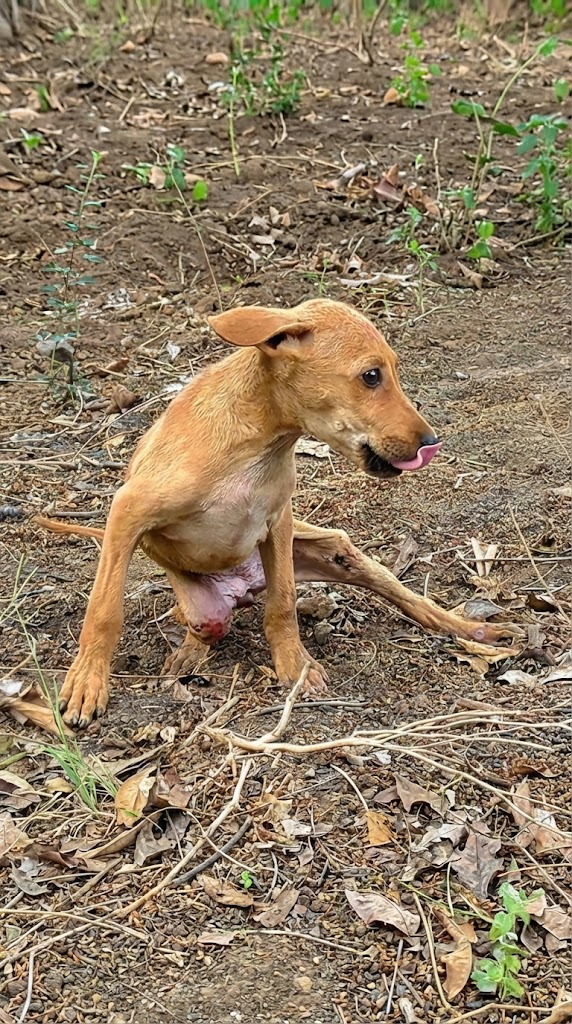
Tofu was so small that he could have disappeared beside the road without anyone noticing.
Dust clung to his fur.
Traffic moved nearby.
And every time the little puppy tried to stand, one of his back legs failed to move properly with the rest of his body.
He pushed himself up.
Tried to take a step.
Then stumbled.
The injured leg trailed behind him as though it belonged to someone else.
No one knew exactly how long Tofu had been living that way.
But by the time rescuers found him beside the road in India, the problem was no longer just an injury.
The muscles in the affected leg had already begun weakening from lack of normal use.
For such a young puppy, that raised a frightening question.
If he did not start using the leg again, would he ever learn to walk normally?
RRSA India decided to give him the chance to find out.
The Puppy Beside the Road Couldn’t Keep Himself Upright
When rescuers approached Tofu, there was little about him that suggested the energetic puppy he might someday become.
His body was weak.
His movements were hesitant.
And the damaged back leg made every attempt at walking unstable.
A healthy puppy would normally be running toward anything interesting.
Tofu was concentrating on simply remaining upright.
He would push forward with his stronger legs while the injured one lagged behind.
Then his balance would fail.
Down he went.
Another attempt.
Another stumble.
The roadside was no place for a puppy already struggling to move.
Food was uncertain.
Rest was uncertain.
And every passing vehicle added another danger he could not easily escape.
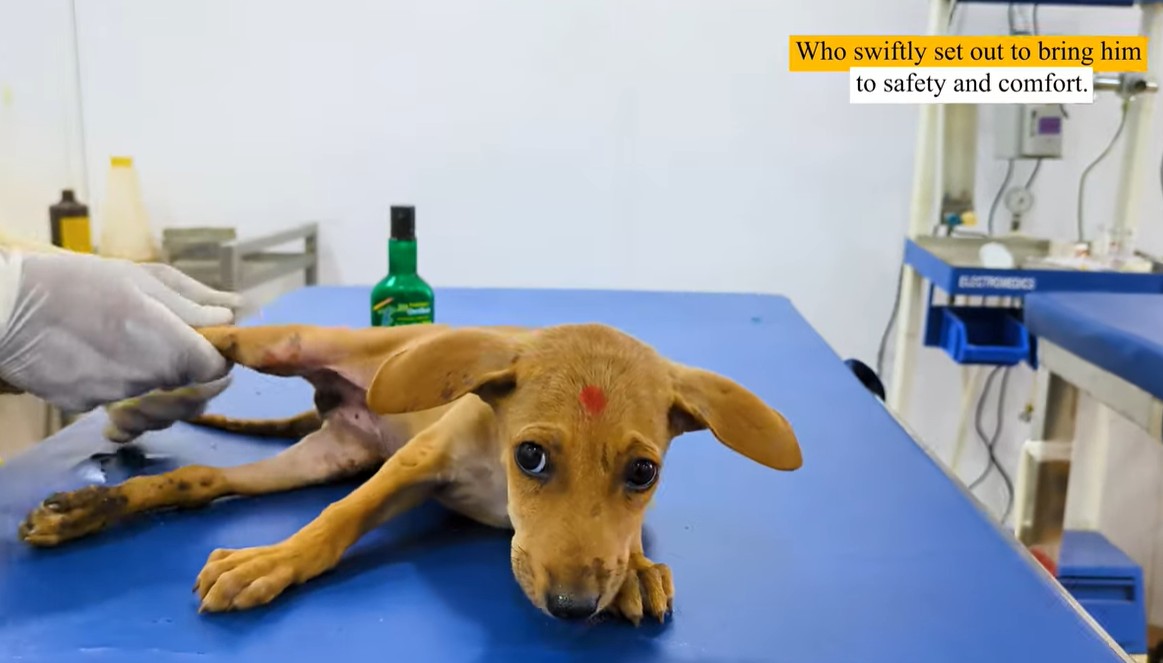
The RRSA India team lifted him carefully and carried him away from the road.
For the first time, Tofu did not have to use his remaining strength simply to survive where he had been found.
Now people could focus on the leg he had barely been able to use.
Video: Tofu’s First Days of Rehabilitation After Being Rescued From the Roadside
His Leg Had Been Weak for Long Enough to Change the Muscle
At the rescue center, veterinarians examined Tofu more closely.
The affected back leg had not been functioning normally for some time.
Because he had relied so heavily on the rest of his body, the muscles in that leg had begun to shrink.
That made the problem self-reinforcing.
The less Tofu used the leg, the weaker it became.
The weaker it became, the harder it was to use.
There was no simple way to reverse that cycle in a single day.
Rehabilitation would require repetition.
The goal was not to force Tofu to stand perfectly.
It was to encourage the damaged leg to participate again.
First a little movement.
Then more.
The rescue team began with one of the simplest tools available.
Their hands.
Every Day Began With Gentle Massage
Massage became part of Tofu’s routine.
Caregivers worked carefully around the weakened leg, encouraging circulation and helping keep the muscles engaged.
At first, there was no dramatic reaction.
Tofu simply lay there while the sessions continued.
For a puppy unfamiliar with regular handling, even allowing people to touch the injured limb required adjustment.
So the team kept the process calm.
No forcing.
No aggressive stretching.
Just repeated, gentle work.
The purpose was consistency.
One session could not rebuild the leg.
Dozens of small sessions might begin giving it another opportunity.
Day after day, hands worked over the same weak muscles.
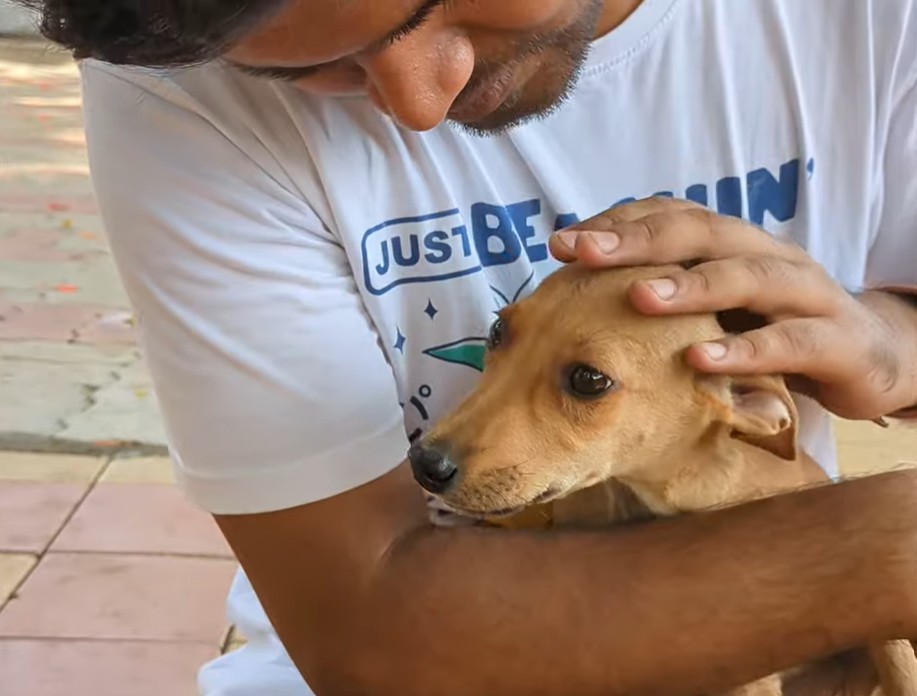
Tofu gradually became more comfortable with the routine.
And as his trust in the caregivers increased, the team was able to move toward a different form of therapy.
One where his body would not have to fight gravity so hard.
In the Water, His Weak Leg Finally Had Room to Move
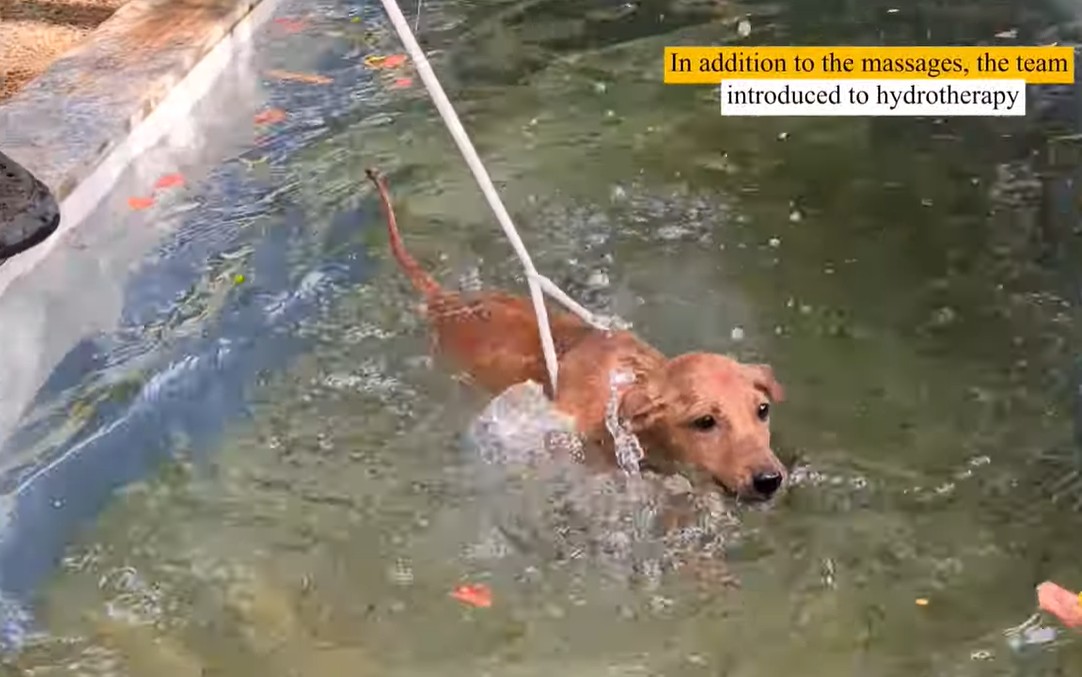
Hydrotherapy became one of the most important parts of Tofu’s rehabilitation.
On land, his own body weight worked against him.
The moment he tried to stand, the weakened leg had to support pressure it was not prepared to handle.
Water changed that.
Buoyancy supported part of Tofu’s weight.
Instead of immediately collapsing when the weak leg failed, he had more freedom to move his limbs.
The first sessions were careful.
Tofu was supported as he entered the water.
Then instinct took over.
His front legs began paddling.
His stronger back leg joined in.
And then the injured leg moved too.
Not perfectly.
Not strongly.
But it moved.
That mattered.
The leg that had dragged behind him on the roadside was now participating in motion.
The water allowed Tofu to practice a movement pattern that had been extremely difficult on land.
Again and again, he paddled.
Again and again, the weakened leg received another opportunity to work.
The progress was measured in tiny motions.
But rehabilitation is often built exactly that way.
His First Important Steps Happened Before He Could Really Walk
As the hydrotherapy sessions continued, the changes became easier to notice.
Tofu’s affected leg began contributing more.
His movements became more coordinated.
The severe dragging started to lessen.
Then came the challenge of transferring that progress back onto solid ground.
Water had supported him.
Grass would not.
When Tofu came out of the pool, gravity returned immediately.
His body had to carry its full weight again.
At first, he remained hesitant.
He placed his stronger paws down confidently.
Then the weaker back leg followed.
A little pressure.
A slight push.
And instead of collapsing immediately, Tofu stayed up.
It was not a perfect step.
That did not matter.
For a puppy who had repeatedly fallen beside the road, using that leg to push against the ground represented real progress.
One step became another.
The movements were still uneven.
But now the weak leg was part of the motion rather than simply trailing behind.
Week by Week, the Limp Became Less Noticeable
Tofu’s improvement did not arrive in one dramatic moment.
It accumulated.
Massage.
Hydrotherapy.
Practice on land.
Rest.
Then repeat.
Week by week, his movements became steadier.
The injured leg still needed work, but he depended on it more.
His gait began looking more balanced.
And as walking became easier, another change appeared.
Tofu started acting less cautious.
At the beginning, much of his attention had gone toward keeping himself upright.
Now he could look around.
Explore.
Move toward things that interested him.
His head came up more often.
His body posture became less withdrawn.
Curiosity had room to return.
That was when the team began seeing the puppy hidden beneath the physical struggle.
The Moment He Reached the Grass Changed the Story
One of the most memorable parts of Tofu’s recovery came after another session in the water.
He stepped out.
His paws reached the grass.
There was no buoyancy supporting him anymore.
No pool helping carry part of his weight.
Tofu had to do the work himself.
He moved forward.
The injured back leg came underneath him.
Then he pushed.
The puppy did not fall.
That small movement was the product of everything that had come before it.
The daily massage.
The repeated water sessions.
The slow practice.
The people who kept helping him try again without demanding immediate results.
For the rescue team, the goal had never been to turn Tofu into a perfect athlete.
It was to give his body the best possible chance to use what remained.
Now he was showing them what that chance could become.
Walking Eventually Became Running
Once Tofu gained enough strength and coordination, his world changed quickly.
Walking was no longer the only goal.
He began moving faster.
Then came the kind of behavior people expect from a puppy.
Running.
The same back leg that had once trailed behind him was now helping propel his body forward.
His gait might not have been perfectly identical to that of every other dog.
That was not what mattered.
Tofu could move.
He could explore.
He could follow his own curiosity instead of being limited to whatever distance his weak body allowed.
The roadside puppy who had struggled to stand was no longer defined by a single damaged leg.
He had become active.
Confident.
And increasingly capable of choosing where he wanted to go.
Tofu Didn’t Recover Because Someone Expected a Miracle
There was nothing magical about the work that helped him improve.
No instant cure.
No dramatic procedure that changed everything overnight.
The process was repetitive.
Massage the leg.
Support movement.
Practice in water.
Try again on land.
Rest.
Repeat.
That kind of recovery requires patience because improvement can be almost invisible from one day to the next.
But compare the beginning with the end, and the difference becomes impossible to miss.
At the roadside, Tofu could barely keep his body upright.
Later, he was pushing off with the leg that had once dragged behind him.
Eventually, he was running.
The transformation came from giving his body enough opportunities to relearn movement.
The Roadside Was Where Tofu Was Found — Not Where He Stayed
Tofu’s story began with a puppy curled near traffic, unable to use one back leg normally.
It could easily have ended there.
A small stray.
An old injury.
A body gradually compensating until the damaged leg became weaker and weaker.
Instead, someone stopped.
RRSA India brought him into care.
Veterinarians evaluated the weakened leg.
Caregivers began rehabilitation.
Water gave Tofu a place to move without carrying his full weight.
Massage helped keep the muscles engaged.
Practice turned small movements into usable steps.
Then those steps grew faster.
The puppy who once stumbled beside the road eventually learned something he had been struggling to do from the beginning.
Move forward without falling.
And once he could do that, he did not stop at walking.
He ran.
Not because his past had disappeared.
Not because the injury had never happened.
But because someone gave his weakened body enough time, therapy, and support to discover how much movement was still possible.
Tofu did not need to become a symbol.
He only needed the chance to become a puppy again.
And in the end, that may be the most powerful part of his story.
The little dog once unable to take a few steady steps finally had somewhere to go—
and legs strong enough to take him there.


